
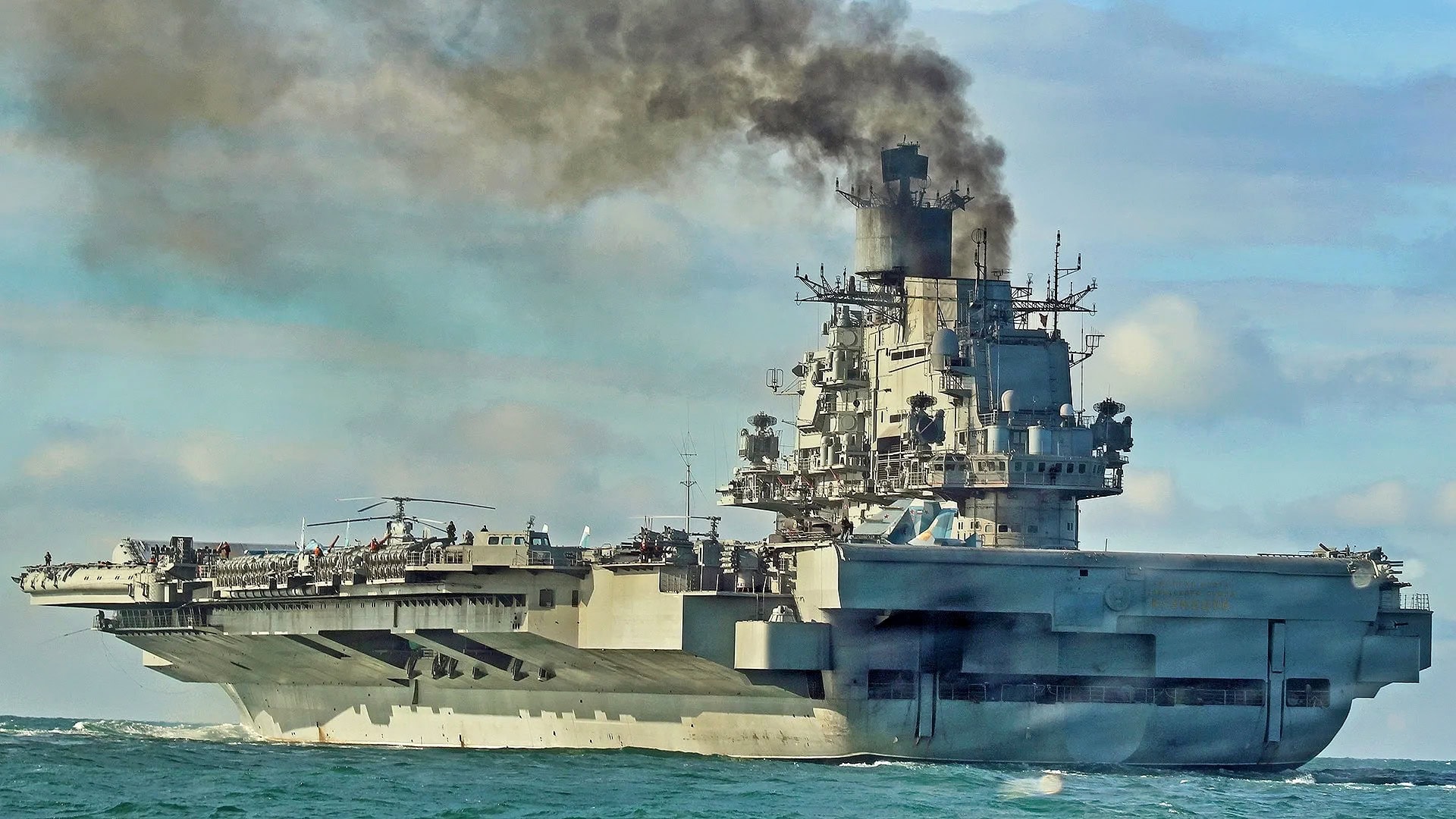
Anytime I ever brought up Russia’s only aircraft carrier, the tragedy we call the Admiral Kuznetsov, U.S. Naval officials either laugh or cringe. As one senior U.S. Navy offical told me over the weekend: “You know what scared us about Admiral Kuznetsov? That Russia had the gall to sail that thing anywhere. Many of us feared she would sink or suffer an accident… the entire thing was a mess. Moscow should be ashamed.”
Admiral Kuznetsov: The Infamous Russian Aircraft Carrier
At least for me, in all my years of tracking this horrific carrier, there is a moment in the Admiral Kuznetsov’s history that captures the whole story.
It is October 2016. The Russian Navy’s flagship is steaming through the English Channel on her way to combat operations off Syria — the first and only major combat deployment of her 25-year career. NATO observers are watching her transit. They are taking photographs. Those photographs would circulate in defense publications around the world for the next decade because of one detail: the Kuznetsov was trailing a column of thick black smoke so heavy that observers initially mistook her for a ship on fire.
She wasn’t on fire. That was just what the Kuznetsov did when she was running normally.
She was also escorted by a tugboat. Russia’s flagship aircraft carrier was en route to her first major combat mission, with a tug in formation in case her engines failed. They quit a lot.
Origin: The Ship That Could Not Decide What She Was
The Kuznetsov was conceived in the late 1970s as Project 1143.5 — the Soviet Navy’s effort to finally build a real aircraft carrier after a generation of half-measures. The Soviets had operated helicopter carriers and small VTOL carriers since the 1960s, but nothing capable of operating conventional fixed-wing fighters in the way American carriers had been doing since World War II.
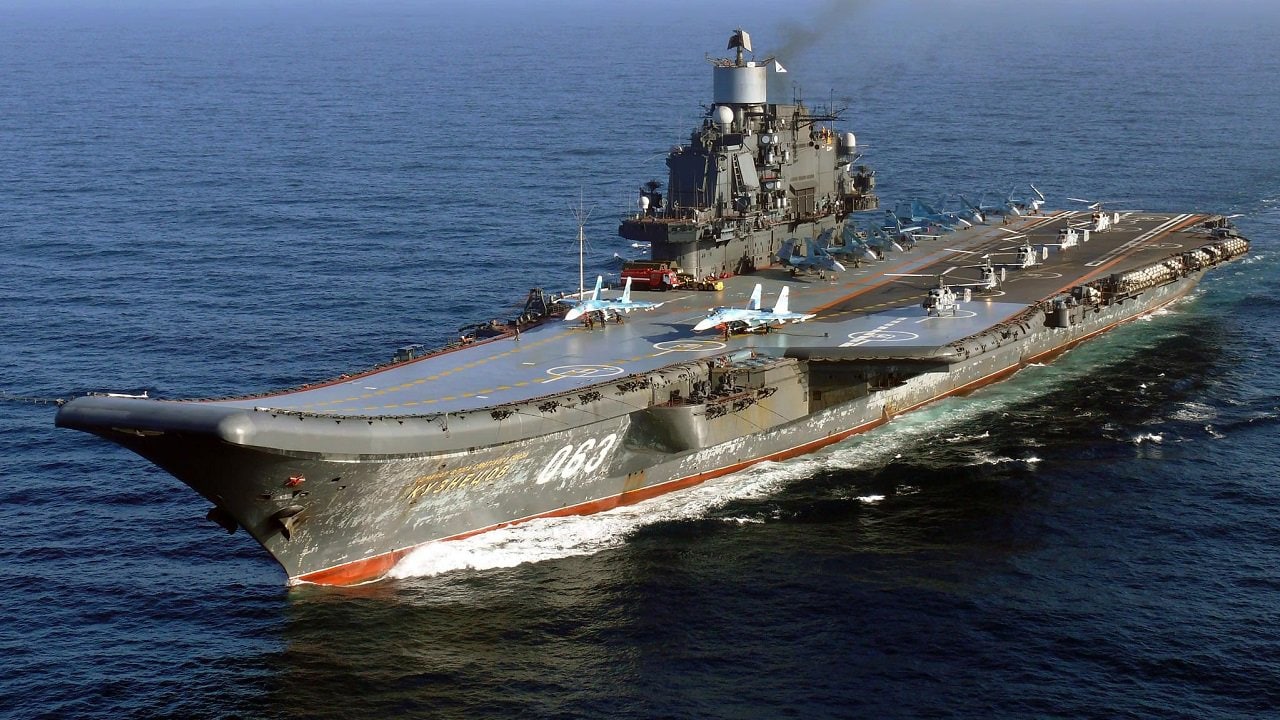
Admiral Kuznetsov. Image Credit: Creative Commons.
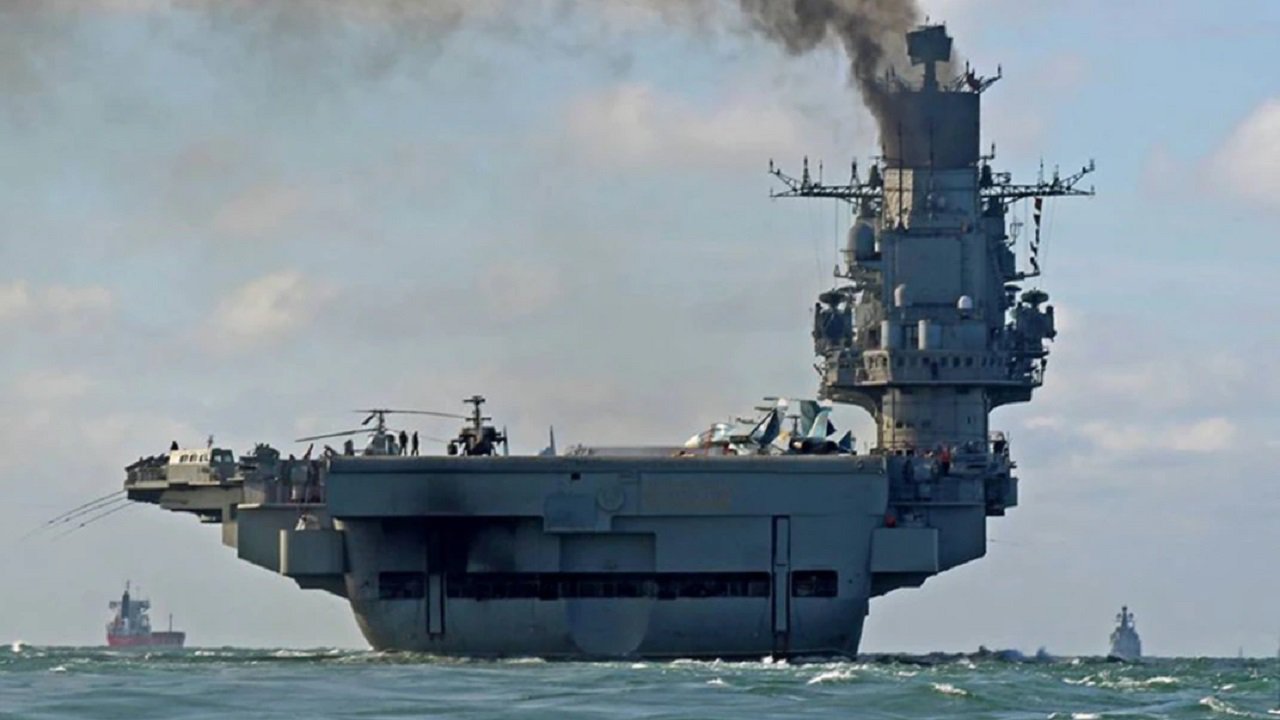
Admiral Kuznetsov Aircraft Carrier. Image Credit: Creative Commons.
The new ship would change that. She would be larger than anything the Soviet Navy had built. She would carry Su-33 air-superiority fighters and MiG-29K multirole fighters. She would project Soviet naval power into oceans that the Soviet Navy had historically been unable to reach.
Then the Soviet doctrinal compromise crept in.
The Soviet Navy did not believe in pure aircraft carriers. Soviet doctrine treated naval aviation as a defensive arm — a means of protecting the strategic missile submarines and surface combatants that were the actual centerpiece of Soviet naval power. So Project 1143.5 was not designed as an aircraft carrier in the American sense. She was designed as a Tyazholyy Avianesushchiy Kreyser — a “heavy aircraft-carrying cruiser” — combining the functions of a carrier with those of a missile cruiser.
This had practical consequences. She carried 12 P-700 Granit anti-ship cruise missile silos, taking up volume that could otherwise have housed more aircraft. She lacked steam catapults, using instead a ski-jump ramp at the bow and arresting cables for landing — a configuration the Russians call STOBAR (Short Take-Off But Arrested Recovery). Without catapults, her aircraft had to launch with reduced fuel and weapons loads, limiting both range and strike capability. Her sortie generation rate was a fraction of an American carrier’s.
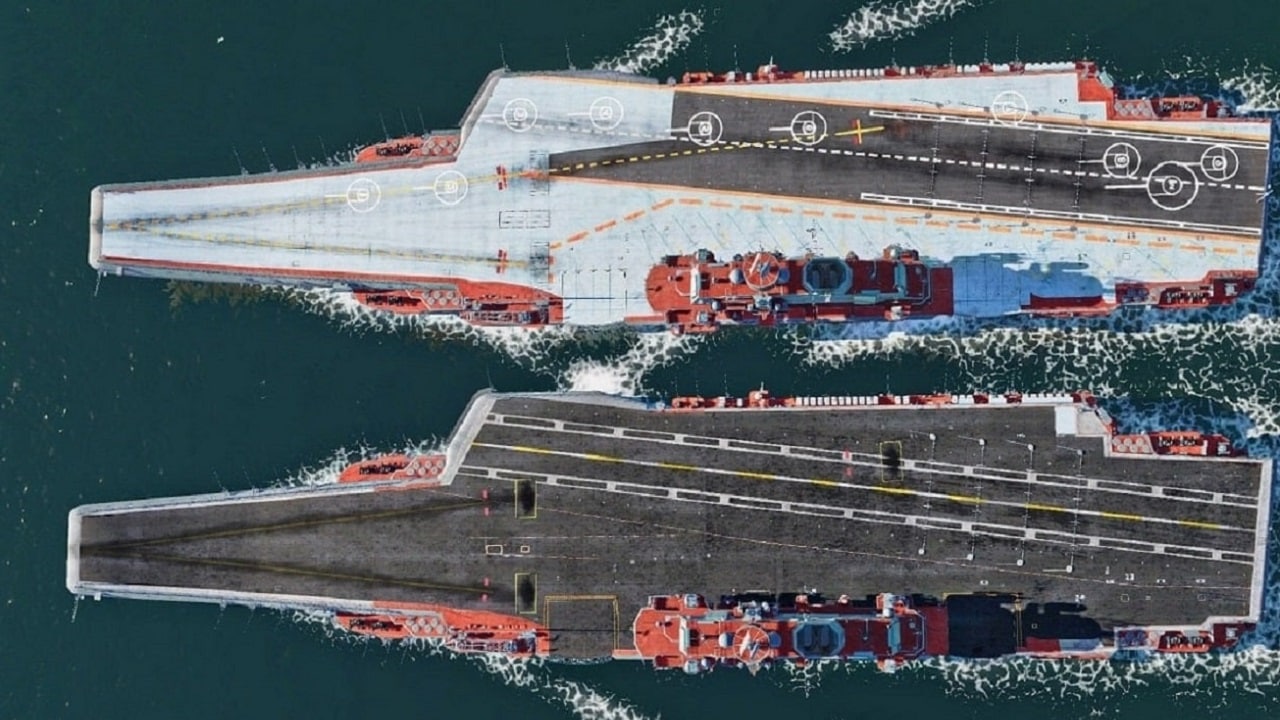
Admiral Kuznetsov before and after a refit. Image Credit: Creative Commons.
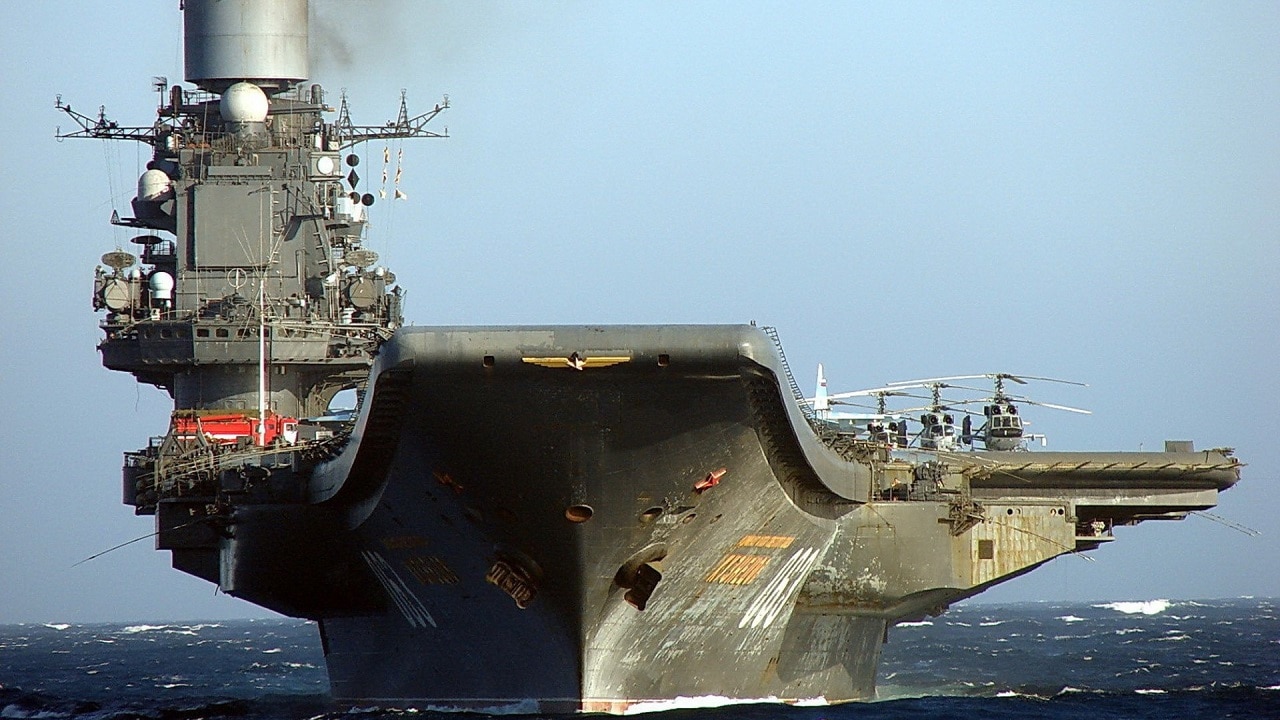
Russia Admiral Kuznetsov. Image Credit: Image Creative Commons.
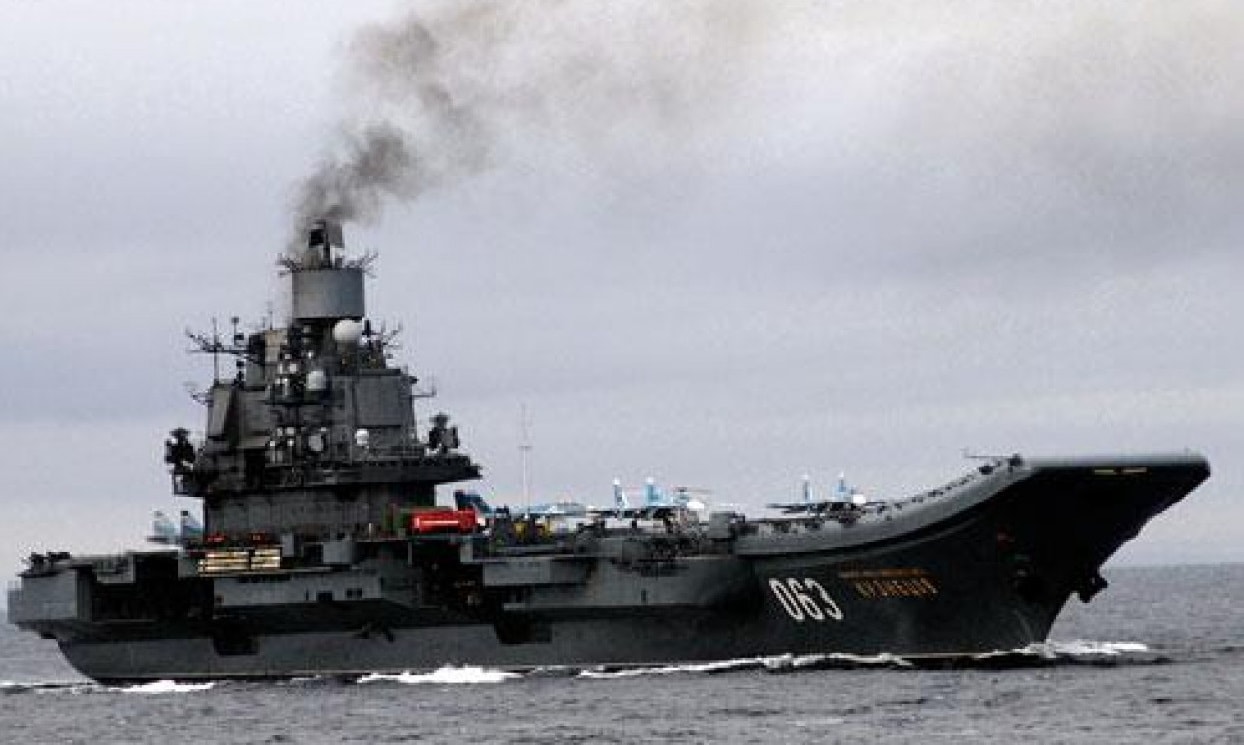
Image: Creative Commons.
She was, in other words, a ship trying to be two things at once and not quite succeeding at either.
Why Russia Was Never Good At Aircraft Carriers
The deeper problem was institutional. The Soviet Navy was a submarine navy. Its officer corps, industrial base, tactical doctrine, and budget priorities were all oriented toward undersea warfare and coastal defense. Carrier aviation was, at best, a third priority.
The Soviets built the Kuznetsov, and her sister ship Varyag (later sold to China and rebuilt as Liaoning), at a single facility — the Black Sea Shipyard at Nikolayev in what was then the Ukrainian Soviet Socialist Republic. When the Soviet Union collapsed in 1991, the only Soviet shipyard capable of building or substantially repairing aircraft carriers became Ukrainian property. Russia would never again have that capability inside its own borders.
Pilot training was equally constrained. Carrier aviation requires a deep bench of qualified naval aviators trained in the unforgiving discipline of catapult launches and arrested recoveries — or, in the Russian case, ski-jump launches and arrested recoveries. The Soviets had a small pool of carrier-qualified pilots. Russia inherited that small pool, and through the 1990s and 2000s, it shrank further. By 2016, U.S. naval analysts were noting that Russia’s carrier-qualified pilots were largely contractors rather than career naval officers, and that Russia lacked the training infrastructure to rebuild the bench.

Admiral Kuznetsov. Image Credit: Creative Commons.
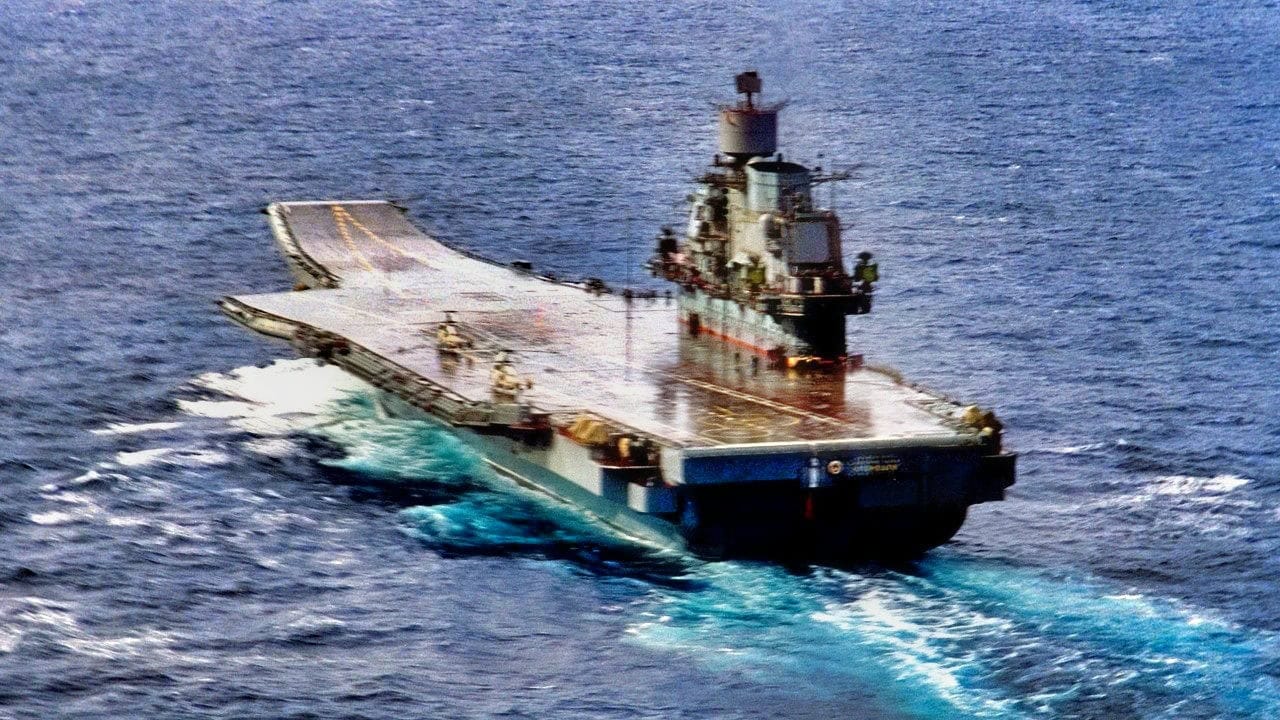
Admiral Kuznetsov Aircraft Carrier Russia. Image Credit: Creative Commons.
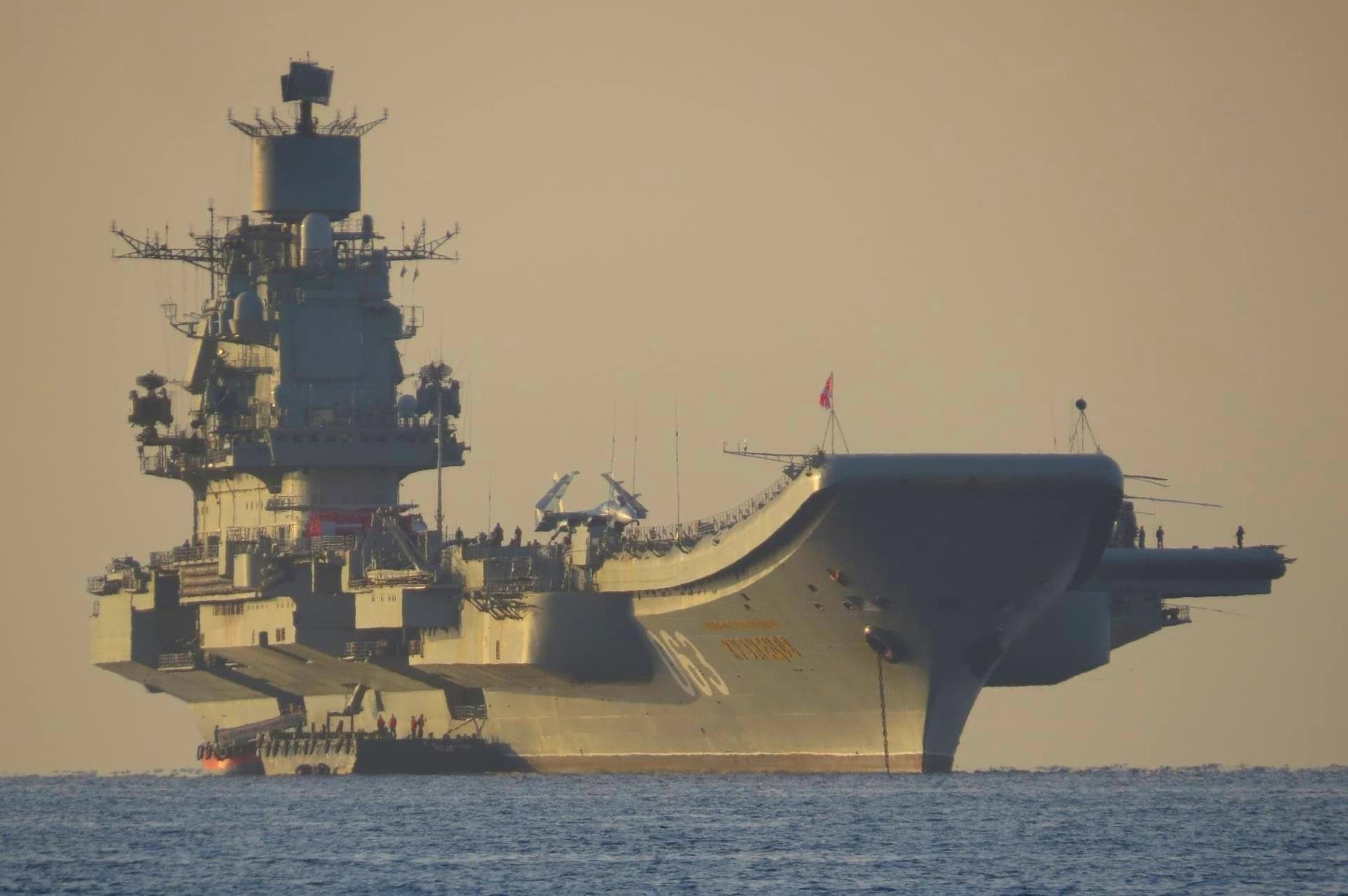
Aircraft Carrier Admiral Kuznetsov. Image Credit: Creative Commons.
The Kuznetsov, in other words, was a Soviet ship operated by a Russian navy that no longer had the industrial base, the support infrastructure, or the trained personnel to run her properly. That was the ship’s structural problem from day one.
The Birth Drama
She was named, renamed, and renamed again. Laid down in September 1982 as Riga, she was renamed Leonid Brezhnev before launching, then Tbilisi during sea trials, before being given her final name — Admiral of the Fleet of the Soviet Union Kuznetsov — in 1990. Naval superstition holds that changing a ship’s name is bad luck. Russian sailors took notice.
When the Soviet Union collapsed in December 1991, it was in the Black Sea. Ukrainian President Leonid Kravchuk telegraphed the ship’s commander to declare the Kuznetsov Ukrainian property and order her to remain in Sevastopol. The deputy commander of the Russian Northern Fleet, Yuri Ustimenko, intervened and ordered the ship to sail north for Murmansk before the Ukrainian government could act. She left without completing her required trials. She has spent the rest of her life as a Russian ship operating without the support infrastructure of her birthplace.
The Black Smoke
The Kuznetsov runs on mazut — a heavy, residual fuel oil that is essentially the bottom-of-the-barrel byproduct of refining lighter petroleum products. Mazut is cheap. It has been used in Russian and Soviet shipping for decades. It is also dirty, sulfur-heavy, and produces enormous volumes of black smoke when burned in steam boilers.
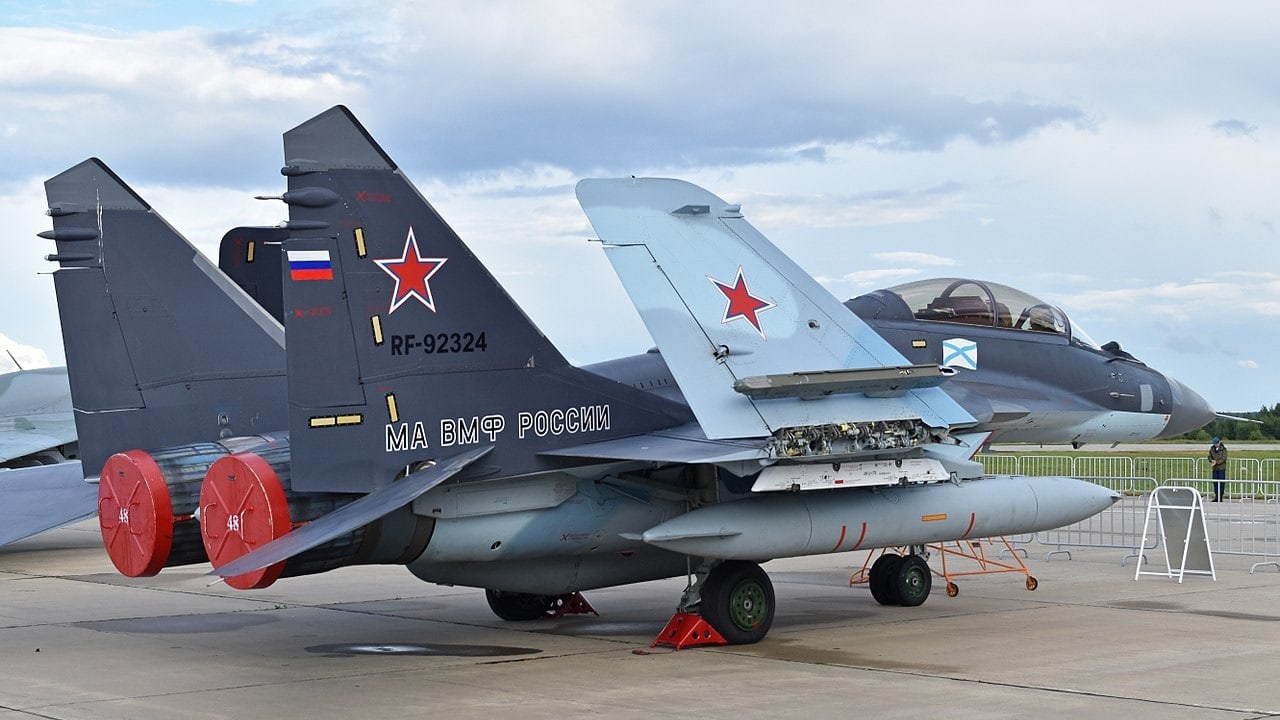
Naval variant of the second generation MiG-29, with the NATO codename ‘Fulcrum-D’. Reported to be operated by the 100th Independent Shipborne Fighter Aviation Regiment (OKIAP) based at Severomorsk. On static display at the Aviation cluster of the ARMY 2017 event. Kubinka Airbase, Moscow Oblast, Russia.
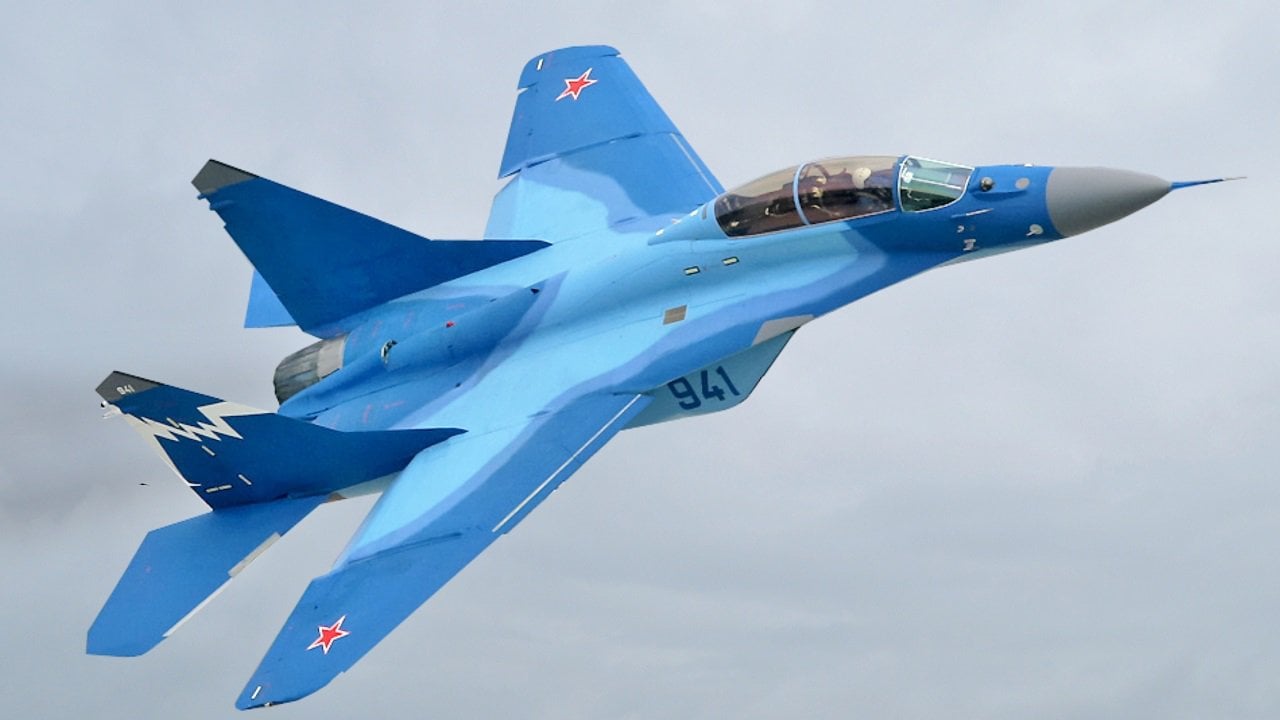
MiG-29K. Image Credit: Creative Commons.
The Kuznetsov has eight KVG-4 turbo-pressurized boilers feeding four shafts. The boilers are unreliable. They are also Soviet-era, which means parts and maintenance expertise are increasingly hard to come by. The combination produces the visual signature that has defined the Kuznetsov in the public imagination for decades: a 58,000-ton warship steaming across the world’s oceans with a column of thick black smoke trailing from her stack like a 19th-century steamer.
That smoke is also a tactical problem. It is visible at long range. It tells anyone within sight where the carrier is. For a ship whose entire purpose is supposed to be projecting force, the inability to do so without announcing her position with a smoke plume that can be seen from horizon to horizon is, charitably, a limitation.
The Syria Deployment
Kuznetsov’s combat record consists of a single deployment. Yep, you read that correctly.
In October 2016, she sailed for the eastern Mediterranean to support Russian operations in Syria. She arrived in early November and began flying combat sorties against rebel and ISIS positions in the Aleppo region.
On November 14, a MiG-29K crashed into the Mediterranean while approaching the Kuznetsov for landing. The pilot ejected and was recovered. The Russian Defense Ministry attributed the crash to a “technical fault.” Subsequent reporting suggested the failure was in the carrier’s arresting gear.
On December 5, a Su-33 was lost when its arresting cable broke during recovery. The fighter rolled off the deck. The pilot ejected and survived. Two carrier aircraft lost in three weeks, both to arresting gear failures.
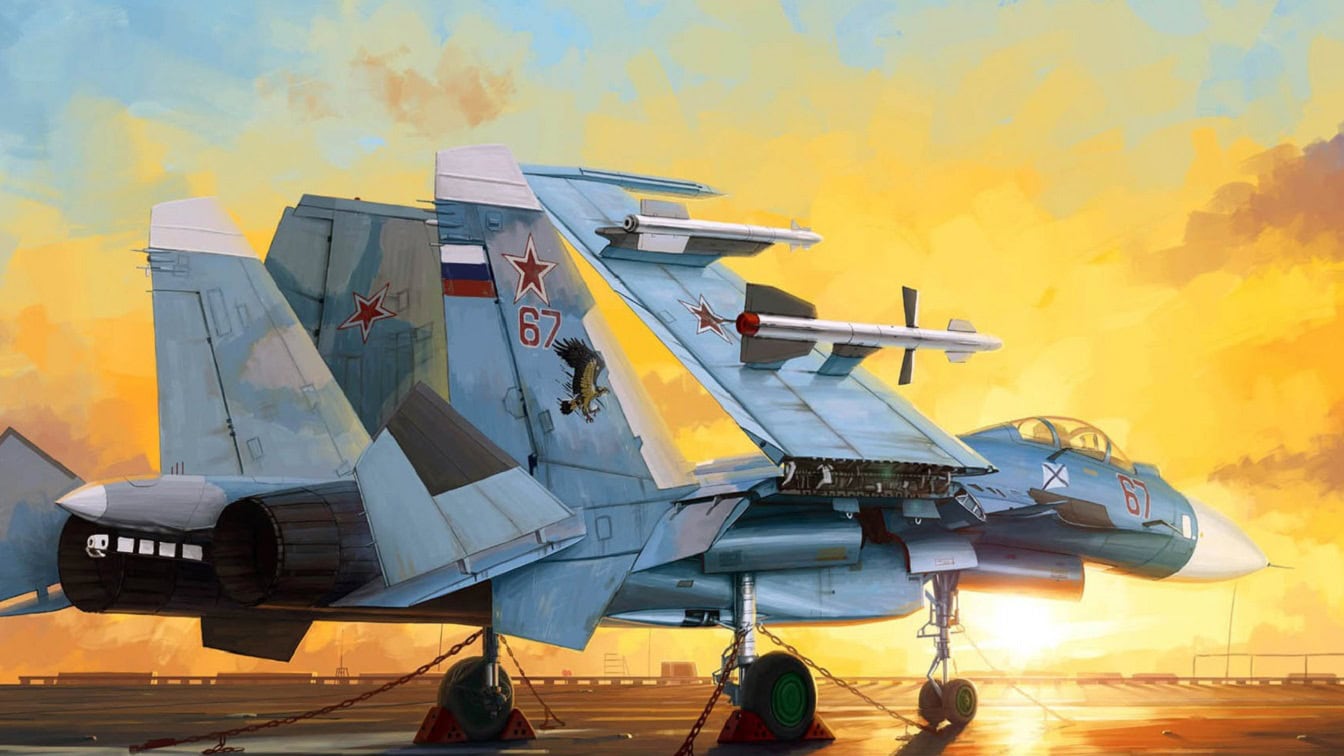
Su-33. Image Credit: Artist Rendering.
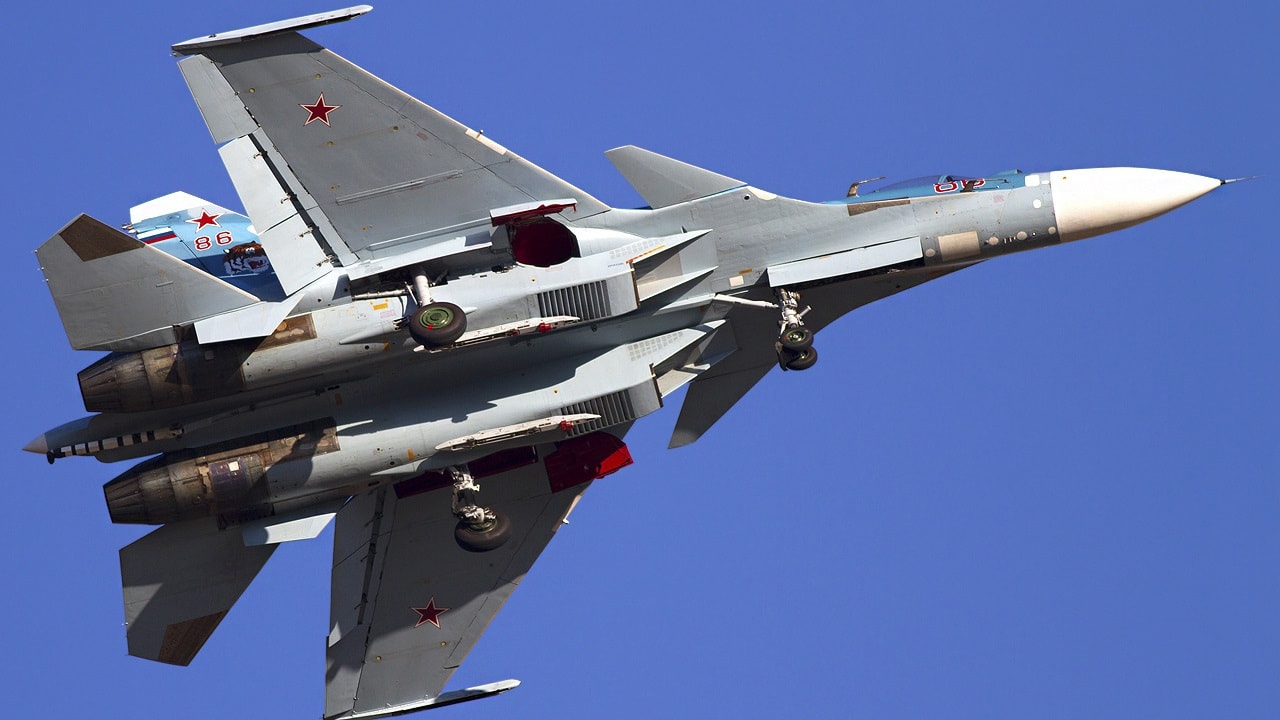
Russia’s Su-33 fighter. Image Credit: Creative Commons.
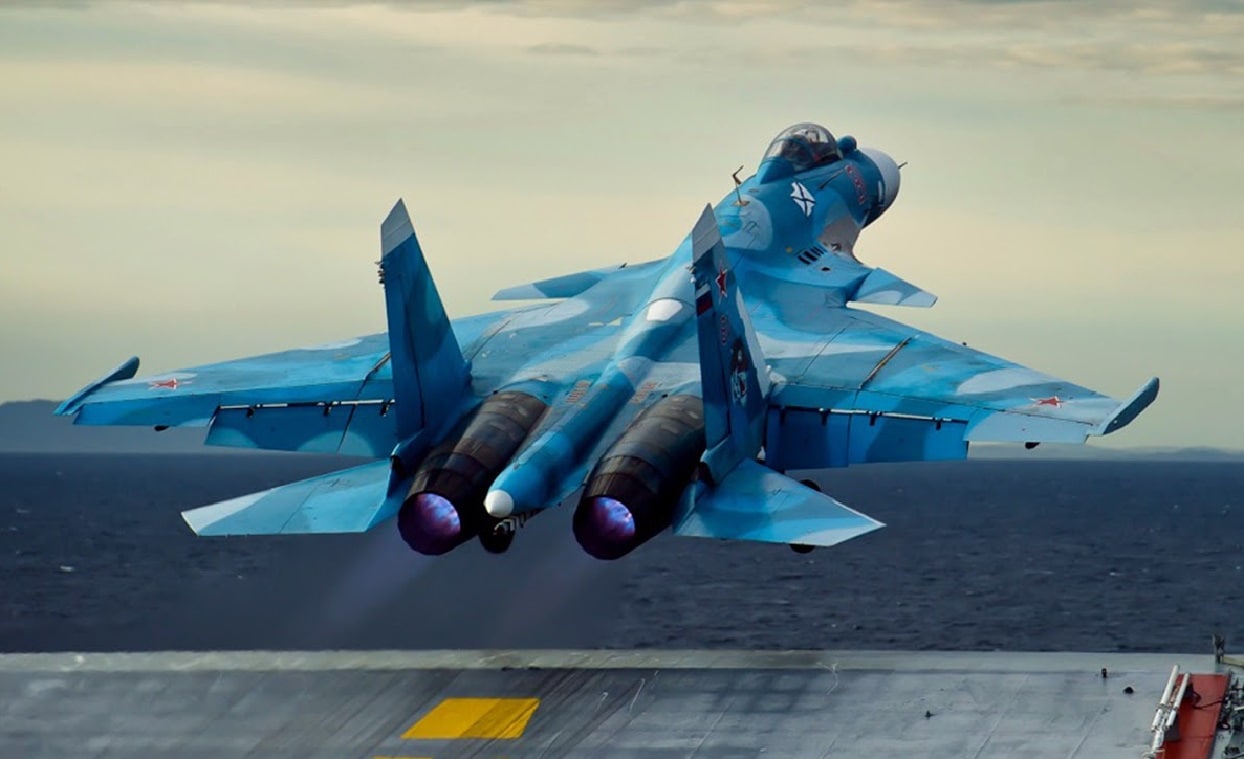
Su-33 Image: Creative Commons.
The Russian Navy’s solution was to relocate the air wing ashore. The remaining Su-33s and MiG-29Ks flew their combat missions for the rest of the deployment from Khmeimim air base in Syria, not from the Kuznetsov herself. Russia’s flagship aircraft carrier, on her one combat deployment, spent the bulk of the operation as a parking lot.
The Refit That Never Ended
The Kuznetsov returned to Murmansk in early 2017 and entered what was supposed to be a comprehensive overhaul.
What followed was a genuine catastrophe.
In October 2018, the PD-50 floating dry dock — the only Russian dry dock large enough to hold the Kuznetsov — sank in Kola Bay during a power failure that caused flooding. As the dock went down, a 70-ton crane crashed onto the carrier’s flight deck, tearing a 200-square-foot hole in the hull. One worker was killed. The carrier nearly went down with the dry dock.
In December 2019, a major fire broke out aboard during welding work. The fire raged for 24 hours, covering 5,381 square feet of the ship. Two workers were killed. Fourteen were injured. The cause was a welding spark igniting diesel fuel. Engineers later determined that all eight of the ship’s KVG-4 boilers needed to be replaced, not the four originally planned, and Ukraine, having stopped supplying military equipment to Russia after the 2014 Crimea seizure, was no longer available as a source of components. The propulsion system would have to be rebuilt from scratch inside Russia.
A smaller fire in 2022 caused additional damage. Ship repair workers cited in Russian media reportedly told military leadership that the carrier’s structural condition made deployment impossible because of the high probability she would sink or capsize. U.S. Navy assessments at various points during the refit noted that the American Navy was monitoring the Kuznetsov not out of fear of her capabilities but out of professional curiosity about whether she would stay afloat.
Repair costs ballooned past every initial estimate. The original 20-billion-ruble estimate was repeatedly revised upward. Sea trials, originally projected for 2022, were pushed to 2024, then to 2025, then suspended entirely. In September 2024, the Kuznetsovs’ crew was reassigned to combat units fighting in Ukraine. The carrier sat at her pier in Murmansk with no crew, no schedule, and no plan.
The End
In July 2025, Andrei Kostin — chairman of Russia’s state-owned United Shipbuilding Corporation, the contractor responsible for the Kuznetsov refit — told Russian media that completing the repairs no longer made sense. “She’s over forty years old, and she’s an extremely costly asset. I think it’s either sell or dismantle.”
Days later, the Russian newspaper Izvestia reported that the Commander-in-Chief of the Russian Navy had decided to mothball the carrier. Useful equipment would be transferred to other ships. A caretaker crew would preserve the hull. The decision on whether to scrap, sell, or eventually finish the modernization was deferred, but the practical effect was that work on the Kuznetsov had ended.
Former Russian Pacific Fleet Commander Admiral Sergei Avakyants publicly endorsed the decision, telling Izvestia that aircraft carriers were “a thing of the past” that “can be destroyed in a few minutes by modern weapons.” Coming from a former Russian fleet commander discussing his own service’s flagship, the statement was extraordinary. It was also, in the Russian context, a face-saving frame: the carrier was not being scrapped because it had failed. It was being scrapped because carriers themselves were obsolete.
The rationalization is not entirely wrong — modern long-range anti-ship weapons do create genuine challenges for carrier operations — but it is also incomplete. The American, Chinese, Indian, French, and British navies are all investing in carrier aviation. China operates two Kuznetsov-class hulls modernized to standards substantially superior to the original, plus its own new domestic design. India operates a Kuznetsov-pattern hull. Russia is the only major navy retiring its carrier capability without replacement, and it is doing so because the country no longer has the industrial base, the trained workforce, or the budget to sustain a carrier program.
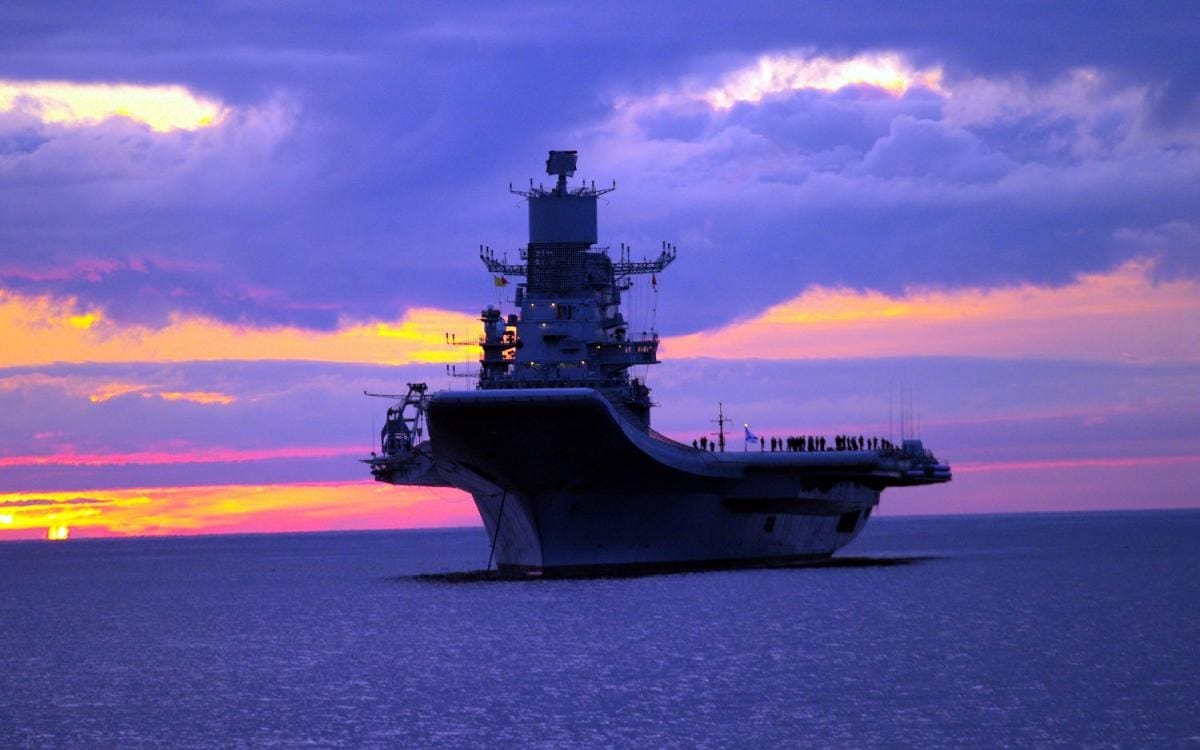
INS Vikramaditya in the Baltic Sea during her trials in 2013.
That is the institutional reality that Kuznetsov has illustrated for thirty years. The black smoke was the symptom. The structural problem was that the Soviet Union built her in a Ukrainian shipyard, then dissolved before she was finished. Everything that has happened since has been Russia trying to operate a complex warship without the supporting infrastructure to do it.
She probably gets cut up for scrap. She might be sold—though it is hard to imagine a buyer. The Russian Navy’s stated 2030 strategy still envisions carrier operations from both Northern and Pacific Fleets. That document increasingly reads as an aspiration.
The Admiral Kuznetsov was the last carrier the Russian Navy ever built. It is increasingly likely she is the last carrier the Russian Navy will ever operate.
About the Author: Harry J. Kazianis
Harry J. Kazianis (@Grecianformula) was the former Senior Director of National Security Affairs at the Center for the National Interest (CFTNI), a foreign policy think tank founded by Richard Nixon based in Washington, DC. Harry has over a decade of experience in think tanks and national security publishing. His ideas have been published in the NY Times, The Washington Post, The Wall Street Journal, CNN, and many other outlets worldwide. He has held positions at CSIS, the Heritage Foundation, the University of Nottingham, and several other institutions related to national security research and studies. He is the former Executive Editor of the National Interest and the Diplomat. He holds a Master’s degree focusing on international affairs from Harvard University. Kazianis is Editor-In-Chief of 19FortyFive.

