
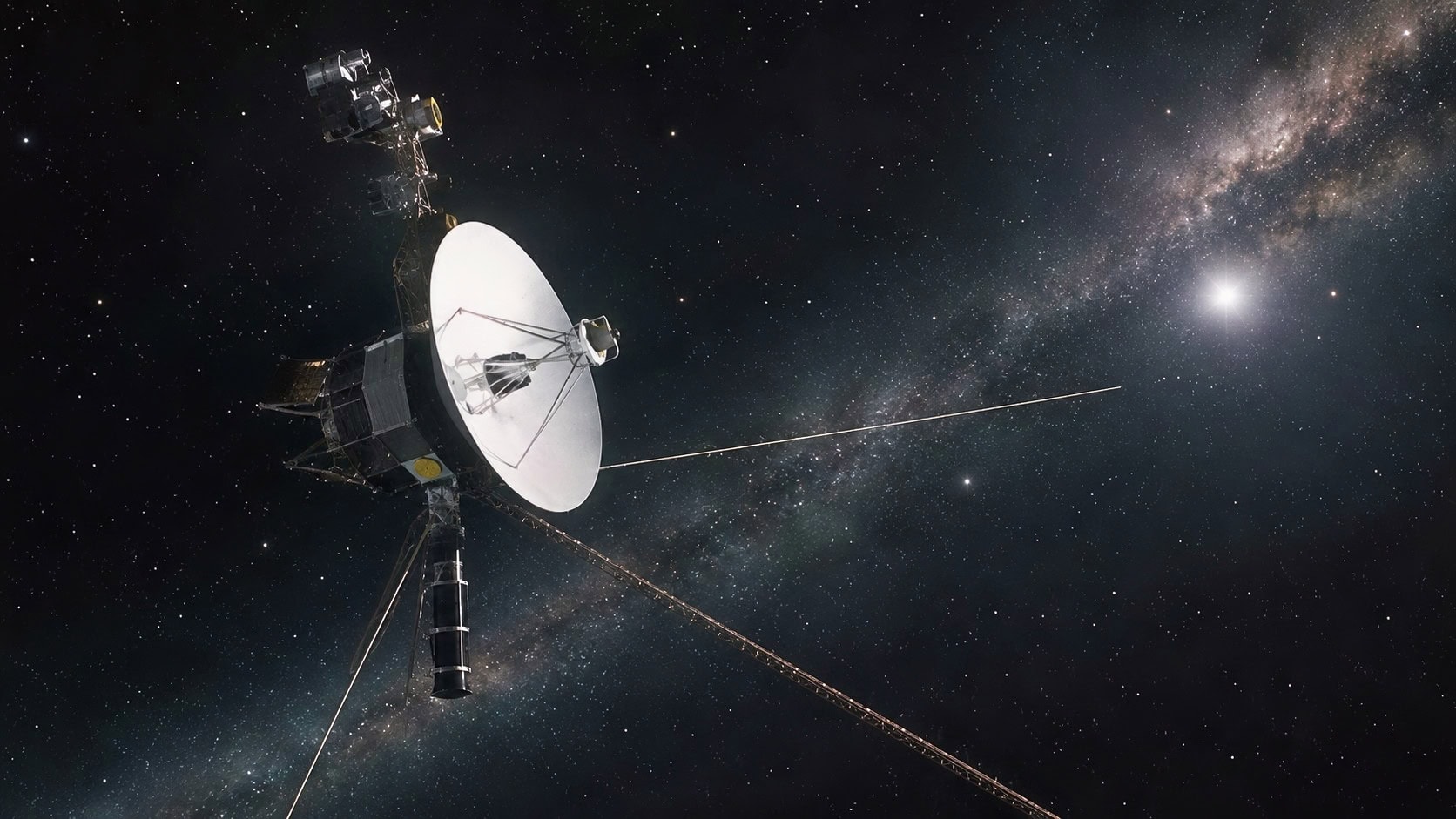
Voyager 1 launched in 1977 on a four-year mission to Jupiter and Saturn, and forty-nine years later, it is still flying, still transmitting, and still taking commands from more than 15 billion miles away. In late 2026, it will cross a line no machine has ever reached. It will be so far from Earth that a radio signal traveling at the speed of light takes a full 24 hours to reach it, which means the engineers who say “good morning, Voyager” on a Monday will not hear the spacecraft’s answer until Wednesday. The only reason it is still alive to cross that line is a small team at NASA‘s Jet Propulsion Laboratory performing a slow, decades-long act of triage, switching off instruments and heaters one by one to save power, reviving thrusters that had been dead for twenty years, and nursing a spacecraft built with 1970s computers across a distance its designers never imagined. Every fix buys only a little more time.
The Mission That Refused To End
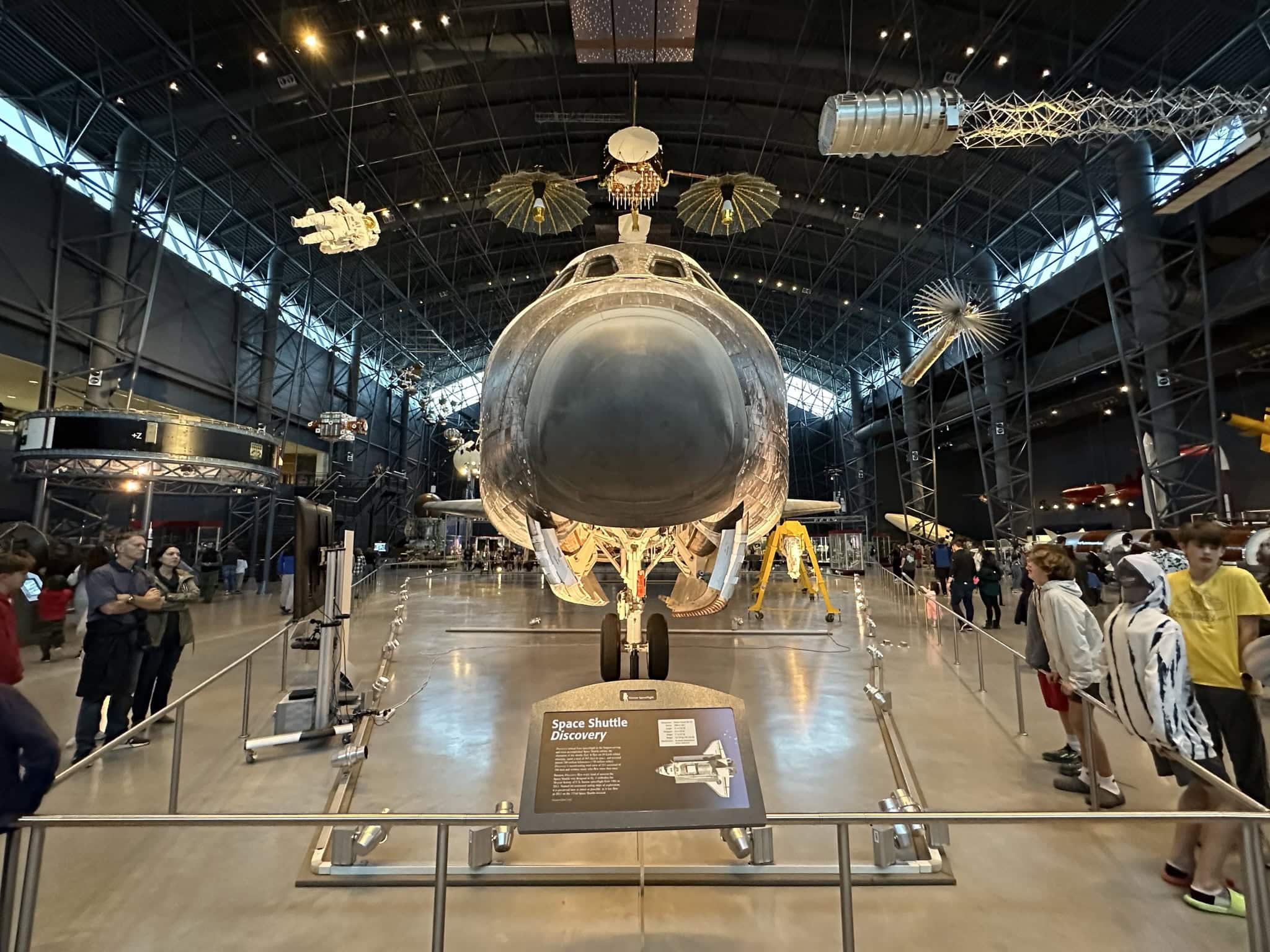
Space Shuttle Photo from back in 2022. Harry J. Kazianis Original Photo.
Voyager 1 lifted off from Cape Canaveral on September 5, 1977, sixteen days after its twin Voyager 2, on a planned four-year journey to study the outer planets. It flew past Jupiter in 1979 and Saturn in 1980, where it discovered new moons, revealed the structure of Saturn’s rings, and confirmed that the moon Titan was wrapped in a thick nitrogen atmosphere.
Then its primary mission ended, and it simply kept going, climbing up and out of the plane of the planets on a trajectory it has held without adjustment since the Saturn flyby.
That accidental afterlife turned Voyager 1 into the longest-running and farthest-traveling spacecraft in history. In 2004, it reached the termination shock, where the solar wind begins to slow against the pressure of interstellar space, and on August 25, 2012, it crossed the heliopause, the outer boundary of the Sun’s bubble of particles and magnetic field, becoming the first human-made object to enter interstellar space.
It is now roughly 15.7 billion miles from Earth, receding at about 38,000 miles per hour, with a one-way radio signal already taking more than 23 hours to reach Earth. Voyager 1 and Voyager 2 remain the only two spacecraft ever to operate outside the heliosphere, sending back the only direct measurements humanity has of the space between the stars.
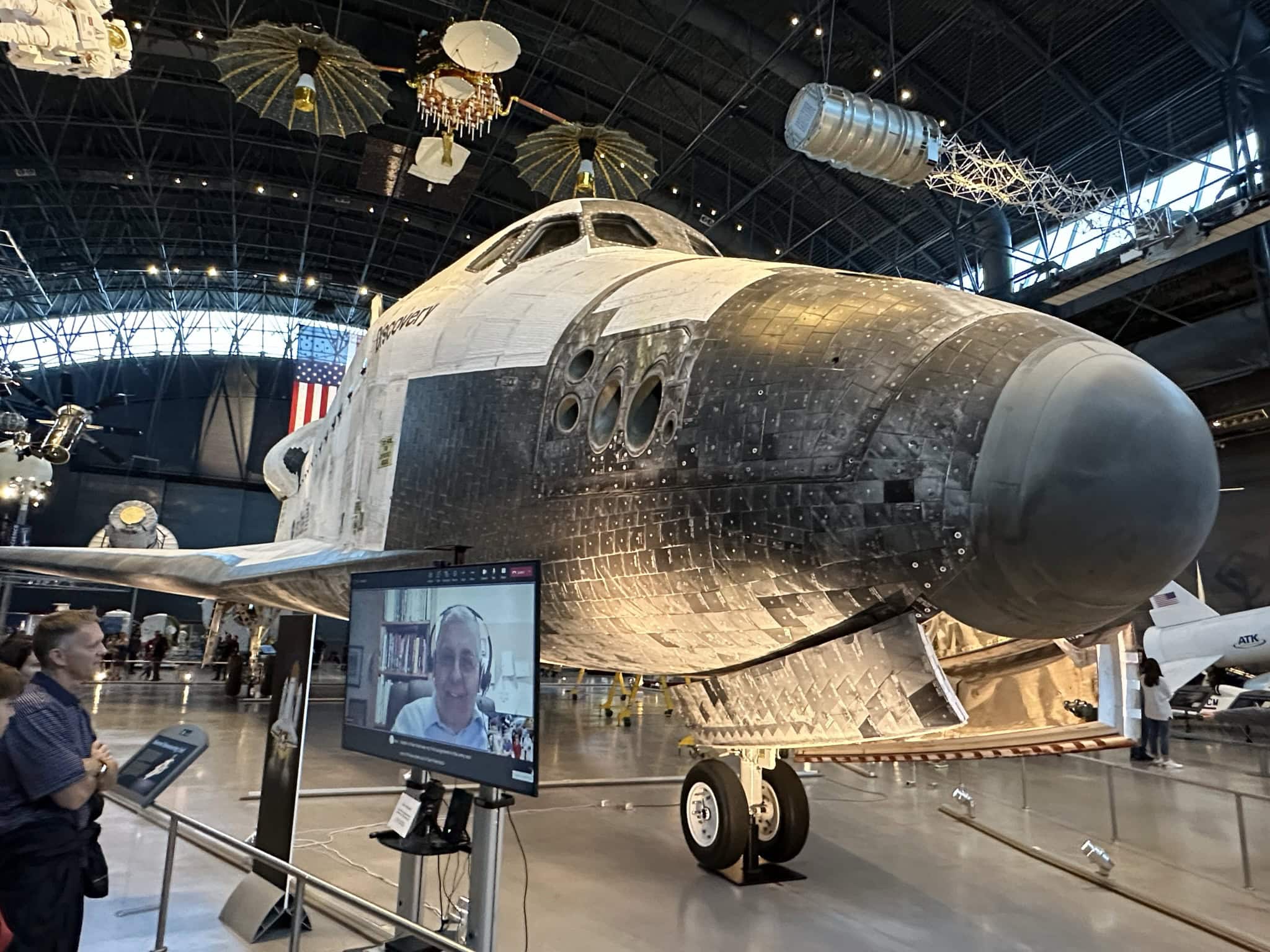
Space Shuttle Photo from back in 2022. Harry J. Kazianis Original Photo.
The Light-Day Milestone
On November 18, 2026, at 2:16 in the morning Pacific time, Voyager 1 will be 16,094,799,096 miles from Earth, the exact distance light travels in 24 hours, a unit called one light-day. It will be the first object ever built by people to reach that mark. The milestone is not a physical boundary in space, just a line on the long road outward, but it changes the daily reality of running the spacecraft in one concrete way.
Suzy Dodd, the Voyager project manager at JPL, described the new cadence in plain terms: “If I send a command and say, ‘good morning, Voyager 1,’ at 8 a.m. on a Monday morning, I’m going to get Voyager 1’s response back to me on Wednesday morning at approximately 8 a.m.”
A one-way signal time of 24 hours means a 48-hour round trip, so every command and every answer is separated by two full days. The team can no longer have anything resembling a conversation with the probe. Each instruction is sent into the dark, and the engineers wait two days to learn what happened.
The data trickles back at about 160 bits per second, slower than a 1980s dial-up modem, and the signal grows so faint over that distance that it takes arrays of giant antennas working together to gather it.
Like this article? Add Us As a Preferred Source on Google
The numbers stretch the imagination. When it reaches one light-day, Voyager 1 will be more than five times farther from Earth than Neptune, yet it will have covered only 0.0027 percent of the distance to Proxima Centauri, the nearest star.
Its three onboard computers hold about 68 kilobytes of memory between them, less than a single phone photo, and run at a fraction of the speed of a pocket calculator. Voyager 2, on its own slower trajectory, will not reach the one-light-day mark until 2035, and is very unlikely to still be transmitting when it does.
Entrance to the Smithsonian. Image Credit: Harry J. Kazianis
Running On A Dying Battery
Everything about keeping Voyager 1 alive comes down to power, and the power is running out. The spacecraft is fueled by three radioisotope thermoelectric generators that convert the heat of decaying plutonium-238 into electricity.
At launch, they produced about 470 watts. Today, they produce roughly 250, and they lose about four watts every year as the plutonium decays and the thermocouples degrade. There is no way to refuel or replace them. The supply only shrinks.
So for more than two decades, the team has been making a long series of subtractions. Voyager 1 launched carrying eleven scientific instruments. Four are still operating, and of those, only two are still collecting science data: the Plasma Wave Subsystem and the magnetometer. The rest have been switched off in a deliberate, pre-agreed order, the instruments judged least essential going first, so the ones that matter most for studying interstellar space can keep running as long as possible. The cameras went dark long ago.
After Voyager 1 took the famous Pale Blue Dot image of Earth in 1990, its cameras were powered off permanently; the imaging software was later deleted from the spacecraft’s memory to save space; and the ground computers that could interpret the image data no longer exist. Even if the team wanted another photograph, the spacecraft can no longer take one.
Every shutdown carries a hidden risk, because the same dwindling power runs the heaters that keep the spacecraft’s components from freezing in the roughly minus 270 degrees Celsius cold of interstellar space.
Turning off a heater saves watts but can let a critical part freeze, and Dodd has warned that if the propellant lines freeze and the antenna drifts off its lock on Earth, the mission would be lost, because the team could no longer get a signal to the spacecraft at all.
The Instruments Going Dark, One By One
The subtractions have accelerated as the power has dropped. In February 2025, the team shut off the cosmic ray subsystem, the suite of telescopes that had helped pinpoint exactly when and where Voyager 1 left the heliosphere. That left three instruments running, with the next shutdown already scheduled, following the order the team had mapped out years in advance.
The next one came sooner than planned. On February 27, 2026, a routine roll maneuver caused an unexpected drop in power, forcing the team to act. “While shutting down a science instrument is not anybody’s preference, it is the best option available,” said Kareem Badaruddin, the Voyager mission manager at JPL.
On April 17, 2026, engineers sent the command to turn off the Low-Energy Charged Particles experiment, an instrument that had been running almost without interruption since 1977, nearly 49 years, measuring the ions and electrons of interstellar space.
That left Voyager 1 with only two operating science instruments, the magnetometer and the plasma wave subsystem, which, between them, sense the interstellar magnetic field and the density of charged particles in the gas the spacecraft is flying through.
The Thruster Save
The most dramatic recent rescue had nothing to do with instruments. To send its data home, Voyager 1 must keep its antenna pointed precisely at Earth, and it does that with small thrusters that roll the spacecraft like a record on a turntable to keep it locked onto a guide star.
Voyager 1 has a primary and a backup set of these roll thrusters. The primaries were declared dead in 2004 after two small internal heaters lost power, and for two decades the spacecraft relied entirely on the backups. Then the backups began to clog. A buildup of residue in their fuel lines threatened to shut them down as early as the fall of 2025, leaving the spacecraft with no working means to point itself.
So the team set out to revive the primary thrusters that everyone had written off twenty years earlier, and they had to do it against a hard deadline. Deep Space Station 43 in Canberra, Australia, a 230-foot dish that is the only antenna on Earth powerful enough to send commands to either Voyager, was scheduled to go offline for major upgrades from May 4, 2025, through February 2026, with only brief operating windows in August and December.
If the thrusters failed during that blackout, there would be no way to fix them. The repair itself carried real danger. The team had to turn on the long-dormant thrusters and then try to restart their heaters, but if the spacecraft’s star tracker drifted too far from its guide star during that window, the thrusters would automatically fire, and if the heaters were still cold when they did, the firing could trigger a small explosion. Everything had to be timed and aimed precisely.
On March 20, 2025, the engineers watched the data come back, more than 23 hours after the spacecraft had actually acted, and saw the heater temperatures climbing. It had worked. “These thrusters were considered dead. And that was a legitimate conclusion,” said Todd Barber, the mission’s propulsion lead, describing it as “yet another miracle save for Voyager” and “such a glorious moment.” Badaruddin, explaining why the team in 2004 had been content to give up on the primaries, put it simply: “they probably didn’t think the Voyagers were going to keep going for another 20 years.” It was the latest in a string of such maneuvers, including a thruster swap in September 2024 to a less-clogged set and the revival of other thrusters in 2018 and 2019.
Fixing A Spacecraft From 15 Billion Miles Away
The thruster revival was one of several saves pulled off across billions of miles in recent years. In November 2023, Voyager 1 began sending home gibberish, an endless string of ones and zeros, and the team spent roughly five months tracing the fault to a single failed memory chip in one of the spacecraft’s 1970s computers, then writing code to work around the dead hardware and restoring the science data by the spring of 2024.
In October 2024, the probe shut off its main X-band transmitter after a fault and fell back to a backup S-band transmitter that had not been used since 1981, faint enough that the team had to hunt for the signal before reconnecting it and restoring the main transmitter weeks later.
The margin is now gone. With the thrusters clogging and no backup left, the spacecraft is, in Dodd’s words, down to a state where everything onboard is single-string, one failure away from ending the mission. To buy more time, the team has designed a software change meant to slow the rate at which the hydrazine fuel lines clog, a fix nicknamed the Big Bang. Because of the stakes, they are testing it on Voyager 2 first, which has slightly more power to spare and sits closer to Earth, making it the safer subject; those tests are planned for May and June 2026.
If they go well, the team will attempt the same fix on Voyager 1 no sooner than July, and if it works, there is even a chance the Low-Energy Charged Particles instrument could be switched back on. The work falls to a small group of engineers, some of them advised by NASA retirees in their eighties who built the original hardware, keeping a spacecraft alive at the edge of the solar system through a single antenna in Australia and a command link that takes two days for a round trip.
The End That Isn’t
This cannot go on forever. JPL estimates the generators may produce enough power to return engineering data into roughly the 2030s, perhaps until about 2036, before the signal fades below what even the largest antennas on Earth can detect. After that, Voyager 1 falls silent. It does not stop, though. The outbound trajectory requires no power, so the spacecraft keeps coasting away from the Sun at 38,000 miles per hour, indefinitely, carrying with it the one piece of itself designed to outlast everything else.
Bolted to the side of each Voyager is the Golden Record, a 12-inch gold-plated copper disc assembled in 1977 by a committee chaired by the astronomer Carl Sagan. It holds 115 encoded images, a 90-minute selection of music ranging from Bach to Chuck Berry, the natural sounds of Earth, spoken greetings in 55 languages beginning with ancient Akkadian and ending with a modern Chinese dialect, and printed messages from the U.S. president and the United Nations Secretary-General, all sealed in an aluminum jacket with a needle and symbolic instructions for playing it.
It was built to survive for nearly a billion years. Sagan understood it would almost certainly never be found, and said the point was less the finding than the sending, that launching such a bottle into the cosmic ocean said something hopeful about life on Earth. In roughly 40,000 years, Voyager 1 will pass within about 1.7 light-years of a faint red dwarf star, the closest it will come to another sun for an almost unimaginable span of time.
That is the contradiction at the center of the mission.
The most distant and longest-enduring object humanity has ever built is kept running not by some self-sustaining marvel of engineering but by a handful of people on Earth, babysitting half-century-old hardware across a widening gap, turning off one heater at a time and reviving thrusters left for dead, knowing each fix only postpones the end.
And as it crosses into the first light-day of distance any human machine has ever reached, it is, for now, still going.
About the Author: Harry J. Kazianis
Harry J. Kazianis (@Grecianformula) was the former Senior Director of National Security Affairs at the Center for the National Interest (CFTNI), a foreign policy think tank founded by Richard Nixon based in Washington, DC. Harry has over a decade of experience in think tanks and national security publishing. His ideas have been published in the NY Times, The Washington Post, The Wall Street Journal, CNN, and many other outlets worldwide. He has held positions at CSIS, the Heritage Foundation, the University of Nottingham, and several other institutions related to national security research and studies. He is the former Executive Editor of the National Interest and the Diplomat. He holds a Master’s degree focusing on international affairs from Harvard University.

