
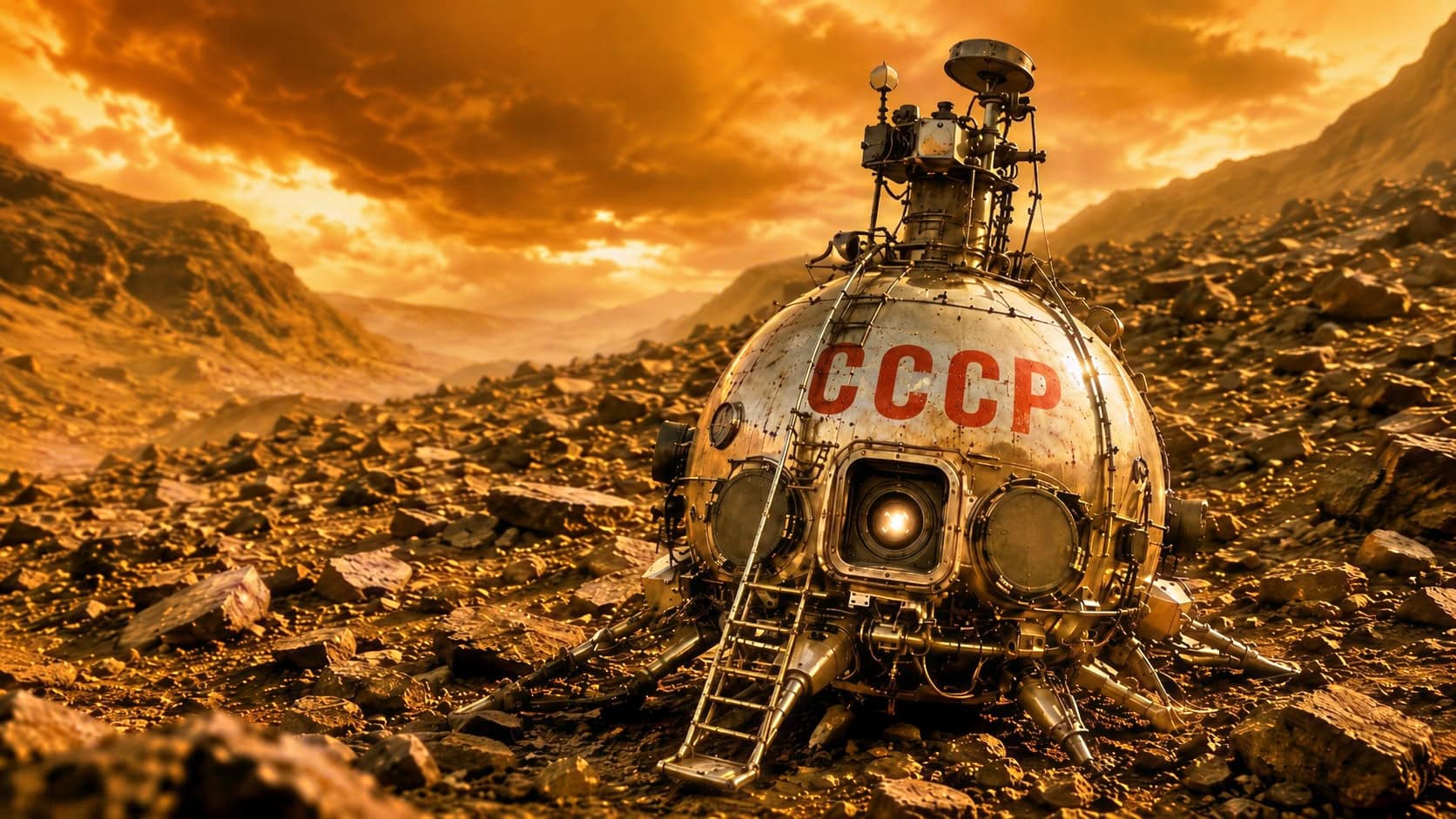
The first photograph ever taken from the surface of another planet exists, and half of it is missing because a lens cap would not come off. On October 22, 1975, a Soviet lander named Venera 9 settled onto a rocky slope on Venus and did something no machine had ever done, capturing an image of the ground of another world and sending it back to Earth. It is one of the most improbable pictures ever made, a field of flat angular stones under a dim sky, shot by a five-watt camera peering through a periscope on a planet hot enough to melt lead and pressurized like the deep ocean. And it is only half a picture. The lander carried two cameras to photograph its full surroundings, and one of the two protective lens caps, the simple covers meant to keep the optics clean during descent, failed to release. The hardest-won image in the history of exploration came home as half a panorama, and the same trivial failure would go on to defeat the next three landers, including two that crossed the solar system and came back blind. The Venera program conquered the worst surface in the solar system and was repeatedly beaten by a lens cover.
The First Photograph From Another World
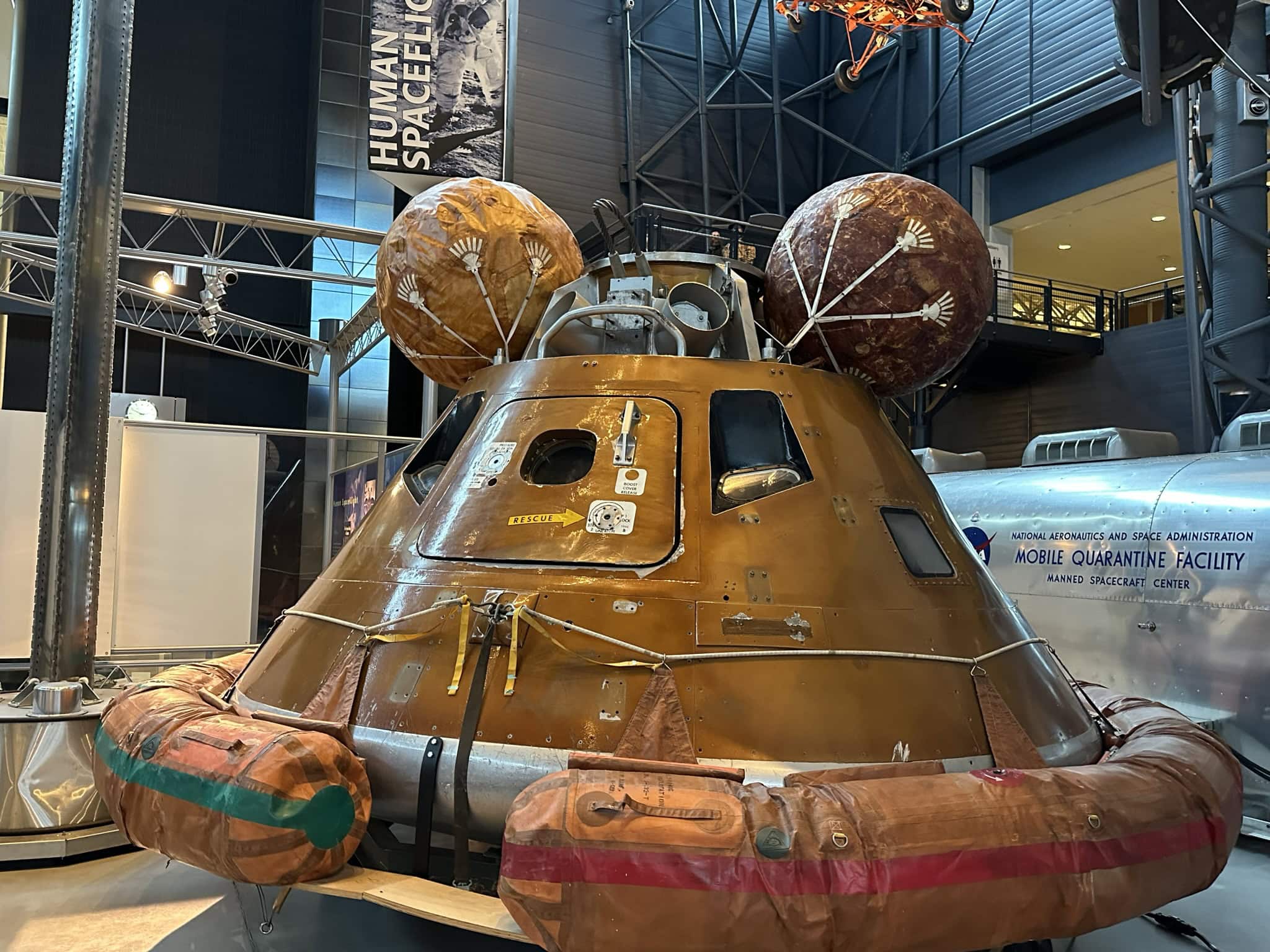
Smithsonian images from the American Cold War Space Program. Image Credit: 19FortyFive Harry J. Kazianis, back in October 2022.
Venera 9 was launched in June 1975 and reached Venus after a journey of more than four months. The spacecraft split into two parts: an orbiter that became the first artificial satellite of Venus and would relay the lander’s signal home, and the lander itself, a 660-kilogram sphere built to survive the descent and the surface long enough to do its work.
On October 22, the lander touched down at 05:13 UTC at the base of a hill near Beta Regio, on a steep boulder-strewn slope of roughly 20 degrees, suspected to be the wall of a tectonic rift valley.
Two minutes after landing, one of the lander’s two camera covers released, and the probe began to scan. Over about thirty minutes, it built up a panorama line by line and sent back a clear black-and-white image of the site, a scree of flat, sharp-edged rocks and slabs lying under a sky lit like an overcast afternoon.
The picture was at once astonishing and almost mundane, a heap of stones on a hillside, except that the hillside was on Venus and the camera that took it drew about five watts of power and sat 360 million kilometers from the nearest human being. For the first time, people could look at the actual ground of another planet.
A Surface That Destroys Cameras
The reason no one had managed this before, and the reason so few have managed it since, is that Venus is built to destroy anything sent to its surface. Venera 9 measured a surface temperature of about 455 degrees Celsius, roughly 851 degrees Fahrenheit, under a pressure near 90 times Earth’s at sea level, the equivalent of being some 900 meters underwater, beneath clouds of sulfuric acid. A camera left exposed to that would not last.
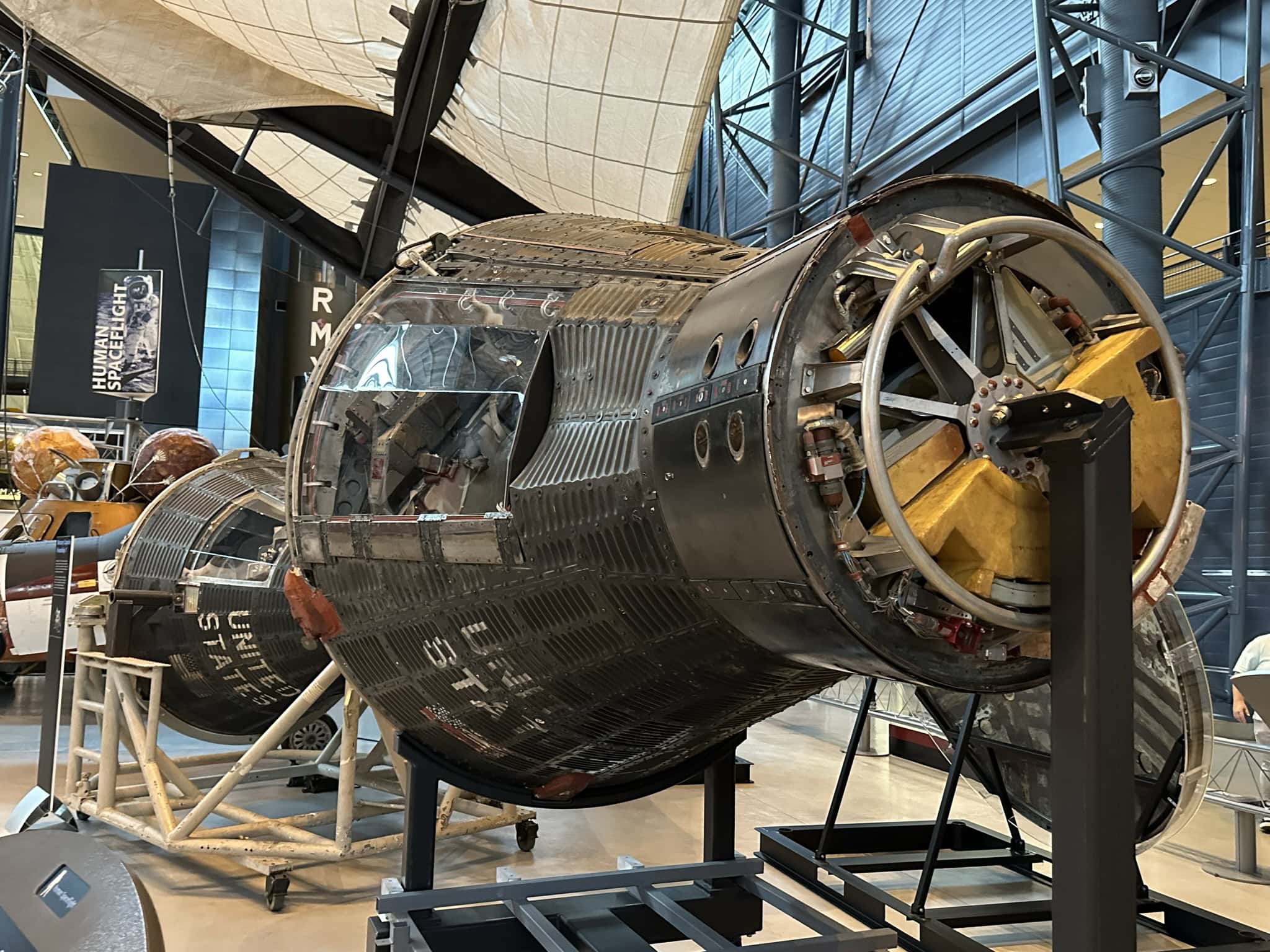
Smithsonian images from the American Cold War Space Program. Image Credit: 19FortyFive Harry J. Kazianis, back in October 2022.
The Soviet engineers solved the problem by sealing the imaging system inside the lander’s pressure vessel and feeding it the outside world through a quartz porthole and a periscope with a scanning mirror, so the delicate electronics never touched the Venusian air.
The popular image of Venus as a place of howling winds needs one correction at ground level. The fierce winds, well over 360 km/h, belong to the upper cloud layers the lander fell through, not the surface, where Venera 9’s instruments recorded only a light breeze of a few tenths of a meter per second, a near-calm made of supercritical carbon dioxide.
The lander survived for about 53 minutes. Contact ended not because the probe finally cooked, as is often claimed, but because the orbiter relaying its signal moved out of radio range as it passed overhead. The lander was very likely still working when its signal to Earth simply went over the horizon.
The Cap That Would Not Come Off
The flaw that defined the mission was almost absurdly small. Venera 9 carried two cameras, mounted on opposite sides of the lander and facing in opposite directions to provide a full view of the surroundings.
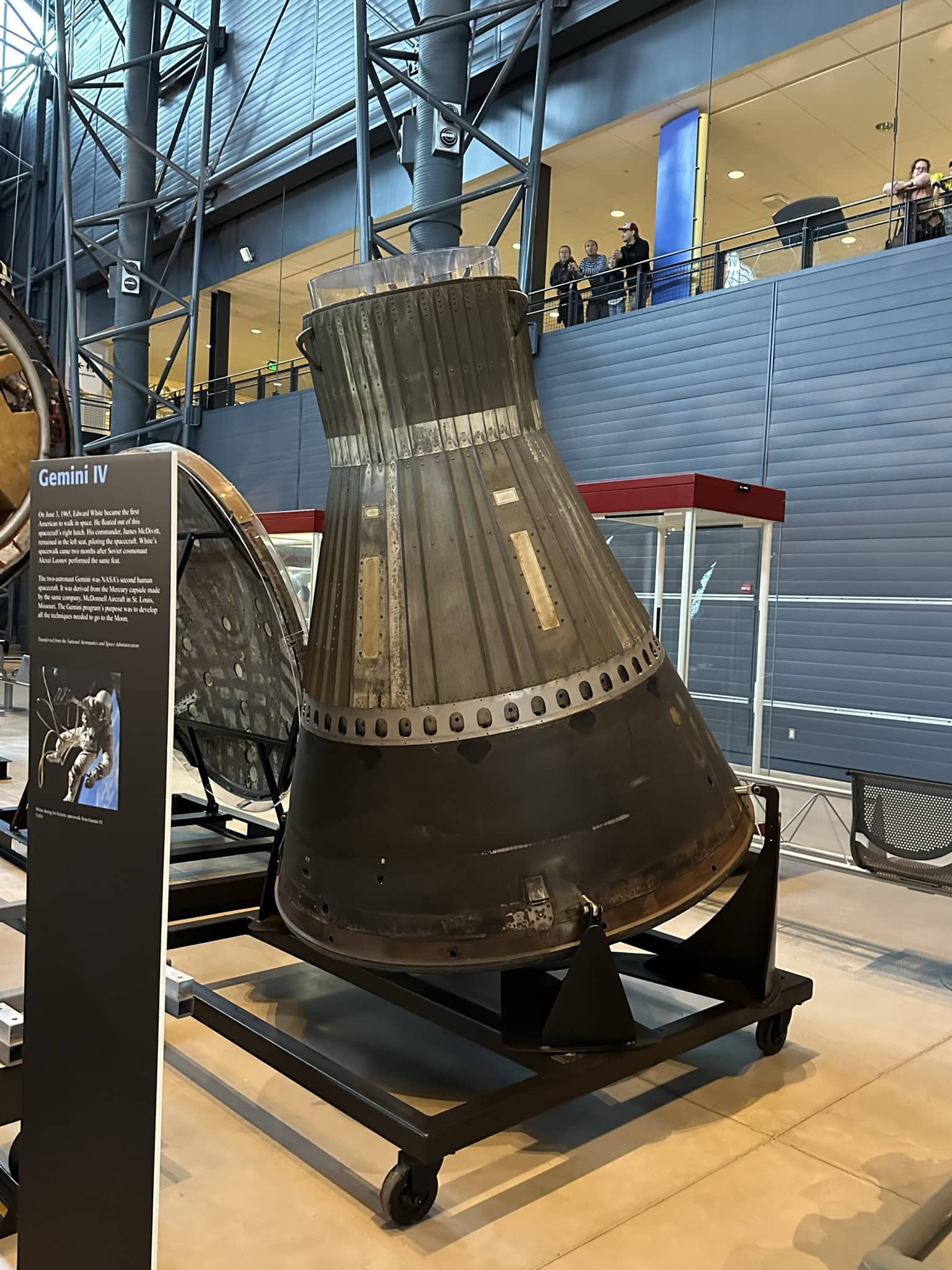
Smithsonian images from the American Cold War Space Program. Image Credit: 19FortyFive Harry J. Kazianis, back in October 2022.
Each was sealed behind a protective cover meant to pop off once the lander was down. One of the two covers was ejected as designed. The other did not, and the camera behind it stared at the inside of a cap that would not move, recording nothing.
Instead of imaging its whole surroundings, the lander returned a single panorama from the one working camera, about half the view its builders had intended. Humanity’s first photograph from the surface of another planet was, through no fault of the camera or the punishing planet, half a picture, stopped by a stuck lid.
The Curse Spreads
Had it happened once, it would be a footnote. It happened four times. Venera 10 landed three days later, on October 25, 1975, survived for about 65 minutes, and met the same fate: one cover was released, one stuck, and another half-panorama came home instead of a full one.
The two landers together still delivered a scientific prize, showing that the surface was strewn with blocky volcanic rock, evidence that much of Venus is basalt, the same stone that floors Earth’s oceans.
Then the failure turned from costly to total. In December 1978, the Soviets landed Venera 11 and Venera 12, an upgraded pair carrying improved cameras meant to capture the first color images of the surface. Both landers worked.
Smithsonian images from the American Cold War Space Program. Image Credit: 19FortyFive Harry J. Kazianis, back in October 2022.
Both survived more than an hour. And on both of them, every camera cover failed to eject, leaving all four cameras staring at sealed caps. Two spacecraft had crossed the solar system, descended through the acid clouds, and survived the deadliest surface ever reached, only to come back without a single photograph.
They were blind, but not silent. Both landers still returned a wealth of data, detecting lightning and radio bursts that provided the first confirmation of electrical activity on another planet and measuring an atmosphere with about 96.5 percent carbon dioxide. They had everything except the pictures, because of a lens cap.
The Fix, And The Cap’s Last Laugh
Only after four crippled missions did the engineers redesign the cap-ejection system and rework the exposure controls. The fix worked. When Venera 13 and Venera 14 reached Venus in March 1982, their covers came off cleanly, and the landers returned the first true color panoramas of the Venusian surface, the dim, yellow-orange landscapes of layered rock that remain the most famous images of the planet. The lens cap, however, was not quite finished. On Venera 14 it ejected exactly as designed, then came to rest on the ground in precisely the wrong place.
When the lander extended its arm to test the surface, the instrument pressed down on the discarded lens cap instead of the soil, and dutifully measured the hardness of its own cover rather than the surface of Venus. The cap had spent four missions refusing to come off. On the fifth, it came off and then sabotaged a different experiment by landing where it was least wanted.
Still The Only Photos Of Venus
In the entire history of spaceflight, only four spacecraft have ever returned photographs from the surface of Venus: Venera 9, 10, 13, and 14.
They remain the only images humanity possesses of that surface, more than fifty years after the first of them and more than forty after the last.
No camera has landed on Venus since the 1980s. The next attempts are still being planned, with NASA’s DAVINCI mission designed to photograph the surface during a descent through the atmosphere and its VERITAS orbiter set to map the planet from above, neither of them a long-duration lander in the Venera mold.
Smithsonian images from the American Cold War Space Program. Image Credit: 19FortyFive Harry J. Kazianis, back in October 2022.
That is the strange weight the Venera images carry. They are among the hardest-won pictures ever taken, the product of a decade of engineering against a planet that crushes and cooks almost everything sent to it, and humanity has not managed to add to them in two generations.
They were also fewer than they are now because the one component standing between the cameras and the surface was not the titanium hull, the cooling system, or the parachutes, but a simple protective cap. The Soviet engineers beat the heat, the pressure, and the acid.
What kept beating them was the lid over the lens.
About the Author: Harry J. Kazianis
Harry J. Kazianis (@Grecianformula) was the former Senior Director of National Security Affairs at the Center for the National Interest (CFTNI), a foreign policy think tank founded by Richard Nixon based in Washington, DC. Harry has over a decade of experience in think tanks and national security publishing. His ideas have been published in the NY Times, The Washington Post, The Wall Street Journal, CNN, and many other outlets worldwide. He has held positions at CSIS, the Heritage Foundation, the University of Nottingham, and several other institutions related to national security research and studies. He is the former Executive Editor of the National Interest and the Diplomat. He holds a Master’s degree focusing on international affairs from Harvard University.