
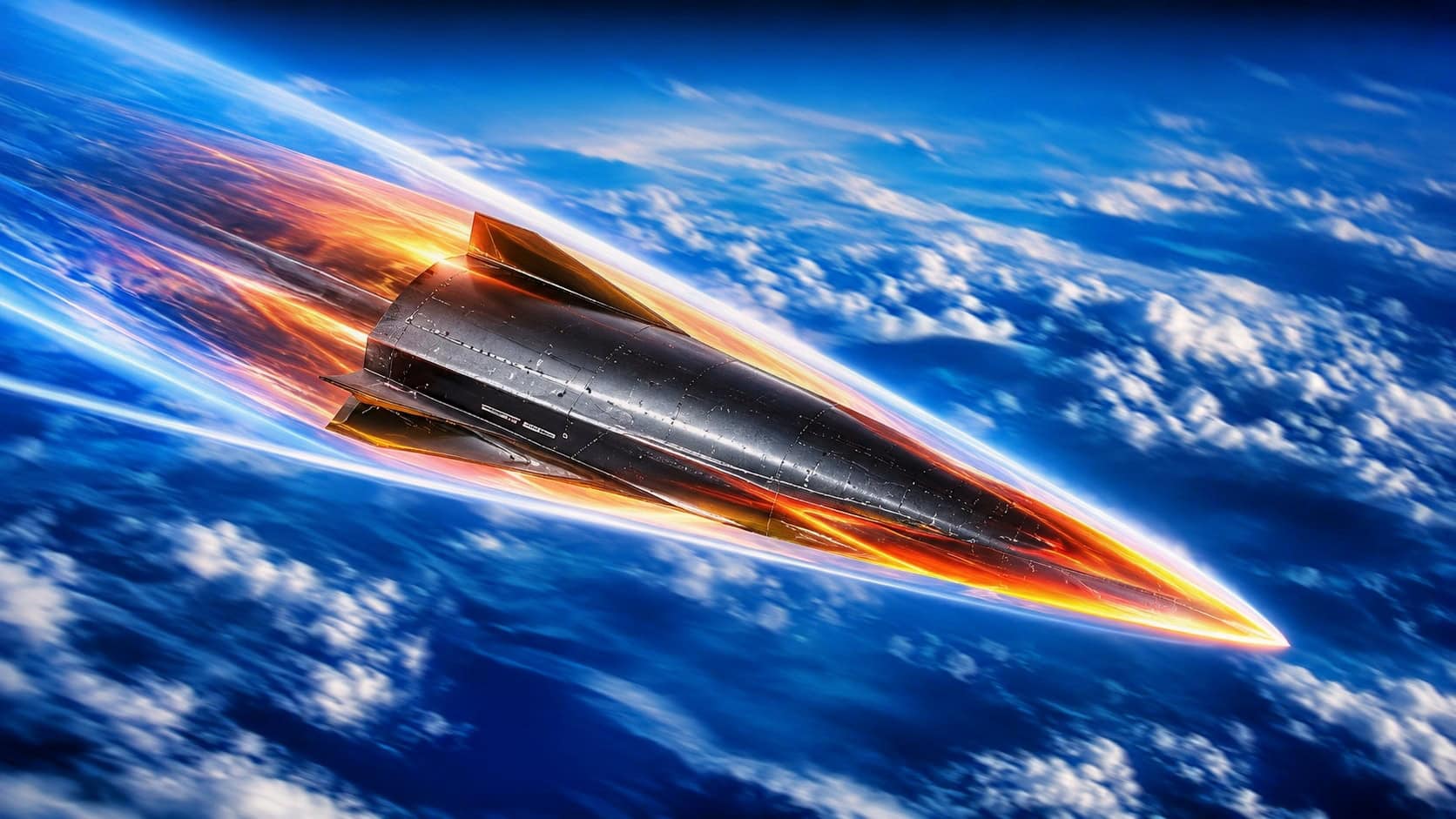
In April, the U.S. Army announced that it was pivoting away from Lockheed Martin’s Long-Range Hypersonic Weapon (LRHW) in favor of lower-cost alternatives.
How did Lockheed react to this? It unveiled a smaller hypersonic weapon, designed to be cheaper and much better suited for mass production.
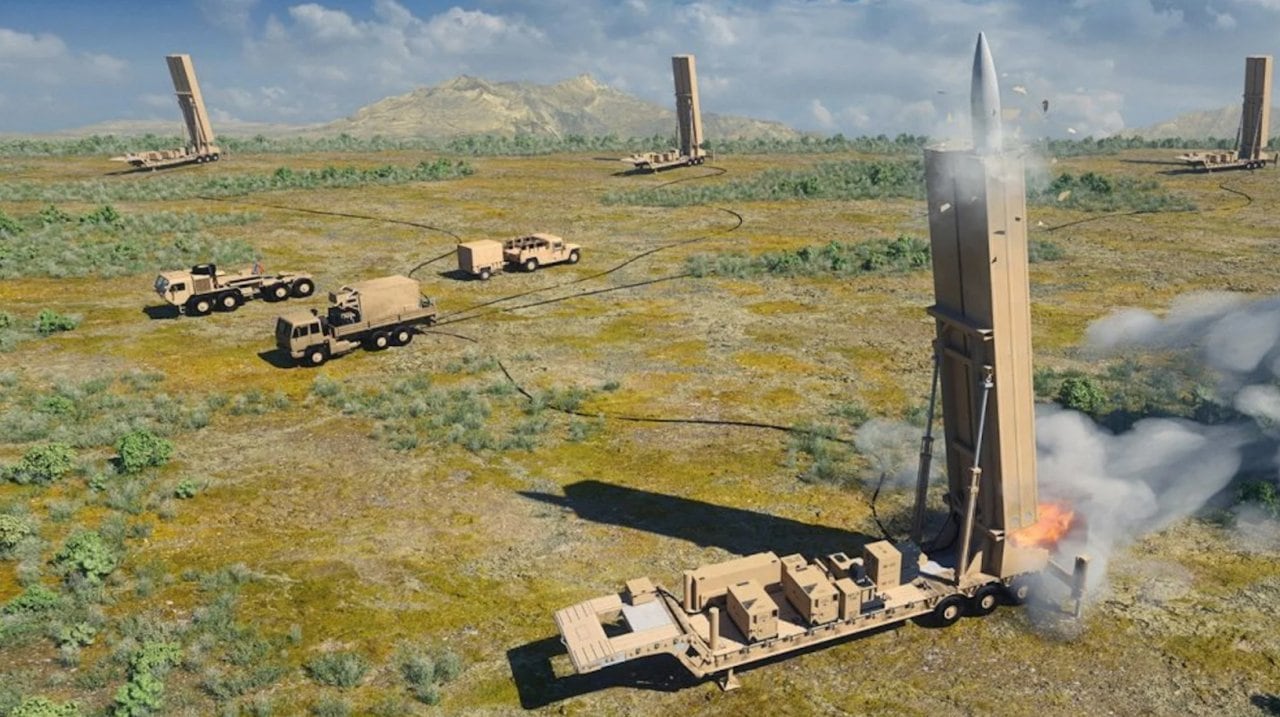
Dark Eagle. Image Credit: Lockheed Martin.
The conceptual design of the Next-Generation Glide Body (NXGB) was revealed on June 24, just a few days ago.
Set to enter testing in 2027, NXGB is envisioned to bolster the United States’ slowly growing arsenal of hypersonic weaponry as an attempt to catch up to adversaries like China and Russia.
A New Hypersonic From Lockheed
The renderings released by Lockheed Martin reveal a wedge-shaped design typical of Hypersonic Glide Vehicles (HGVs).
The design is reminiscent of that of Lockheed’s Common Hypersonic Glide Body (CHGB), which is used on the LRHW. “We designed this capability from the outset to provide greater value to our customers while delivering an operational advantage to the warfighter,” said Johnathon Caldwell, Lockheed’s general manager of Strategic and Missile Defense Systems.
The company also added that NXGB was designed to address the Army’s evolving requirements by combining performance with production scalability.
The program seeks to expand the U.S.’s hypersonic arsenal while also ensuring that they can be manufactured in large numbers without breaking the bank.
Hypersonic glide bodies operate differently from traditional ballistic missiles.
Instead of following a fixed trajectory, they are launched on a rocket booster, after which the glide body separates and travels through the upper atmosphere at speeds exceeding Mach 5 while maneuvering toward its target.
This maneuverability complicates interception efforts because it prevents most existing systems from predicting the missile’s path. The United States has already fielded earlier designs, such as the CHGB, used in the Army’s LRHW and the Navy’s Conventional Prompt Strike (CPS) program.
While effective in demonstrating the viability of hypersonic glide technology, those earlier systems faced challenges related to cost and limited production output, which constrained their broader deployment.
Learning From the Dark Eagle Experience
The LRHW “Dark Eagle” has been stuck in a sort of development hell. From 2017 to 2024, the missile underwent a series of tests, which were reportedly quite successful.
The initial plan was to have the missile operational by 2024; however, the program continued to experience delays. The most recent flight test took place in March 2026, with the first operational deployment set for “soon,” according to the Army.
During Operation Epic Fury, some reports indicated that the Army considered deploying the LRHW near Iran for operational testing under actual combat conditions, but as of this writing, it appears these plans were never followed through on.
Indeed, now it seems that the Dark Eagle has fallen out of favor with the Army. The reason is the missile’s staggeringly high cost.
With a fly-away cost at around $35-40 million per missile, the LRHW is an expensive piece of hardware that is extremely difficult to produce in large numbers.
Its high cost means production is limited to no more than 24 missiles annually, which may sound like a lot for an advanced missile, but compared to the materiel output of China or Russia, this number is nowhere near sufficient for a high-intensity conflict that the U.S. expects.
Consequently, in the Army’s fiscal year 2027 budget, funding for the LRHW program was silently axed, with the current plan to procure only 500 cheaper variations of the missile by 2029.
The U.S. Needs Cheaper Missiles
The problem for Lockheed is that the company now has to compete against a growing number of smaller startup companies that are making their own missiles at a fraction of the cost.
We have previously written on the small startup Castelion and its Blackbeard hypersonic missile. According to preliminary investigations, a typical missile from Castelion has a flyaway cost of around $300,000, much lower than Lockheed’s LRHW.
The Army hopes to one day establish production lines capable of producing around 500 Blackbeard missiles per month, and the Navy has also expressed interest in the missile.
For the longest time, larger contractors like Lockheed Martin and Raytheon dominated the arms market.
Now, with the DoW looking to reduce procurement spending, the government is turning to other vendors that offer similar capabilities at a considerably lower cost.
NXGB, therefore, takes a manufacturing-first approach to cut costs and compete with smaller firms. “NXGB demonstrates our commitment to delivering next-generation deterrence that is not only effective, but affordable and producible at scale,” said Caldwell.
The missile, Lockheed stated, draws on several decades of development experience and incorporates proven technologies and lessons learned from already fielded systems.
According to some reports, the program has already completed its preliminary review and meets the Army’s criteria for performance and affordability. The first flight demonstration of the NXGB is scheduled for 2027, after which the Army is expected to decide whether to proceed with the platform.
About the Author: Isaac Seitz
Isaac Seitz, a Defense Columnist, graduated from Patrick Henry College’s Strategic Intelligence and National Security program. He has also studied Russian at Middlebury Language Schools and has worked as an intelligence Analyst in the private sector.