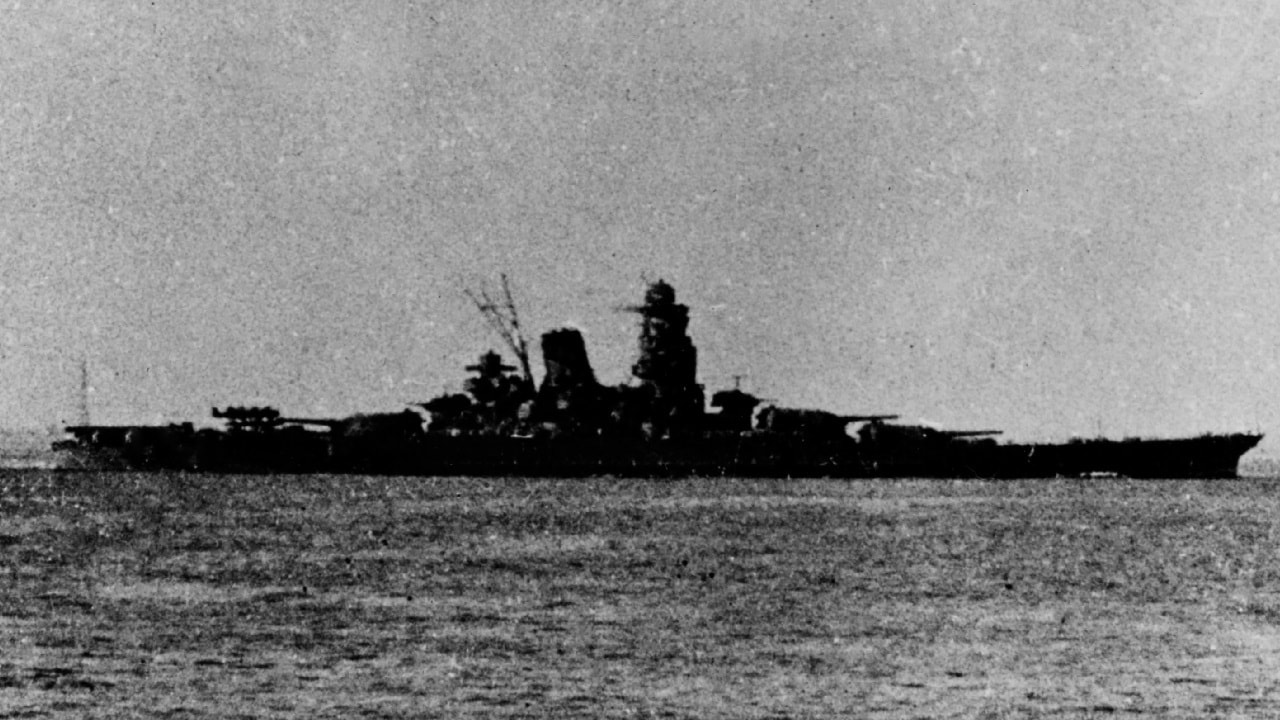
Summary and Key Points: After building the Yamato class, the largest battleships ever completed, Japan’s Imperial Navy began designing an even greater successor, the A-150 or Super Yamato, around 1938. Surviving plans, which historians note are incomplete and partly disputed, describe a ship of roughly 75,000 to 91,000 tons carrying six 20-inch guns, the largest naval guns ever designed, with armor exceeding the Yamato’s. Japan intended each such battleship to defeat several American ships at once, offsetting the industrial scale it could never match. The design was abandoned by 1941 as naval aviation, demonstrated by the British air raid on Taranto in 1940, proved that aircraft carriers, not battleships, would decide the Pacific War.
Japan’s Super Yamato Was the Biggest Battleship Ever Imagined–And It Still Wouldn’t Have Won the Pacific War
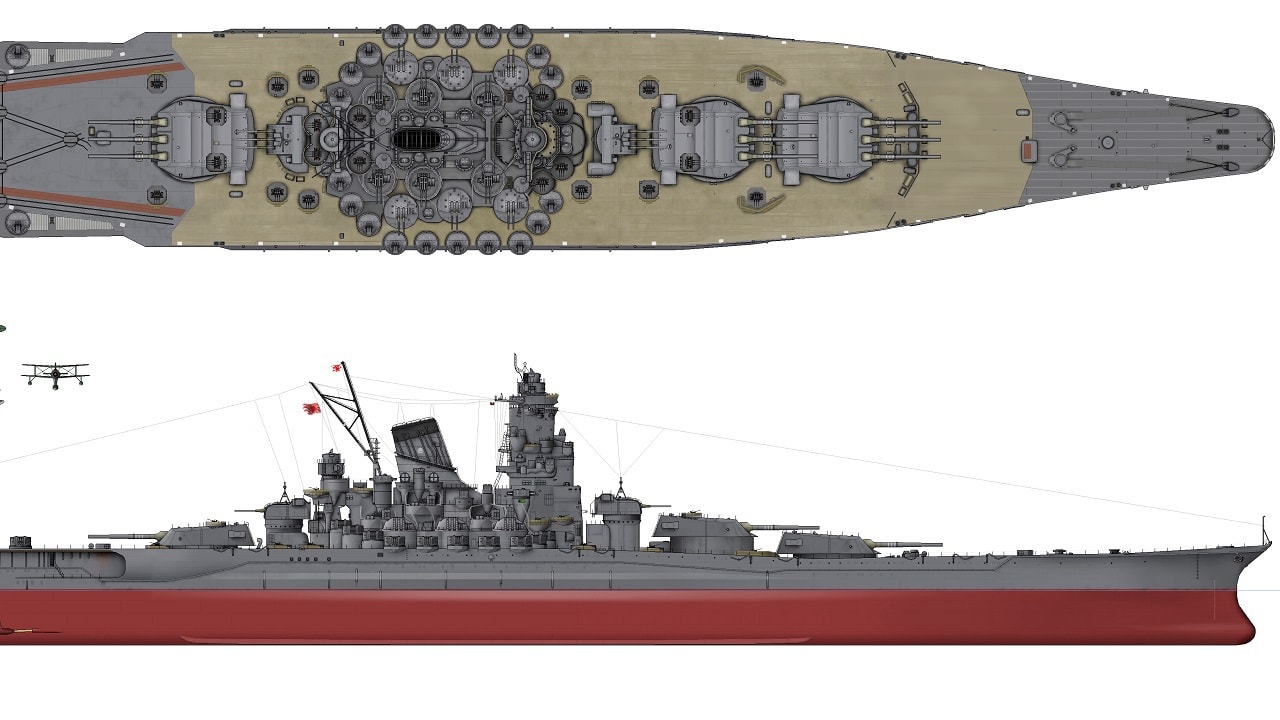
Battleship Yamato Blueprint. Image Credit: Creative Commons.
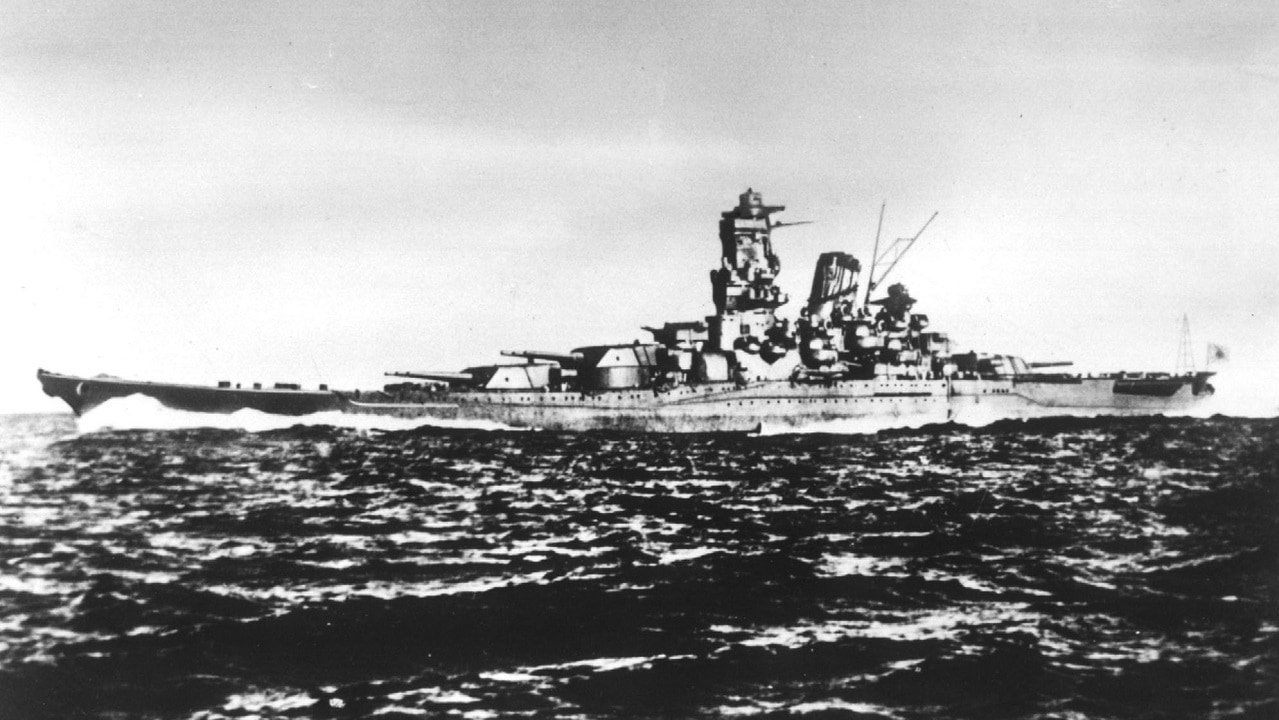
Battleship IJS Yamato from World War II.
The Imperial Japanese Navy (IJN) punched well above its weight. Having defeated the Russian fleet at the Battle of Tsushima in 1905, thereby ending the Russo-Japanese War with a decisive victory over the Russian Empire, the IJN committed itself to building a series of great battleships. These battleships weren’t just great. They were massive. The Yamato-class battleship remains a fascination of naval experts even today, 80 years after the defeat of the Empire of Japan during the Second World War.
But in the 1930s, as the Yamato-class battleship took off, Japanese engineers began asking themselves, “What comes after the Yamato-class?” Naturally, they wanted a battleship that would, like the Yamatos, surpass all other naval warships in the world. That design effort began around 1938 and was largely completed by 1941, the year that the Japanese attacked Pearl Harbor and brought the industrial juggernaut that was the United States into the Pacific War against them.
The A-150: Japan’s Vision for the Ultimate Battleship
Ultimately, because of pressing wartime demands imposed on that relatively small island nation, Tokyo had to abandon its designs for what it designated the A-150 battleship, the “Super Yamato.” Had it gone into production, though, it would have been the largest, most powerful battleship in the world.
For instance, early concepts of the A-150 have the ship coming in at around 91,000 metric tons. A-150’s designers intended for the great battleship to achieve speeds of approximately 30 knots. An A-150 battleship would have thicker armor than even the Yamato-class, which would have been quite something, considering how well-armored the Yamatos were. And the A-150 battleship would have come equipped with nine 20-inch guns.

Iowa-class Battleship Broadside. Image Credit: Creative Commons.
Indeed, those 20-inch guns would have been the largest ever mounted on a battleship. The Yamato-class battleship’s guns were already pushing 18 inches. A-150 would have increased that caliber by another two inches. That might not sound that much bigger than 18-inch guns. But, 20-inch guns could have completely upended the tactical situation at sea, shifting many advantages from the American fleet to the Japanese fleet.
Of course, because of the war, surviving documentation of the A-150’s design is incomplete. Some historians argue that the numbers discussed above are exaggerated. These experts contest the claims that the A-150 would have displaced upwards of 91,000 metric tons. Instead, they insist that the ships would have displaced at most 75,000 tons.
Built to Outfight, Not Outbuild, America
The reason Japan wanted increasingly large battleships was not only the prestige factor. It’s because Tokyo’s leadership understood that its tiny island punched well above its weight. Lacking many natural resources and possessing a relatively small population compared to many of its rivals,
Tokyo knew it could never hope to outbuild the Americans in wartime. So, Japanese naval warfare experts believed they needed to outfight the Americans. Per IJN doctrine, each Japanese battleship needed to defeat multiple United States Navy battleships in sustained combat.
By placing three twin turrets of six 20-inch guns, Japan’s naval strategists believed that they’d have a chance to overcome multiple American warships in battle. Earlier studies examined if the A-150 could have had up to nine 20-inch guns.
However, the Japanese quickly abandoned those concepts because the weight (and cost) became impractical. Modern naval historians generally believe the six-gun configuration represented the mature design.
Why Did Japan Cancel the A-150?
By 1941, Japan had increasingly come to realize that the future of naval warfare lay in naval aviation. Battleships were going the way of the old galleon. Therefore, aircraft carriers would determine the outcome of the Pacific War. That’s why the Japanese ultimately chose to strike Pearl Harbor not with their mighty battleships, but with their aircraft carriers. That’s also why it worked so well.
One of the defining moments that sealed the A-150’s fate did not involve the IJN at all. It was the Attack on Taranto in which the British Royal Navy used naval aviation to attack the Italian Navy with great success in 1940. That example of naval aviation’s potency in combat inspired the Japanese to abandon the A-150 and instead focus their finite resources on developing aircraft carriers, escort ships, submarines, and aircraft production.
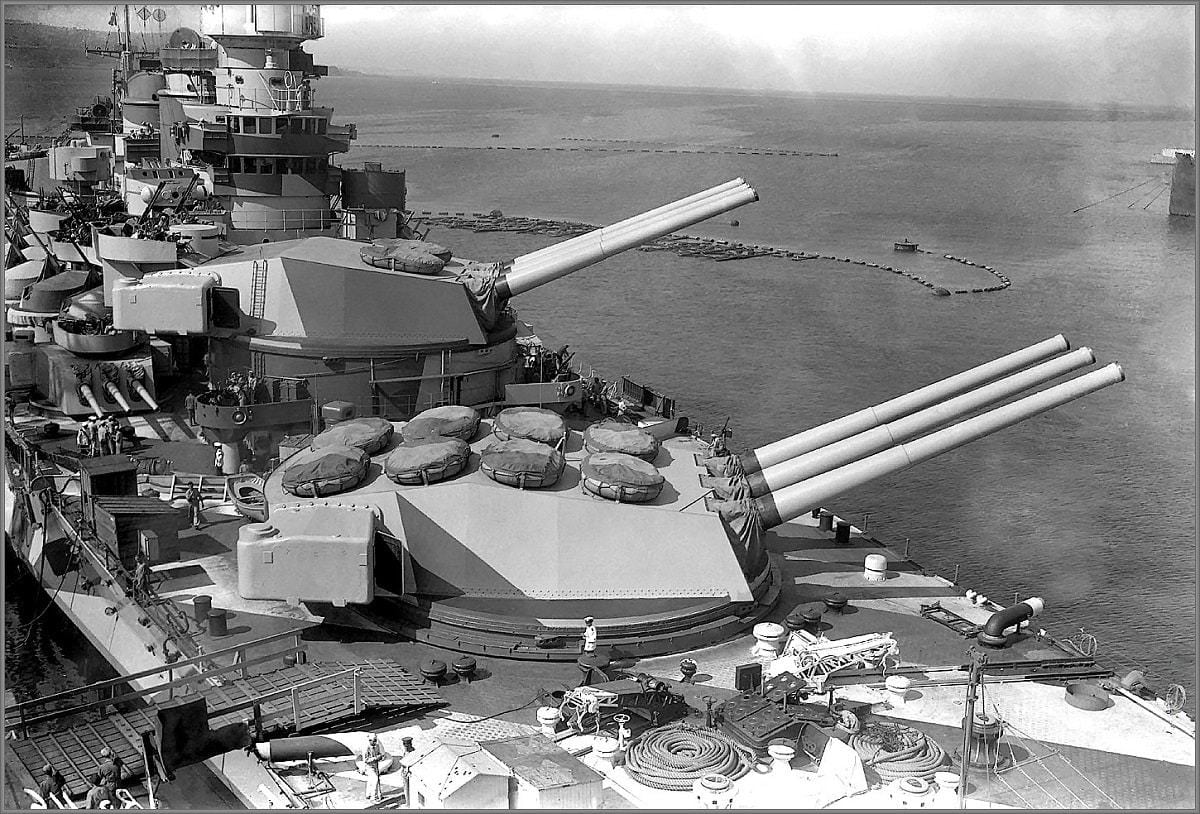
Italy Roma Battleship. Image: Creative Commons.
Industrial Limitations
What’s more, there were real industrial limitations for Japan. After all, this was a smaller country. Japan struggled to build the Yamato-class because of how significant a drain on finite resources that class of battleship had been for Tokyo.
The proposed A-150 battleship was even bigger. It needed larger shipyards than what the Yamatos required. It required more steel and a bigger armor plate. Larger gun factories were needed, too. And even more skilled workers would have been called upon to complete the task.
All while Japan was preparing for continental war and eventual conflict with the United States.
Would It Have Made a Difference?
In certain tactical engagements, as noted earlier, the A-150 might have shifted the advantage to the IJN against US forces. But the US Navy had advantages, thanks to its sheer scale and the distributed nature of its fleet. At some point, one exquisite, massive battleship is simply no match for the power of dozens of enemy ships attacking that one battleship–along with their air wings.
An A-150 would have dominated any surface gun duel. When facing battleships, the A-150 would have enjoyed superior armor protection, heavier shells with longer range, and therefore would have possessed tremendous survivability.
But, against aircraft? No way.
Just as the Russians discovered with their tanks when faced with topside drone attacks in the Ukraine War (and the Israelis today against Hezbollah are learning), not planning for attacks against your heavier platforms from above means that your heavier platforms are useless. While battleships did possess protection on their topsides, that protection was rarely as good as the rest of a battleship’s armor.
Meanwhile, during Operation Ten-Go, Yamato was sunk almost entirely by carrier aircraft before ever reaching the American fleet. The battle effectively proved that even the world’s largest battleship–the Yamato–was susceptible to sustained air attack. An even larger A-150 would have faced the same tactical quandary.
Optimizing for the Previous Generation of Warfare
Japan correctly identified America’s industrial advantages before World War II ever erupted. Its solution, though, was stuck in the past. Larger battleships could not withstand sustained air attacks from planes launched from distant aircraft carriers. They struggled, too, against American submarines. Plus, the Japanese could never match the Americans in terms of industrial might. So, there’d never be enough of these complex, expensive, irreplaceable battleships to make the kind of strategic difference Tokyo required.
The United States won the Pacific War not because of its individual battleships. But because it had a distributed, massive ecosystem of various platforms that operated in tandem. Aircraft carriers did not sail alone. They had escorts. They were protected aircraft. Submarines formed another layer of defense. And merchant ships kept all those warships well stocked while underway.
The US Navy was a modern combined-arms force in the Pacific Theater. While the Japanese were the first to realize the significance of carriers when they struck Pearl Harbor, they were still far too committed to the old way of war; they were still looking for the next big battleship.
There is, sadly, a lesson for the modern US Navy today in the IJN’s failure in WWII. Like the Japanese of yesteryear, the United States has traded away its once-dominant industrial-scale production in favor of precise manufacturing of exquisite, hard-to-replace, large platforms. That model of warfare works only if one is fighting lesser foes. If, however, a war erupts against a peer industrial power with greater industrial scale, no exquisite, finite platform can match the far greater numbers of less advanced enemy systems at sea.
In essence, the Americans are looking more like the Japanese of WWII when faced with a potential adversary, like the People’s Republic of China (PRC), which looks increasingly like the manufacturing kingpin of America 80 years ago.
About the Author: Brandon J. Weichert
Brandon J. Weichert is the Senior National Security Editor at 19FortyFive.com. He also manages The Weichert Brief on Substack. Weichert also hosts “National Security Talk” on Rumble. He is the author of four bestselling national security books, the most recent of which is A Disaster of Our Own Making: How the West Lost Ukraine (Encounter Books). Follow him via Twitter/X @WeTheBrandon.