
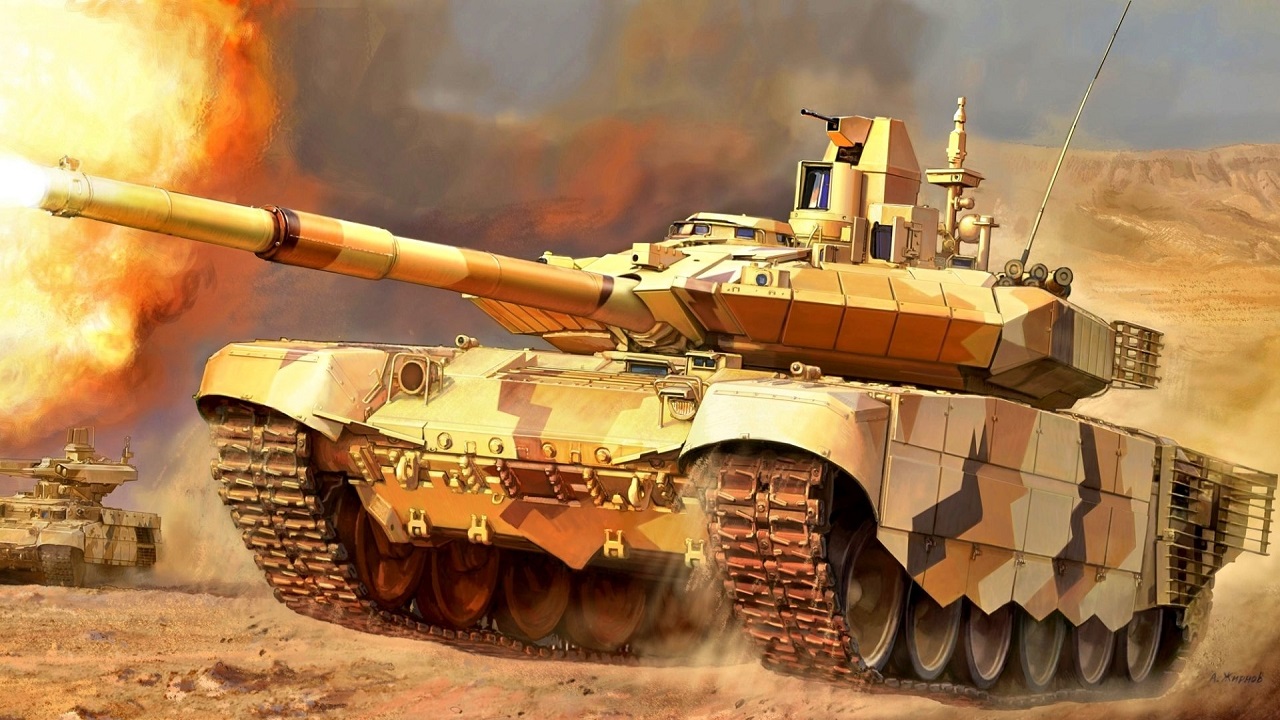
Summary and Key Points: On July 4, 2026, open-source imagery appeared to show a Russian T-90M fitted with the Arena-M active protection system outside a factory for the first time, a possible sign the hard-kill defensive suite is finally moving toward the front. Russia is presenting Arena-M as the answer to the drones that have been shredding its armor in Ukraine. But the system was designed to shoot down anti-tank missiles, not the slow, swarming first-person-view drones that now account for a large share of tank losses, and the interceptor math suggests it cannot stop them. It is a real upgrade over the chicken-wire cages welded onto Russian tanks today, and it is also being asked to solve a problem it was never built for.
Russia’s T-90M Tank Is Evolving: An Introduction
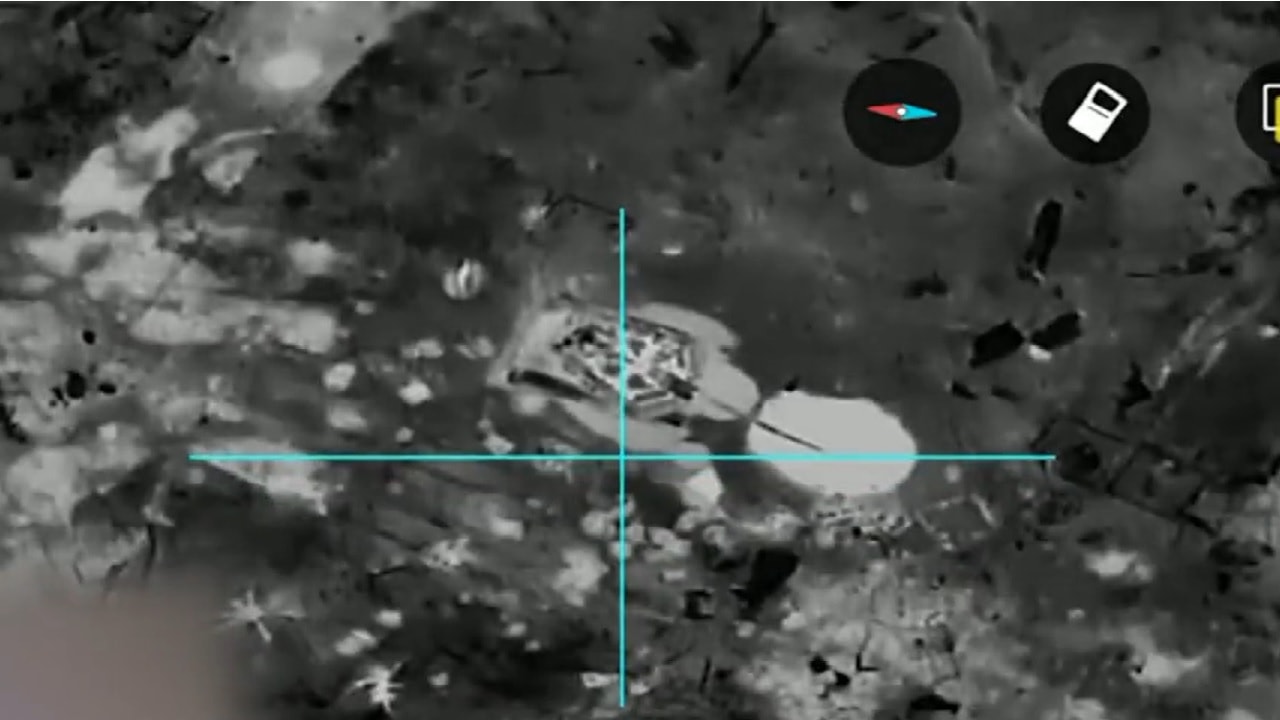
Ukraine Drone Attack on T-90M. Image Credit: Twitter Screenshot.
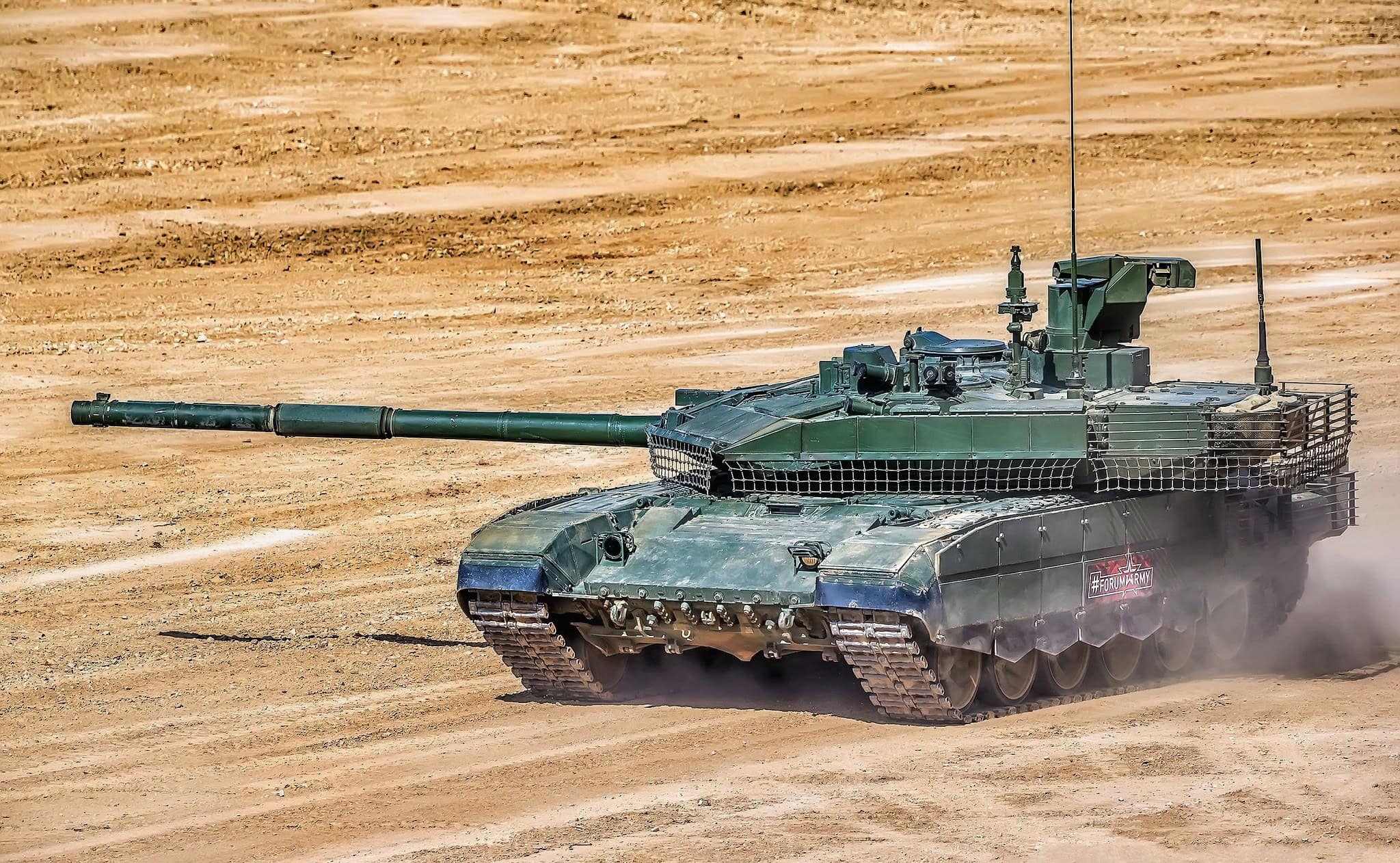
T-90M. Image Credit: Creative Commons.
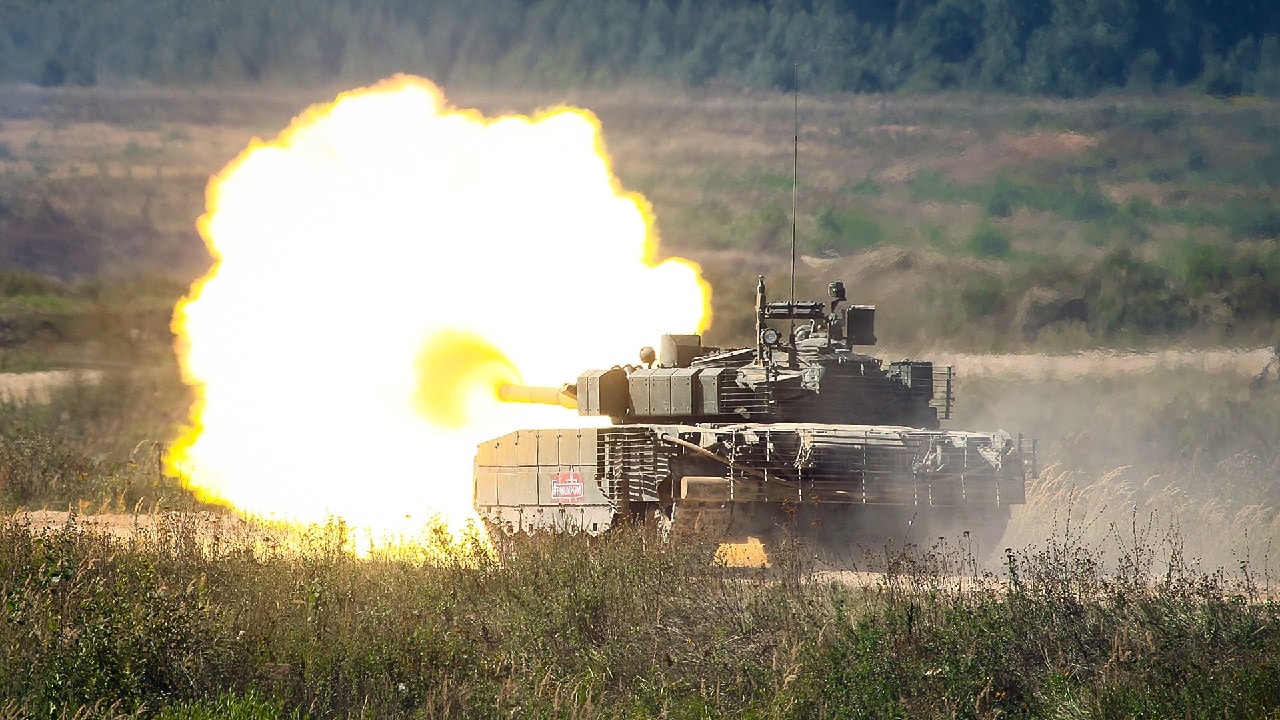
T-90M tank. Image Credit: Creative Commons.
The photograph that circulated in early July was modest on its face: a T-90M Proryv main battle tank riding on a heavy transporter, its turret carrying a configuration matching the Arena-M layout that Uralvagonzavod first displayed in February 2025. The image was not geolocated, no Russian Ministry of Defense statement confirmed a delivery to a combat unit, and armored vehicles ride transporters for many reasons.
Still, as Army Recognition reported, the appearance of an Arena-M-equipped tank outside a controlled factory setting is a stronger open-source hint that the system may be shifting from demonstration toward early distribution. Moscow is treating it as a milestone in tank survivability. The harder question, the one the announcements skip, is whether Arena-M actually defeats the weapon that is killing Russian tanks.
A System Built for the Last Threat
Arena-M is a hard-kill active protection system developed by the Kolomna-based KBM design bureau, and its lineage explains its limits. Russia has been working on the Arena concept since the 1990s, and funding shortfalls kept earlier versions mostly on the export market rather than in Russian service.
The system uses a Doppler radar to scan for incoming threats, and when it detects one, it calculates the trajectory and launches a counter-munition to destroy the projectile before impact. That design was optimized for a specific class of threat: anti-tank guided missiles and rocket-propelled grenades, weapons that travel fast along relatively predictable, flat trajectories toward the tank’s sides. Against those, a radar-cued interceptor is a proven concept.
The drone problem is a different shape entirely. To adapt, Russia updated the Arena-M software in 2025 to add what officials call an anti-drone mode, using the micro-Doppler signature of spinning propeller blades to pick out small aircraft.
A Russian Defense Ministry officer confirmed the updated software on a Russia-24 broadcast, the first on-air acknowledgment that the anti-drone capability had been implemented for newly produced tanks. But a software patch does not change the physics the hardware was built around. FPV drones are slow, highly maneuverable, and attack from steep top-down angles into the thin roof armor, and they arrive in numbers. A system engineered to swat a single fast missile from the side is being asked to track and kill a swarm of small, erratic aircraft diving from above.
The Math That Doesn’t Close
The clearest reason for skepticism is the interceptor count. Analysts who have examined Arena-M note that it carries roughly 26 interceptor rockets, with overlapping coverage but only a fraction of them facing any given direction, and two are expended per engagement. That magazine was sized for the occasional missile, not for saturation.
Russian crews in Ukraine have described a very different volume of incoming fire, reporting six to ten FPV drones launched at a single vehicle, sometimes a dozen, and in one sector as many as 30 drones targeting one tank. A defensive system with a handful of interceptors facing each direction runs empty long before that many attackers are dealt with, and a swarm can simply overwhelm it by arithmetic.
The system faces further complications that degrade its usefulness against drones. It is vulnerable to decoys and false positives, and it may be triggered by something as harmless as a passing bird, wasting interceptors it cannot spare. Crews worried about accidental activation may leave it switched off, yet drone attacks frequently come when a vehicle is not expecting them.
These are the reasons the top-down attacks that have plagued Russian armor are so hard to stop: the threat is cheap, numerous, and aimed at exactly the angle a side-facing missile-interceptor was not built to cover. The T-90M has long been billed as among the best-protected tanks in the world, and that reputation has not survived contact with cheap drones.
What the Crews Are Doing
The most revealing evidence is behavioral. During Ukraine’s incursion into Russia’s Kursk region, Ukrainian forces captured at least three undamaged T-90Ms, tanks whose crews had abandoned them rather than stay and fight.
That pattern, repeated across a war in which Russia has lost armor faster than it can replace it, suggests crews do not trust their protection enough to gamble their lives on it. Defense analyst David Hambling has argued that the real purpose of the Arena announcements may be as much psychological as technical, intended to persuade tank crews that they are not driving to certain death.
The timeline reinforces the doubt. Russia announced that Arena would be fitted to T-90Ms roughly eighteen months before the July 2026 sighting, and for most of that period, nothing materialized in the field. As Hambling put it, “promises are cheaper than high-tech armor.” The gap between repeated announcements and confirmed deployment is itself a signal, because a system that genuinely solved the drone problem would be rushed to the front and publicized at every opportunity, not glimpsed once on a transporter after a year and a half of delay. Russia’s T-90M losses have run into the hundreds even as the tank was billed as among the best-protected in the world, and the drones did most of that work. The nightmare has no obvious end, and a handful of turret-mounted rockets does not change its shape.
Not Useless, but Oversold
None of this means Arena-M is worthless, and the honest case for it deserves to be stated. A radar-cued hard-kill system is a genuine advance over the improvised defenses Russian crews have relied on: the welded roof screens mockingly called cope cages and the shed-like superstructures of the so-called turtle tanks, all of which succumb quickly to repeated FPV strikes.
Even skeptics concede Arena-M should improve a tank’s odds of survival at the margin. And the drone threat is genuinely hard for everyone, not only Russia, which is why the United States and Israel are pursuing their own active protection programs, and why even Israel’s mature Trophy system has reportedly been defeated by a drone in Gaza. Active protection is the direction the entire tank world is moving in, and Russia is not wrong to pursue it.
The problem is the mismatch between the claim and the capability. Russia is fielding a system optimized for the previous generation of anti-tank weapons and marketing it as the cure for the current one, and the interceptor math, the crew behavior, and the eighteen months of unfulfilled announcements all point the same way.
The tank that Russia bills as nearly invulnerable keeps burning, and it keeps burning because cheap drones attack faster than any finite magazine of interceptors can answer. Arena-M is a serious piece of engineering aimed at a threat that has already evolved past it, and until the arithmetic of the swarm is solved, a handful of rockets on the turret will not change the basic exchange that has defined this war, in which a drone costing a few hundred dollars destroys a tank costing several million.
MORE – The F-15EX Eagle II Is Flying with Drones
About the Author: Harry J. Kazianis
Harry J. Kazianis (@Grecianformula) was the former Senior Director of National Security Affairs at the Center for the National Interest (CFTNI), a foreign policy think tank founded by Richard Nixon based in Washington, DC. Harry has over a decade of experience in think tanks and national security publishing. His ideas have been published in the NY Times, The Washington Post, The Wall Street Journal, CNN, and many other outlets worldwide. He has held positions at CSIS, the Heritage Foundation, the University of Nottingham, and several other institutions related to national security research and studies. He is the former Executive Editor of the National Interest and the Diplomat. He holds a Master’s degree focusing on international affairs from Harvard University.