
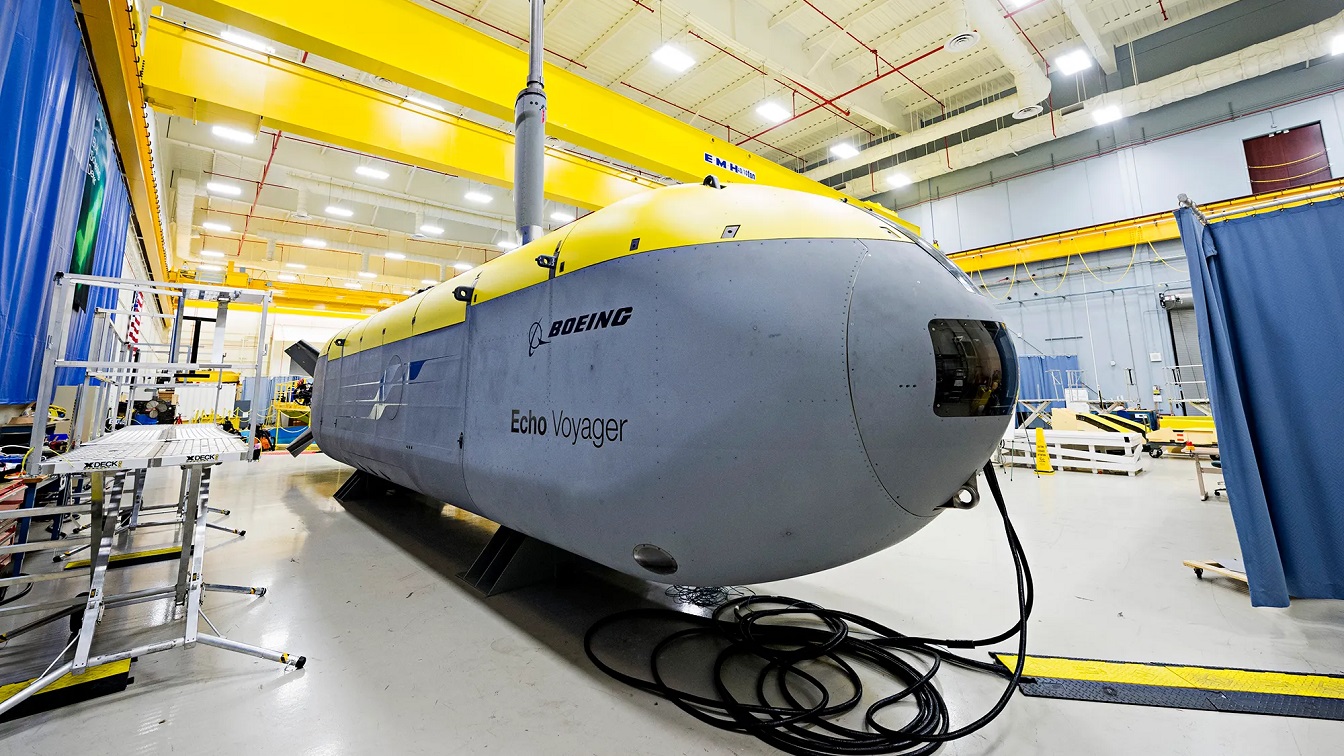
Summary and Key Points: In June 2025, the Government Accountability Office reported that the Navy could not say whether it would ever field Boeing’s Orca robot submarine because there were no clear requirements the vehicle could meet within the budget. Eleven months later, the Navy committed to sixteen of them. The Orca is an 80-ton autonomous submarine whose signature job is sliding mines onto the seabed in waters too dangerous to risk a crewed boat, a genuinely useful mission attached to a program that ran years late and hundreds of millions over budget while a defense startup built a rival, delivered it early, and started selling it back to the Pentagon. The capability is real. Whether this is how America should buy it is the question the headlines skip.
The Navy’s Mine-Laying Submarine Fiasco: An Introduction
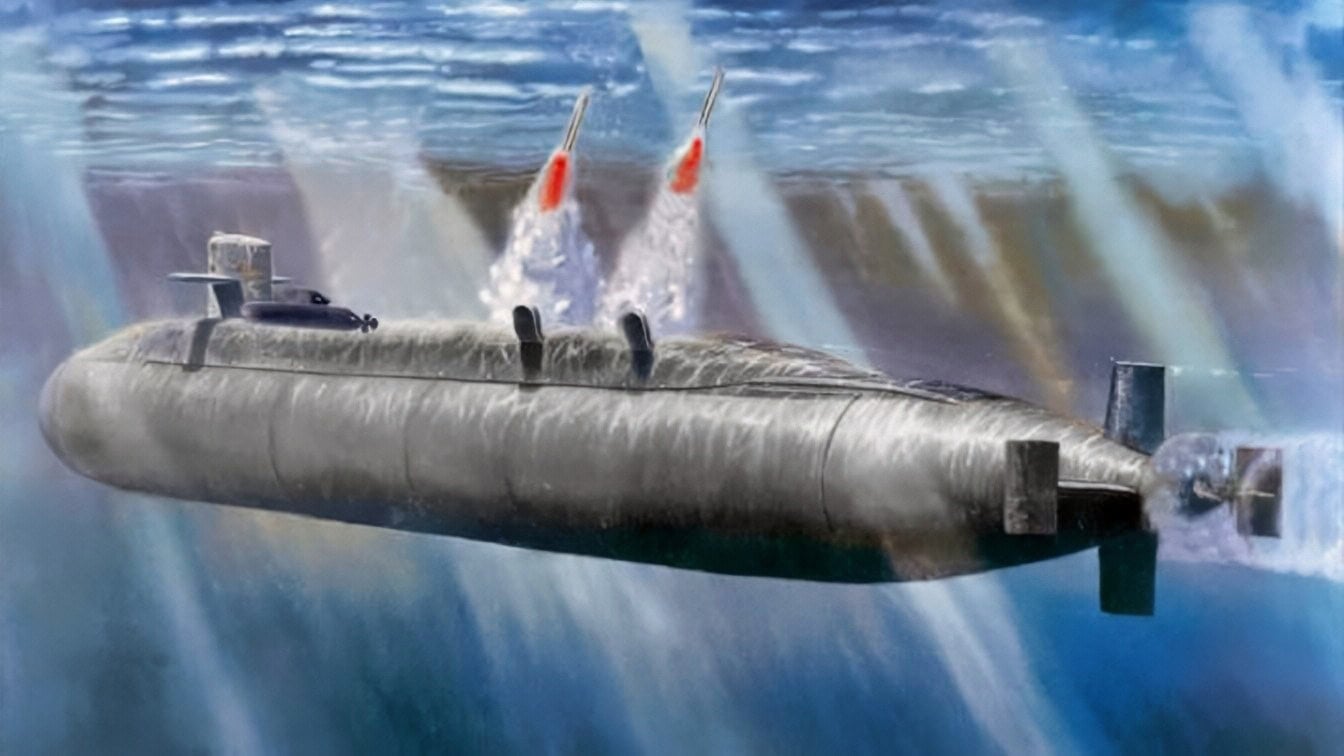
Puget Sound Naval Shipyard, Wash. (Aug. 14, 2003) — Illustration of USS Ohio (SSGN 726) which is undergoing a conversion from a Ballistic Missile Submarine (SSBN) to a Guided Missile Submarine (SSGN) designation. Ohio has been out of service since Oct. 29, 2002 for conversion to SSGN at Puget Sound Naval Shipyard. Four Ohio-class strategic missile submarines, USS Ohio (SSBN 726), USS Michigan (SSBN 727) USS Florida (SSBN 728), and USS Georgia (SSBN 729) have been selected for transformation into a new platform, designated SSGN. The SSGNs will have the capability to support and launch up to 154 Tomahawk missiles, a significant increase in capacity compared to other platforms. The 22 missile tubes also will provide the capability to carry other payloads, such as unmanned underwater vehicles (UUVs), unmanned aerial vehicles (UAVs) and Special Forces equipment. This new platform will also have the capability to carry and support more than 66 Navy SEALs (Sea, Air and Land) and insert them clandestinely into potential conflict areas. U.S. Navy illustration. (RELEASED)
The pitch for a robot mine-laying submarine is easy to understand and hard to argue with. Laying mines in a defended strait or chokepoint has always meant sending something expensive and crewed into the most dangerous water on the map: a multi-billion-dollar attack submarine, a surface ship, or an aircraft, any of which can be lost with its people. An autonomous vehicle changes the arithmetic. It can do the job in a place where losing the machine is not just survivable but preferable to risking a crew, and it can loiter for weeks doing it. That mission is exactly what the Navy says its Extra Large Unmanned Undersea Vehicle is for, and it is why the program survived long enough to reach this year’s decision. The trouble is everything that happened between the idea and the decision.
Naval Reality: What the Orca Actually Is
Boeing’s Orca is not a scaled-up torpedo; it is a small submarine with no one aboard. The base hull runs about 51 feet, stretching to roughly 85 feet with its signature 34-foot modular payload section, and the vehicle displaces around 80 tons, far too large to launch from another submarine, so it deploys from a pier under its own power. A diesel-electric hybrid plant gives it a reported range of nearly 6,500 nautical miles and endurance for missions measured in months. It navigates blind to the outside world, relying on an inertial navigation unit, Doppler velocity logs, and depth sensors rather than GPS and constant communication that a crewed boat can use to surface and collect. It is, in the Navy’s own description, a cutting-edge autonomous diesel-electric submarine with a modular bay built to swap payloads for whatever mission comes next.
The headline payload is the reason the program draws attention. The Orca’s most discussed job is to carry and place the Hammerhead, a planned seabed mine that anchors to the ocean floor and holds an encapsulated anti-submarine torpedo, the modern descendant of the Cold War-era CAPTOR mine. Put the platform and the payload together, and the strategic logic is clean: mine an adversary’s undersea approaches without putting a crewed submarine or its sailors inside the threat ring. Beyond mines, the modular bay can, in principle, carry sensor arrays, seabed surveillance packages, decoys, and smaller undersea drones, which is the open-ended promise that keeps the concept alive across budget cycles.
Defense Ledger: The Auditors’ Verdict
The concept was never the problem; the execution was. The Navy hired Boeing in 2019 to build five Orcas for a contract that grew to roughly $274 million, with the first vehicle due in December 2020 and all five expected by the end of 2022. The first one, a test asset rather than an operational boat, arrived in December 2023, about three years late, and the program’s cumulative cost has been reported by the GAO at roughly $885 million. The delays traced to the hard parts of the idea: the autonomy software and the propulsion needed to move an 80-ton vehicle for months without a crew. Captain Matt Lewis, a director in the Navy’s Unmanned Maritime Systems program, described the core difficulty plainly, noting that once a vehicle goes underwater, it must manage the air-water interface and the latency of command-and-control that comes with it, without the human judgment a crewed submarine brings to the fight.
Then came the verdict that makes this year’s decision so striking. In a June 2025 report, the GAO, citing service officials, wrote that it was “unclear whether the Navy will transition the XLUUV to a program of record because there are no clear requirements that the XLUUV can meet within current budget constraints.” That is an auditor’s way of saying the Navy had a very expensive submarine and no affordable job the submarine was sure it could do. Eleven months later, the Navy did it anyway: the May 2026 shipbuilding plan moved Orca from prototype to a program of record, funding two vehicles in fiscal 2027 and sixteen through fiscal 2031, with $135.8 million requested next year and about $1.13 billion across the future-years defense plan. The requirements question the GAO raised was not so much answered as overtaken.
The Race: A Startup Lapped the Prime
What turns this from a routine procurement stumble into a genuine strategic question is who was building the alternative. In 2022, the defense-technology company Anduril and the Australian government began co-funding a rival extra-large undersea drone called Ghost Shark, with each side reportedly contributing around $50 million. Anduril delivered the first prototype in April 2024, 12 months ahead of schedule, and Australia’s defense industry minister said all three prototypes came in on budget and early. In September 2025, Australia committed to a fleet with a A$1.7 billion program of record; seven weeks later, Anduril opened a Sydney factory, and the first production vehicle rolled off the line ahead of schedule in October with delivery to the Royal Australian Navy set for January 2026. Concept to production in under four years, with roughly $100 million in development funding.
Anduril has not been shy about the contrast, and it has standing to draw it. The company’s leadership said the American XLUUV effort “has been struggling for the better part of a decade,” had spent far more, and remained further behind. The twist that should worry Boeing most is what came next: Anduril built a factory in Quonset Point, Rhode Island, has been testing US-specific payloads, and is pitching Ghost Shark directly to the US Navy, with one vehicle already ordered for American use. The ally’s drone is now a candidate to compete with Orca on Orca’s home turf, which is a pointed verdict on the prime-contractor model that produced the Orca in the first place.
The Counterpoints: The Ambition Was Real
Fairness requires the other side of the ledger, and it is substantial. Orca aimed higher than Ghost Shark on the specifications that matter most for the mine mission: its 34-foot payload section swallows eight-plus tons of cargo, a far larger magazine than its rival carries, and the Navy sized it for the range and endurance a Pacific fight demands. Some of “late and lapped” is the price of a more ambitious target, not simple failure, and comparing a heavier, longer-legged vehicle to a lighter one flatters the lighter one. The distributed-undersea logic driving the whole enterprise is sound regardless of which hull wins: spreading risk onto machines you can afford to lose, and keeping crewed submarines for the missions that truly need human judgment, is where every serious navy is heading, with Australia, Britain, and the United States all investing through the AUKUS partnership. And the Navy’s commitment this year can be read charitably, as the service is finally deciding the capability is worth having even before the paperwork on requirements is clean.
All of that is true, and none of it dissolves the question the GAO put on the table. A program can be strategically necessary and still be a cautionary tale about how America buys hardware, and Orca is shaping up to be both. The mission, mining contested waters without risking a crew, is one the US Navy genuinely needs as it prepares for a possible fight in the Pacific. The uncomfortable lesson sitting next to it is that a startup and a mid-sized ally took the same idea from concept to the water in the time it took the traditional system to deliver a single test vehicle and an auditor’s warning. The Navy just bet a billion dollars that Boeing can close that gap. Somewhere off the coast of California, the company that already closed it is testing payloads for the same customer.
MORE – Why So Few Nations Can Make Stealth Fighters
About the Author: Harry J. Kazianis
Harry J. Kazianis (@Grecianformula) was the former Senior Director of National Security Affairs at the Center for the National Interest (CFTNI), a foreign policy think tank founded by Richard Nixon based in Washington, DC. Harry has over a decade of experience in think tanks and national security publishing. His ideas have been published in the NY Times, The Washington Post, The Wall Street Journal, CNN, and many other outlets worldwide. He has held positions at CSIS, the Heritage Foundation, the University of Nottingham, and several other institutions related to national security research and studies. He is the former Executive Editor of the National Interest and the Diplomat. He holds a Master’s degree focusing on international affairs from Harvard University.

