
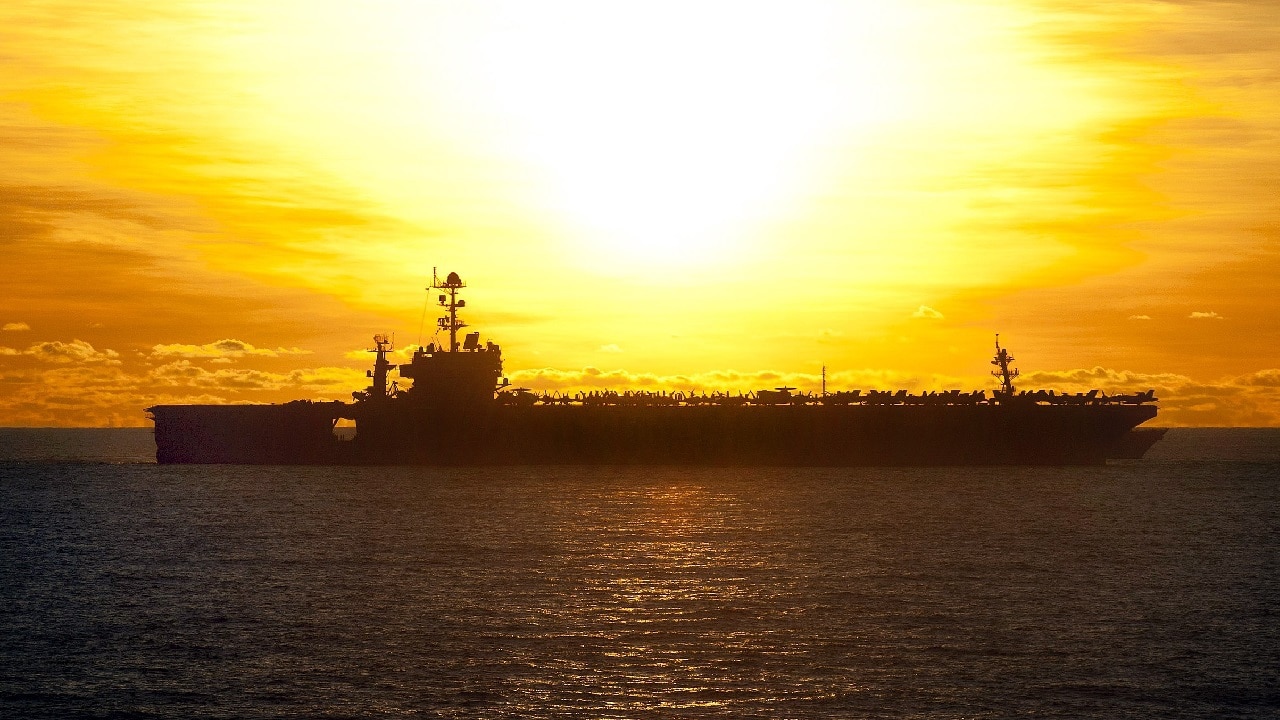
Summary and Key Points: China’s People’s Liberation Army Navy now operates more than 90 modern destroyers and frigates, a force that has grown faster than any other navy on earth and that analysts increasingly see as the real story behind the country’s three aircraft carriers. The destroyer force alone has climbed from 20 ships in 2003 to roughly 50 today, with seven or eight Type 052D destroyers entering service in 2025, more in one year than the Royal Navy operates in total. Above them sit ten Type 055 cruisers, and below them, a new Type 054B frigate class is entering production. Recent deployments around Australia and into the Pacific show the tiers operating together as a system.
China’s Navy Is Far More Than Just New Aircraft Carriers
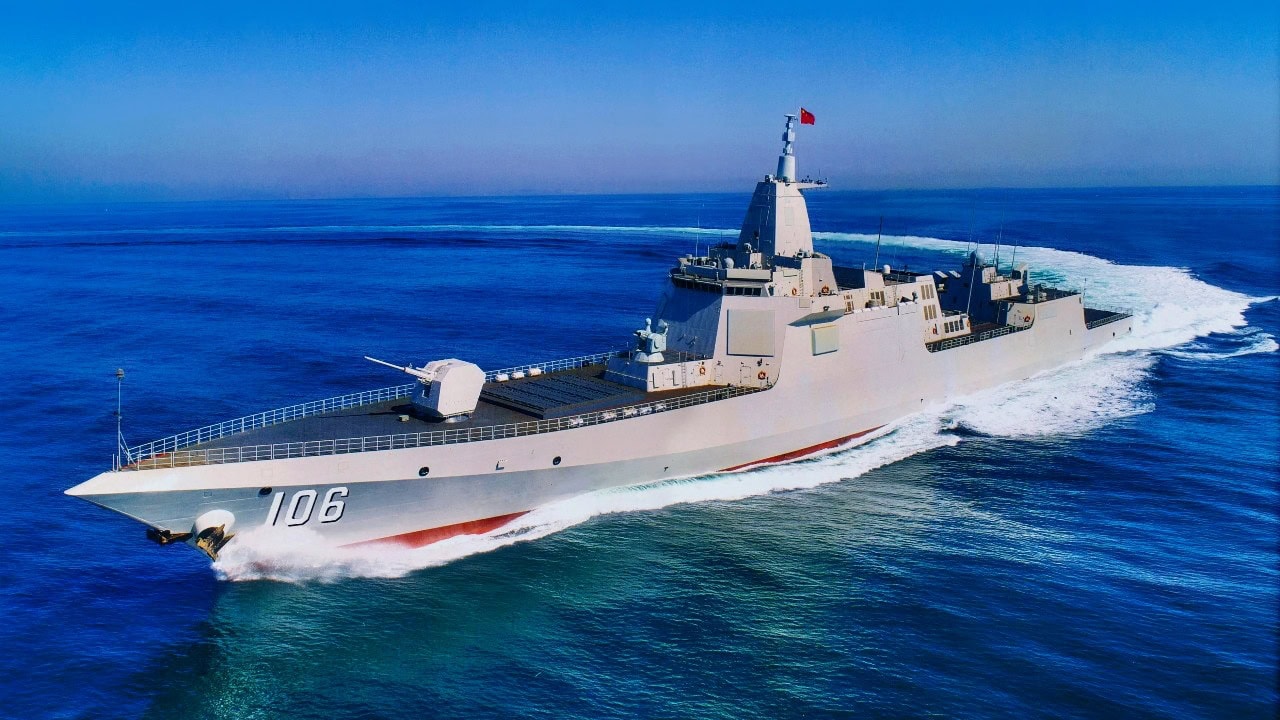
Type 055 Destroyer from China. Chinese Navy Handout/State Media.
Early last year, a Chinese naval task group circumnavigated Australia, held two live-fire drills in the waters between Australia and New Zealand, and forced dozens of airliners to divert in mid-flight.
The most revealing thing about the deployment was what it did not include: an aircraft carrier. A cruiser, a frigate, and a replenishment oiler projected Chinese power 5,000 miles from home on their own, because the transformation of China’s navy was never really about its three flattops but about the escort fleet built behind them, now more than 90 modern destroyers and frigates and growing at a pace no other navy approaches. The carriers are the misdirection.
When Australians looked out from the Sydney area in February of last year and found the People’s Liberation Army Navy conducting gunnery drills off their coast, the group responsible was designated Task Force 107, after the hull number of the ship leading it: the Type 055 cruiser Zunyi. Alongside it sailed a single frigate and a fleet oiler. Australian and New Zealand ships and aircraft shadowed the formation for weeks as it worked its way entirely around the continent, and civil aviation authorities rerouted commercial traffic around live-fire zones that were announced with almost no notice.
No carrier ever appeared, and none was needed. Three ships built in the past decade delivered the message by themselves, which is precisely the point the hull-counting debate keeps missing. The world audits China’s naval rise by its aircraft carriers, which draw every comparison to the U.S. Navy’s, while the force that actually changed the balance was built underneath the headlines, one destroyer at a time.
Naval Ledger: The Fleet Behind the Flattops
The aggregate numbers are familiar: the Pentagon’s December 2025 China Military Power Report counts a battle force of well over 370 ships, the world’s largest navy by hull count. What the topline hides is where the growth is concentrated. CSIS’s China Power project tracks the destroyer force at 20 ships in 2003, 42 in 2023, and 50 by early this year, meaning China added as many modern destroyers in the past three years as some NATO navies operate in total.
Beneath the destroyers sit roughly 40 Type 054A frigates built since 2008, with a new frigate class now entering production behind them. Add it up, and China operates more than 90 modern destroyers and frigates, nearly all commissioned in the past two decades, nearly all armed with vertical launch cells, and nearly all younger than the average ship in the U.S. surface fleet.
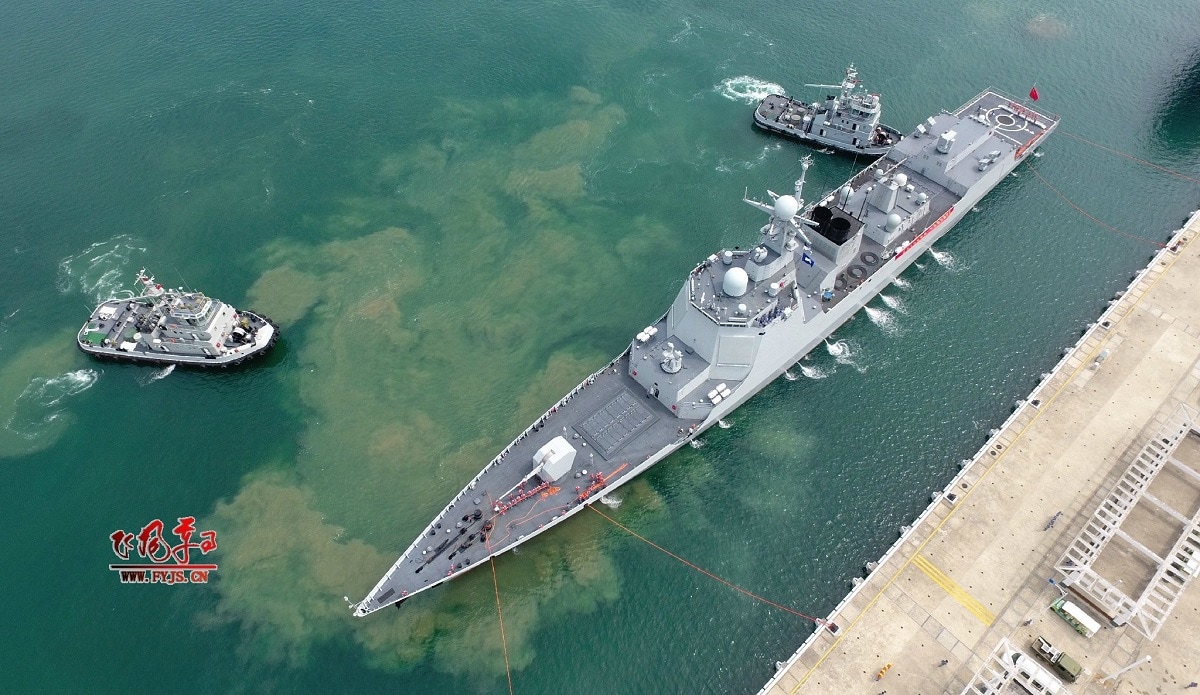
Chinese Navy. Image: Chinese Internet.
The qualitative judgment matters more than the arithmetic, and it comes from an unlikely source of praise. The Defense Intelligence Agency’s assessment, carried in the Congressional Research Service’s standing report on Chinese naval modernization, is that derivative designs are gone, replaced by modern multimission destroyer, frigate, and corvette classes whose sophistication now matches Western standards and, in the agency’s words, is “in some cases exceeding that of other modern navies.” That is the Pentagon’s own intelligence arm crediting Chinese surface combatants with matching or beating their Western counterparts on design. The interesting question is no longer whether the ships are real but what China is assembling them into.
The System: Command Ship, Workhorse, and Screen
Seen from above, the escort fleet resolves into a deliberate three-tier architecture. At the top sits the Type 055, the 13,000-ton, 112-cell warship that Washington classifies as a cruiser and Beijing insists is a destroyer, a naming dispute that says as much about the naval balance as any specification. Ten are now in service: the original eight commissioned between 2020 and 2023, plus the first two ships of an upgraded second batch, Dongguan and Anqing, confirmed in service in March and spreading the class across all three of the navy’s theater commands for the first time.
Four more second-batch hulls were launched between 2023 and last October, reportedly carrying improved power generation and combat systems. The Type 055’s job in the architecture is command: area air defense, battle management, and a 112-cell magazine bigger than any U.S. destroyer’s.
The middle tier is the workhorse. The Type 052D destroyer, a roughly 7,500-ton ship with 64 cells, has been in continuous production for 14 years, and the total is now approaching 40 hulls, with 7 or 8 entering service in 2025 alone. That is more new destroyers commissioned in one year than the Royal Navy operates in total. The bottom tier is the newest and, for the moment, the least noticed.
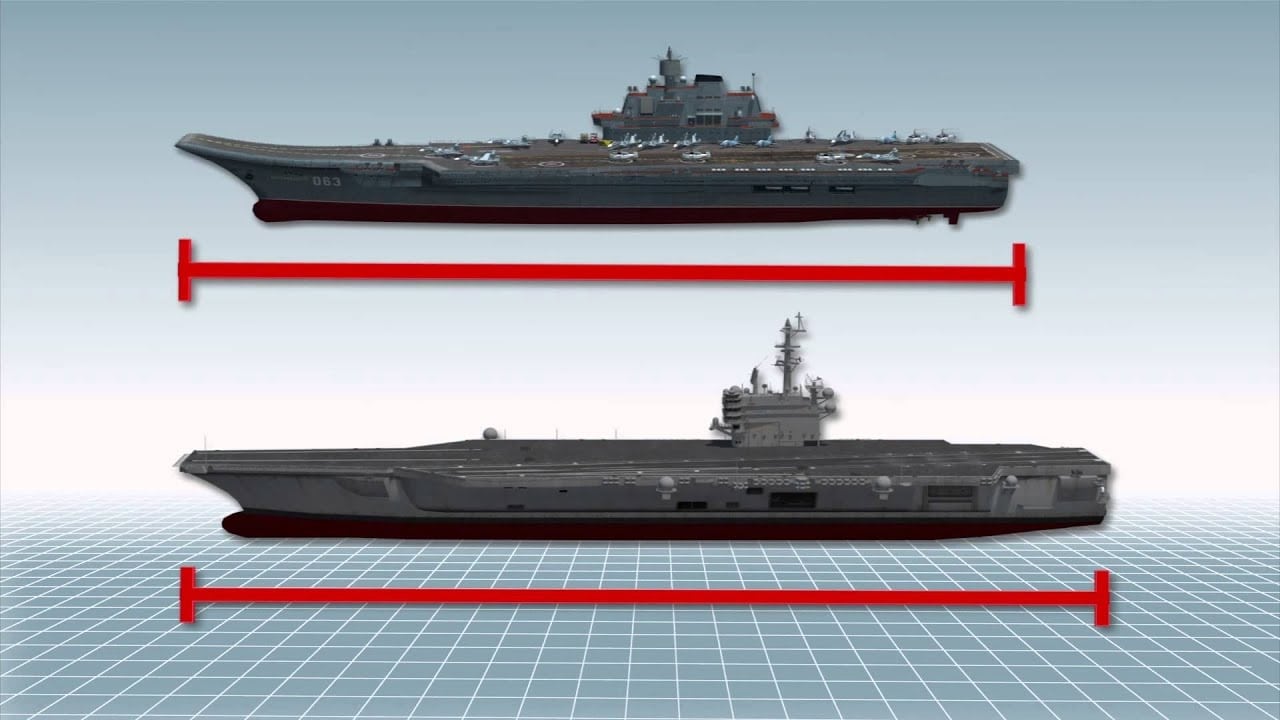
Comparison of U.S. and Chinese Aircraft Carrier sizes. Image Credit: Screenshot.
The Type 054B frigate, a stealth-shaped 6,000-ton escort with a fixed active electronically scanned array radar in an enclosed mast and a heavy anti-submarine emphasis, commissioned its lead ship Luohe in January 2025 with a sister following within weeks, and satellite imagery this spring showed the third and fourth hulls at an advanced stage of assembly, the mark of a class moving from prototype to production run. Command ship, workhorse, screen: it is the same layered logic American carrier groups have used for decades, being manufactured at Chinese speed.
Far Seas: The Template Comes Together
The proof that this is a system rather than a collection arrived over the past fourteen months, in three deployments of escalating clarity. The first was the Tasman circumnavigation, a cruiser-led group operating for weeks at the far end of the Pacific with organic replenishment and no land-based cover. The second came on May 25 and 26, when Japan’s military tracked a five-ship formation around the carrier Liaoning some 880 kilometers southwest of Okinotorishima, and the escort roster told the story: a Type 055 in the air-defense and command slot, the brand-new frigate Luohe making the class’s first carrier-group deployment in the anti-submarine screen, and a 45,000-ton Type 901 fast combat support ship along to keep the group at sea, sixteen months after Luohe commissioned.
That is a strike-group template, assembled from ships that in several cases did not exist five years ago, crewed on integration timelines that ought to worry force planners more than any single hull. The third was smaller and quieter: on June 30, the newly commissioned Dongguan made its first Pacific transit through the Miyako Strait, with a Japanese frigate and patrol aircraft scrambling to shadow it, under four months from commissioning to blue water.
Set those alongside the escort task forces China has rotated through the Gulf of Aden continuously since 2008, and the pattern is not a navy experimenting with distant operations but one that has made them routine.
The Missile Layer: A Destroyer That Fires Ballistic Missiles at Ships
The armament curve is climbing as fast as the hull count. In December, Chinese state media released the first live footage of a YJ-20 anti-ship ballistic missile launching from the Type 055 Wuxi, in what the accompanying release called a “type certification test,” per Naval News’s annual fleet review.
Whatever the missile’s real performance, the category itself is the headline: a surface combatant firing ballistic missiles at ships is a capability no Western navy fields, and it rides in the same 112-cell magazine that already mixes long-range surface-to-air missiles, land-attack weapons, and supersonic anti-ship cruise missiles. The magazine math compounds the hull math. Every Type 055 that commissions adds more launch cells than an entire Type 054B carries, and China is adding both at once.
The Counterpoints: What the Hull Count Hides
The honest ledger runs long, and it starts with experience. This fleet has never fought: China has not waged a major naval action since a 1988 skirmish over reefs in the South China Sea, and the Aegis system, with its combat suites, carries four decades of integration and live combat that the Chinese networks cannot claim. Anti-submarine warfare remains the historic soft spot, which is exactly what the Type 054B exists to fix and has not yet proven.
The new frigate’s own magazine is a genuine limitation, with its 32 cells reported to carry medium-range air-defense and anti-submarine weapons but not the fleet’s premier anti-ship missiles. Sustained distant operations still rest on a handful of large fast combat support ships. The officer corps has been repeatedly shaken by corruption purges that have reached flag ranks and navy portfolios. Allied arithmetic cuts against the raw count too, since Japan’s and South Korea’s substantial modern fleets sit on the other side of the ledger, as CSIS has noted, and the shipbuilding-capacity gap that produced this fleet says nothing about how well the ships would fight. And every navy’s hull count obeys deployment math: 370 ships on the register is not 370 ships at sea.
All of it is true, and most of it describes 2026 rather than 2031. Experience is the one deficiency that accumulates automatically, and the deployments above show the accumulation happening on purpose: every Miyako transit, every Aden rotation, every circumnavigation is reps, performed on ships young enough to carry the learning for thirty years. The gaps are real. The trajectory is the story.
Which returns to the Australian task group. The Type 055 explainers tend to treat China’s big escorts as impressive individual machines, and they are. But Zunyi off Sydney, Luohe screening the Liaoning, and Dongguan running the Miyako Strait four months out of the yard are not machines being admired but a system being exercised, tier by tier, farther from home each season. China’s carriers will keep collecting the headlines, and the comparison pieces will keep counting flattops three against eleven. The ships that rewrote the Pacific balance are the ninety-odd behind them, and they did it while everyone was watching something else.
More – China’s Navy Could Come Under Attack from B-2 Stealth Bombers
About the Author: Harry J. Kazianis
Harry J. Kazianis (@Grecianformula) was the former Senior Director of National Security Affairs at the Center for the National Interest (CFTNI), a foreign policy think tank founded by Richard Nixon based in Washington, DC. Harry has over a decade of experience in think tanks and national security publishing. His ideas have been published in the NY Times, The Washington Post, The Wall Street Journal, CNN, and many other outlets worldwide. He has held positions at CSIS, the Heritage Foundation, the University of Nottingham, and several other institutions related to national security research and studies. He is the former Executive Editor of the National Interest and the Diplomat. He holds a Master’s degree focusing on international affairs from Harvard University.