
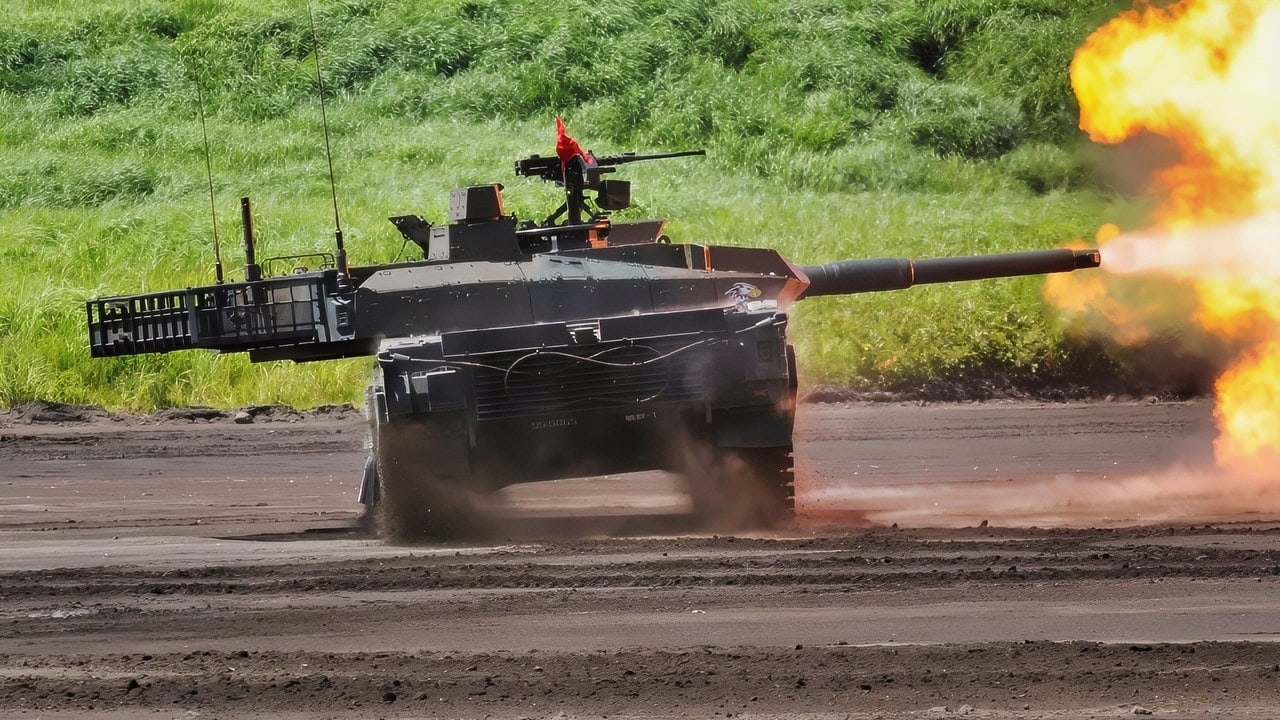
Summary and Key Points: The Type 10 main battle tank is a technological marvel: a lightweight, network-linked, actively suspended machine with an autoloaded 120mm gun, built by Mitsubishi Heavy Industries for one of the most demanding defense establishments on earth. It is also nearly invisible outside its home country, because for its entire service life, Japan’s postwar arms-export ban kept it from being sold or even marketed abroad. The result is one of the most underrated tanks in the world, a genuinely advanced design that most people have never heard of. Now, as Japan loosens its export rules and a first foreign buyer reportedly circles, the Type 10 is finally stepping out of the shadows. Here is the definitive look at what makes it special and why it stayed hidden for so long.
Japan Type 10 Tank: An Introduction
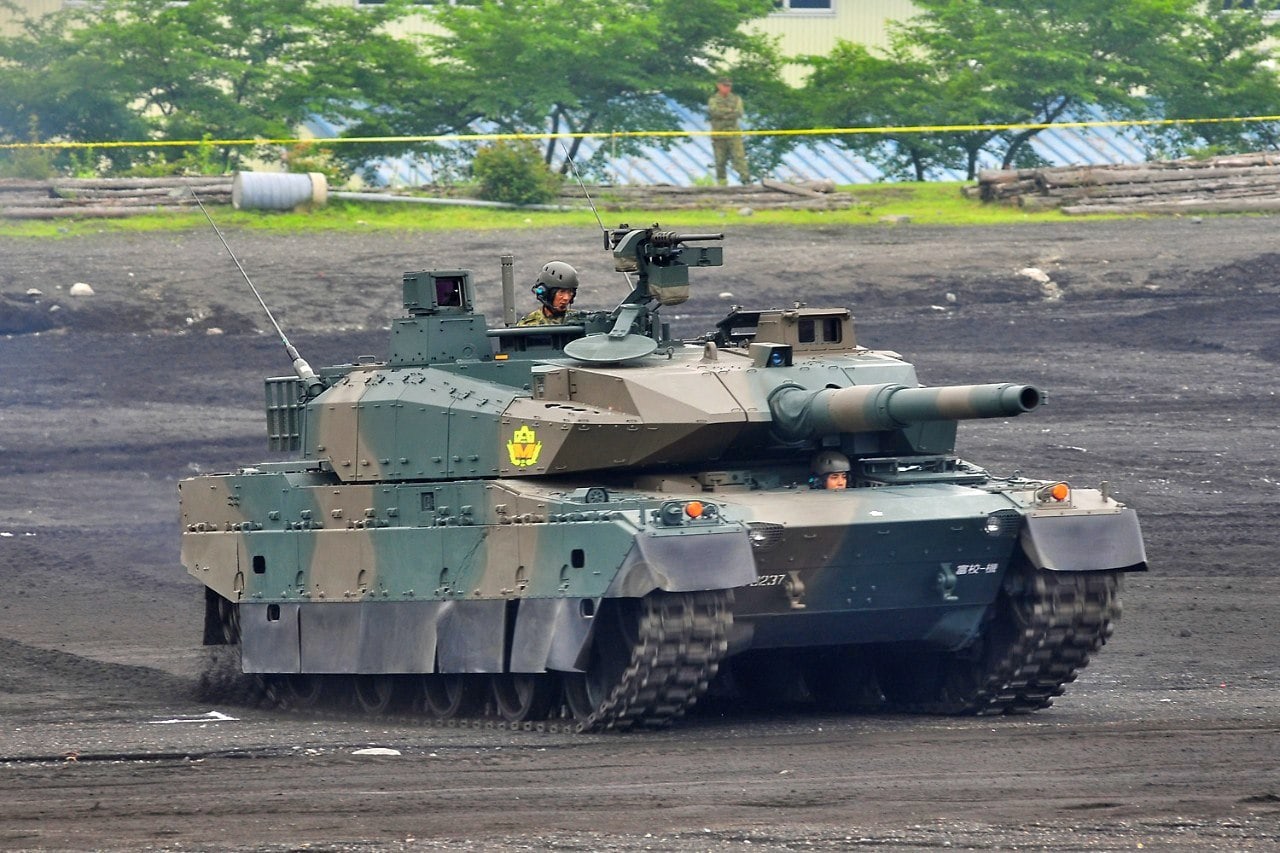
Japan Type 10 Tank. Image Credit: Creative Commons.
Ask a casual observer to name the world’s best tanks, and the answers come quickly: the American Abrams, the German Leopard, maybe the Korean K2 or the Israeli Merkava. Almost no one names the Type 10, and that says more about Japanese defense policy than about the tank itself. By the measures that define a modern main battle tank, mobility, networking, firepower, and adaptability, the Type 10 belongs in the conversation with any of them. It has simply never been allowed to compete for the world’s attention.
Developed under the TK-X project beginning in the 1990s and entering service in 2012, it represents a distinctly Japanese answer to the question of what a tank should be, and that answer is worth understanding.
A Tank Built Around Japan’s Bridges
The most important fact about the Type 10 is also the least glamorous: it was designed around Japanese infrastructure. Japan is a mountainous archipelago laced with narrow roads and older bridges, and its previous top tank, the 50-ton Type 90, was so heavy that it was effectively confined to the northern island of Hokkaido, unable to cross much of the country’s bridge network. That was an unacceptable limitation for a nation that needs to move armor to wherever a threat appears, from the northern islands to the southwestern approaches near Taiwan.
So Mitsubishi engineers made weight a founding requirement. The Type 10 comes in at roughly 44 tons in transport configuration and about 48 tons combat-ready, several tons lighter than the Type 90 and far lighter than the 60- to 70-ton Western heavyweights. The payoff is strategic reach: according to Japanese defense assessments, around 84 percent of the country’s bridges can support a Type 10, compared with roughly 65 percent for the Type 90 and only about 40 percent for typical NATO main battle tanks. Where the West pursued ever-heavier armor, Japan built a tank it could actually deploy nationwide, a philosophy of right-sizing rather than maximizing that runs counter to prevailing armored doctrine and looks increasingly prescient in an age when strategic mobility matters as much as frontal armor.
The Network in the Turret
If the weight is the Type 10’s founding principle, its digital nervous system is its signature achievement. The entire program was born from a specific problem: the aging Type 74 and Type 90 lacked the internal space to accommodate modern command-and-control electronics, so Japan needed a clean-sheet design built around networking from the start. The result is the 10NW C4I system, which integrates the tank into Japan’s Field Communication System and Regiment Command Control System, enabling real-time data sharing, automatic target synchronization, and platoon-level target recognition.
In plain terms, a formation of Type 10s can function as a networked team, sharing what each tank sees, distributing targets so two tanks do not engage the same threat, and coordinating fire in ways that were cutting-edge when the tank debuted and remain formidable today. Mitsubishi’s own description emphasizes a real-time data link that enables high-mobility maneuvering and accurate shooting at the same time. The tank’s fire-control suite offers full hunter-killer capability, letting the commander scan for and hand off targets to the gunner while continuing to search, with day-night thermal imaging for the whole crew. This networked, sensor-fused approach to armored warfare is exactly the direction every modern tank program has since moved in, and the Type 10 was there early.
Firepower and the Fast Gun
The Type 10’s main armament is a 120mm smoothbore gun developed domestically by Japan Steel Works, derived from the Rheinmetall design that arms the Leopard 2 and, in a different form, the Abrams. Crucially, it is fully compatible with standard NATO 120mm ammunition, so the tank can fire allied rounds as well as Japan’s own advanced Type 10 armor-piercing fin-stabilized discarding-sabot round and a domestically licensed version of the German DM33. Feeding the gun is an autoloader mounted in the rear of the turret, which cuts the crew to three: a commander, gunner, and driver, and allows the gun to fire roughly every 3.5 seconds, faster than a human loader can sustain.
It was this ammunition that figured in the tank’s darkest day. On April 21, 2026, during a live-fire exercise at the Hijudai training area in Oita Prefecture, a shell detonated prematurely inside a Type 10’s turret, killing three Ground Self-Defense Force crew members and injuring a fourth, prompting Japan to suspend live-fire drills with both the Type 10 and the Type 90, which use the same shells, while an investigation into the cause proceeds. It was a grim reminder that even the most advanced systems carry risk, and the focus on the ammunition rather than the tank’s design reflected where investigators directed their attention.
Mobility That Few Tanks Can Match
Where the Type 10 genuinely dazzles is in movement. It rides on a second-generation hydropneumatic active suspension that lets the tank raise and lower its entire hull and lean or tilt front-to-back and side-to-side, adjusting its posture to the terrain or to achieve a better firing angle, hunkering down behind cover or elevating its gun over a ridge. Paired with that is a continuously variable transmission driving a 1,200-horsepower Mitsubishi diesel, an unusual choice that gives the Type 10 a remarkable trick: it can travel at its top speed of 70 kilometers per hour in reverse just as fast as it can going forward, allowing it to dart into a firing position and retreat without turning around, a significant survival advantage in the dispersed, ambush-heavy fighting Japan’s terrain would produce.
That combination of light weight, high power-to-weight ratio, and sophisticated suspension makes the Type 10 one of the most agile main battle tanks in the world, and analysts have long compared its nimble, lightweight character to France’s fast-firing Leclerc. In the mountainous, compartmentalized landscape it was built for, few tanks would be more maneuverable.
Protection, and Its Honest Limits
Protection is where the Type 10’s design tradeoffs show most clearly. It uses modular ceramic composite armor, with removable panels that let commanders adjust the protection level to the mission, adding armor for a high-threat environment or stripping it for maximum mobility, and its top armor is designed to defeat explosively formed penetrators. But there is no free lunch in tank design, and a 44-ton tank cannot carry the sheer mass of frontal armor that a 70-ton Abrams or Leopard does. Against the most powerful anti-tank threats, the Type 10 trades some brute survivability for the mobility and deployability that Japan prioritized. It is a deliberate and defensible choice, but a choice nonetheless.
That tradeoff has grown more consequential in the drone era, where cheap loitering munitions and top-attack weapons threaten even the heaviest tanks, and it is driving the Type 10’s future. Japan’s Ministry of Defense has announced an upgrade program to improve the tank’s survivability against man-portable anti-tank weapons and unmanned aerial systems, including an active protection system, with Rafael’s Trophy and Rheinmetall’s StrikeShield reportedly under consideration, and a remotely operated 30mm gun specifically to counter drones. Because the tank was designed to be modular, these improvements can be retrofitted onto existing vehicles and built into new ones.
The Tank Japan Couldn’t Sell
All of which returns to the central mystery: if the Type 10 is this good, why has it remained a secret? The answer lies not in the tank but in Japanese law. For decades after World War II, Japan maintained a strict ban on arms exports rooted in its pacifist constitution, and the Type 10 was never offered for sale or export to anyone. It was built in small numbers for one customer, the Japan Ground Self-Defense Force, with production creeping along at around ten tanks a year and a total inventory of roughly 130, a fraction of what a widely exported tank like the Leopard 2 or K2 has produced. A tank that is never sold, never marketed, and never sent abroad simply never enters global consciousness, no matter how advanced it is.
The export ban shaped the tank’s fate in concrete ways. When Turkey explored using the Type 10’s powerpack for its Altay tank program, negotiations collapsed in 2014, in part over Japan’s export restrictions and its reluctance to license the technology. But that policy has been steadily loosening. Japan revised its arms-export principles beginning in 2014 and has continued to relax them as it rebuilds its defenses against a rising China and a nuclear North Korea; the change is now reaching the Type 10. In May 2026, the Philippines reportedly examined the Type 10 as a potential option amid delays in another tank program, the kind of foreign interest that would have been legally impossible a decade ago. Whether or not that specific inquiry leads anywhere, it signals a new reality: the tank Japan built only for itself may finally find buyers abroad.
North Korean Chonma-ho Tank. Image: KCNA.
That is the real story of the Type 10. It is not an obscure tank because it is a mediocre one. It is obscure because it was engineered for a single country’s unique needs, built in small batches, and locked behind an export ban for its entire life, a genuinely world-class machine hidden almost entirely from view. As Japan sheds the last of its postwar reticence about selling weapons, the Type 10 is stepping into a spotlight its engineering earned long ago, and the rest of the world is finally getting a look at one of the best tanks it never knew existed.
MORE – The F-16 Is the LeBron James of Fighter Planes
About the Author: Harry J. Kazianis
Harry J. Kazianis (@Grecianformula) was the former Senior Director of National Security Affairs at the Center for the National Interest (CFTNI), a foreign policy think tank founded by Richard Nixon based in Washington, DC. Harry has over a decade of experience in think tanks and national security publishing. His ideas have been published in the NY Times, The Washington Post, The Wall Street Journal, CNN, and many other outlets. He has held positions at CSIS, the Heritage Foundation, the University of Nottingham, and several other institutions related to national security research and studies. He is the former Executive Editor of the National Interest and the Diplomat. He holds a Master’s degree focusing on international affairs from Harvard University.

