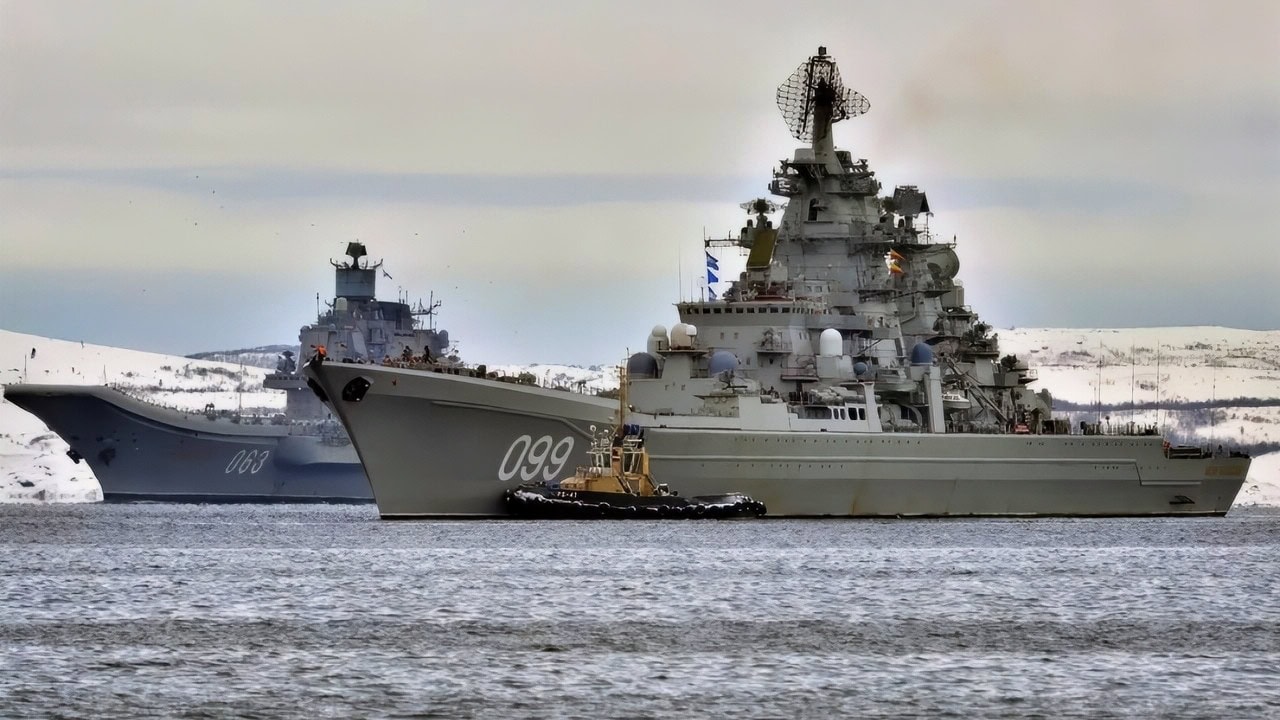
Russia has never been a naval power on the order of the United States. But it has possessed key naval capabilities–notably its submarines–that have ensured Russia (and the old Soviet Union) more than kept up with its American rivals.
Moscow revived some old Soviet era designs.
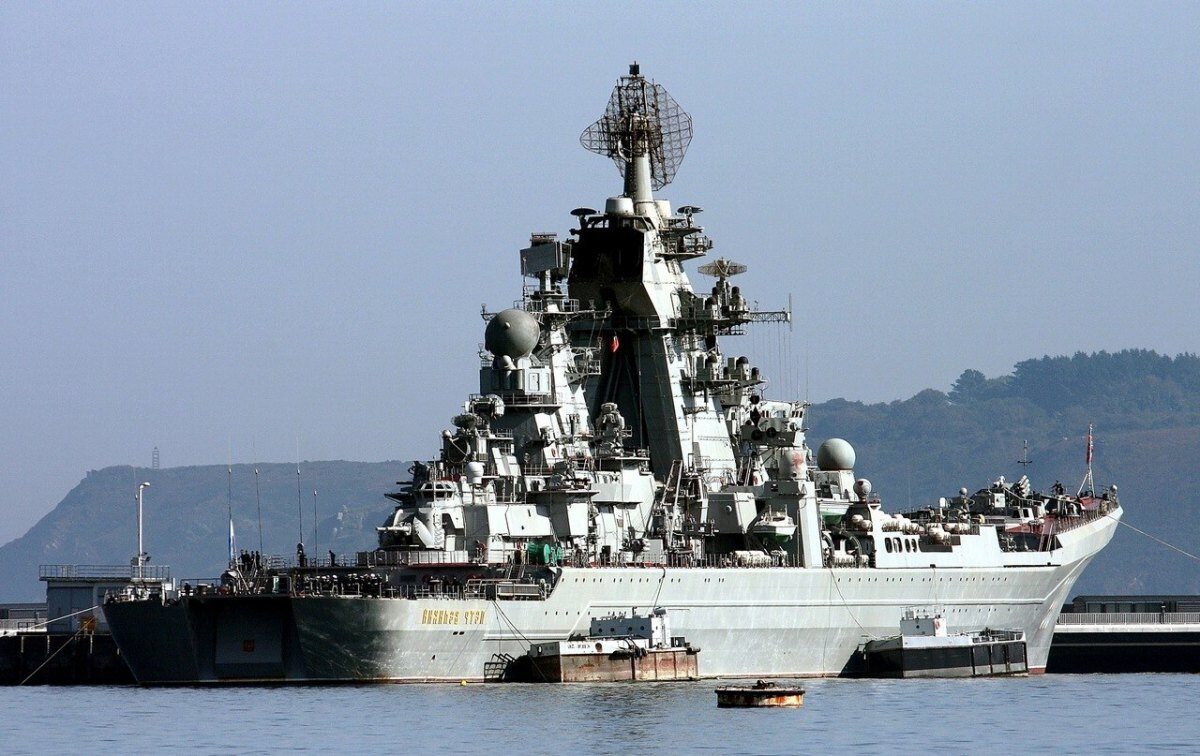
Kirov-Class. Image Credit: Creative Commons.
Among them is the Russian Navy’s Project 1144 Orlan, the Kirov-class battlecruiser, a symbol of Russia’s enduring naval ambition that commands respect among defense analysts and policymakers and inspires confidence in Russia’s strategic capabilities.
The big question is not whether the renovated Kirov-class will work as advertised.
It will. But understanding its limitations in the age of drone and missile swarms should temper expectations, encouraging a realistic and cautious view among naval strategists and defense enthusiasts.
Especially since there are so few of these ships in existence, Russia currently has only the Admiral Nakhimov in its fleet.
It’s not like Russia is planning to build a fleet of the Kirov-class battlecruisers. It’s more like they had one of these things rusting out in the yard and Putin decided to make lemonade out of a lemon.
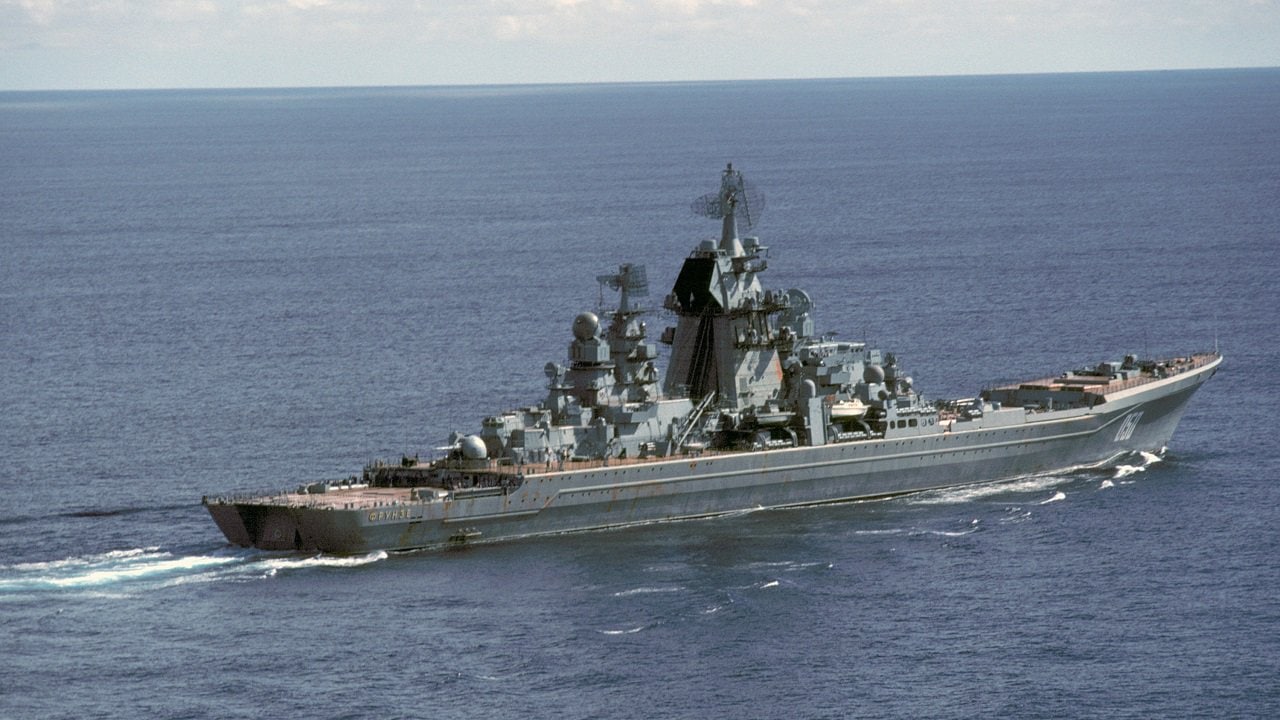
Aerial starboard quarter view of the Soviet Kirov-class guided missile destroyer FRUNZE underway back in 1985.
The Original Soviet Version
Conceived in the 1970s, the original Project 1144 Orlan was designed for a very specific mission.
Unlike the US Navy, which based its maritime strategy upon aircraft carriers, Soviet naval planners assumed they’d fight US carrier strike groups without possessing comparable naval aviation.
So, the Red Navy decided to build an enormous nuclear-powered cruiser. They then planned to arm that nuclear-powered cruiser with enough missiles to overwhelm the US Aegis defenses.
The Kirov-class was specifically designed to sink US nuclear-powered carriers. In essence, the Kirov-class became less of a traditional cruiser and more what Western analysts designate as a “battlecruiser,” because of its size, endurance, and offensive power.
Notable Characteristics
The Kirov-class battlecruiser is a giant of a warship. It dwarfs anything in the Russian surface warfare fleet.
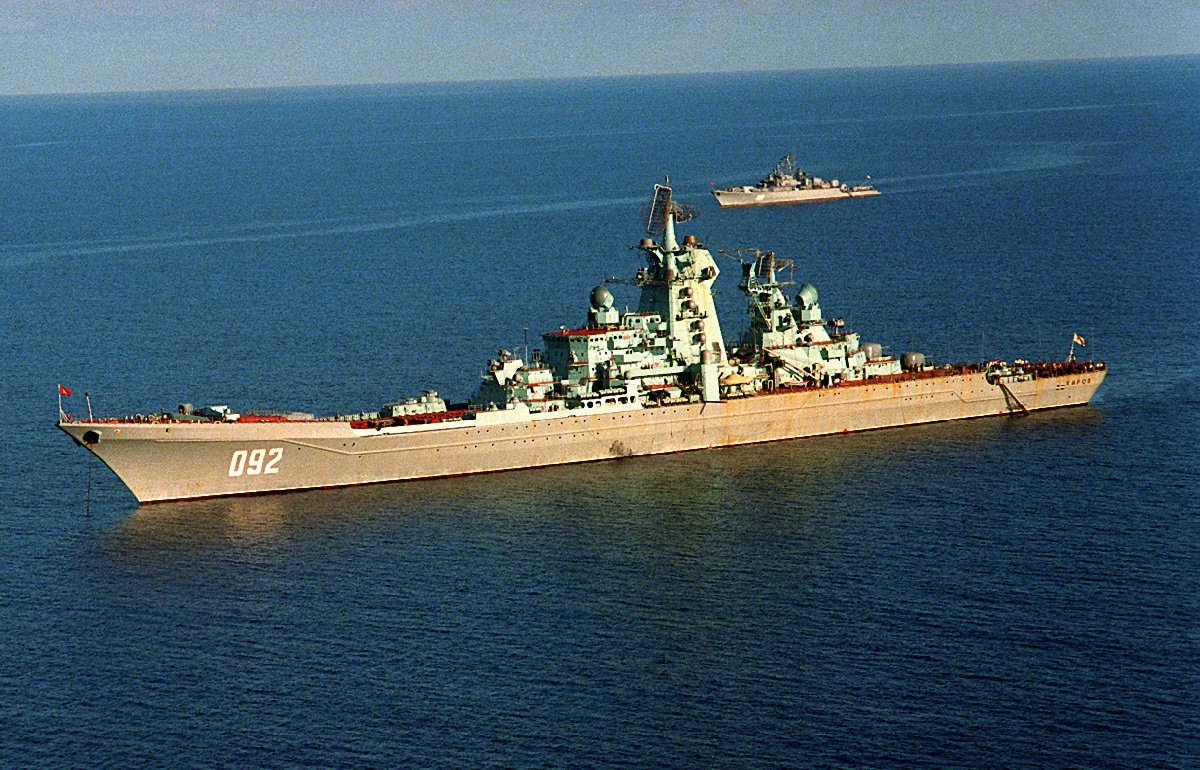
A port view of the Soviet nuclear-powered guided missile cruiser KIROV at anchor. In the background is a Soviet Krivak I-class guided missile frigate.
Indeed, the only other maritime system that is bigger would be the US carriers they’re designed to sink. Just consider the following characteristics:
Displacement: 28,000 tons when fully loaded
Propulsion: Two nuclear reactors power steam turbines that give the ship virtually unlimited operational endurance
Crew: Between 700 and 800 sailor
Armament: 20 P-700 Granit anti-ship missiles, long-range S-300F air defense missiles, medium-range surface-to-air missiles (SAMs), torpedoes, anti-submarine rocket launchers, and large naval guns
This ship is a monster. And Russia’s modernization of the ship has only made it more of a sea beast.
The refitted ship’s over 170 VLS cells, capable of launching Kalibr, Oniks, and Zircon missiles, pose a significant threat. Still, modern layered defenses and electronic countermeasures could mitigate the risk of missile saturation.
The Iowa Connection
In a related article on this topic from last year, national security expert and Editor-In-Chief Harry Kazianis highlighted the rationale behind the Soviet Union’s initial interest in building the Kirov-class.
At that time, to fulfill his pledge for making an expanded navy, then-President Ronald Reagan was reactivating the Iowa-class battleships.
Not to be outdone, the Soviet Union initiated its Kirov-class battlecruiser program.
At the time, the Reagan administration believed it needed the kind of firepower that only a battleship could provide.
Although it is less obvious that the Reagan administration’s decision to restart the Iowa-class battleship was due to the Kirov-class being built in the USSR.
It is safe to say, though, that the Kirov-class battlecruiser certainly influenced perceptions of Soviet and, now, Russian naval thinking about overcoming America’s surface warfare fleet.
Russia’s Last Great Surface Combatant
Missile capacity and swarming tactics of the kind the Admiral Nakhimov brings to any fight are significant threats to the US Navy.
After nearly 30 years of modernization, Russia intends to make the Admiral Nakhimov the flagship of its legendary Northern Fleet.
Admiral Nakhimov has received new radar systems, modern electronic warfare (EW) capabilities, new weapons, and reactor refurbishment, making it a truly modern and powerful combatant.
There are still serious problems with the ship.
The Soviet Union, at the height of its power, struggled to maintain its small group of Kirovs. Modern Russia, while certainly doing better than it did in the 1990s, will find it challenging to maintain these ships.
The “Battleship Problem”
Most interesting are the arguments against the Kirov-class from the West. On the one hand, you might say it was just envy or denial on the part of nations that lack this capability.
On the other hand, though, some of us in the West have been railing against large surface combatants in our navies because they ultimately present too tempting a target for modern missile and drone swarms–no matter how effective their defenses are.
Russian vessels in the Black Sea have already experienced the realities of modern warfare.
Throughout the Ukraine War, Ukrainian drones and anti-ship missiles have damaged or destroyed expensive Russian naval platforms for relatively little cost to the Ukrainians.
Sure, Admiral Nakhimov has a powerful array of defensive and offensive systems. But the laws of physics cannot be ignored.
They can only be manipulated. Yes, Russia empowered the Admiral Nakhimov with a massive arsenal of defensive systems. Ultimately, however, those defensive systems are not limitless.
Russian naval planners must ask themselves whether it was really worth the billions of dollars and resources over time to build a 28,000-ton battlecruiser if that ship can be overwhelmed by relatively cheap weapons, such as drones and even missiles.
This argument is also why the Trump administration must drop its own attempts to build the Trump-class battleship.
Is This Ship Worth It?
The Kirov-class remains one of the most impressive and expensive warship designs in modern history. Its combination of nuclear propulsion, heavy weapons, and layered defenses makes it a formidable foe at sea.
Yet, the strategic environment no longer favors such vessels. Modern naval warfare demands that combatants embrace distributed lethality; they enhance their submarine capability and long-range precision weapons.
New warfare strategies call for the elevation of unmanned systems to provide instant, cheap attacks and persistent surveillance of the enemy.
Concentrating combat power in a single or a handful of powerful surface ships might look good for the camera and for propaganda purposes. But they will not yield the kind of victory that Russia needs.
Admiral Nakhimov is less a pathway to the future of naval warfare and more of a peek into what might have been.
Had the Soviet Union not collapsed in 1991 and the Cold War endured, the Kirov-class would represent the apotheosis of a design philosophy specifically carried over from the height of the Cold War.
As a modern combatant, it will be a threat. But its threat will be tempered by the advances in cheap, abundant, unmanned systems and missiles.
About the Author: Brandon J. Weichert
Brandon J. Weichert is the Senior National Security Editor at 19FortyFive.com. He also manages The Weichert Brief on Substack. Weichert also hosts “National Security Talk” on Rumble. He is the author of four bestselling national security books, the most recent of which is A Disaster of Our Own Making: How the West Lost Ukraine (Encounter Books). Follow him via Twitter/X @WeTheBrandon.