
North Korea’s Nuclear Weapon Requirements: North Korea’s leader Kim Jong-un must be elated with the impact of his family’s nuclear weapons program. The North’s nuclear forces likely played a significant role in the U.S. choice to start a war against the lesser Iranian nuclear weapon threat rather than attack the greater North Korean nuclear weapon threat. And President Trump even offered Kim a concession by recognizing North Korea as a nuclear power. To deter North Korean nuclear weapon use, the United States and South Korea have threatened that Kim’s regime would not survive if Kim carries out a nuclear weapon attack. However, the United States failed to eliminate the Iranian regime in the ongoing war against Iran despite the relatively good intelligence the United States had. Consequently, Kim may be doubting the strength of the U.S. nuclear deterrent threat, and many in South Korea may be questioning the viability of the U.S. extended deterrence commitments.
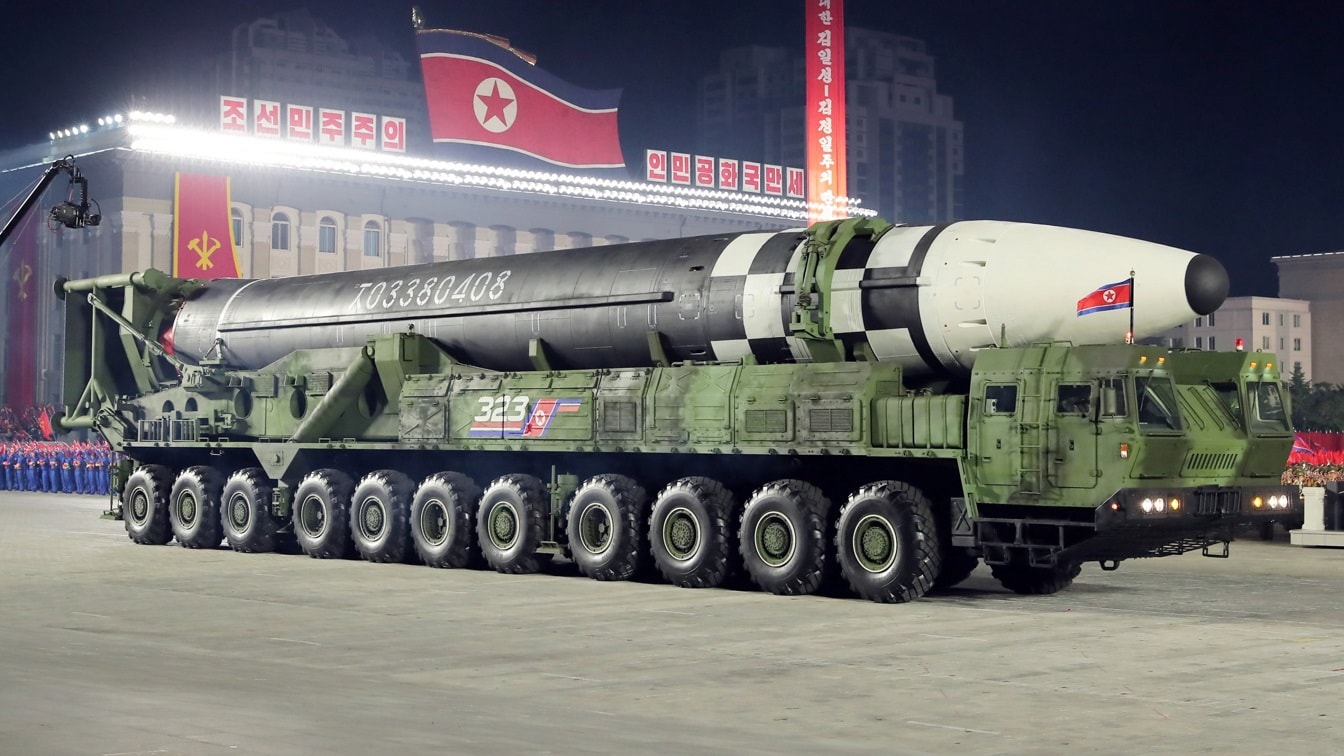
These successes confirm Kim’s focus on his nuclear forces. Kim’s current 60 or more nuclear weapons appear sufficient for his current deterrence purposes. Still, Kim has repeatedly called for an “‘exponential’ increase in his nuclear forces.” He has showcased missile launchers which in total could carry many hundred missiles with nuclear weapons. He appears to be seeking a force of at least 300 to 500 nuclear weapons, which would pose an unacceptable threat to the United States and its allies.
What Are Kim’s Objectives and Strategies?
For many countries, leaders’ objectives establish national security strategies, which in turn determine national military force requirements. North Korea appears to follow this pattern.
There is broad consensus in the North Korean expert community that Kim Jong-un’s primary objectives are his personal survival, the survival of his regime, and his absolute control over North Korea. Kim and his regime regularly threaten the United States with nuclear and other attacks to deter any U.S. attacks against North Korea, demonstrating his serious concerns about such possibilities. To deter U.S. nuclear attacks, Kim needs to be able to impose unacceptable costs on the United States, which he has interpreted as threatening U.S. territory, and especially U.S. cities, with nuclear attacks sufficient to overcome U.S. defenses and survive U.S. efforts to destroy North Korean nuclear forces.
Kim must also manage internal opposition that could imperil his survival. He uses a fear-based approach for controlling his people. North Korean culture also demands that the leader be powerful, and Kim has used his nuclear weapons to demonstrate that power. He has also demonstrated his power by gaining strong support from both Russia and China.
I believe that Kim’s secondary/supporting objectives are dominance of the Korean Peninsula and establishing the North as a powerful world power, a peer of the United States. In particular, he wants to demonstrate this power to both deter and coerce the United States. Successfully achieving these objectives would increase his ability to secure the inputs he needs to accomplish his primary objectives: Getting the international position, internal political support, economic resources, and military forces he needs to survive. Kim’s nuclear weapons assist in achieving success in these areas.
Until the end of 2023, the Kim Family planned to invade South Korea to unify with South Korea and dominate the peninsula. Kim’s grandfather first attempted this in the Korean War that started in 1950. But at the end of 2023, Kim renounced unification as an objective and began speaking of South Korea as the North’s “principal enemy.” Ambassador Julie Turner explained Kim’s abandonment of unification “as a desperate attempt to get control of the internal information environment.” Kim cannot afford to have his people recognize and seek for the superior lifestyle available outside the North, especially as experienced in South Korea. North Korea applies extreme measures to prevent outside information from penetrating the North.
An invasion into the South would ideologically contaminate many North Korean personnel with the wonders of South Korea compared to the living conditions in the North. If an invasion succeeded, Kim could control the South in the short-term in exchange for, over time, likely losing the support and control of his people and eventually his country.
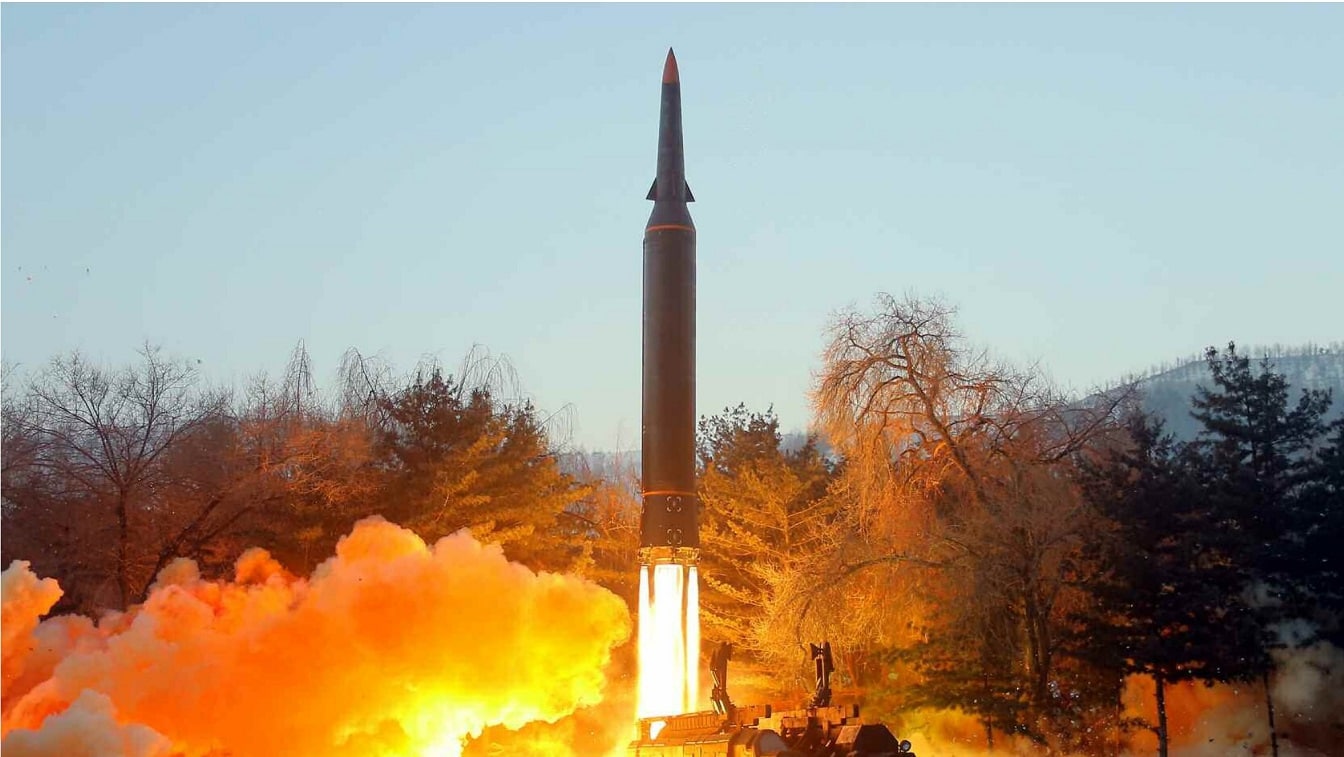
North Korea’s New Hypersonic Missile. Image Credit: KCNA/North Korean State Media.
Kim apparently realized that he did not need nor want military control of the South. Instead, he seeks to create an Iron Curtain around North Korea through which little outside information and influence can penetrate. All he needs from South Korea is enough “tribute” to sustain his lifestyle, his regime, and his military programs—probably less than 5 percent of South Korean GDP. He does not want more than that because it would give some North Koreans the resources needed to avoid his control through bribery and corruption, imperiling his regime. Kim would also want the ability to force the South to cease specific activities that jeopardize North Korean internal control (like K-Pop?).
To dominate the South without an invasion, Kim needs to create the image of North Korean military superiority and to decouple the U.S./South Korea alliance. It is therefore not surprising that North Korea carries out regular missile and other military technology tests in addition to parades to showcase its relatively advanced military weapons (which in some cases have been mockups or very limited examples of advanced weaponry). To decouple the alliance, Kim also needs to raise questions about the appropriateness of South Korean dependence on U.S. military power and the reliability of U.S. extended deterrence. And he has certainly been working to do both.
North Korean Nuclear Force Requirements
Based on these perspectives of Kim’s objectives and strategy, we can estimate Kim’s nuclear force requirements. Clearly, we do not know for sure. But there are two factors that should be considered.
First, Kim uses his nuclear forces to deter threats against the North by threatening damage to key adversary targets in the United States, South Korea, Japan, and China. But Kim knows that not all of his nuclear weapons will be delivered to targets. He therefore needs many more nuclear weapons than the number of targets he would like to affect. Some weapons will fail, while others will be destroyed before they can be launched, and yet others will be destroyed by missile defenses and other defensive systems. To address these potential losses, he likely wants at least two to three times as many weapons as the targets he wants to threaten in South Korea, Japan, and China. He probably wants three to four times as many as U.S. targets because of the U.S. defenses against ICBMs.
Kim presumably wants to be able to damage enough adversary targets to deter an attack intended to destroy his regime. He has threatened to “thoroughly annihilate” the United States. But given his evolving capabilities, he is probably seeking an ability to threaten at least 25 or so military, political, and civilian targets in each of his adversaries. In the United States, these targets could include bomber bases, political capitals, and cities.
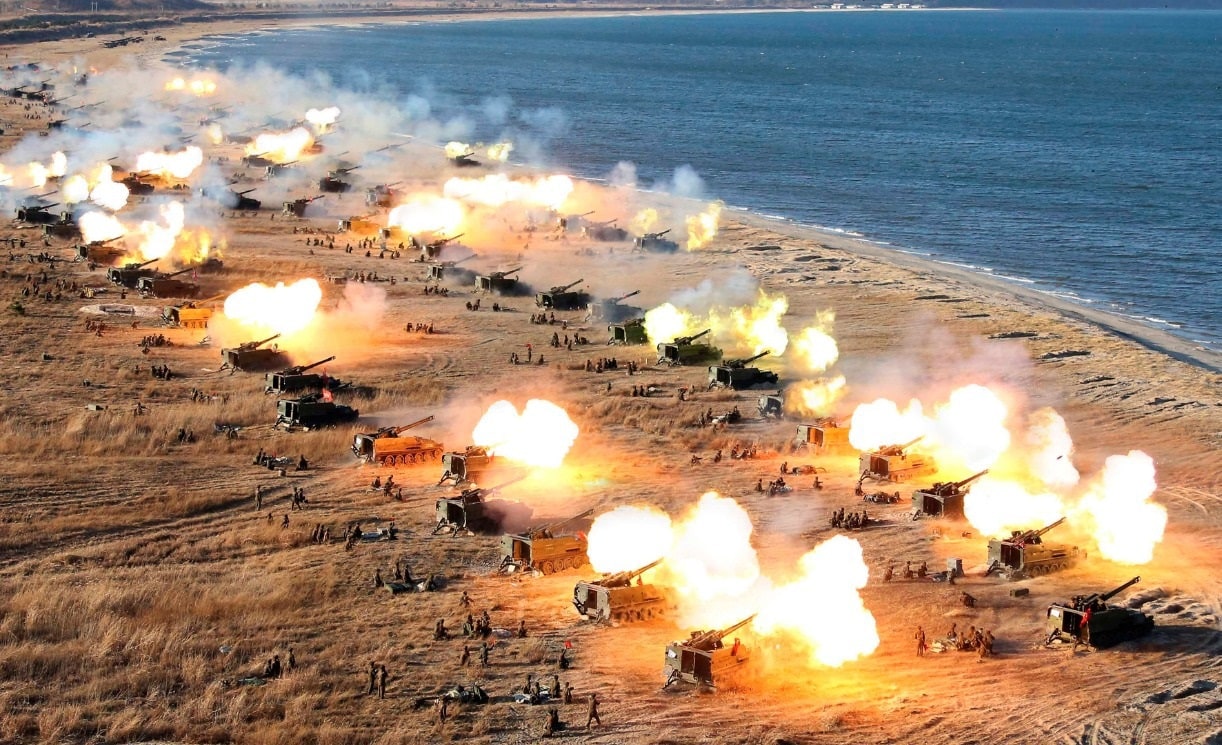
Image: KCNA/North Korean State Media.
For example, one North Korean 20 kiloton weapon targeted on each of ten major U.S. cities could cause nearly 1.5 million fatalities and 2.5 million serious casualties, a level of damage that could well deter many U.S. presidents from going after the Kim regime. If Kim carries out limited nuclear attacks, his ability to damage 25 U.S. targets would allow him to carry out repeated limited attacks in response to any U.S. limited retaliations prompted by U.S. extended deterrence commitments. His ability to impose such pain and suffering on Americans would force the U.S. president to determine if he really is prepared to “trade San Francisco for Seoul,” or whether he would abandon U.S. allies.
These North Korean requirements are large when combined with sufficient weapons to replace various possible lost nuclear weapons. For the United States, these 25 targets times three to four weapons per target would mean 75 to 100 total nuclear tipped ICBMs and other very long-range systems. And against Japan and China, Kim would likely want at least 25 nuclear weapons each times two to three, totaling 100 to 150 nuclear weapons for targeting Japan and China combined.
With short-range delivery means, Kim appears to be seeking the ability to threaten at least 75 to 100 targets in South Korea with nuclear weapons. North Korea has explicitly identified airfields, ports, and military command and control facilities as targets for North Korean nuclear weapons, which could potentially allow Kim to be able to neutralize many South Korean asymmetric military advantages. Kim would also want to coerce the South Korean government by targeting the civilian population. And he would want the ability to destroy South Korean facilities for producing nuclear weapons should South Korea ever pursue such weapons, Kim seeking to sustain nuclear superiority over the South. To replace potential losses, Kim would want 150 to 300 nuclear warheads for targeting South Korea.
The combined North Korean nuclear weapon requirements for targeting purposes would thus be roughly 325 to 550.
Second, Kim seeks to be treated as a nuclear superpower by the world governments. Yet many articles on states possessing nuclear weapons cast North Korea as a minor player. Kim likely perceives that he must at least equal if not exceed the nuclear inventories of France and the United Kingdom. The UK reportedly possesses about 225 nuclear weapons whereas France possesses about 290 operational warheads plus 80 warheads awaiting dismantlement. Thus, Kim likely seeks at least 300 to 400 nuclear weapons—consistent with his targeting requirements—to establish the perception that he is a major nuclear power, at least on par with the UK and France.
The Growing North Korean Nuclear Weapon Inventory
Of course, it is hard to tell the actual magnitude of North Korean nuclear weapon capabilities today because the North has often practiced deception as one component of its means for deterring outside intervention. Many experts on North Korean nuclear weapons put the current North Korean nuclear inventory at roughly 60 weapons plus enough fissile material to make a total of about 90 or 100. But other experts credit the North with as many as 150 nuclear weapons today. Kim’s order for an exponential increase in his nuclear weapons is consistent with him being well short of his perceived requirements.
Estimates of North Korea’s future nuclear weapon inventory depend upon an accurate understanding of his inventory today plus an educated projection of how many nuclear weapons North Korea can produce per year. One expert estimates that North Korea can now produce 10 nuclear weapons annually based upon the capacity of the uranium enrichment facilities that Kim unveiled in 2024, 2025, and 2026. Another expert reported in 2017 that North Korea may have already been able to produce 12 nuclear weapons per year. The North’s recent increase in production capacity has likely now increased this estimate to around 20 nuclear weapons per year. Such rates will likely increase with Kim’s plans for exponential increase. At the current rates, Kim may be able to cross the 300 nuclear weapon threshold as soon as 2033 or as late as 2050. He may be presenting an exaggerated view of his nuclear force size to enhance his ability to deter and coerce other countries, or he may be concealing some of his nuclear capabilities to avoid more serious intervention by the United States and its allies.
Conclusion
North Korea should not be allowed to possess 300 nuclear weapons. According to the U.S. Defense Intelligence Agency, “North Korea’s use options and target selection will evolve as its nuclear force grows, potentially lowering its nuclear use threshold in the coming years.” While Kim may not consider using nuclear weapons if the situation in North Korea is stable, he may consider limited nuclear weapon use to divert the attention of his people during North Korean instability. Or he may use nuclear weapons to destroy a South Korean nuclear weapon production program.
And he may threaten to launch follow-on attacks if his personnel even see the launch of a potential U.S. nuclear weapon retaliation against North Korea. Even one nuclear detonation on the United States or its allies would be an unacceptable disaster. Subsequent potential retaliation exchanges would risk uncontrolled nuclear escalation.
Preventing the continued growth of the North Korean nuclear weapon force is thus very important. The U.S. leadership needs to become serious about reining in Kim’s nuclear force expansion.
The United States has given Kim ample opportunities to negotiate some restraint, and he continues to refuse to employ such restraint. It is now time to begin employing “carrot and stick” measures to make some progress.
About the Author: Bruce W. Bennett
Bruce W. Bennett is a senior defense analyst. He works primarily on research topics such as strategy, force planning, and counterproliferation, specializing in Korean security. He also teaches graduate school classes on “Understanding Nuclear Forces” and “Wargaming Limited Nuclear Weapon Employment.”