
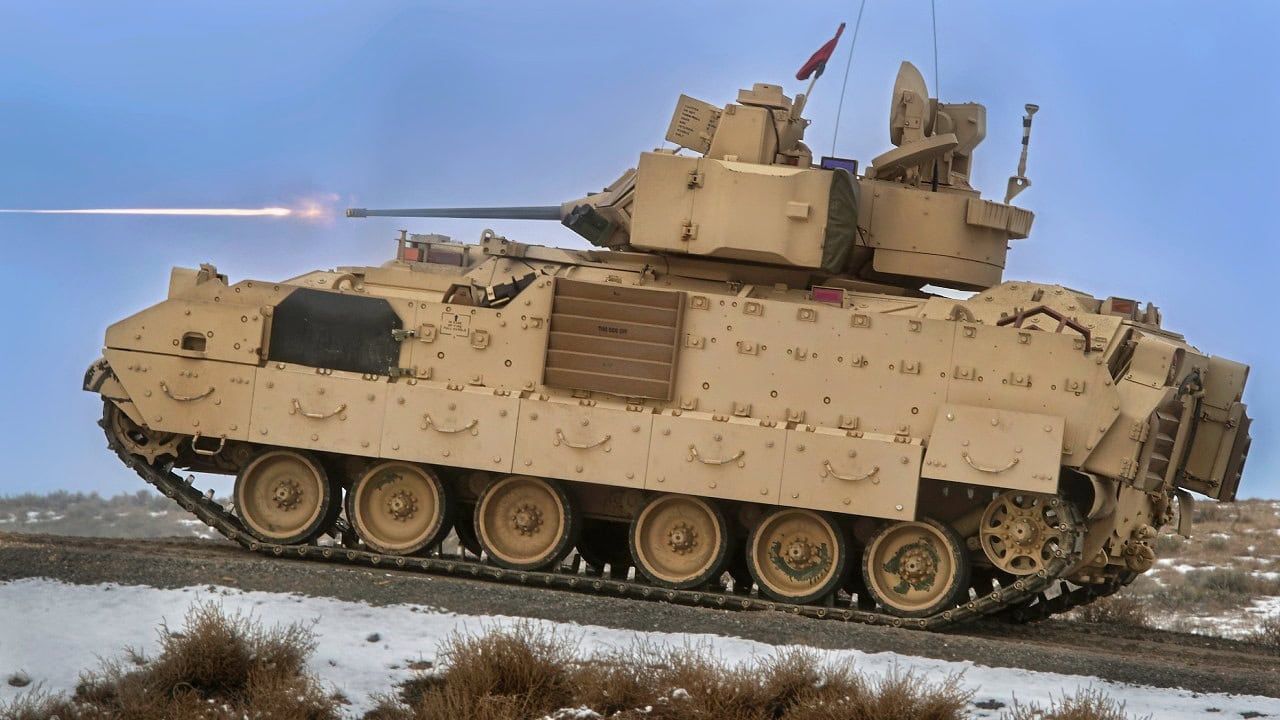
Key Points and Summary – $14 billion was spent to build the Bradley Fighting Vehicle. More than $22.9 billion has been spent without replacing it. The Army has been promising a successor to the Bradley since 2003. Future Combat Systems was canceled in 2009 after roughly $19 billion. Ground Combat Vehicle was canceled in 2014 before anyone built a prototype. The first Optionally Manned Fighting Vehicle effort was canceled in 2020. Twenty-three years, three dead programs, no vehicle. The Bradley is 45 years old. It is fighting in Ukraine right now. And in May, the Army unveiled two more candidates to replace it — the General Dynamics Griffin III and the American Rheinmetall Lynx.
The Bradley Fighting Vehicle Won’t Go Away

XM30 Image. Defense Contractor Handout.
“Life begins at 30,” according to some, so perhaps it’s apropos that the United States Army has applied the XM30 alphanumeric designation to an experimental project that, if it ultimately succeeds, will represent a new beginning and a new mechanical life form in the realm of infantry fighting vehicles (IFVs).
In the 45 years since it survived its controversial prototype phase and made its official operational debut, the Bradley IFV—named for the WWII Gen. Omar Bradley—has demonstrated its effectiveness in the crucible of combat time and time again, from the 1991 Persian Gulf War to the current Russia-Ukraine War.
Nonetheless, that venerable quadragenarian war machine is still showing its age and weaknesses. So then, where does the XM30 program stand in its efforts to finally succeed where other would-be Bradley successors have failed?
XM30 Program Basics
Before we get into the current status of the XM30 program, a basic backstory is in order. Courtesy of Kyle Gunn in a November 19, 2025 article for Task & Purpose, we discover the Army’s following key criteria for the XM30 candidates:
-Carrying capacity for a crew of two and six infantry soldiers, thus matching the Bradley’s squad compatibility whilst reducing the number of operating crew members thanks to an unmanned turret and other automated features

M2 Bradley. Image Credit: Creative Commons.
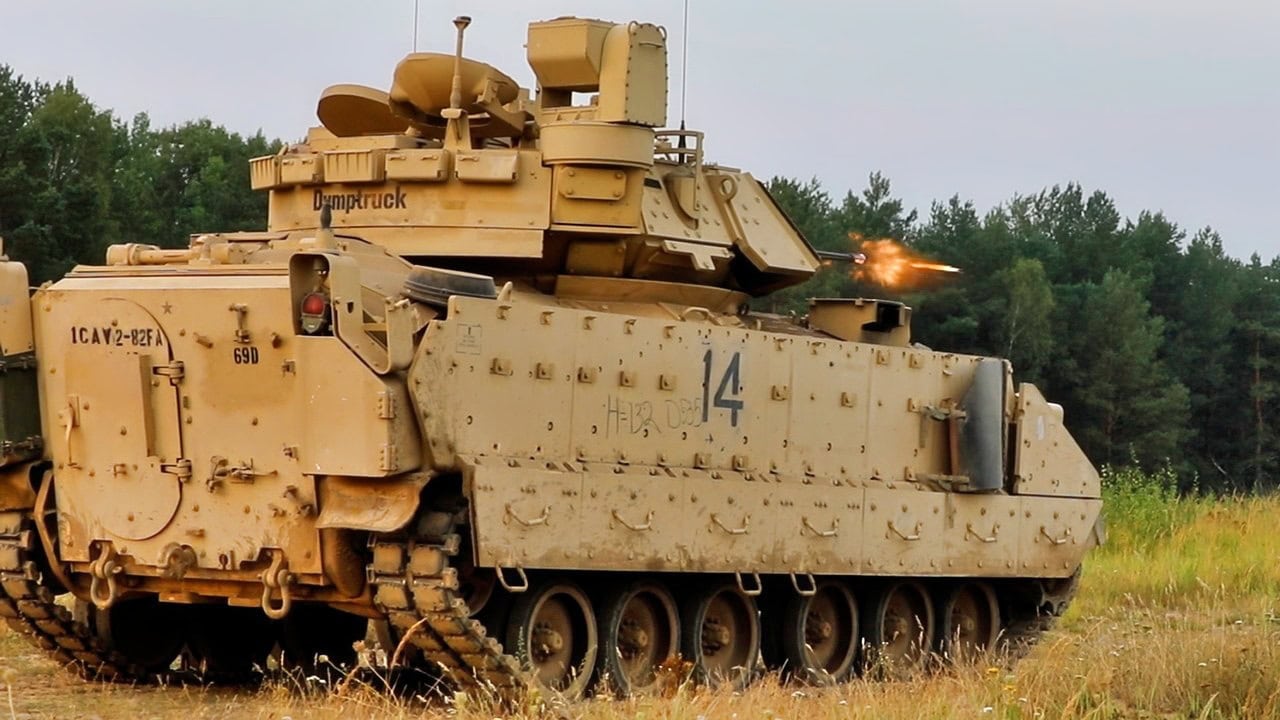
Troopers with 3rd Armored Brigade Combat Team, 1st Cavalry Division firing the 25mm canon on a Bradley fighting vehicle in order to zero the vehicles weapons systems at a range in Poland. Ranges such as these familiarize troopers with the vehicles systems in order to ensure combat readiness.
-A hybrid-electric powertrain that provides greater fuel efficiency, reduced thermal and acoustic signatures, and the ability to run sensors on “silent watch;” the latter vitally important in this day & age of killer drones bearing thermal cameras
-Open-architecture digital systems which allow rapid upgrades without redesigning the entire vehicle
-“The most notable leap, however, is lethality. The XM30 is expected to field the XM913 50mm cannon, or a 30mm gun with an upgrade path, giving it far greater range and the ability to fire programmable airburst munitions designed to counter both light armored threats and aerial drones.”
So Then, What Are the Latest Developments with the XM30?
To answer that question, we turn to an anonymously authored 3 June 2026 article in Army Recognition titled “U.S. Army Reveals First Designs of Two XM30 AI Infantry Fighting Vehicle Candidates Replacing Bradley.” Therein, we learn that the Army unveiled combat vehicle concepts from General Dynamics and American Rheinmetall at the NDIA MDEX 2026 (National Defense Industrial Association Maneuver Defense and Expeditionary Conference 2026) in Huntington Place, Detroit, Michigan, showcased on 13 May 2026 by a certain COL Novak, the XM30 Program Manager.
The showcase was conducted not via three-dimensional models or prototypes, but rather through CAD (Computer-Aided Design) renderings showing side-profile engineering views of both IFV concepts currently advancing through Phases 3 and 4 of the program, covering detailed design, prototype construction, and testing through December 2027.
XM30 Candidate #1: General Dynamics Land Systems Griffin III
General Dynamics Land Systems (GDLS) is the current producer of the M1 Abrams—the most successful main battle tank (MBT) ever produced—which means they have a highly advantageous, well-established track record of building effective armored war machines for the Army.
Appropriately, the Griffin III platform is compatible with the digital architecture envisioned for the M1E3 variant of the Abrams. Other salient and desirable features include an unmanned Northrop Grumman XM913 50mm Bushmaster Chain Gun® turret, ensconcing the crew in a protected capsule within the hull, a hybrid-electric drive, and modular armor.
Weighing approximately 40 tons, Griffin III is similar to the latest Bradley variants, which, on the minus side, is awfully heavy, but on the plus side, is potentially more familiar to Army logisticians, thereby offering a flatter learning curve and fewer new tricks for the proverbial old dog soldiers to learn.
However, there’s a potential red flag fluttering in the face of the Griffin III: it was the platform submitted for the Army’s Mobile Protected Firepower program, which morphed into the M10 Booker. And as we know now, the Booker turned out to be an ill-fated, embarrassing fiasco.
XM30 Candidate #2: American Rheinmetall Vehicles KF41 Lynx
American Rheinmetall Combat Vehicles is the Stateside subsidiary of Rheinmetall AG, which is headquartered in Düsseldorf, North Rhine-Westphalia, Germany, and is the largest German and fifth-largest European arms manufacturer. Congress demands that the XM30 selectee be “Made In The USA,” and accordingly American Rheinmetall is partnering with Raytheon, Textron, and L3Harris to build the vehicle.
As noted on Raytheon’s official product info page, “Team Lynx is designing and will manufacture the XM30 Combat Vehicle in the United States, partnering with suppliers across the country to expand critical engineering and manufacturing jobs in the nation’s industrial base.”
It’s somewhat analogous to the Beretta USA subsidiary being tasked with building the Italian-designed Beretta M9 pistols that were the standard-issue sidearms for the U.S. Armed Forces from 1985 to 2017.
The KF41 Lynx already has some well-established bona fides, and it’s being fielded by the Hungarian Defense Forces (Magyar Honvédség). Among its laudable features are a more modular and spacious design and a Lance 2.0 turret which carries a 30mm cannon with upgrade potential.
The standard variant’s carrying capacity is a crew of three and eight infantry, but the U.S. version could be configured to meet the Army’s two-crew, six-dismount requirement.
Like its Rheinmetall competitor, the Lynx is also quite heavy, weighing in at around 44 tons depending on configuration; While transportable by C-17 Globemaster III transport plane, it may require preparation to fit the weight and dimension limits.
However, the weight penalty is offset by a design emphasizing automation, sensor fusion, and optional integration of loitering munitions.
Moving Forward
Army spokespersons confirmed that Phase 5 of the XM30 test program will transition into a Middle Tier Acquisition – Rapid Fielding effort with a request for proposals planned for the first quarter of Fiscal Year (FY) 2027.
About the Author: Christian D. Orr
Christian D. Orr is a Senior Defense Editor. He is a former Air Force Security Forces officer, Federal law enforcement officer, and private military contractor (with assignments worked in Iraq, the United Arab Emirates, Kosovo, Japan, Germany, and the Pentagon). Chris holds a B.A. in International Relations from the University of Southern California (USC) and an M.A. in Intelligence Studies (with a concentration in Terrorism Studies) from American Military University (AMU). He is also the author of the book “Five Decades of a Fabulous Firearm: Celebrating the 50th Anniversary of the Beretta 92 Pistol Series,” the second edition of which was recently published.