
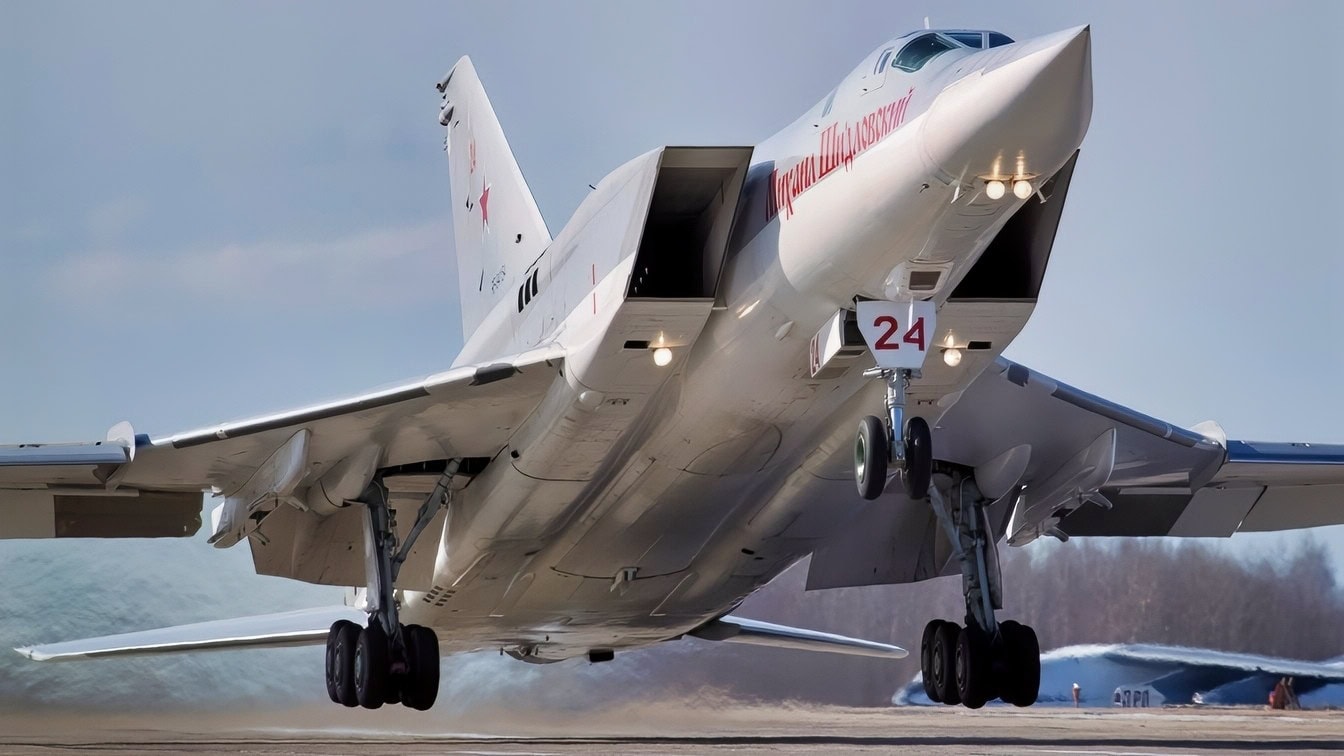
Russia’s Tu-22M3M Is a Mach 2-Class Bomber Built Around a 24-Ton Weapons Load: Russia’s Tu-22M3M is the deepest modernization yet of the Soviet Tu-22M3 Backfire bomber. The first prototype flew on December 28, 2018, and a second aircraft began flight testing in March 2020. Moscow once planned to convert 30 bombers, but it has not published a fleet count or confirmed squadron-level fielding.
The aircraft keeps the Tu-22M3’s large variable-sweep airframe, four-person crew, and two afterburning engines. Published Russian figures place its maximum takeoff weight near 124 metric tons, length at 42.46 meters, and maximum combat load at 24 metric tons. Depending on the source and flight condition, its claimed top speed ranges from 2,000 to 2,300 kilometers per hour, with a published subsonic range of 2,200 kilometers and a ceiling near 13 to 14 kilometers.
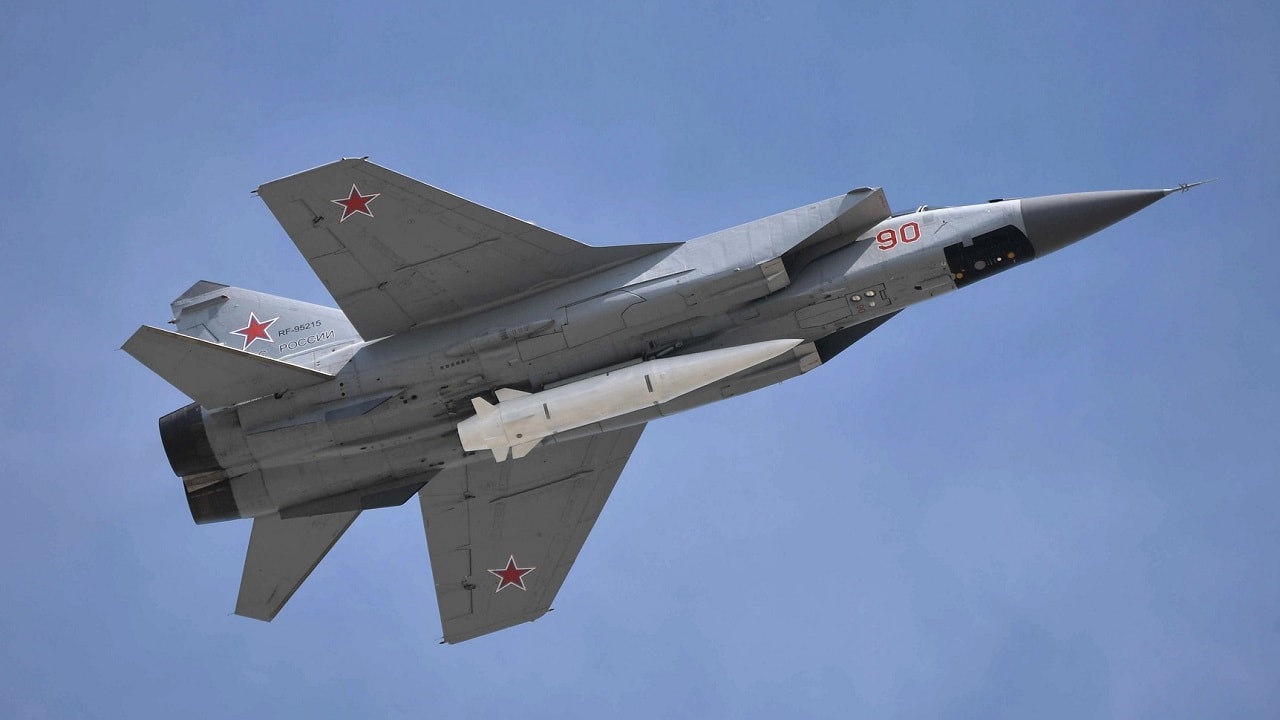
Kinzhal missile aboard a Tu-22M3 bomber.
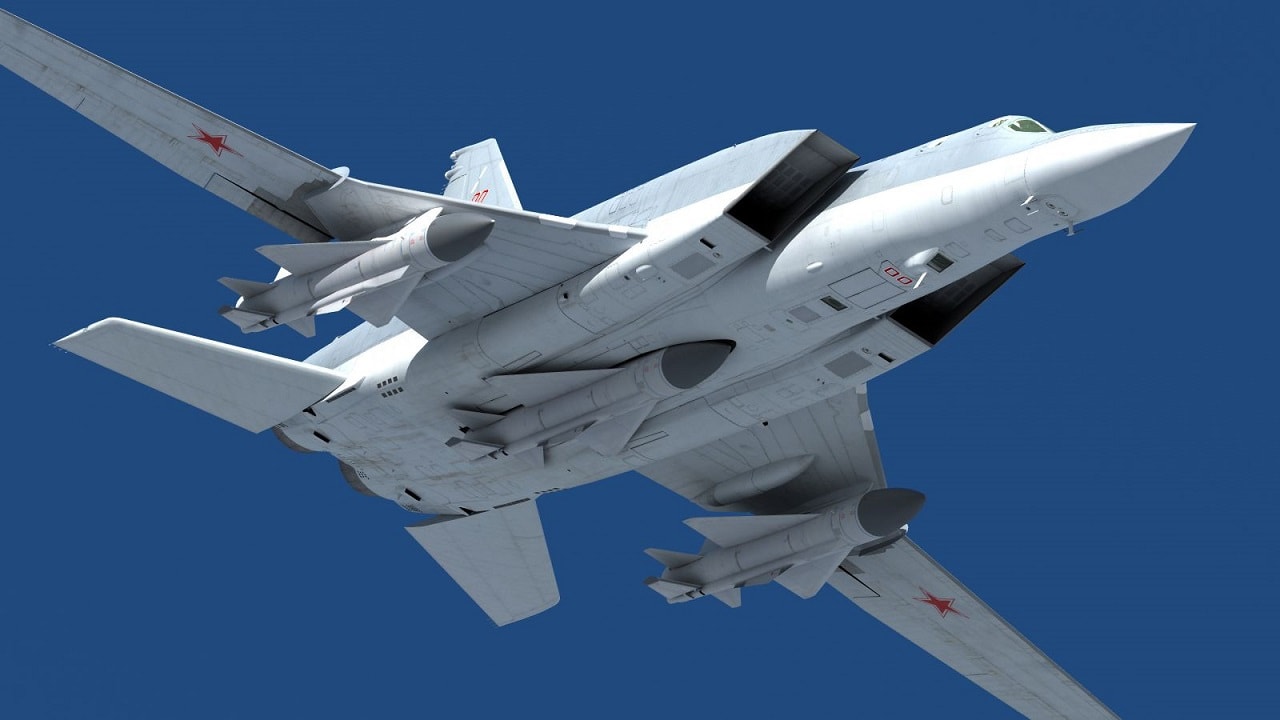
Russian Tu-22M3M fighter-bomber. Image Credit: Creative Commons.
Cost is the least reliable metric associated with the program. Russia has not released an audited price for a Tu-22M3M conversion or a newly equipped aircraft. Ukraine’s commander-in-chief valued one legacy Tu-22M3 at about $100 million after a 2025 strike, but that was a wartime estimate rather than a Russian procurement figure.
The M3M’s military value rests on speed, payload, and standoff weapons. It lacks the low-observable shaping needed to routinely penetrate a modern air-defense network. Its job is to move quickly toward a launch area, release long-range missiles against ships or land targets, and turn away before fighters or surface-to-air missiles reach the bomber.
Russia has used legacy Tu-22M3s extensively in the Ukraine war, while public evidence does not establish M3M combat operations.
The Tu-22M Was a New Bomber Hidden Behind an Old Name
Tupolev presented the Tu-22M as an evolution of the earlier Tu-22, but the aircraft was largely a new design. The first Tu-22M prototype flew in 1969. The improved Tu-22M3 followed in June 1977, featuring more powerful NK-25 engines, redesigned intakes, and wings that could sweep back to 65 degrees. It entered service in 1989, and Russian sources state that 268 Tu-22M3s were produced.
NATO called it the Backfire-C. Soviet planners built it to attack carrier groups, maritime formations, and theater targets with heavy missiles. Its speed and load made it one of the most serious threats facing U.S. naval forces late in the Cold War, especially when several bombers attacked together with Kh-22 carrier-killer missiles. The airframe later flew over Afghanistan, Chechnya, Georgia, Syria, and Ukraine, preserving a long-range strike role Russia has no easy way to replace.
The Tu-22M3M Replaces the Bomber’s Electronic Core
The modernization focuses on systems used for navigation, communication, target acquisition, and weapon employment. United Aircraft Corporation described new digital avionics, displays, navigation equipment, communications, engine controls, and electronic warfare. Janes reported that roughly 80 percent of the systems connected to the bomber’s electronic “brain” were new, with significant commonality with the Tu-160M.
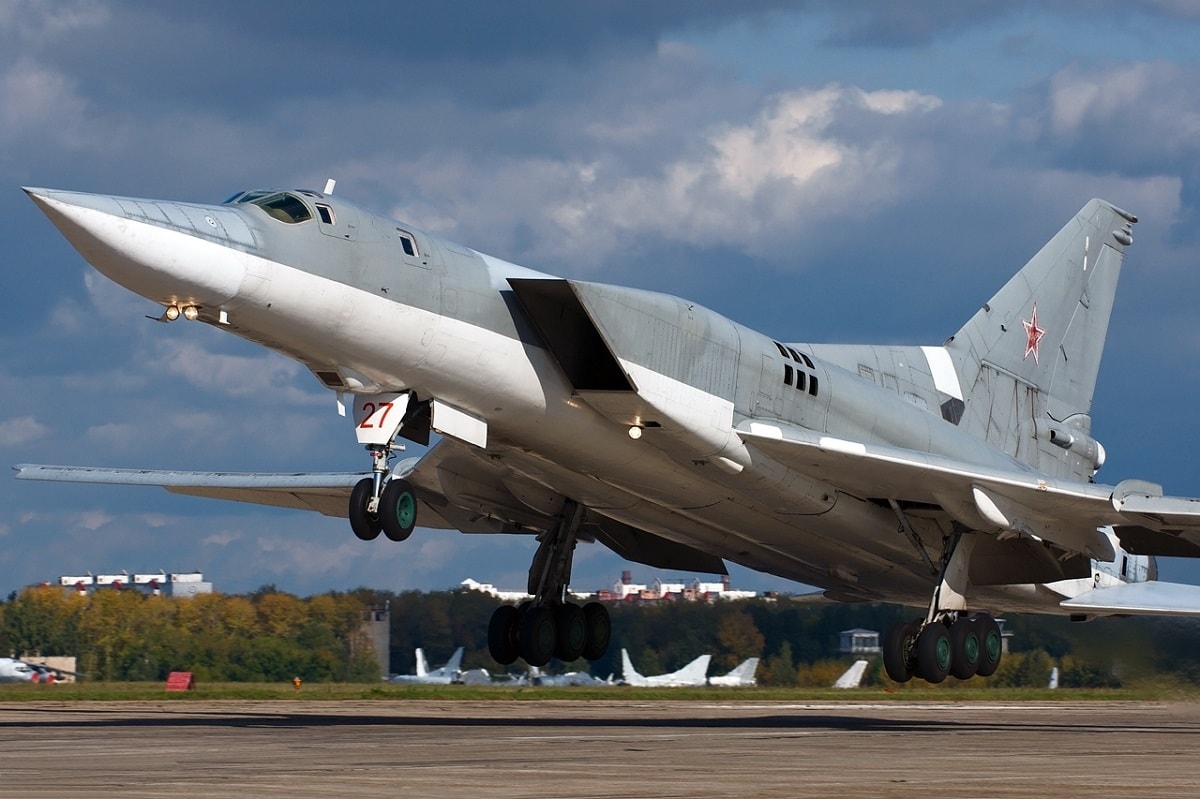
Tu-22M. Image: Creative Commons.
Russian plans also linked the program to an improved radar, precision-navigation equipment, modern defensive aids, and restored aerial refueling. Early reporting tied later aircraft to the NK-32-02 engine used by the Tu-160M, although Moscow has not published evidence of a fleetwide engine conversion. The verified core of the M3M remains a mission-system rebuild inside a Cold War structure, an approach that addresses obsolete electronics without removing the bomber’s vulnerability in the stealth era.
Three Heavy Missiles or a 24-Ton Bomb Load Define the Armament
There is no single hardpoint number because the station count changes with racks and weapons. In its heavy-missile configuration, the Tu-22M3 has one semi-recessed centerline station and two wing-glove pylons.
That arrangement supports as many as three Kh-22 or Kh-32-class missiles. The M3M has also been described as intended to carry up to four Kh-47M2 Kinzhal missiles, though public evidence does not show that it is loaded in regular squadron service.
The internal weapons bay holds a six-round rotary launcher for the smaller Kh-15, while four external stations raise the theoretical total to 10. The Kh-15 is a legacy weapon, and its present operational status is uncertain.
Published load charts also list up to 69 FAB-250 bombs, 42 FAB-500s, eight FAB-1500s or two FAB-3000s, along with naval mines and other stores. The 24-ton limit describes the maximum payload; fuel, range, rack configuration, and mission requirements determine the practical load.
The Kh-22 remains the best-known weapon associated with the bomber. Russia developed the Kh-32 as a longer-range and more modern successor, with Russian reports assigning it a range of up to 600 kilometers.
The Kinzhal would give the M3M another high-speed standoff option if integration reaches operational units. Russia has used Kh-22-family weapons against Ukrainian targets, turning an anti-ship bomber into a sanctuary-based land-attack platform.
Mach 2 Helps the Tu-22M3M Reach a Launch Line
Speed shortens the time needed to reinforce a theater or move between launch areas. It also gives defenders less time to react once a bomber begins its final approach. The advantage does not make the Tu-22M3M safe inside dense air defenses.
Its large radar and infrared signatures force it to rely on missile range, electronic warfare, escorts, and carefully selected routes.
The missile carries much of the penetration burden. Against a carrier group, the bomber still needs accurate targeting information from satellites, aircraft, ships, or other sensors. Against land targets, it needs coordinates and a route that keeps the launch aircraft outside the strongest defenses.
Ukrainian attacks on Russian airfields have shown another weakness: a fast bomber remains vulnerable while parked, and aging airframes are difficult to replace after losses.
Russia’s 30-Aircraft Upgrade Plan Has Not Appeared
The original Tu-22M production line closed in the early 1990s. Russia therefore has to select surviving airframes, inspect their structures, and rebuild them at Kazan rather than assemble a fresh fleet.
That makes every retirement or combat loss more consequential, since the industrial base does not produce replacement Tu-22Ms. The remaining fleet must cover training, conventional strikes, maritime missions and nuclear duties.
An open-source assessment published in January 2026 said only two aircraft had been identified as upgraded, far below the announced 30-aircraft objective.
Russia has also prioritized work on the Tu-160M and other wartime aerospace programs at Kazan.
The result leaves a finite Backfire fleet carrying a growing share of long-range strike work.
Russian authorities had not disclosed the M3M conversion price, the number accepted by operational units, or a date for the first fully equipped regiment as of August 1, 2026.
About the Author: Harry J. Kazianis
Harry J. Kazianis (@Grecianformula) was the former Senior Director of National Security Affairs at the Center for the National Interest (CFTNI), a foreign policy think tank founded by Richard Nixon based in Washington, DC. Harry has over a decade of experience in think tanks and national security publishing. His ideas have been published in the NY Times, The Washington Post, The Wall Street Journal, CNN, and many other outlets worldwide. He has held positions at CSIS, the Heritage Foundation, the University of Nottingham, and several other institutions related to national security research and studies. He is the former Executive Editor of the National Interest and the Diplomat. He holds a Master’s degree focusing on international affairs from Harvard University.

