
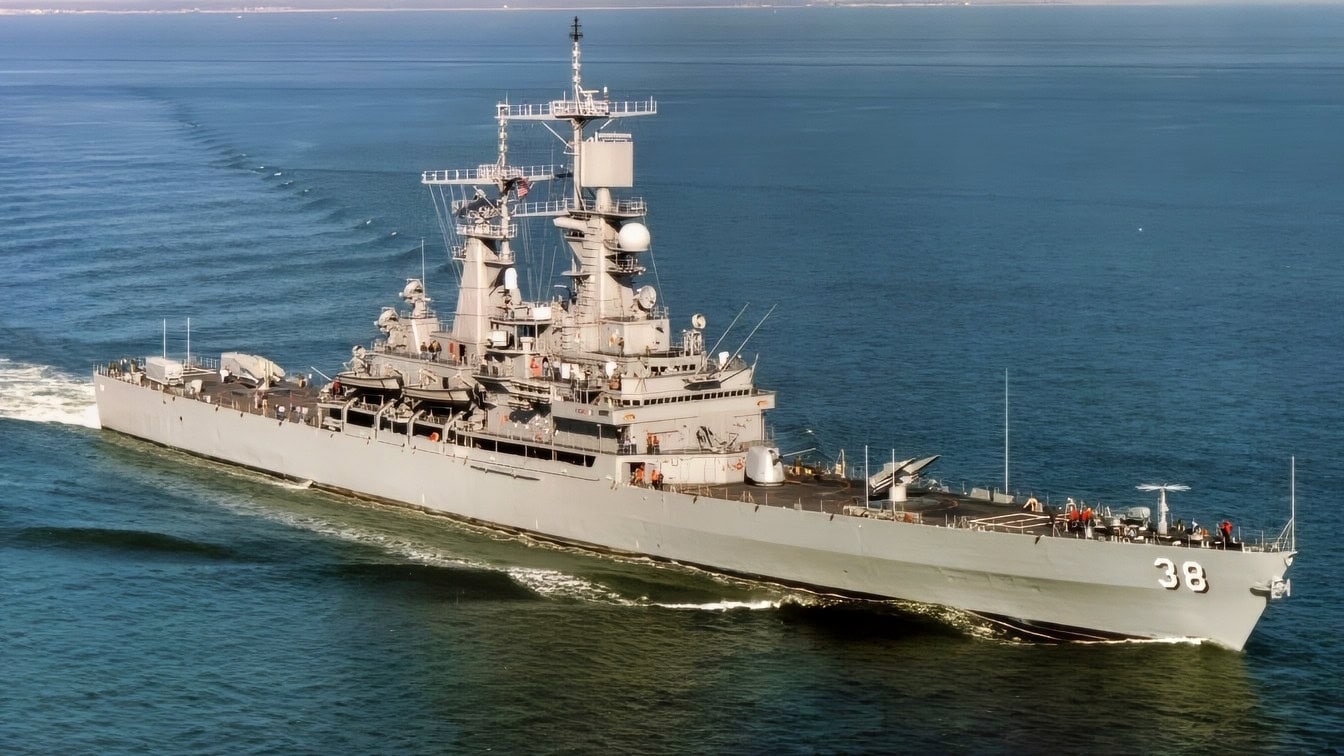
USS Virginia by the Numbers: $250 Million, More Than 80 Missiles and Two Nuclear Reactors: When I asked one US Naval expert what he thought of the USS Virginia, he was blunt and to the point: “I called her the missile battleship.” I get why.
USS Virginia By the Numbers
A 1972 Navy estimate assigned $250 million to the future USS Virginia, including construction, electronics, ordnance, and government-furnished equipment. Basic shipyard construction accounted for $85.4 million. Much of the cost was in the nuclear plant, sensors, and weapons, which were delivered separately to Newport News Shipbuilding.
Newport News laid the keel on August 19, 1972, launched the cruiser on December 14, 1974, and saw her commissioned on September 11, 1976. The trip from keel-laying to active service took 1,484 days. She began as DLGN-38 under the Navy’s old “guided-missile frigate” classification and became CGN-38 in 1975.
Virginia displaced 11,666 long tons at full load, measured 586 feet overall, and carried nearly 580 officers and sailors. Two General Electric D2G nuclear reactors supplied turbines rated at 60,000 shaft horsepower, which turned two propeller shafts and drove the ship beyond 30 knots.
Her mature armament exceeded 80 missile rounds. One Navy ship record lists 66 Standard and ASROC rounds, while technical accounts of the forward and aft Mk 26 systems total 68. Either figure puts the later missile load at 82 to 84 after eight Tomahawks and eight Harpoons were added. Two 5-inch guns, two Phalanx systems, and lightweight torpedoes completed the battery.
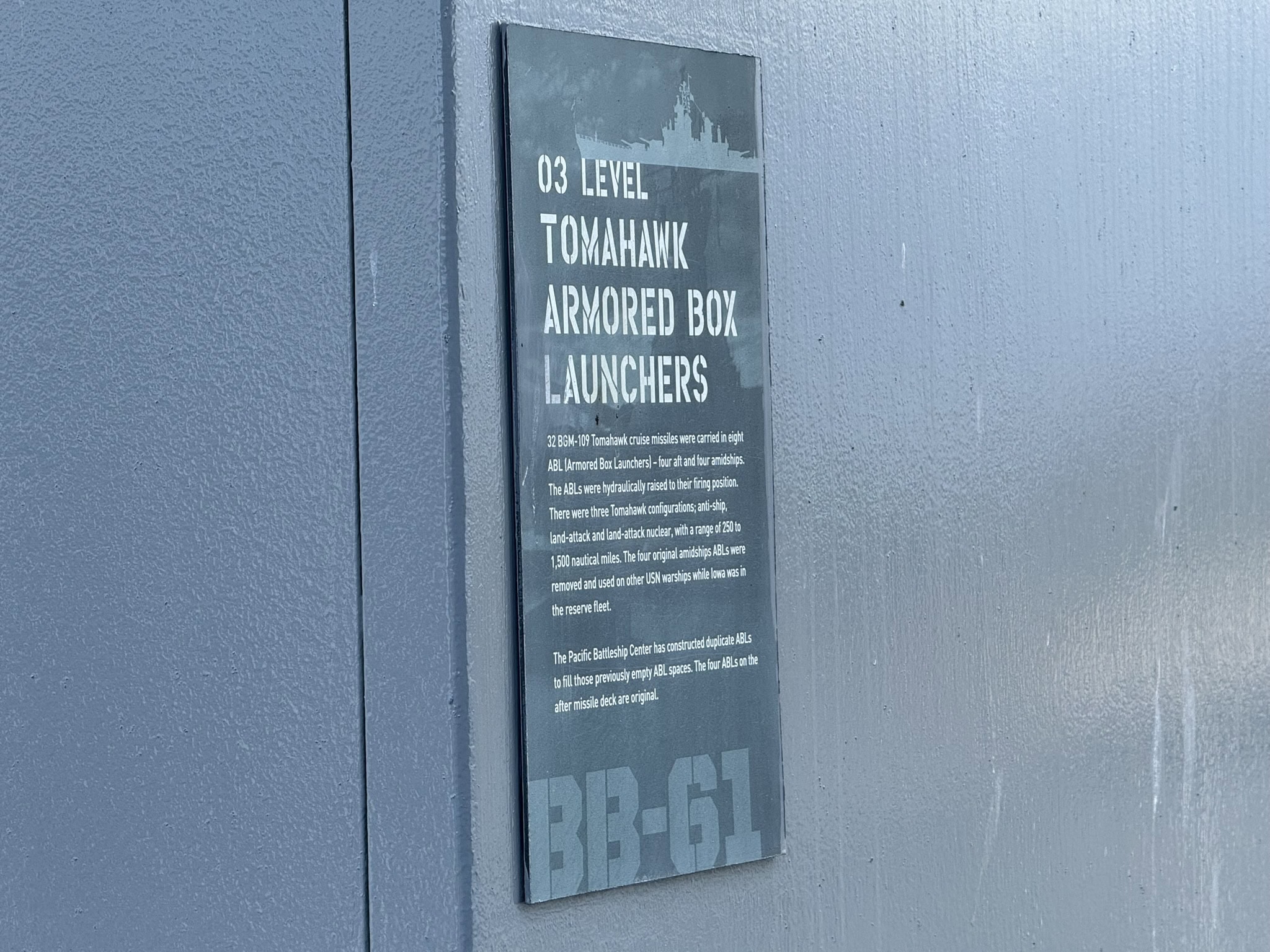
Tomahawk Box on USS Iowa. 19FortyFive.com Image.
A $250 Million Lead Ship Came From a Three-Ship Contract
The cost needs context. In December 1971, the Navy awarded Newport News a three-ship construction contract with a target price of $254.8 million and a $300 million ceiling. That covered yard work, not every combat system and piece of government-furnished equipment.
The Government Accountability Office’s $250 million leadership estimate added $18.8 million in planning, $27.8 million in electronics, $43.3 million in ordnance, and $46.8 million in other ship equipment. The approved program estimate reached $820.4 million after development, outfitting, and advanced nuclear work for possible follow-on ships were included. Virginia was expensive because the Navy was putting capital-ship endurance and firepower into a cruiser hull.
The Navy wanted escorts that could remain with nuclear carriers over long distances without drawing propulsion fuel from an oiler. Virginia followed the precedent established by USS Long Beach in a smaller four-ship design.
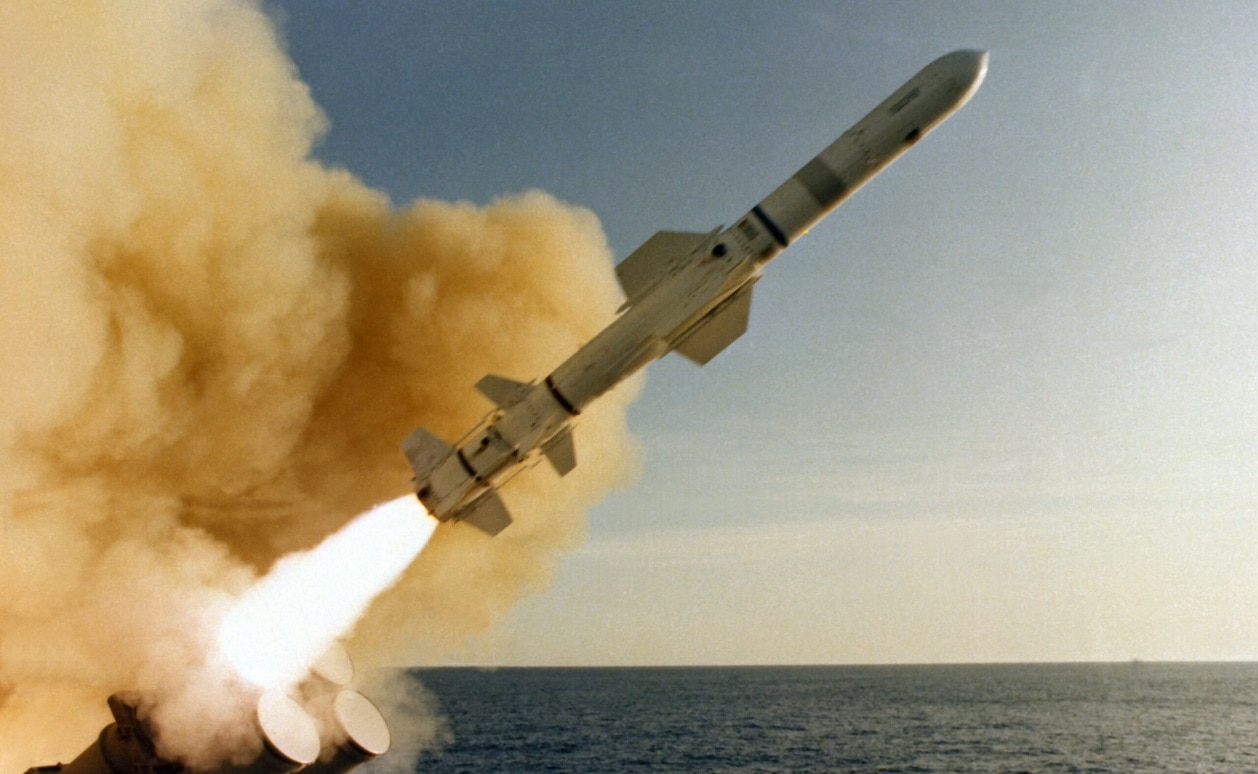
A view of an RGM-84 surface-to-surface Harpoon missile, immediately after leaving a canister launcher aboard the cruiser USS LEAHY (CG-16), near the Pacific Missile Test Center, Calif.
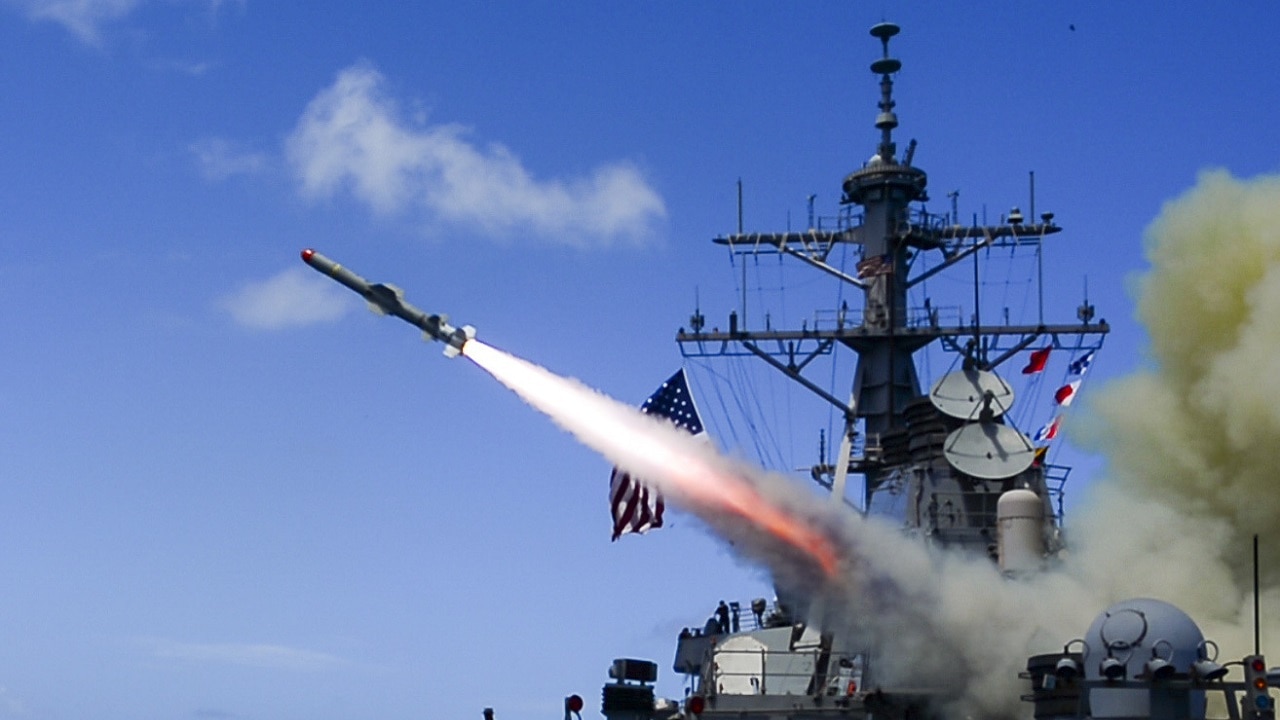
WATERS NEAR GUAM (Mar. 10, 2016) – Arleigh Burke-class guided missile destroyer USS Fitzgerald (DDG 62) conducts a live fire of a harpoon missile during Multi-Sail 2016. Multi Sail is a bilateral training exercise aimed at interoperability between the U.S. and Japanese forces. This exercise builds interoperability and benefits from realistic, shared training, enhancing our ability to work together to confront any contingency. (U.S. Navy photo by Mass Communication Specialist 3rd Class Eric Coffer/Released)
Two Nuclear Reactors Drove 11,666 Tons Beyond 30 Knots
The D2G plant let Virginia sustain high speed during carrier operations without refueling at sea. Food, ammunition, spares, and crew endurance still limited deployments, while conventionally powered escorts remained tied to oilers.
Nuclear propulsion also demanded specially trained crews, nuclear-qualified shipyards and eventual reactor refueling. Those costs explain why surface fleets concentrated nuclear power in submarines and aircraft carriers.
Virginia joined NATO’s Northern Wedding exercise in 1978, began Mediterranean deployments in 1979, and crossed the Indian Ocean in 1980 before continuing to the Philippines for emergency sonar-dome repairs. Nuclear endurance allowed the Navy to shift a heavily armed escort between theaters without budgeting for propulsion fuel during transit.
The Post-Refit Battery Exceeded 80 Missile Rounds
Virginia was built around one forward and one aft Mk 26 twin-arm launcher. The magazines carried a mission-dependent mix of Standard surface-to-air missiles and ASROC anti-submarine weapons. The two launchers could display four missiles at once, and each launcher weighed 43,000 pounds.
Two Mk 45 5-inch/54-caliber guns covered targets that the missiles did not. Navy data give the weapon a conventional range of about 13 nautical miles and a firing rate of 16 to 20 rounds per minute. Both mounted together offered a theoretical 32 to 40 shells per minute.
A 1984 overhaul added Standard SM-2 capability, two Phalanx close-in weapons, and armored boxes holding eight Tomahawks. Eight deck-mounted Harpoons supplied an anti-ship strike. Installing the Tomahawks consumed the aft helicopter area, trading aviation capacity for long-range attack.
The result resembled a missile-era capital ship more than a traditional battleship. Virginia lacked heavy armor and giant guns, but carried weapons for air defense, submarine warfare, surface attack, and land strike. Her rail launchers were soon overtaken by the Mk 41 vertical-launch system, which gave every loaded cell immediate access to the fight.
Lebanon Put Virginia’s Five-Inch Guns Into Combat
Virginia’s most intensive gun action came during her 1983 Mediterranean deployment. On September 19, Virginia and USS John Rodgers moved close to the Lebanese coast and fired about 300 5-inch rounds during two hour-long barrages. The fire supported Lebanese forces around Suk El Gharb as fighting threatened positions connected to the multinational peacekeeping mission.
The cruiser remained off Lebanon during a deployment marked by repeated attacks and the October 23 bombing of the Marine barracks in Beirut. Virginia provided emergency assistance after the bombing and returned to Norfolk on December 1. No public combat record credits her with a ship-to-ship engagement. Her combat action was directed ashore.
The deployment distinguished Virginia from earlier nuclear-cruiser experiments. Her costly missile system defended carrier groups, while the two conventional guns delivered the first sustained combat fire.
Desert Storm Gave Virginia a Long-Range Strike Mission
Virginia deployed in December 1990 for Operations Desert Shield and Desert Storm. She spent much of the next six months in the eastern Mediterranean and commanded a small strike group including USS Spruance and nuclear-powered attack submarines.
On January 22, 1991, Virginia launched two Tomahawk land-attack missiles toward Iraq. Contemporary accounts described them as the longest combat Tomahawk shots attempted at that time. The cruiser also coordinated four additional launches, part of the wider cruise-missile campaign against Iraq.
The operation validated the decision to replace the helicopter installation with Tomahawk boxes. A ship commissioned as a carrier air-defense escort had become a land-attack platform operating hundreds of miles from its targets.
Aegis and Reactor Refueling Ended an 18-Year Career
Virginia’s combat systems aged faster than the hull. Aegis-equipped Ticonderoga-class cruisers offered better battle management, while later ships carried Mk 41 cells with a broader weapons mix. The Navy found conventional Aegis ships easier to build and modernize than a nuclear cruiser, which required extensive redesign.
The class approached its first reactor refuelings as post-Cold War budgets contracted. Planned complex overhauls were canceled rather than combining expensive nuclear work with another electronics upgrade. Virginia left service in November 1994 after a little more than 18 years, reflecting the recurring trade between missile capacity and operating cost.
Virginia entered the nuclear-ship recycling program at Puget Sound in 1999. One 43,000-pound Mk 26 launcher survived. It now stands at Norfolk Naval Shipyard’s Trophy Park in Portsmouth, Virginia, with training Standard missiles resting on the rails that once formed the forward half of the cruiser’s double-ended battery.
MORE – Battleship USS Iowa Was Retired Too Soon
About the Author: Harry J. Kazianis
Harry J. Kazianis (@Grecianformula) was the former Senior Director of National Security Affairs at the Center for the National Interest (CFTNI), a foreign policy think tank founded by Richard Nixon based in Washington, DC. Harry has over a decade of experience in think tanks and national security publishing. His ideas have been published in the NY Times, The Washington Post, The Wall Street Journal, CNN, and many other outlets worldwide. He has held positions at CSIS, the Heritage Foundation, the University of Nottingham, and several other institutions related to national security research and studies. He is the former Executive Editor of the National Interest and the Diplomat. He holds a Master’s degree focusing on international affairs from Harvard University.

