
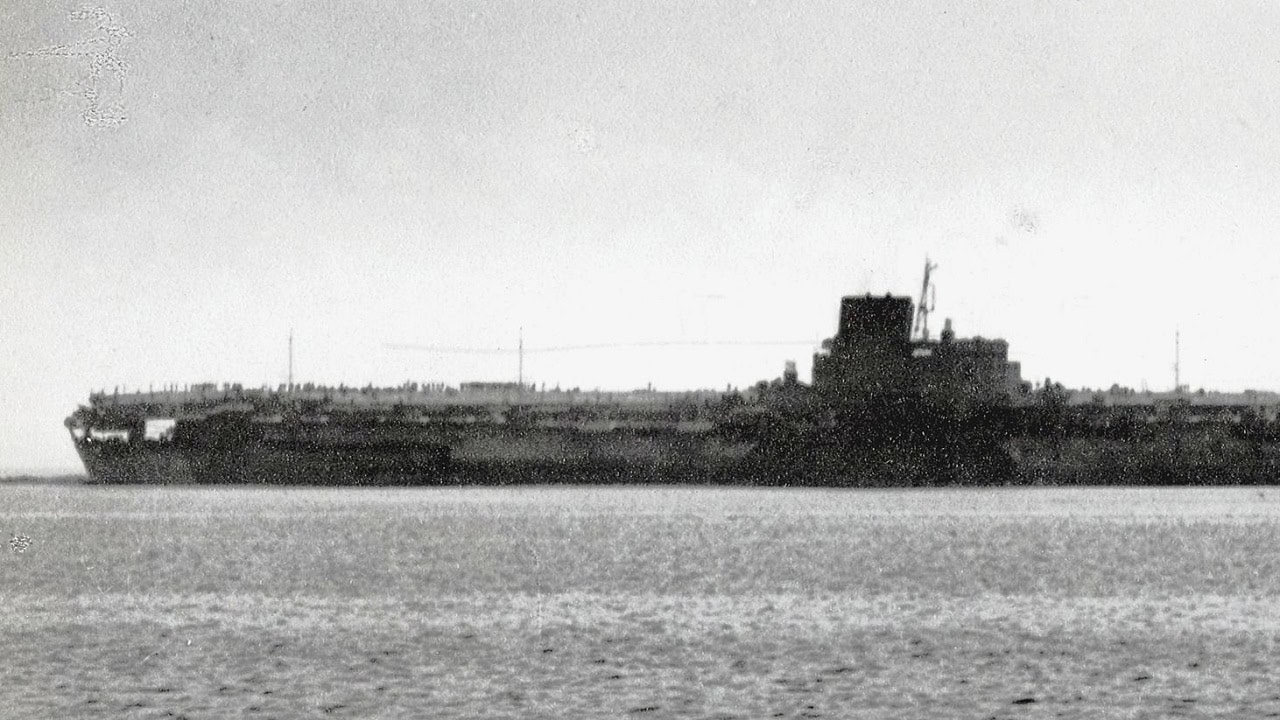
Imperial Japanese Aircraft Carrier Shinano by the Numbers: 72,000 Tons, 47 Aircraft, and Four Torpedo Hits – Japan commissioned Shinano on November 19, 1944, as the largest aircraft carrier built to that point. The converted Yamato-class hull displaced about 72,000 long tons at full load, stretched roughly 872 feet, and was designed to operate 42 to 47 aircraft. Ten days later, four torpedoes from USS Archerfish sent her to the bottom.
The Yokosuka Naval Arsenal laid Shinano’s keel on May 4, 1940, inside a dry dock built for the Yamato class. The vessel started as Japan’s third super-battleship, intended to carry nine 18.1-inch guns like Yamato and Musashi. Construction and conversion lasted about four and a half years.
The battleship plan disappeared after Japan lost Akagi, Kaga, Soryu, and Hiryu at Midway in June 1942. Shinano’s hull was already too advanced for naval architects to begin again with an efficient carrier design. They retained the machinery, the armored lower hull, and much of the internal structure, then added a hangar, an island, and an armored flight deck.
The result was a ship of extraordinary size but limited offensive capacity. Shinano was designed partly as a support base capable of refueling, rearming, and repairing aircraft from other carriers. Her own combat group was smaller than the air wings carried by purpose-built American carriers, which weighed far less.
Midway Turned the Third Yamato Into a Carrier
Shinano was roughly 45 percent complete when Japan chose conversion. The machinery was largely installed, the main deck was in place, and work had advanced around the gun barbettes and magazines. Those facts explain why the carrier retained so much of the Yamato-class battleship structure.
The existing magazines were adapted for aviation ammunition, and armored elevators moved weapons toward the flight deck. An open-sided hangar reduced the danger of gasoline fires like those at Midway. The battleship-to-carrier conversion was nearly as demanding as new construction and still produced a compromise.
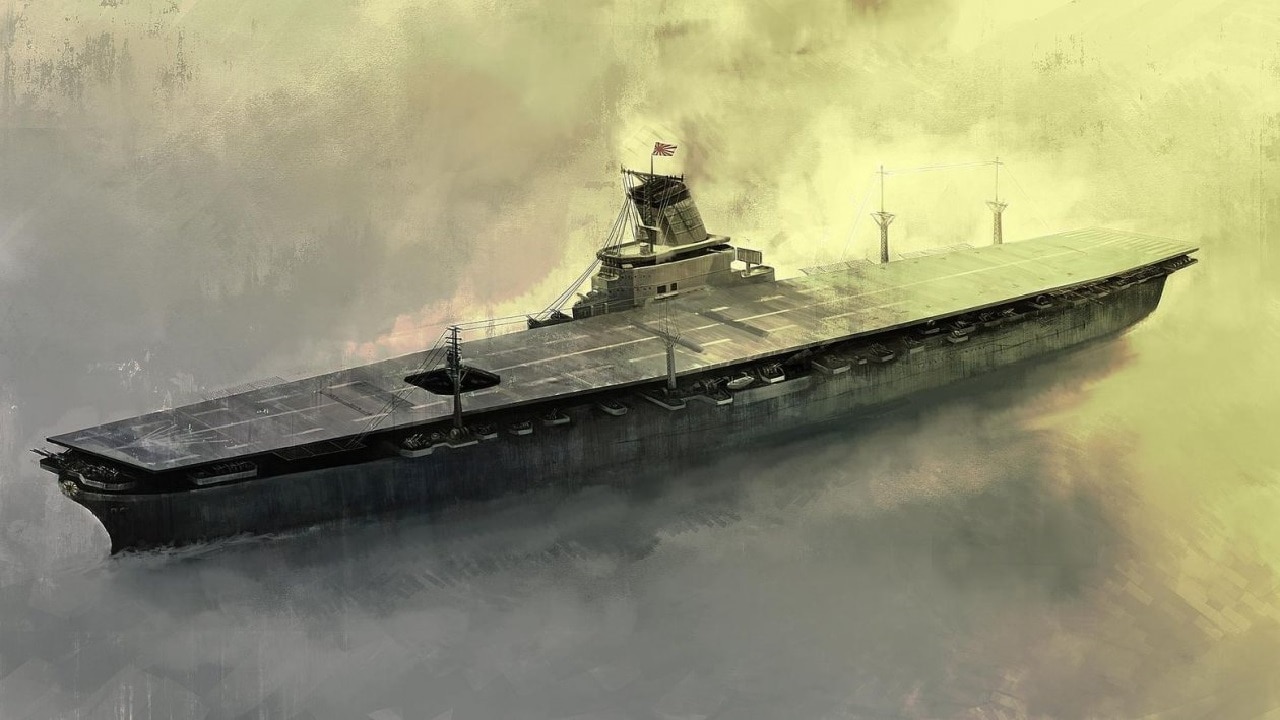
Aircraft Carrier Shinano. Image Credit: Creative Commons.

Shinano Aircraft Carrier from Japan.
72,000 Tons Supported Only 47 Operational Aircraft
Postwar sources differ slightly on displacement. A detailed reconstruction of Japanese carrier construction places Shinano near 68,000 long tons during trials and almost 72,000 tons fully loaded. She remained the world’s heaviest carrier until the American Forrestal class arrived in the 1950s.
The flight deck measured about 840 feet long and 131 feet wide. Roughly three inches of armor covered most of it over structural steel. One postwar study calculated that the ship carried almost 17,700 tons of armor inherited or adapted from her battleship origins.
Twelve boilers supplied four geared turbines producing 150,000 shaft horsepower through four propellers. Shinano was designed for about 27 knots and an estimated range of 10,000 nautical miles at 18 knots. Defensive weapons included sixteen five-inch guns, more than 100 25 mm anti-aircraft guns, and 12 rocket launchers.
The planned air group comprised 18 fighters, 18 attack aircraft, and six reconnaissance planes, with several in reserve. Shinano also had workshops and storage for replacement aircraft serving other ships and land bases, but those planes were not a large embarked strike wing. That distinction explains why the 72,000-ton hull carried fewer operational aircraft than much smaller carriers.
Japan Sent Shinano to Sea Before She Was Finished
Work accelerated after Japan lost Taiho and Shokaku during the Battle of the Philippine Sea and after B-29 reconnaissance reached the Tokyo area. Shinano suffered bow damage during an October 1944 undocking accident, received hurried repairs, and entered commission on November 19.
Captain Toshio Abe requested a delay in the transfer from Yokosuka to Kure, where final fitting out was supposed to continue. Many watertight doors had not been installed, openings through bulkheads remained unsealed, pumps and fire mains were incomplete, and the damage-control organization had little training.
Shinano departed on November 28 with three destroyer escorts and more than 2,500 sailors, shipyard workers, and other personnel aboard. The carrier also transported 50 Ohka rocket-powered weapons and six Shinyo explosive motorboats. Her operational air wing was waiting at Kure.
USS Archerfish Tracked the Carrier for Six Hours
Archerfish was a Balao-class submarine displacing about 1,525 tons on the surface. Its radar found the Japanese formation on the evening of November 28. Commander Joseph Enright then spent about six hours moving into attack position as Shinano zigzagged through the darkness.
An overheating shaft bearing forced the carrier to slow to roughly 18 knots. Abe also recalled a destroyer that moved toward Archerfish because he feared the submarine was a decoy for an American wolfpack.
Shortly after 3:15 a.m. on November 29, Archerfish fired six torpedoes set to run shallow. Four hit Shinano’s starboard side. Enright saw the carrier begin to list before taking his submarine deep.
Incomplete Watertight Integrity Turned Four Hits Into a Loss
The torpedoes did not immediately destroy the Shinano. Officers trusted the ship’s battleship armor and kept her moving, forcing more water through openings below the waterline. Flooding spread through missing doors, cable penetrations, and compartments that had not been tested for watertightness.
The list increased as pumps failed to control the water. Two destroyers attempted to tow the carrier, but their lines parted. Abe ordered the abandonment of the ship at 10:18 a.m. Shinano rolled to starboard and sank stern-first at 10:57.
About 1,435 sailors and civilians died, including Abe, while the escorts rescued 1,080 people. Shinano remains the largest warship sunk by a submarine.
The U.S. Navy Did Not Know What Archerfish Had Sunk
Shinano had been built under such secrecy that American intelligence initially credited Archerfish with sinking a much smaller 28,000-ton carrier. Enright’s sketches preserved the outline of the target until Japanese records became available after the war.
Those records confirmed Shinano’s identity. Enright received the Navy Cross, and Archerfish received the Presidential Unit Citation for the patrol.
MORE – Ukraine’s Drone Playbook Is Making Putin Think Twice
About the Author: Harry J. Kazianis
Harry J. Kazianis (@Grecianformula) was the former Senior Director of National Security Affairs at the Center for the National Interest (CFTNI), a foreign policy think tank founded by Richard Nixon based in Washington, DC. Harry has over a decade of experience in think tanks and national security publishing. His ideas have been published in the NY Times, The Washington Post, The Wall Street Journal, CNN, and many other outlets worldwide. He has held positions at CSIS, the Heritage Foundation, the University of Nottingham, and several other institutions related to national security research and studies. He is the former Executive Editor of the National Interest and the Diplomat. He holds a Master’s degree focusing on international affairs from Harvard University.