
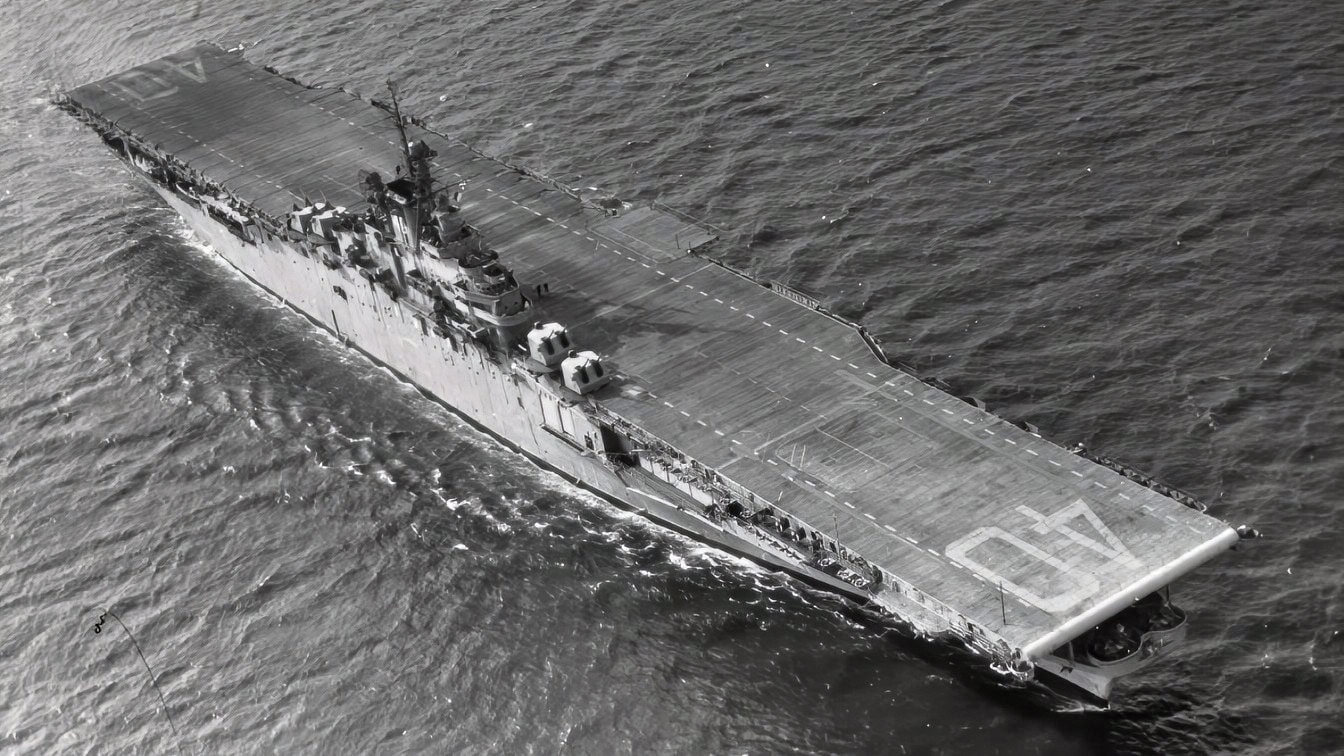
The World War II Battle of Tarawa, which took place from November 20–23, 1943, was one of the bloodiest battles in United States Navy and Marine Corps history—the “devil dogs” suffered almost as many KIA in 76 hours therein as U.S. troops suffered in the six-month Guadalcanal campaign— so it stands to reason that the USN would commemorate that battle by naming a warship in its honor.
Indeed, it didn’t take long for the Navy to do so, commissioning an aircraft carrier bearing the Tarawa name barely two years after the battle ended.
USS Tarawa (CV-40) Initial History, Premise, and Vital Stats
USS Tarawa was the 22nd ship of the 24-strong Essex class of aircraft carriers. More specifically, she was part of the so-called “long-hull” Ticonderoga subclass, which featured a bow lengthened above the waterline into a “clipper” form.
The increased rake and flare provided deck space for an additional quadruple Bofors 40mm anti-aircraft gun mount, and the flight deck was slightly shortened forward to provide better arcs of fire.
These modifications came in quite handy for defense against Japanese kamikaze attacks.
CV-40 carried 32 of those 40mm Bofors guns for self-defense, along with 46 Oerlikon 20mm AA guns and a dozen 5-inch/38-caliber dual-purpose naval guns. As for the flattop’s raison d’etre, carrying capacity was 90-100 aircraft.
Other tech specs included a hull length of 888.5 feet, a beam width of 93.2 feet, a flight deck width of 129.9 feet, a draft of 30.8 feet, and a fully-laden displacement of approximately 38,500 tons. Max speed was 33 knots. Crew complement was 3,448 commissioned officers and enlisted seamen.
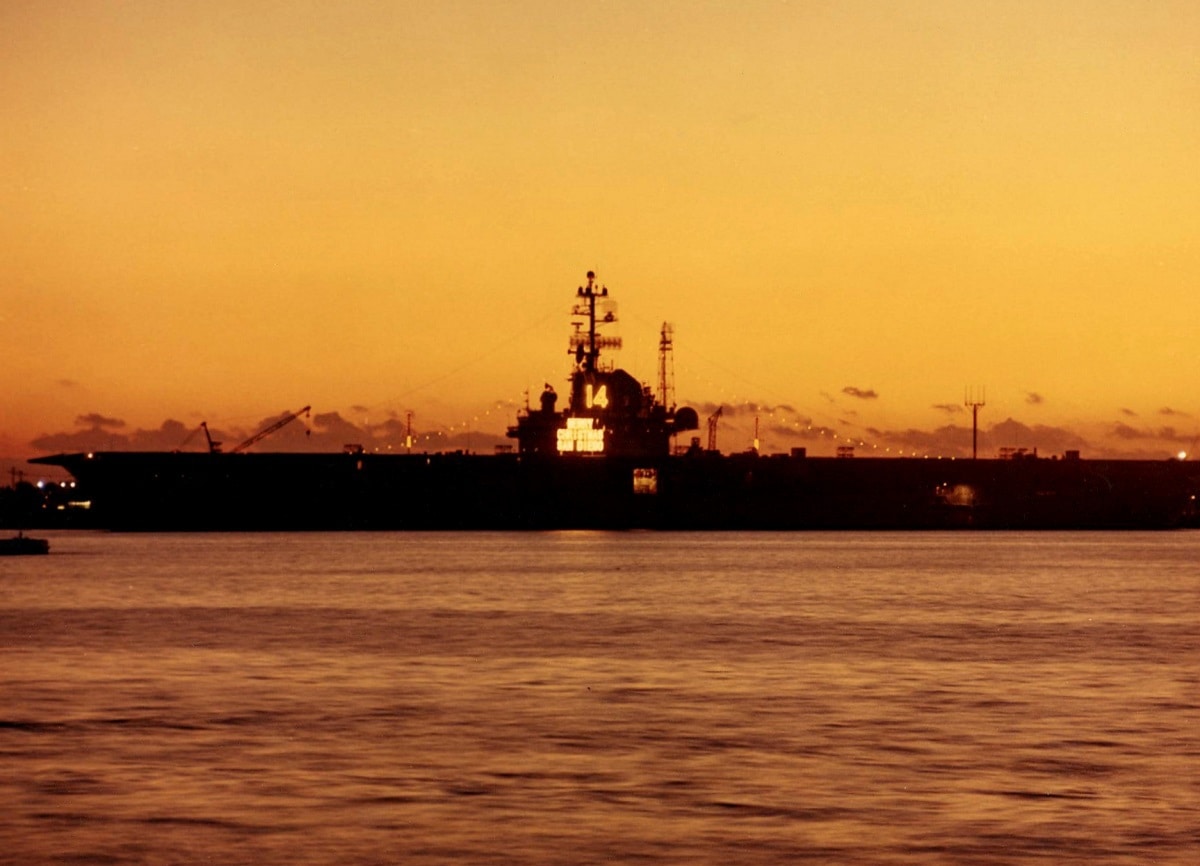
Essex-Class. Image Credit: Creative Commons.
Shipbuilding was carried out at the Norfolk Naval Shipyard in Portsmouth, Virginia. The warship was laid down on March 1, 1944, launched on March 12, 1945, and initially commissioned on December 8, 1945. Capt. Alvin Ingersoll Malstrom—a Silver Star recipient during WWII—was the vessel’s first skipper.
Operational History in Brief
By virtue of her commissioning date, CV-40 missed out on seeing WWII action by four months. As part of the postwar drawdown, she was decommissioned on June 30, 1949.
And ironically enough—especially considering the incredibly bloody battle she was named after—USS Tarawa would end up as the *only* Essex-class flattop—1 out of 24, which equates to a 4.16 percentile—to never see combat action!
Luck of the draw perhaps? Whatever you chalk it up to, Naval History and Heritage Command (NHHC) elaborates further: “[O]n 30 November 1950, she was ordered reactivated in response to the Navy’s urgent need for warships, particularly for aircraft carriers, to prosecute the war which had erupted in Korea the previous summer…On 3 February 1951, Tarawa was recommissioned at Newport, R.I., Capt. John H. Griffin in command.
Though reactivated in response to the Korean War [sic], Tarawa never saw service in that conflict. Rather, she served as a replacement in the Sixth and Second Fleets for carriers dispatched to the war zone.
On 1 October 1952, she became an attack aircraft carrier and was redesignated CVA-40.
The warship finally made it to the Asiatic war zone in the spring of 1954, but long after the July 1953 armistice had ended hostilities.”
On January 10, 1955, CVA-40 was redesignated again, this time as CVS-40 to reflect her conversion to antisubmarine warfare (ASW) carrier status.
She was finally decommissioned for the last time on May 13, 1960, but would still receive yet one more redesignation in May 1961 whilst sitting in reserve status at Philadelphia, this time as AVT-12, indicating auxiliary aircraft transport status.
Where Is She Now?
Alas, unlike four of her Essex-class sister ships—namely USS Yorktown (CVS-10), USS Hornet (CVS-12), USS Lexington (AVT-16), and USS Intrepid (CVS-11)—CV-40 wasn’t preserved for posterity as a floating museum.
She was stricken from the Naval Register on June 1, 1967, and on October 3, 1968, she was sold for scrap to the Boston Metals Company in Baltimore, Maryland.
The USS Tarawa moniker was revived via the Tarawa-class amphibious assault ships that were built between 1971 and 1980. The eponymous lead ship of that class, USS Tarawa (LHA-1), served from 1976 to 2009, and was sunk as a target during Exercise RIMPAC 2024, sent to the bottom by an AGM-158C LRASM (Long Range Anti-Ship Missile) launched from an F/A-18F Super Hornet.
It remains to be seen whether and when the Navy will commission another vessel bearing the name Tarawa.
MORE – The Real Iran War Problem Trump Can’t Solve
About the Author: Christian D. Orr
Christian D. Orr is a Senior Defense Editor. He is a former Air Force Security Forces officer, Federal law enforcement officer, and private military contractor (with assignments worked in Iraq, the United Arab Emirates, Kosovo, Japan, Germany, and the Pentagon). Chris holds a B.A. in International Relations from the University of Southern California (USC) and an M.A. in Intelligence Studies (with a concentration in Terrorism Studies) from American Military University (AMU). He is also the author of the book “Five Decades of a Fabulous Firearm: Celebrating the 50th Anniversary of the Beretta 92 Pistol Series,” the second edition of which was recently published.