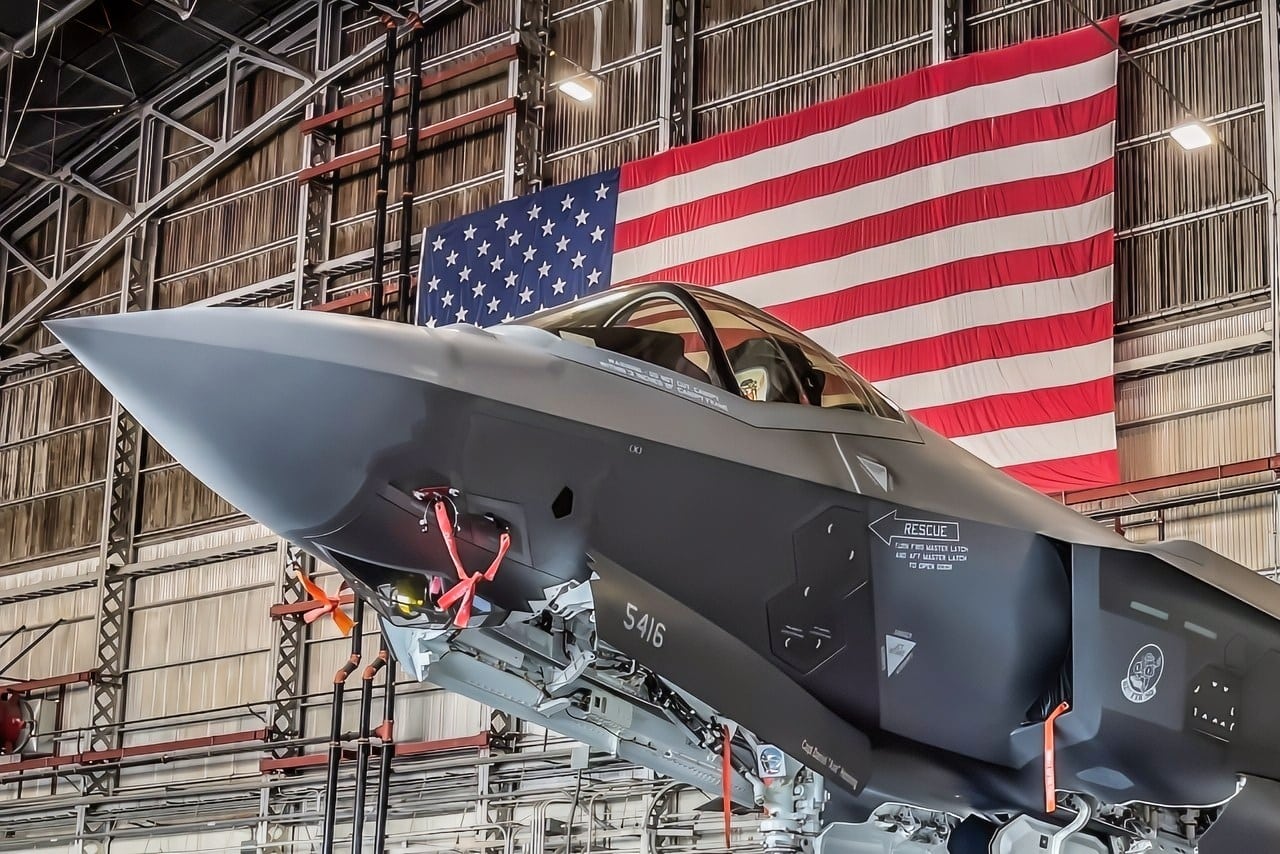
Canada’s ongoing hunt for a replacement fighter jet for its Cold War-era CF-18 Hornets is one of Ottawa’s longest and most contentious procurement controversies. A question that appeared to be amicably settled in 2023 has resurfaced as a lively debate. The impetus for the continued uncertainty around Canada’s decision on the F-35 has very little to do with the warplane itself — a jet that meets virtually all of Canada’s requirements — and much more to do with Canada’s increasingly contentious and, at times, outright adversarial relationship with its neighbor to the south.
The Canadian competition originally resulted in Lockheed Martin’s F-35A being selected over Sweden’s Saab Gripen E. Canada put ink to paper after that procurement competition, signing an agreement with Lockheed for 88 F-35As in total, with initial deliveries slated for 2026. But what was seen as a done deal is no longer a settled question.
Beginning early last year, the Canadian government decided to review its decision on the F-35A.
That review remains ongoing, and Canadian Defence Minister David McGuinty has confirmed that Canada is still assessing its options vis-à-vis the fighter jet.
While Ottawa has continued making payments for jets it has already contracted for, the government has left open the option of altering its future fighter fleet composition to include an alternative to the F-35A.
A Deteriorating Relationship
The once-amicable relationship between Ottawa and Washington significantly deteriorated under the Trump administration, with the two countries’ quibbles centered on trade disputes and border concerns.
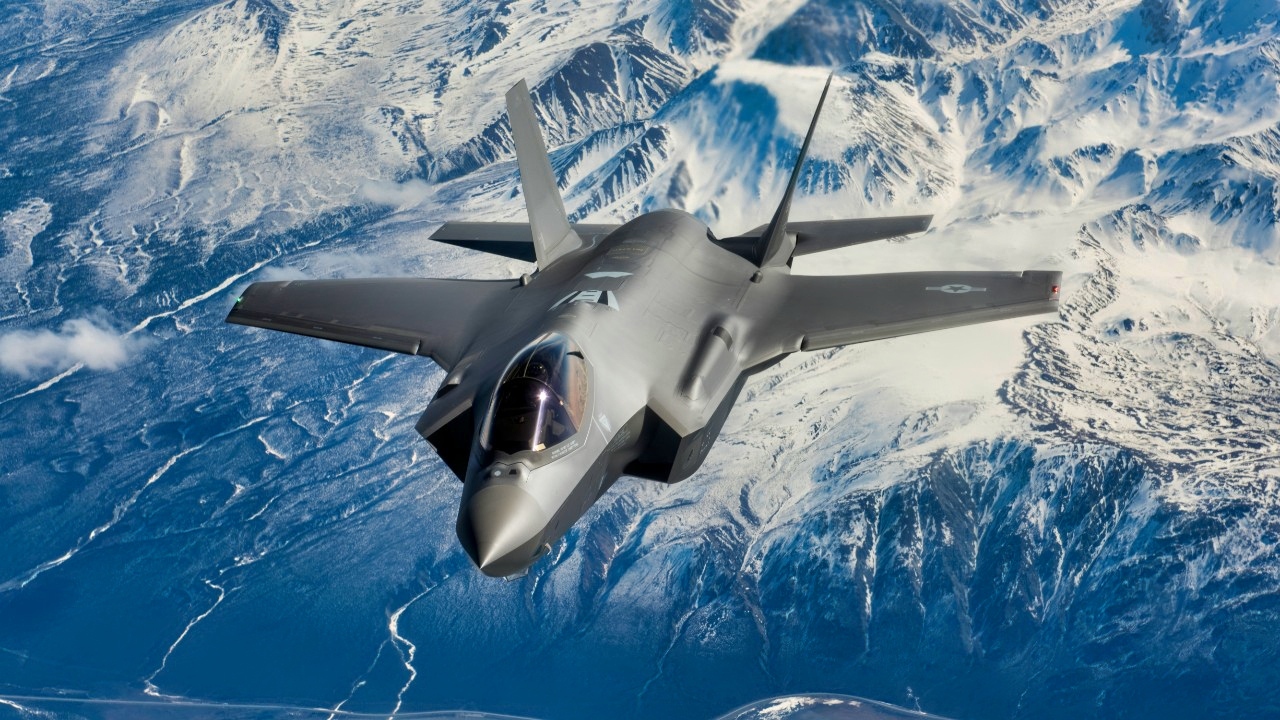
A new F-35A Lightning II fifth-generation fighter aircraft flies over the Alaska Canada Highway en route to its new home at the 354th Fighter Wing, Eielson Air Force Base, Alaska, April 21, 2020. The F-35 represents a new model of international cooperation, ensuring U.S. and Coalition partner security well into the 21st Century. (U.S. Air National Guard photo by Tech. Sgt. Adam Keele)
In light of Canada’s heavy reliance on the United States for trade and defense, the wisdom of future American dependability came under question.
Because the F-35’s software, logistics, and much of the platform’s sustainment are under American control, F-35 detractors argue that Canada is highly exposed to the whims of this and future administrations.
The NATO Angle
Support for the F-35 remains, however. Canada operates through both NORAD and NATO, and the F-35 is quickly becoming the standard fighter of choice for many countries within the NATO alliance.
Flying the same aircraft promotes and simplifies logistics, training, intelligence sharing, and joint operations with partners. Replacing the F-35 with another aircraft risks complicating logistical questions.
Saab’s Gripen E
The most obvious alternative to the F-35A is Saab’s Gripen E, a Swedish fighter and runner-up in the Canadian procurement competition that the F-35A ultimately won.
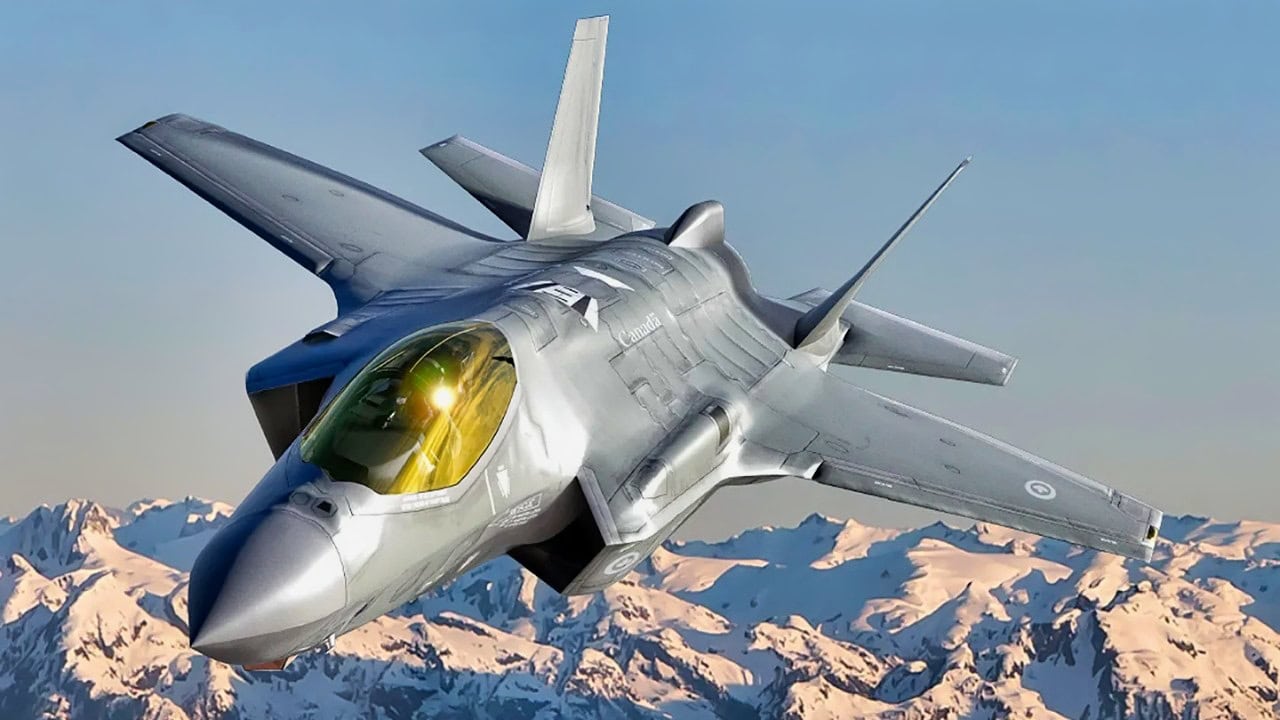
Canada F-35. Image Credit: Creative Commons.
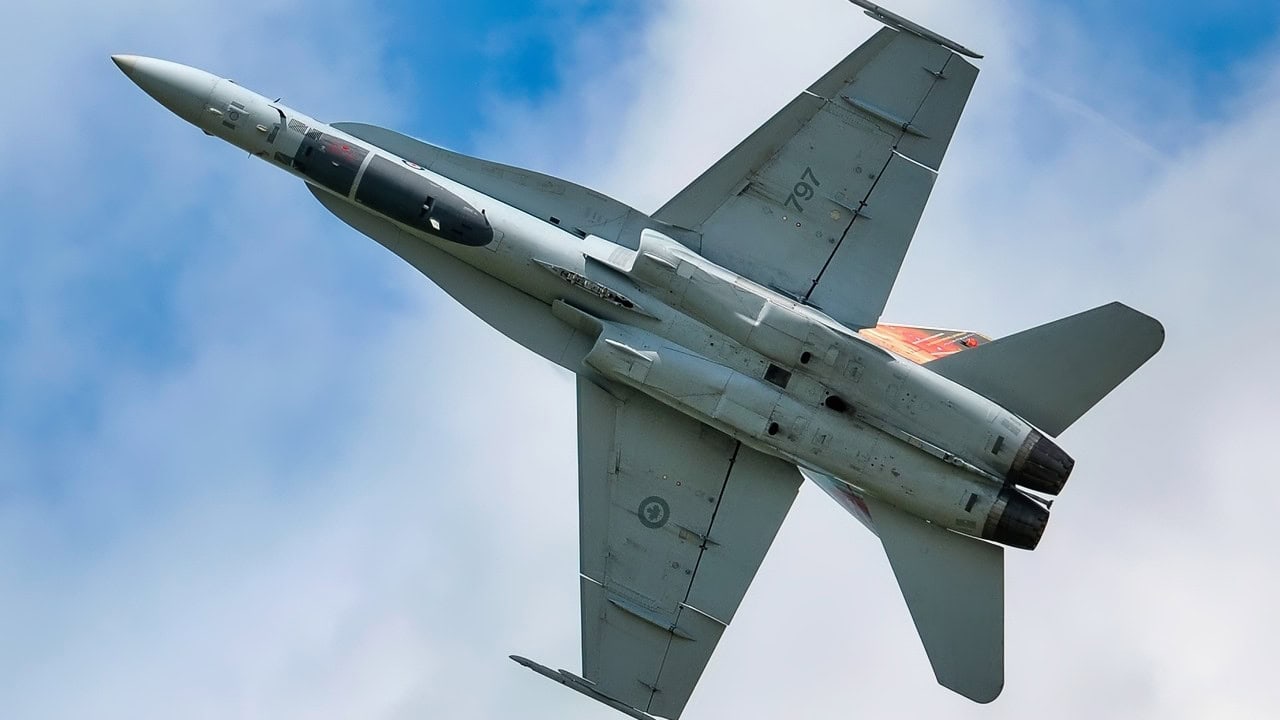
Canada CF-18 Hornet Fighter
The Gripen E boasts a couple of advantages that its proponents are quick to point out.
The Gripen E costs less to acquire and operate and was designed from the outset for dispersed, decentralized operations from austere airfields.
It is also relatively straightforward to service, refuel, and repair. Sweetening the deal is Saab’s offer for extensive Canadian industrial participation, which the company says would lead to significant job creation in Canada.
And while those factors are certainly true, they mask significant compromises as well.
The Gripen E is a capable fighter, but its technologies are very much rooted in fourth-generation fighter technology.
As such, the Gripen E lacks the radar-defeating low-observable stealth characteristics that make the F-35 such a valuable platform. In a modern air combat environment with integrated air defense systems, the Gripen E would be forced to rely on electronic warfare and stand-off weapons, unlike the F-35, which would attempt to evade radar detection completely.
The Canadian Armed Forces came to that conclusion during their fighter competition, and decided that the Gripen E would have limited capabilities in a high-end operation with a peer adversary.
A Mixed Fleet?
One possibility is that Canada could adopt a mixed fleet rather than relying on a single aircraft. Hypothetically, the Royal Canadian Air Force would retain a core of F-35A aircraft for NATO deployments and high-end operations while also buying into the Gripen E program for more routine Arctic patrols and domestic air defense.
The move could reduce dependence on a single supplier and also preserve access to fifth-generation capabilities.
But operating two different fighters creates complications too: two distinct pipelines for training, maintenance, logistics, spare parts, and infrastructure would be a significant drawback.
Over the long term, operating two distinct platforms could be more expensive than operating a single fleet.
Beyond this procurement question, Canada has also indicated it is mulling a decision on the next generation of combat aviation: sixth-generation aircraft.
Just last month, Ottawa joined the Global Combat Air Programme, commonly known as GCAP, as an observer nation. GCAP currently counts three country members, the British, Japanese, and Italians, who hope to combine their resources and expertise to build a sixth-generation fighter.
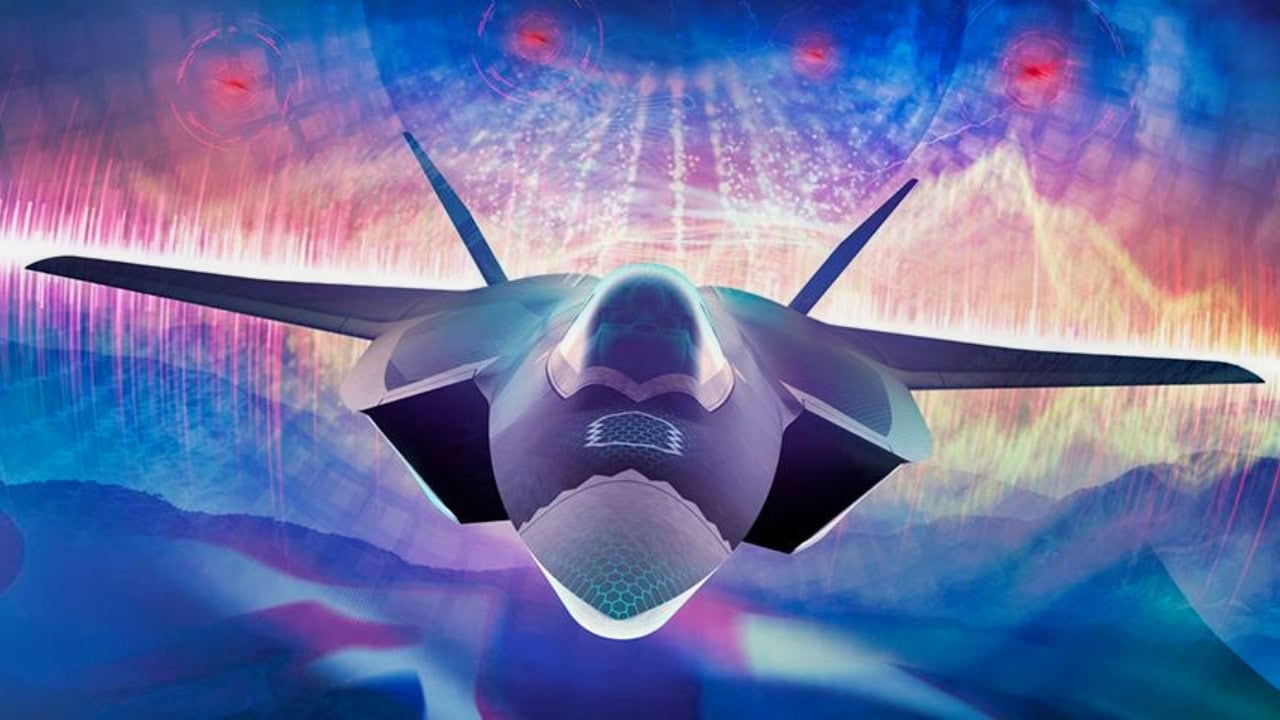
GCAP Fighter. Industry Handout Image.
Importantly, Canada’s observer nation status does not commit Ottawa to purchasing future aircraft — in fact, it imposes no financial obligations on the country — but it does allow access to internal discussions about technology development, anticipated operational roles, and potential industrial collaboration.
Into the Future
While the F-35A remains the leader in capabilities and interoperability, the F-35 question has become one of a political nature. Genuine questions about supply chain resilience, as well as the future reliability of access to American military equipment — without strings attached — have opened up what was once seen as a closed procurement question.
If Canada moves forward with all 88 F-35As it was originally slated to order, or opts instead for a mixed fleet, remains an open question.
About the Author: Caleb Larson
Caleb Larson is an American multiformat journalist based in Berlin, Germany. His work covers the intersection of conflict and society, focusing on American foreign policy and European security. He has reported from Germany, Russia, and the United States. Most recently, he covered the war in Ukraine, reporting extensively on the war’s shifting battle lines in the Donbas and writing on its civilian and humanitarian toll. Previously, he worked as a Defense Reporter for POLITICO Europe. You can follow his latest work on X.