
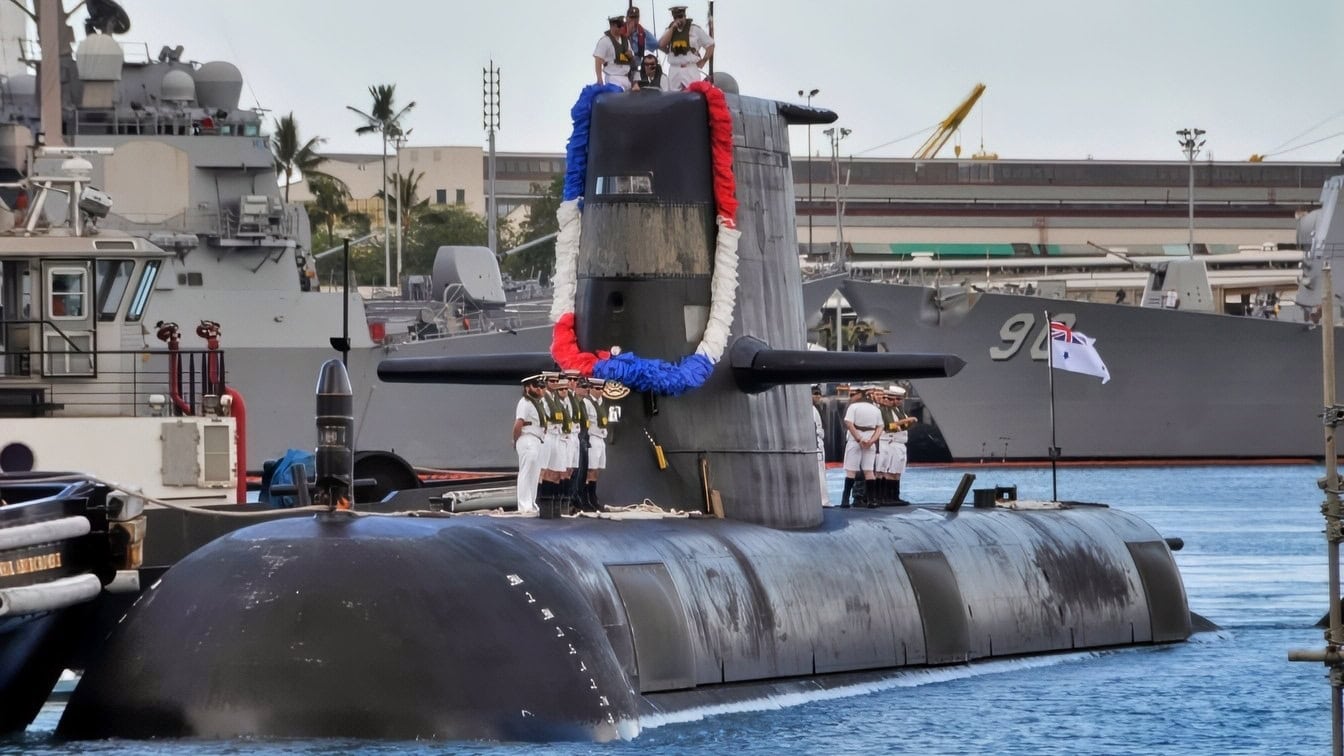
AUKUS program is a trilateral partnership between the United States, the UK, and Australia.
One of the program’s primary goals is to produce a new class of nuclear submarines for the Royal Australian Navy (RAN): the Aukus-class.
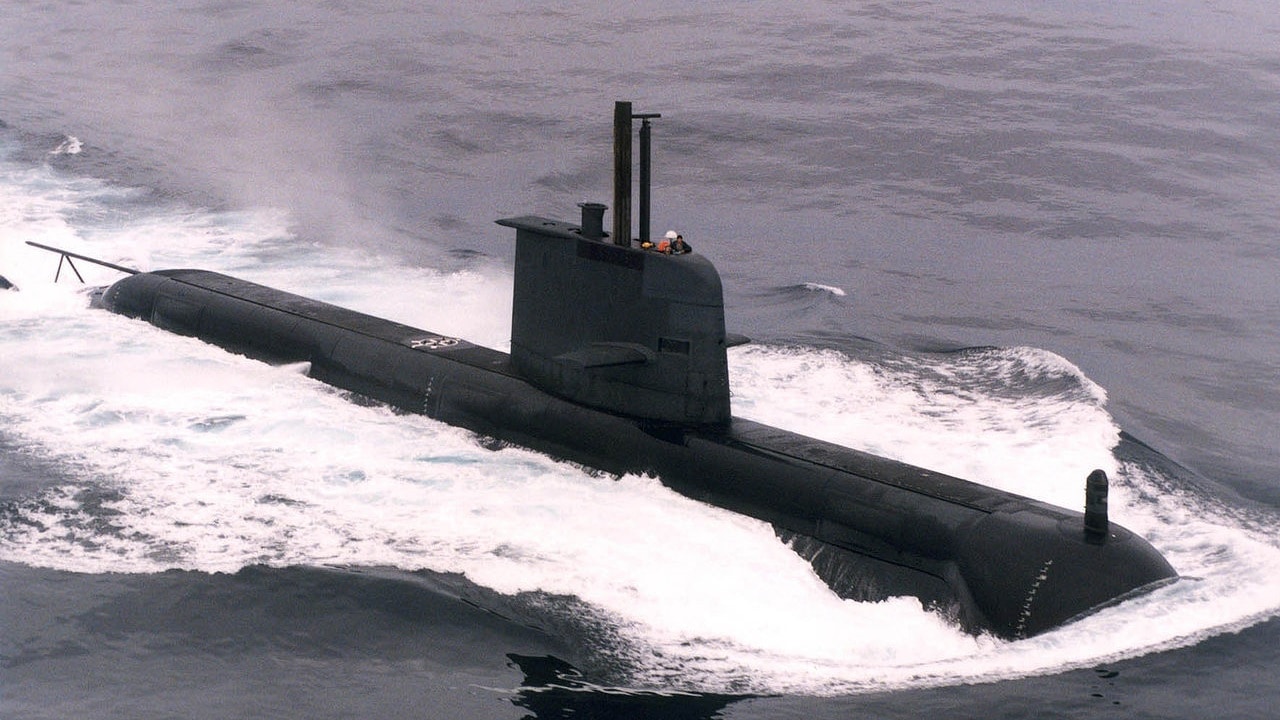
Collins-Class Submarine from Australia.
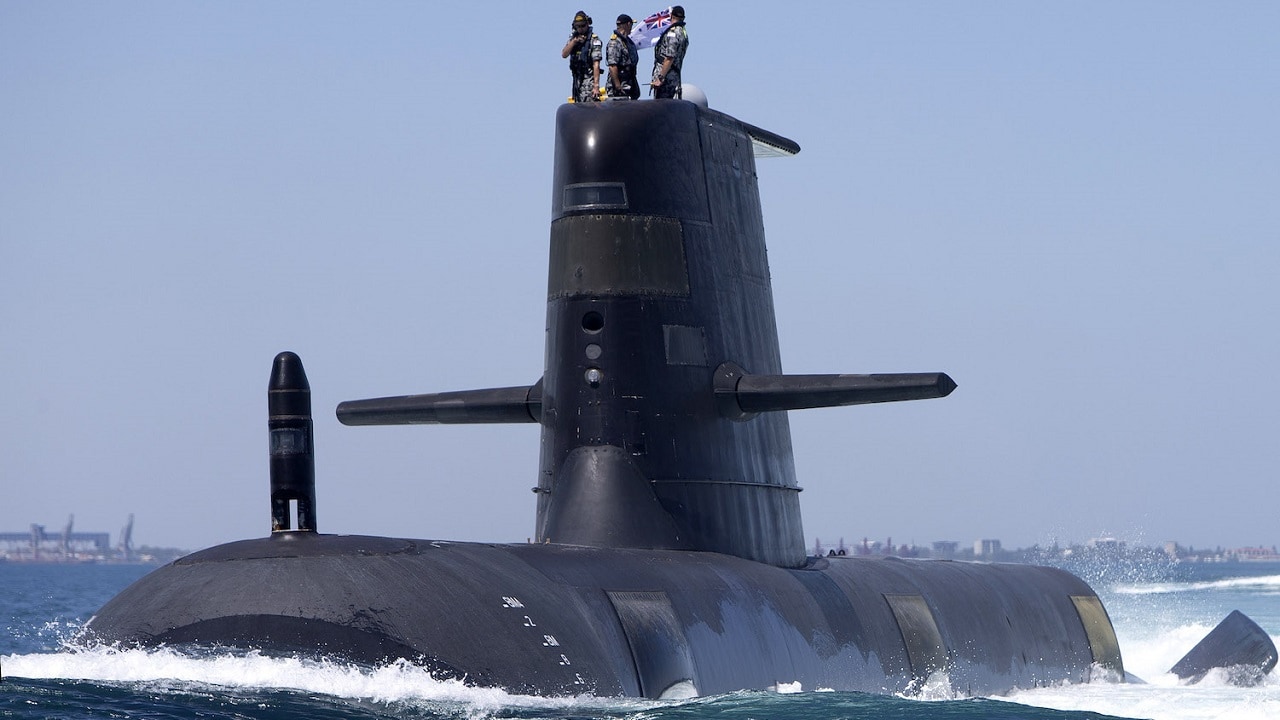
Collins-Class Submarine from Australia’s Navy.
However, the initiative has run into multiple hurdles, with cost overruns and delays running rampant. With the program timeline constantly pushed back, the RAN is forced to rely on its aging Collins-class submarines until the U.S. delivers its promised Virginia-class submarines as a stop-gap measure.
The Collins-class submarines have been in service since the 1990s, and their service life has been plagued by various issues from day one.
Development and Construction
In 1978, the RAN launched a study into replacing its then-aging Oberon-class submarines.
The Navy also suggested that its replacements be built domestically in Australia, a proposal that was met with significant pushback given the precarious state of Australian shipbuilding at the time.
Nevertheless, the proposal was eventually accepted, and the RAN sent out a request to the most prominent diesel-electric submarine manufacturers.
After reviewing their options, the Australians settled on the Type 471, a design by the Swedish shipbuilder Kockums which would be fitted with the Rockwell Combat system.
In 1986, the Navy formalized a contract for six submarines, totaling around $3.9 billion.
Construction of the Collins-class began in 1990.
While submarines were intended to be built domestically, certain sections and subsections had to be built abroad for cost and manufacturing considerations, although around 70% of the ships’ hulls were built and assembled at the newly built production facility in South Australia.
It was during construction that the first of many issues with the ship surfaced. Many defective welds were discovered in the bow and escape sections.
These sections, assembled in Sweden, were rushed due to time constraints, and, according to some reports, the Swedes employed welders who were not qualified to work with the high-strength steel used on the Collins-class. Consequently, fixing the poor-quality welds quadrupled the time that HMS Collins spent in dock.
Design Problems and Delays
The problems didn’t end once Collins, the first ship of the class, finally started her sea trials. It was discovered that the ship’s acoustic profile produced much more noise than the initial studies had anticipated, especially at higher speeds.
Although tests were conducted using scale models, the ship’s design was altered during development.
The propellers had to be redesigned entirely to reduce cavitation. Several changes had to be made to Collins’ hull to fix its acoustic profile.
The dorsal fin was lengthened and tapered to better integrate it into the upper hull section, and the hollow section aft of the bow curvature was filled in with carbon fibor/fibreglass cover.
Additional modifications were made to the ship’s casings to further refine its profile and avoid cavitation.
Other problems were discovered with the ship’s propulsion and mast systems, but the major bottleneck was the development of the combat system.
Originally, Rockwell was tasked with developing an entirely new combat system for the Collins-class.
The project ran into a major hurdle when Singer Librascope and Thomson-CSF, two companies that were partnering with Rockwell, refused to release their software code for Rockwell to sell.
As a result, the combat system was massively delayed.
The major difficulty, however, was that the RAN’s requirements for the Rockwell combat system were too ambitious for the technology of the time.
Rockwell had attempted to develop the technology from scratch, but in the 80s and 90s, computer technology simply was not advanced enough to fulfill the Navy’s demands.
Eventually, the Australians were forced to purchase the American AN/BYG-1 system, which is used on the Virginia-class submarines.
Life Extension and Replacement
The first years of the Collins-class’s service life were rough, with the ships spending more time in maintenance than at sea.
Because of their multiple issues, the ships were disliked by the public and viewed as a massive waste of everyone’s time and resources.
In 2011, however, the federal government conducted a review of the Collins-class led by Dr. John Coles, who drafted the 2012 Coles Report.
The report detailed the many deficiencies in the program’s management and recommended a number of sweeping changes and reforms.
These reforms were implemented in 2013, and ever since then, the Collins-class has made a remarkable recovery. The class’s readiness rates improved dramatically, although the program has not been without its issues.
Despite the Collins-class’s dramatic turnaround, the ships are aging.
The lead ship was commissioned back in 1996 and has recently passed 30 years in service.
Maintaining these subs is becoming increasingly difficult for the Australians as the ships receive one life-extension program after another.
The original replacement, the Attack-class submarines, was later canceled, and now AUKUS is intended to serve as the Collins-class’s replacement.
However, with the AUKUS program facing delays and difficulties, the RAN has to rely on its Collins-class submarines until the Americans deliver the three Virginia-class ships they promised in 2023.
About the Author: Isaac Seitz
Isaac Seitz, a Defense Columnist, graduated from Patrick Henry College’s Strategic Intelligence and National Security program. He has also studied Russian at Middlebury Language Schools and has worked as an intelligence Analyst in the private sector.

