
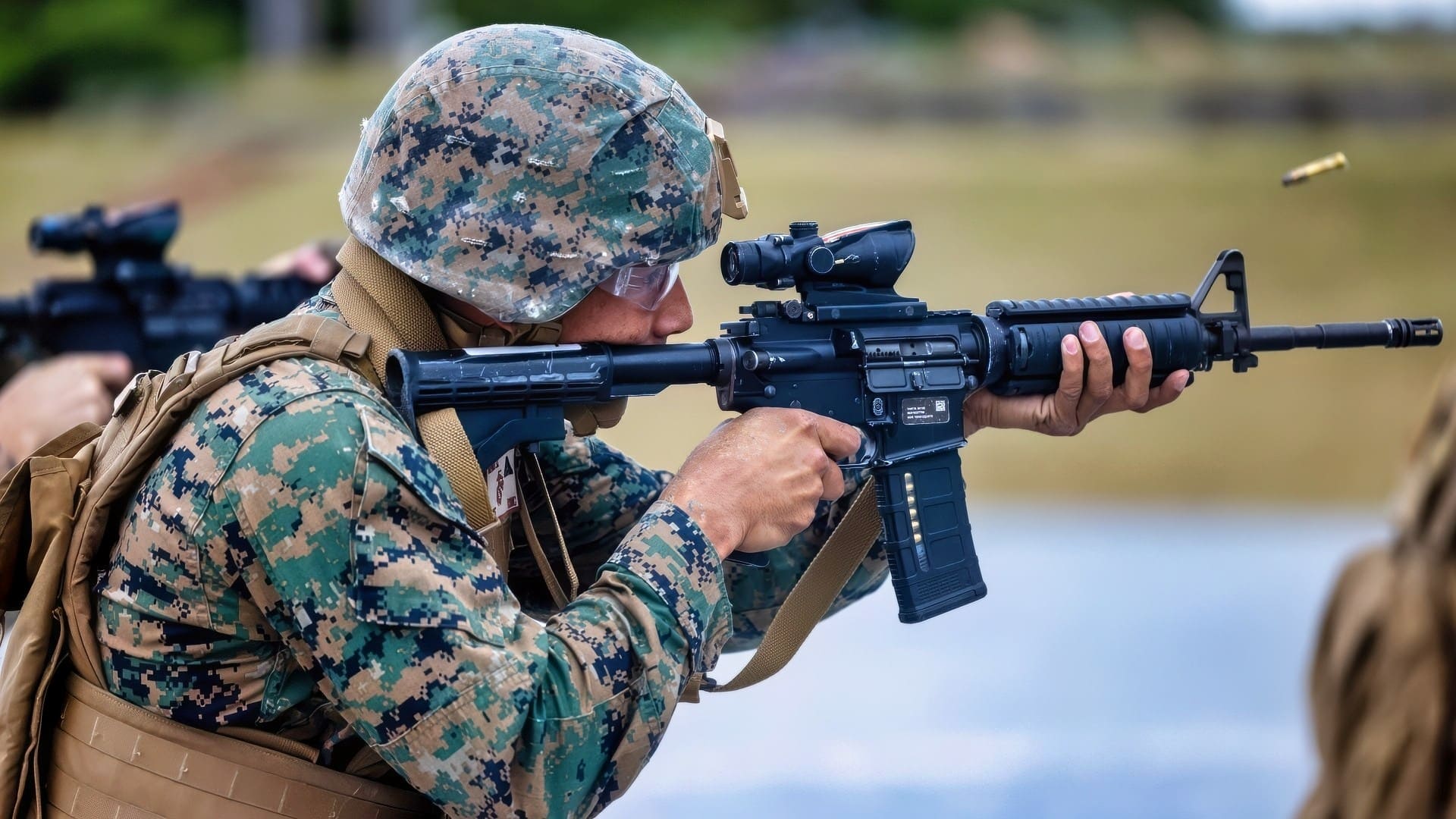
I’ve spent enough time around the M4 Carbine weapon system, and around the men and women who’ve carried it, to know that the M4 carbine was an outstanding weapon.
The M4 didn’t just become the standard-issue weapon of the U.S. military by accident; it earned that role through three decades of combat, adaptation, and hard lessons learned from several conflicts.
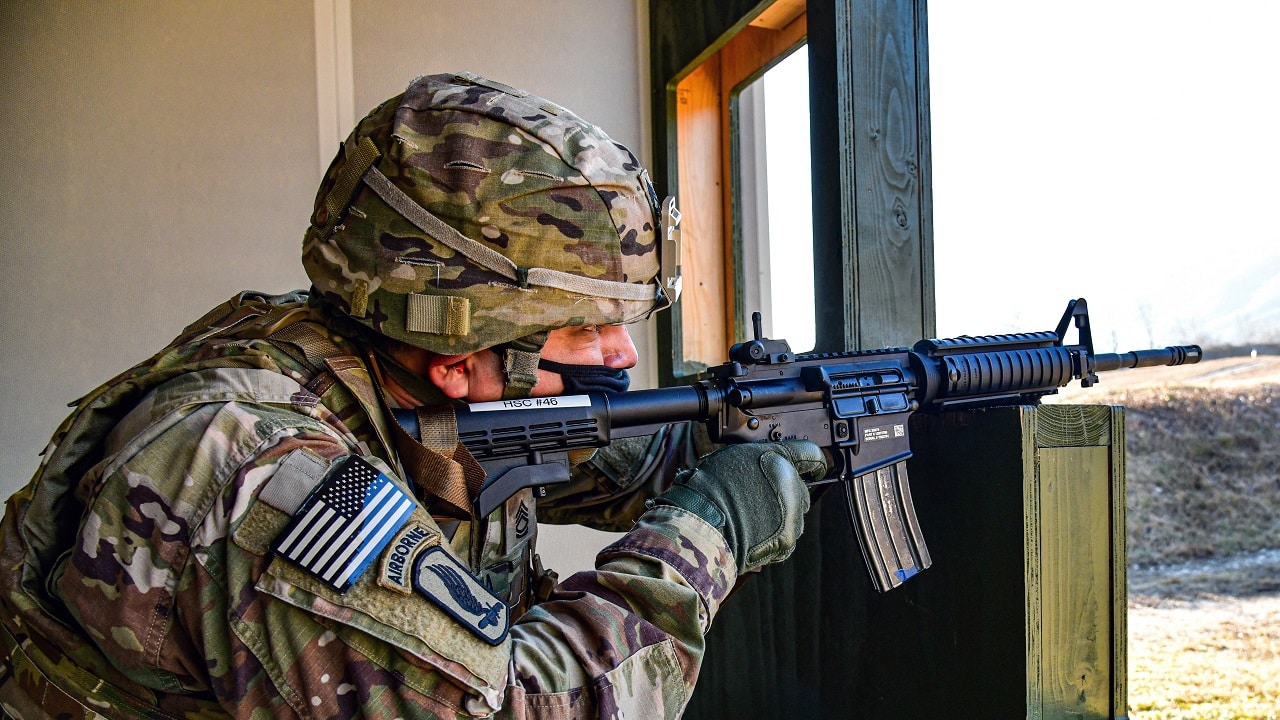
A Soldier assigned to U.S. Army Southern European Task Force, Africa engages pop-up targets with an M4 carbine during marksmanship training at Cao Malnisio Range in Pordenone, Italy, Jan. 26, 2021. (U.S. Army photo by Davide Dalla Massara)
The M4 Carbine was first issued to select units in the mid-90s. In the 7th Special Forces Group, we received M4S in early 1994. And it was very popular and incredibly modular.
From the M16 In Vietnam to the M4
To understand the M4, you have to go back to Vietnam and the M16’s rocky introduction.
The M16 Rifle and its variants had a storied, if uneven, history.
Eugene Stoner, an engineer for ArmaLite Corp., developed the AR-15 rifle in the late 1950s.
ArmaLite received favorable reviews but failed to secure a government contract.
The rifle replaced the M14’s wooden stocks with black plastic ones and changed the caliber from .30 to .223/5.56mm.
In 1959, Colt obtained a license for the design and sold it to the US Air Force in 1962. The Department of Defense redesignated the rifle as the M16, and since then, upgraded and variant models of the M16 have served in the US military.
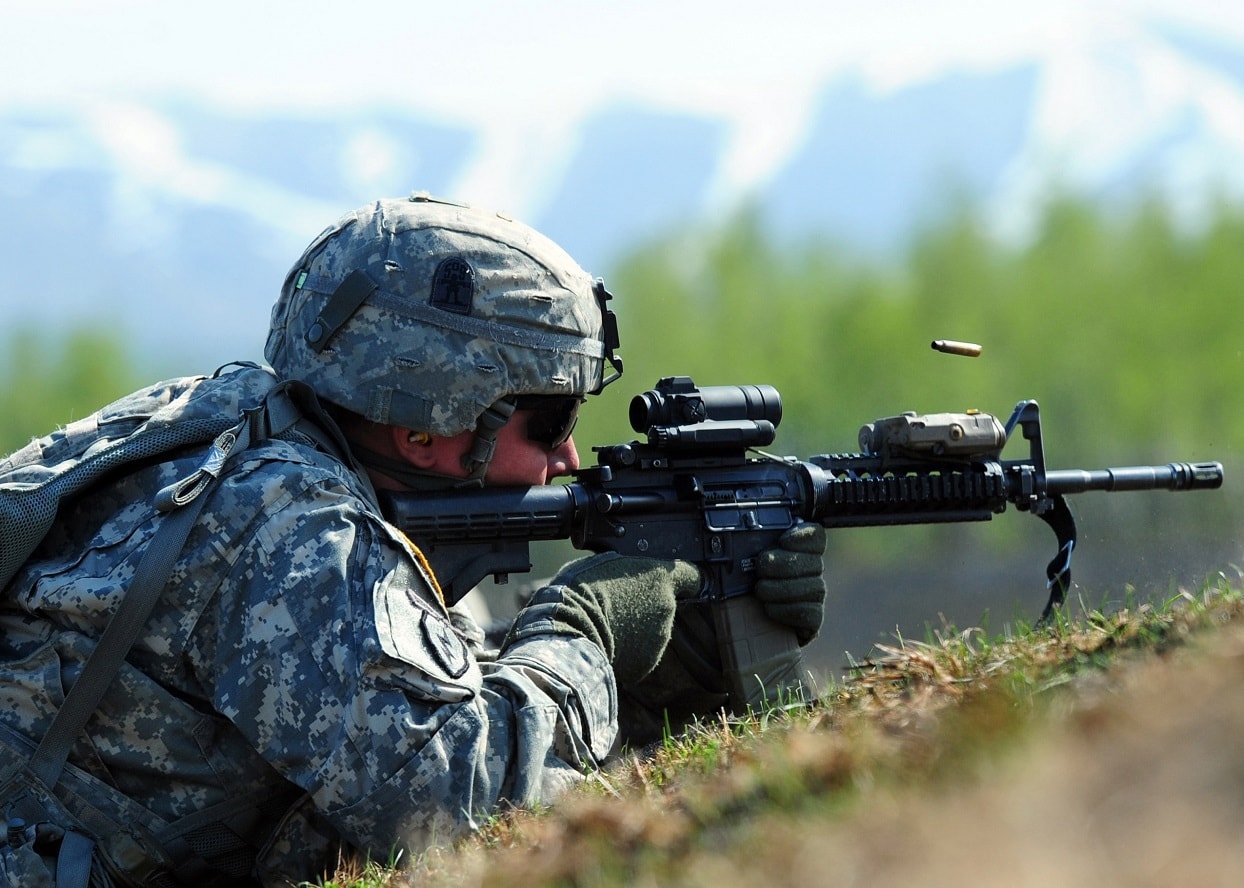
JOINT BASE ELMENDORF-RICHARDSON, Alaska — Cpl. Johnny Hurst, assigned to A Company 3rd Battalion (Airborne) 509th Infantry Regiment, a native of Chicago, Ill., fires his M-4 carbine during a live-fire and movement-to-contact operation on the Infantry Squad Battle Course at Joint Base Elmendorf-Richardson, Friday, May 31, 2013. The Soldiers focused on core infantry skills such as fire team movement, communication, shifting fire, and once on the objective identifying and eliminating weapons caches and treating and evacuating casualties. (U.S. Air Force photo/Justin Connaher)
Early Issues In Vietnam Were Fixed
Early models of the M16 were used in Vietnam during the mid-1960s but were prone to jamming.
Most of the issues were resolved through improved training on cleaning the weapon, adjusting the powder in the ammunition used, and developing the forward assist, which reduced malfunctions. This weapon was called the M16A1.
The rifle was used throughout the US military until the early 1980s, when the military changed the design to use a heavier barrel for longer sustained fire.
Additionally, the fully automatic feature was removed because it was deemed wasteful of ammunition and inaccurate.
Instead, the rifle incorporated the three-round burst. This model was dubbed the M16A2.
The Army had experimented with shortened M16 variants dating back to the XM-177 Commando and the CAR-15 program in Vietnam, but those early carbines had their own issues, with shorter gas systems resulting in more felt recoil, more fouling, and less reliable cycling.
XM177s featured very short 10-inch (XM177E1) or 11.5-inch (XM177E2) barrels with a long, distinct “moderator” muzzle device designed to reduce flash and muzzle report.
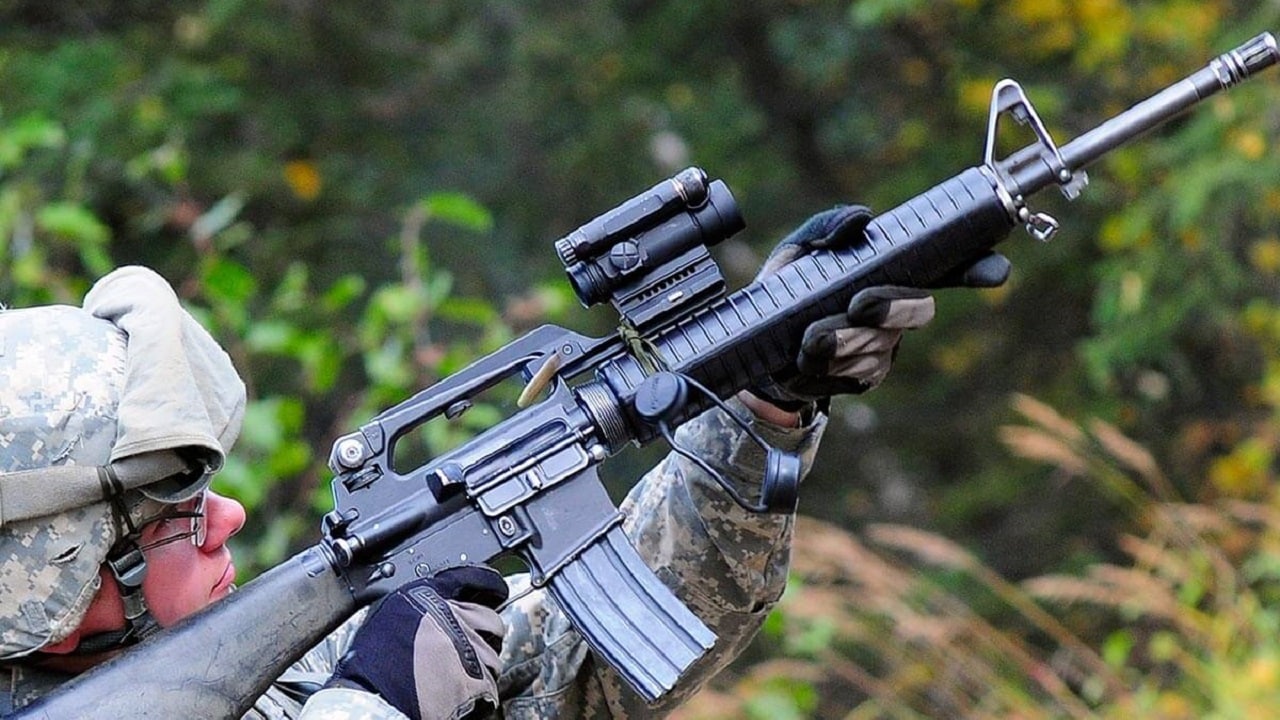
M16A2. Image Credit: Creative Commons.
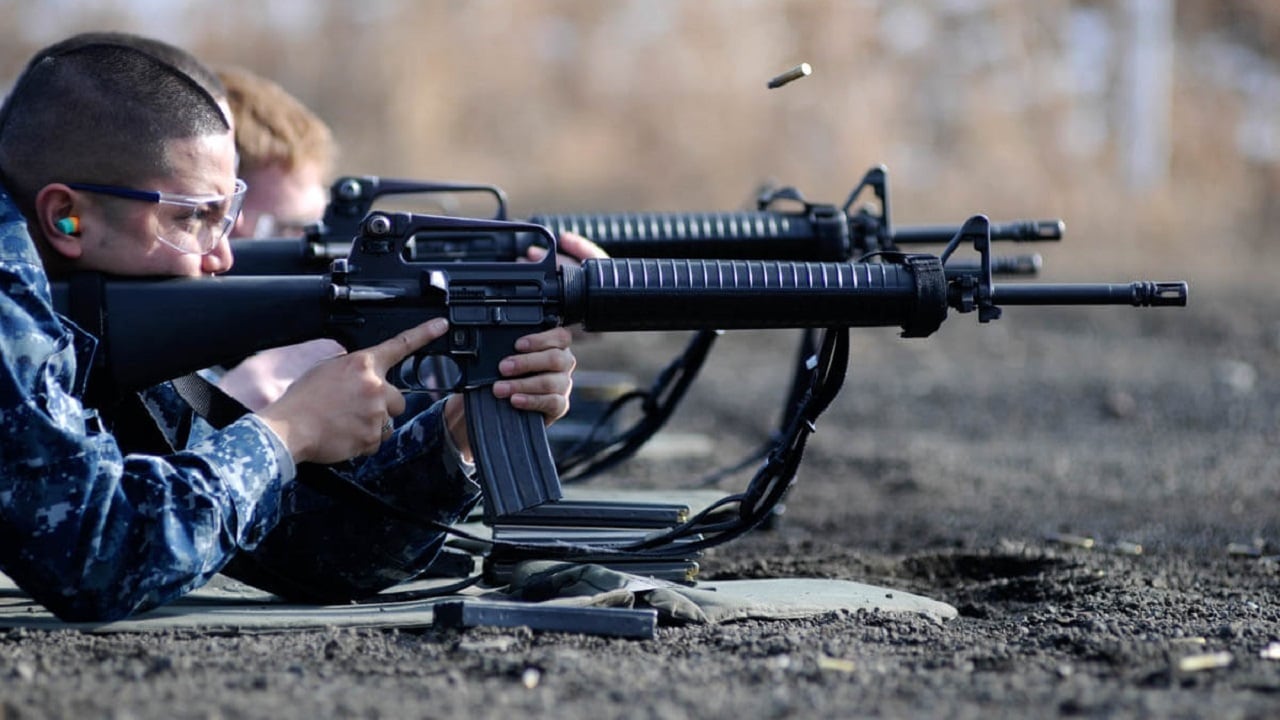
M16A2 rifle. Image Credit: US Army Creative Commons.
Special Forces in Vietnam used the XM-177 (Colt Commando) because its lightweight, compact design with a retractable stock was ideal for dense jungle fighting, where the standard M16 was too long.
Its 10- to 11.5-inch barrel provided superior firepower compared to submachine guns in close-quarters combat.
The short barrel and collapsible stock made the weapon easy to handle in tight, dense, and tangled vegetation, reducing the risk of snagging. It offered 5.56mm rifle-caliber, full-automatic fire from a weapon roughly the size of a submachine gun.
The M4 Was Adopted In The Early 1990s
It took until the early 1990s for Colt to refine the design into what became the M4. The Army officially adopted it in 1994, and by 1997, it was fielding it to units in numbers.
The idea was simple: keep the reliability that troops already knew from the M16A2, but cut the barrel down to 14.5 inches, add a collapsible stock, and give troops a weapon that could do double duty, a rifle and close-quarters weapon in one package.
Baptism by Fire In “The Mog”
The M4 didn’t get its real test in training. It was acquired in Mogadishu in October 1993, technically before full adoption, when an early carbine variant rode with Task Force Ranger during the Battle of Mogadishu.
Master Sergeant Gary Gordon, who was awarded a posthumous Medal of Honor, famously used a customized Colt Model 723 with a painted finish and a suppressor during the 1993 battle.
Then came Afghanistan and Iraq, where the M4 became the default weapon for an entire generation of American infantrymen, special operators, and support troops alike.
However, during the 2008 Battle of Wanat in Afghanistan’s Nuristan Province, the weapon became a flashpoint.
Soldiers reported that M4S overheated and jammed during sustained firefights against a numerically superior enemy force.
That fight, along with mounting field reports from a decade of high-tempo combat, forced the Army to take a hard look at whether the direct-impingement gas system and carbine-length gas tube could withstand the punishment of modern combat.
The Improvements Made To The M4
The Army fielded the M4A1 as the new standard, with a heavier barrel profile to better handle sustained automatic fire, full-auto capability replacing the old three-round burst, and an ambidextrous fire control group.
Piston-driven aftermarket uppers, improved extractors, better bolts, and free-float rail systems all worked their way into the fleet.
Optics evolved too: the ACOG, the Aimpoint, and later a whole ecosystem of red dots and magnifiers turned the M4 into a modular weapons platform rather than a fixed rifle with iron sights.
That’s really the M4’s legacy: it became the chassis for an entire generation of attachments, optics, lights, and grips that let individual units and even individual shooters configure the weapon for their specific mission.
Special operations units pushed this the hardest, running suppressors, offset optics, and shorter barrels for CQB work, while conventional units adopted trimmed-down versions of the same modularity.
The M4 taught the American military to think of rifles as platforms rather than fixed designs — a mindset that directly shaped the NGSW program and the eventual move toward the XM7 in some units.
SOCOM units received the M4A1 and highly modified the weapon even further with the SOPMOD Block 1 Accessory Kit.

The l SOPMOD Block I kit included, but was not limited to:
–Knight’s Armament Company (KAC) Rail Interface System/Rail Adapter System (RIS/RAS) forearm with rail covers of various lengths.
-KAC Vertical Foregrip (VFG)
-KAC 300m backup iron sights (BUIS)
–Trijicon TA01M4A1 4x32mm Advanced Combat Optical Gunsight (ACOG)
-Aimpoint ECOS-N (Enhanced Combat Optical Sight-Navy), a variant of the CompM2 using the Wilcox Aimpoint CompM mount instead of the standard-issue QRP mount
-Tactical Ordnance and Equipment Improved Combat Sling, which allows for secure cross-body/patrol carry.
–Precision Reflex, Inc. (PRI) M69 Bracket Mount for the AN/PVS-14 night vision device.
The M4’s Lasting Legacy
Despite the ongoing 5.56 vs. 7.62 or the 6.8 mm debate about whether the military should have moved to a piston system sooner, none of that changes the fact that the M4 is one of the most combat-tested rifles in American history.
It armed troops during the wars in Afghanistan, Iraq, and fifteen-plus years of counterinsurgency warfare across two theaters.
It’s been carried by conventional grunts, Green Berets, SEALs, Marines, and contractors alike, and it’s been adapted, criticized, upgraded, and adapted again in a cycle that mirrors the broader story of the post-9/11 military: an institution that learns in real time, under fire, and keeps building on what works.
The M4 was never meant to be perfect. It was meant to be good enough, adaptable enough, and reliable enough to get troops through whatever came next, and for three decades, it has done exactly that.
Its true legacy isn’t the rifle itself, but the model it created: a weapons platform that evolves with the fight instead of waiting for the fight to catch up.
That’s the standard the NGSW and future small arms programs will be measured against, whether they admit it or not.
The U.S. Army is replacing the M4 with the M8 Carbine (based on the SIG Sauer MCX Spear) to counter advanced enemy body armor with a more powerful 6.8mm round, offering significantly improved range, penetration, and effectiveness against threats, leveraging advanced optics to enhance accuracy, despite being heavier and carrying less ammunition.
The M4 Carbine remains popular with troops because its compact, lightweight design (14.5-inch barrel) improves maneuverability in close-quarters combat (CQC) and vehicle operations while maintaining effective, accurate, and reliable performance at medium range.
Its modularity is unmatched. The M4 features a standard MIL-STD-1913 rail system, allowing soldiers and users to easily mount optics, lasers, lights, and grips to suit specific missions.
With the modifications to optics, lasers, etc., it was accurate and a dream to shoot.
No rifle is a perfect fit for every environment, but the M4 was a really good one in a lot of environments.
Which is why the civilian version remains immensely popular for home defense, recreational target shooting, and competitive shooting sports.
About the Author: Steve Balestrieri
Steve Balestrieri is a National Security Columnist. He served as a US Army Special Forces NCO and Warrant Officer. In addition to writing on defense, he covers the NFL for PatsFans.com and is a member of the Pro Football Writers of America (PFWA). His work was regularly featured in many military publications