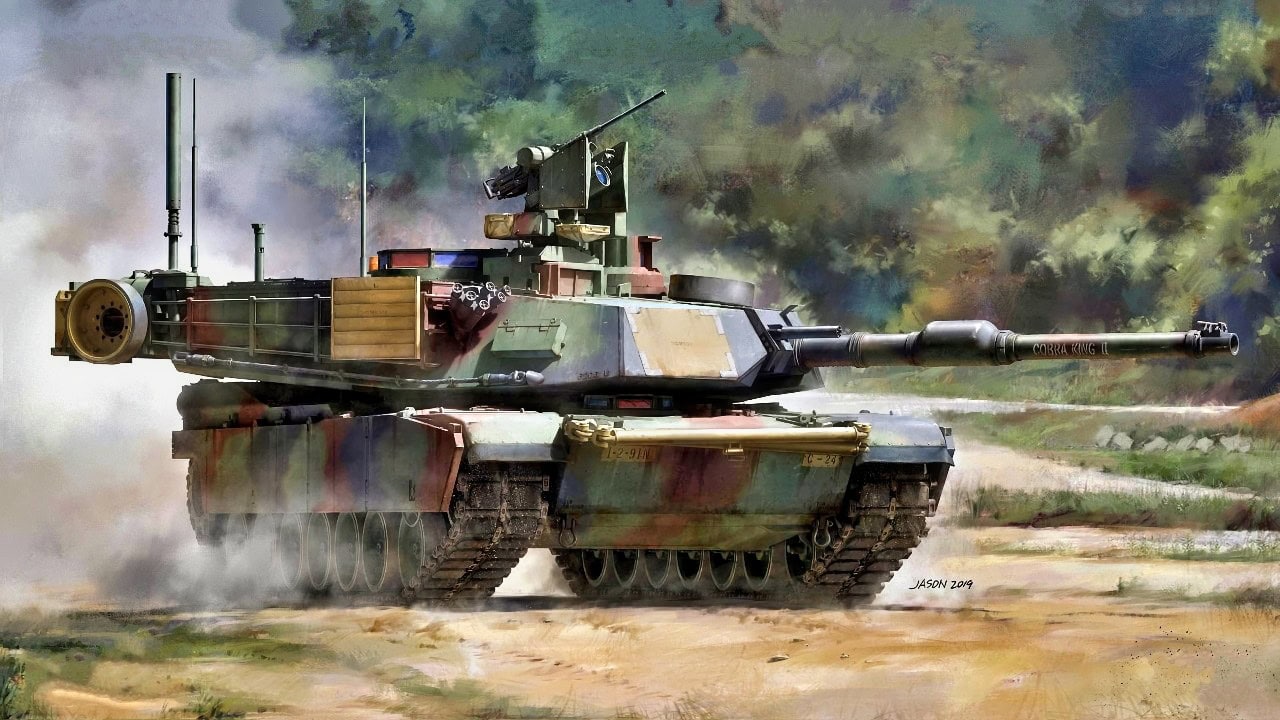
When the Americans and Australians were arm-twisted by their Ukrainian allies into handing over M1 Abrams Main Battle Tanks (MBTs), it was assumed that these iconic US-made tanks–the platforms that rolled over Saddam Hussein’s army in Desert Storm–would make all the difference.
Turns out, the Abrams didn’t help.
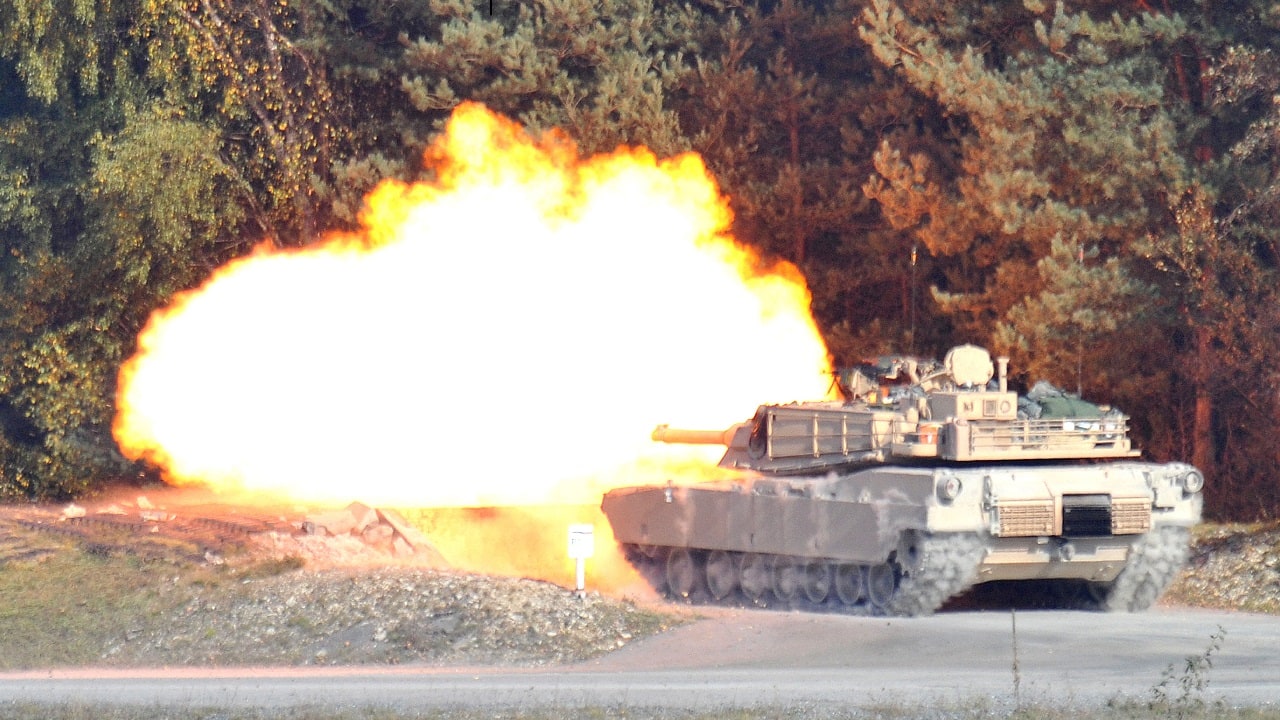
M1 Abrams. Image Credit: Creative Commons.
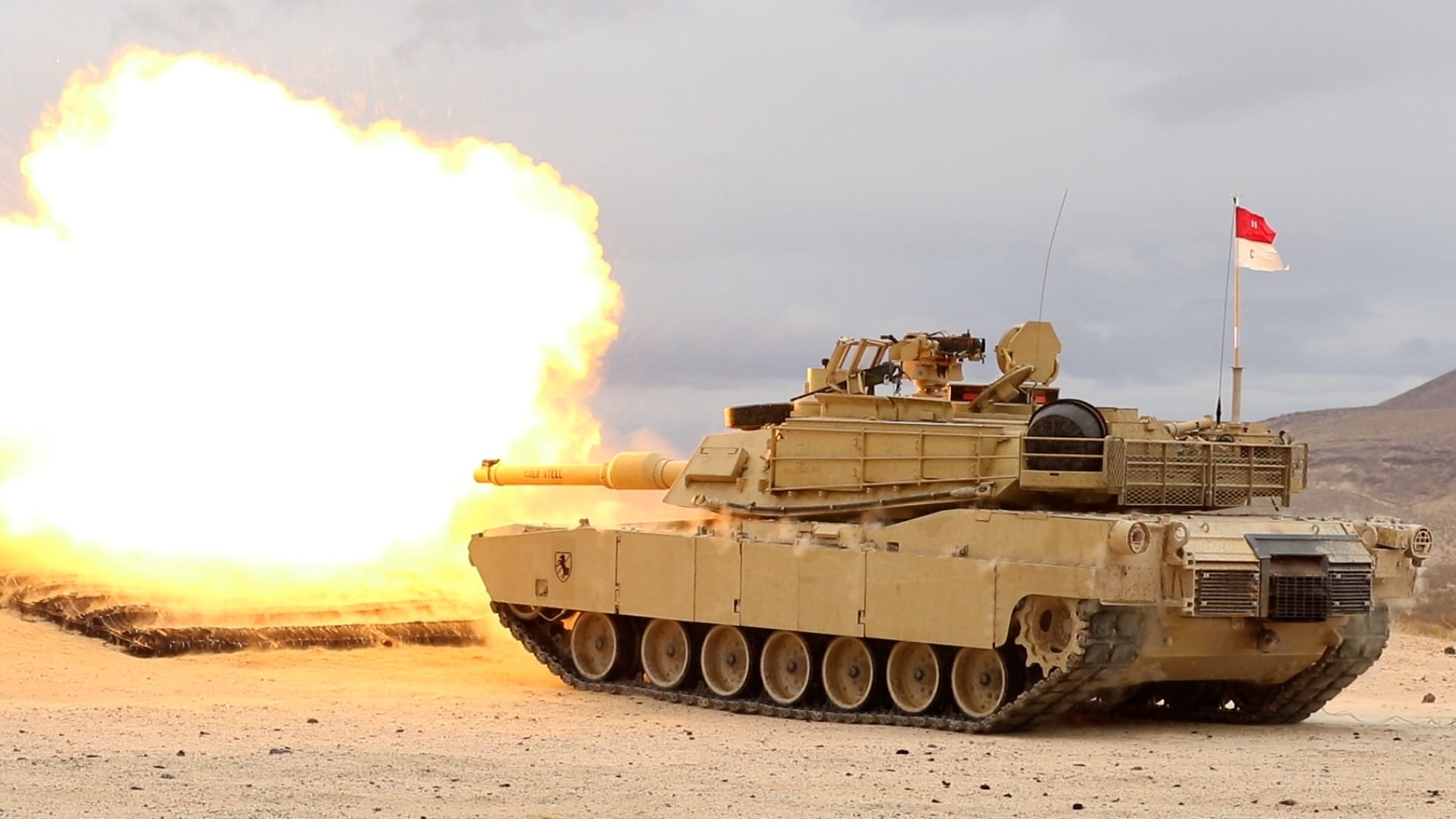
An M1A2 Abrams SEP V2 main battle tank, assigned to Cold Steel Troop, 1st Squadron, 11th Armored Cavalry Regiment, fires a M865 target practice cone stabilized discarding sabot with tracer on December 9, 2021, at the National Training Center and Fort Irwin training area.
In fact, they’ve been a burden that the Ukrainians have been forced to spend much time and effort adapting to the painful realities of the typical Ukrainian battlefield.
The Background
The original batch of 31 American-provided M1A1 Abrams MBTs were highly susceptible to Russian First-Person View (FPV) drones and anti-tank missiles. These vulnerabilities led to massive losses of the American tanks.
By mid-2025, Military Watch Magazine reports that a staggering 27 of the 31 US-supplied Abrams MBTs have been lost.
In other words, that’s an 87 percent loss rate of the initial batch by mid-2025. The American Abrams didn’t even last two years in the war in Ukraine!
To offset these gruesome losses, the Australians handed over 49 of their aging Abrams MBTs to the Ukrainians, worth around 245 million Australian Dollars.
They completed that delivery in December 2025.
It is much harder to determine how many of the Australian-provided Abrams tanks the Ukrainians have lost, due to the way that Ukraine is classifying their combat losses for operational security.
Yet we know the first confirmed loss occurred in late December 2025, not long after the Australians completed delivery of these tanks to Ukraine. That loss occurred near the frontline city of Pokrovsk in the contested Donetsk Oblast.
Despite the painful failures of these tanks under the hellish, modern combat conditions that dominate Ukraine, the Ukrainian Armed Forces are committed to making these remaining systems work better under the stress of the drone-dominated battlefield.
To better survive the nightmarish drone warfare, David Axe recently reported that the Ukrainians had installed what are known as “Cope Cages” on top of tank turrets.
Cope Cages Are Just That: Cope
These “Cope Cages” are basically custom wire and steel frames welded onto the turret roofs and engine decks of the Abrams MBTs.
That better protects the tanks from the topside drone attacks that Russian FPV drones have been subjecting them to.
Armor on the top of the turret and the engine compartment is weakest because tank designers never had to consider the threat drones might pose when they built the Abrams.
Some individual Ukrainian units, such as the First Separate Assault Regiment, have purportedly reinforced the composite armor built around the Abrams with Soviet-era Kontakt-1 Explosive Reactive Armor (ERA) bricks.
As the name suggests, these ERA bricks explode at incoming shaped charges before those incoming shaped charges can hit the tank.
Meanwhile, some Ukrainian Abrams tank crews have mounted radio jammers designed to disrupt the linkages controlling incoming Russian FPVs, disabling them electronically before the kamikaze drones can hit the tanks.
The decision to give Western tanks to Ukraine on the eve of its (failed) 2023 counteroffensive sounded like a masterstroke.
Western military planners who crafted much of that failed counteroffensive clearly assumed that the systems they had all trained on could easily be plugged into the Ukrainian Armed Forces.
But these systems are highly complex. What’s more, they were designed to fight a fundamentally different war than what the Ukrainians are currently fighting.
The Wrong Tank for the Wrong War
Western tanks–especially the Abrams–require more than just deployment into a combat zone.
These complex, expensive tanks require copious air cover, a well-trained crew, competent technicians, reliable artillery, and counter-drone defenses.
None of these factors were present.
The West just dumped a tranche of tanks into the laps of the desperate Ukrainians, expecting them to plug those systems into their war plan with little complication.
No one accounted for the new reality that drone swarms presented to tanks in attack.
What’s more, few understood the steep learning curve these tanks required for Ukrainian crews.
That’s not even mentioning the complex logistics involved in maintaining even older (possibly especially older) Abrams tanks.
Yes, Cope Cages and ERA have enhanced the Abrams’ utility and survivability in Ukraine.
No amount of technical wizardry can overcome the real drag that a mismatched platform, such as the Abrams, poses for the Ukrainian Armed Forces in the current war in Ukraine.
In these scenarios, lighter, faster, and more dispersed platforms are preferable to larger, heavier, and more complex systems like the Abrams MBT.
About the Author: Brandon J. Weichert
Brandon J. Weichert is the Senior National Security Editor at 19FortyFive.com. He also manages The Weichert Brief on Substack. Weichert also hosts “National Security Talk” on Rumble. He is the author of four bestselling national security books, the most recent of which is A Disaster of Our Own Making: How the West Lost Ukraine (Encounter Books). Follow him via Twitter/X @WeTheBrandon.