
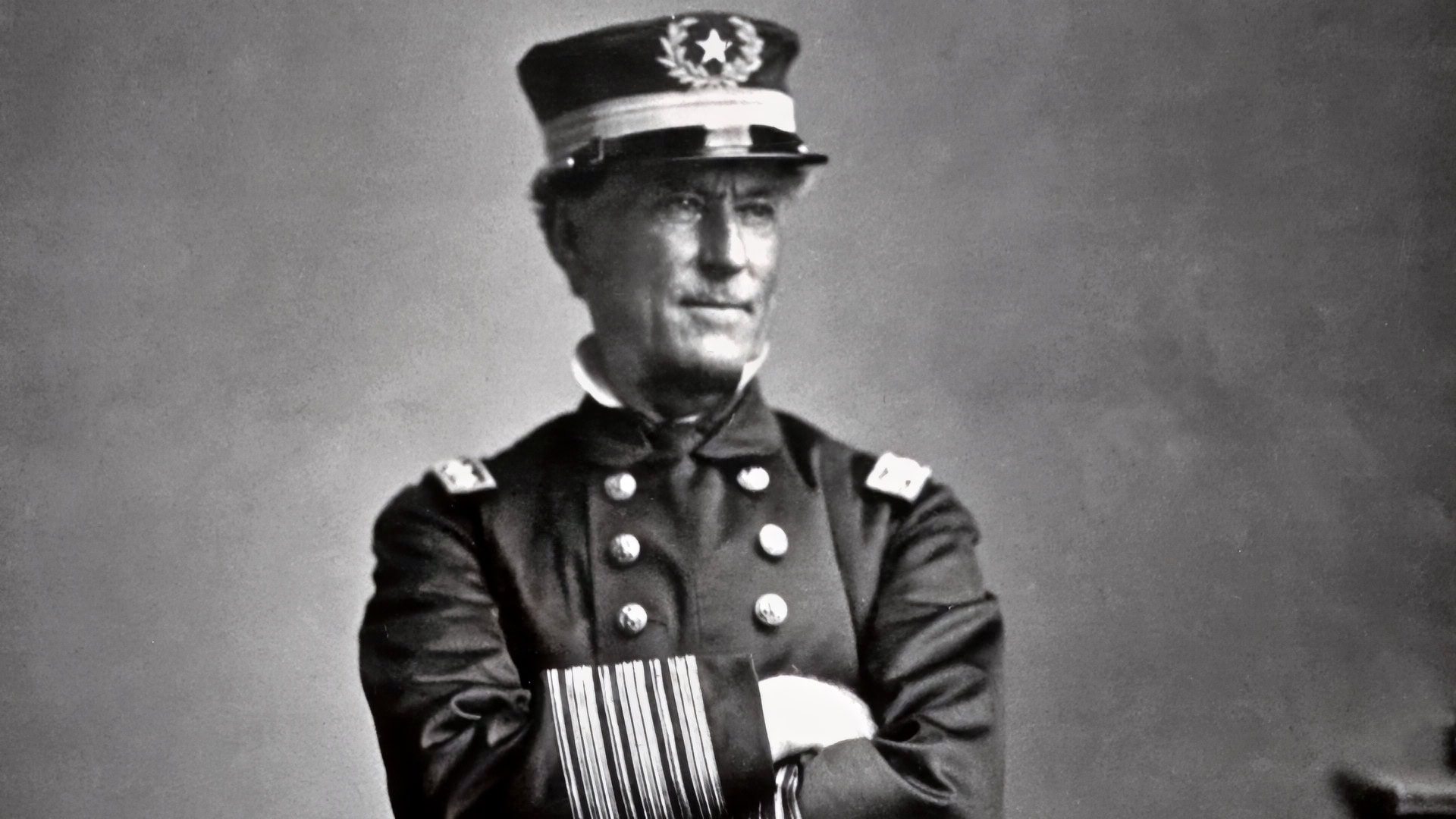
On the morning of August 5, 1864, a 63-year-old admiral stood lashed to the rigging of a wooden flagship, watching one of his ironclads roll over and sink in a Confederate minefield, and gave the order every American sailor has been taught since. Honesty requires saying up front what serious historians have said for a century: “Damn the torpedoes, full speed ahead” is a compression, a smoothing of a longer, messier exchange that no one wrote down on the day and that survivors remembered in different words. Say that plainly, and the story only gets better, because the six famous words are the least remarkable thing about the man behind them. David Glasgow Farragut went to sea at nine, commanded his first ship at twelve, waited half a century for his war, and became the first rear admiral, the first vice admiral, and the first full admiral the United States Navy ever had.
This is his story, told at 162 years’ distance.
A Midshipman at Nine
He was born James Glasgow Farragut on July 5, 1801, at Campbell’s Station, near Knoxville, Tennessee, son of Jordi Farragut, a Minorcan-born sailor who had fought for American independence.
When the boy’s mother died, naval officer David Porter took the child into his own home to raise for the sea, and the grateful boy later took the name David in his honor.
Through Porter’s influence, he was warranted a midshipman on December 17, 1810, aged nine, and by 1811, he was at sea in the frigate Essex.
The War of 1812 gave him a childhood no novelist would dare invent: cruising the Pacific with Porter, he was made prize master of a captured ship at twelve, navigating her to port while her deposed captain sulked below, and at thirteen he fought through the Essex’s doomed last stand against two British warships off Valparaiso.
He also learned early that his life would not be charmed: at his first examination for lieutenant, in 1821, he failed, and had to try again four years later.
The Long Middle
Then came the part of a naval career the statues never show: four decades of it. Farragut chased pirates in the West Indies, served across the Mediterranean and off Brazil, was made commander in 1841 and captain in 1855, and was sent west to carve the Navy’s first Pacific yard out of Mare Island, California, running it from 1854 to 1859.
When the Civil War came, he was nearly sixty, a Tennessee-born, Virginia-dwelling officer whom the seceding South assumed it would inherit. Instead, he declared for the Union, packed his family north within days, and told doubters they would live to regret their course.
The Navy Department, initially wary of the Southern-born captain, handed him its hardest assignment.
New Orleans
In January 1862, Farragut took command of the West Gulf Blockading Squadron with orders to take New Orleans, the Confederacy’s largest city and port.
When bombardment of the guardian forts failed, Farragut chose audacity over siege: in the pre-dawn dark of April 24, 1862, he ran his wooden fleet straight past Forts Jackson and St. Philip under furious fire, destroyed the Confederate flotilla beyond, including eleven vessels, and put the South’s greatest city under his guns; it surrendered without a street fight.
A grateful Congress created a rank American squadrons had never needed, and on July 16, 1862, Farragut became the first rear admiral in the history of the United States Navy. Two years of Mississippi fighting and Gulf blockade later, one great prize remained: Mobile.
Mobile Bay, and What He Said
Mobile Bay was the Confederacy’s last major Gulf port, guarded by three forts, a torpedo field, the ironclad ram CSS Tennessee, and Admiral Franklin Buchanan.
At dawn on August 5, 1864, Farragut took four monitors and fourteen wooden ships in, his flagship Hartford lashed to the gunboat Metacomet, and Farragut himself lashed high in the rigging, at his crew’s insistence, so he could see over the gunsmoke.
Minutes into the action the lead monitor Tecumseh struck a torpedo, the era’s word for a moored mine, and went down in under a minute with most of her crew. The column faltered; the Brooklyn, next ahead, backed water at the edge of the minefield with the fleet stacking up under Fort Morgan’s guns.
Here is where the legend and the record must be separated, as promised. What Farragut’s son recorded in his 1879 biography, the earliest full version, is: “Damn the torpedoes! Four bells! Captain Drayton, go ahead! Jouett, full speed!”
A shipboard clerk standing near the admiral wrote down a different version in a wartime keepsake, “Damn the torpedoes! Go on! Put the helm a-starboard, Captain Drayton!”, adding the wonderful detail that Farragut was not a profane man, which means the one damn of his recorded career was spent precisely here.
Some veterans of the battle doubted any words could have carried over the guns at all.
No account from the day itself exists, and the six-word slogan is a later polish.
What is beyond dispute is the substance the words compress: with a mine-sunk ironclad ahead, Farragut swung his wooden flagship out of line, took the lead, and steamed directly across the torpedo field, primers reportedly snapping against the Hartford’s hull, gambling correctly that long immersion had ruined most of the mines.
The gamble was real; a mine in that same field killed sailors clearing it afterward.
The fleet followed him through, battered the Tennessee into surrender after her lone stand against the entire squadron, and Mobile Bay was closed; Fort Morgan fell on August 23, and the victory helped carry Abraham Lincoln to reelection three months later.
First Admiral
The country ran out of existing ranks to give him. Vice admiral was created for Farragut at the end of December 1864, and on July 25, 1866, by act of Congress, he became the first full admiral in American history, the first of its kind rank of his career.
He took the European Squadron on a triumphal cruise, calling even at Minorca, his father’s island, declined those urging a presidential run in 1868 with the reply that he had never for a moment entertained political life, and died on active duty at Portsmouth, New Hampshire, on August 14, 1870, aged 69, after 59 years in the Navy, which is to say all but ten of them. President Grant walked at the head of his ten-thousand-strong funeral procession.
The Navy has kept a USS Farragut in commission across three centuries, a destroyer bearing the name sails today, his square anchors downtown Washington, and every officer of the fleet he founded ranks beneath him forever, first on the list by act of Congress and right of deed.
The exact words at Mobile Bay will never be settled.
The wake through the minefield is on the chart.
About the Author: Harry J. Kazianis
Harry J. Kazianis (@Grecianformula) was the former Senior Director of National Security Affairs at the Center for the National Interest (CFTNI), a foreign policy think tank founded by Richard Nixon based in Washington, DC. Harry has over a decade of experience in think tanks and national security publishing. His ideas have been published in the NY Times, The Washington Post, The Wall Street Journal, CNN, and many other outlets. He has held positions at CSIS, the Heritage Foundation, the University of Nottingham, and several other institutions related to national security research and studies. He is the former Executive Editor of the National Interest and the Diplomat. He holds a Master’s degree focusing on international affairs from Harvard University.

