
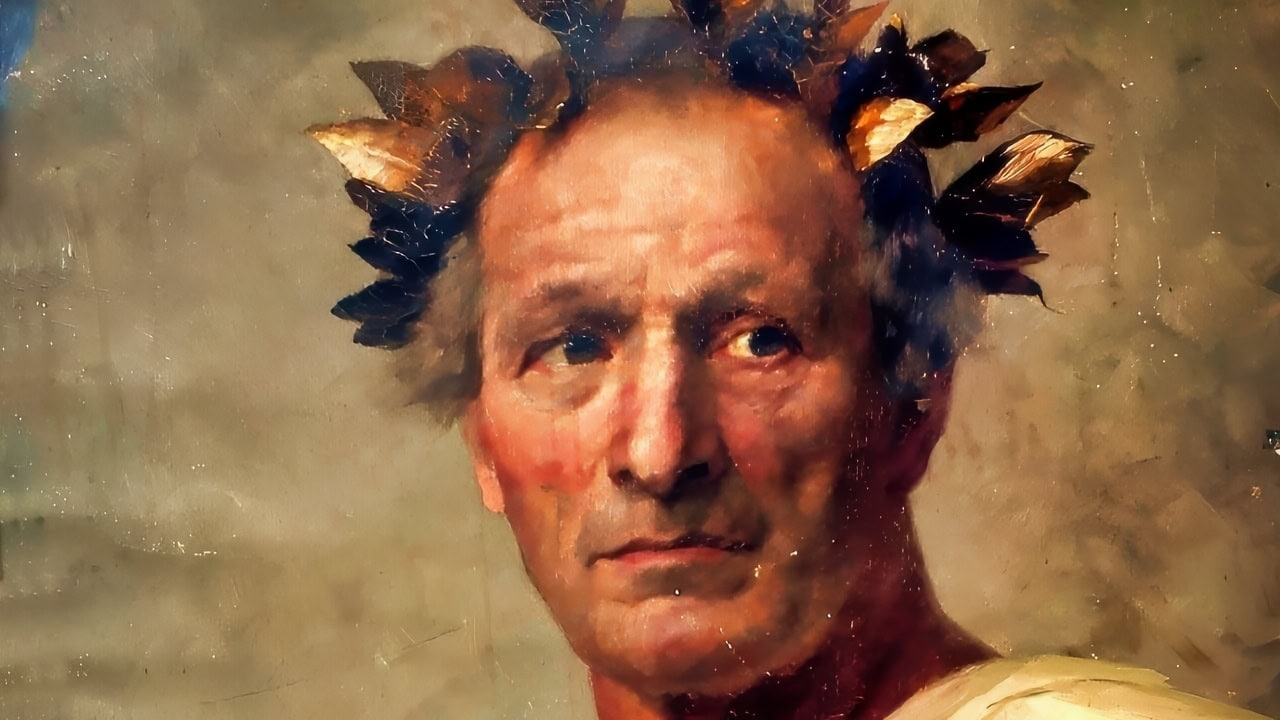
On a January night in 49 BC, a Roman general halted his army at a provincial stream so small that historians spent centuries afterward arguing over which trickle it was, spoke a four-word sentence, and rode across into two thousand years of quotation. “Alea iacta est,” the die is cast, has introduced more decisions than any phrase in any language, and the arithmetic checks out precisely: from January 10, 49 BC to this year, counting carefully across a calendar with no year zero, is 2,074 years. And here, in the tradition this series has made a habit of, is the honest complication stated up front, because it makes the story better: nobody can tell you with certainty what Caesar said at the Rubicon, or even what language he said it in.
The confusion is two millennia old, the sources disagree, and the man himself never mentioned the river at all.
What is certain is the decision, which is why the words, whatever they were, still resonate.
What Julius Caesar Said
The Latin tag the world knows comes from the biographer Suetonius, writing about 170 years after the event, who has Caesar say “iacta alea est”, the die is cast; the familiar word order is a later rearrangement.
But Plutarch, writing at nearly the same distance, reports something more interesting: Caesar spoke in Greek, calling out a line from a comedy by the playwright Menander that translates as let the die be cast. The difference is not pedantry; it changes the meaning. Suetonius’s Latin is a fatalist’s shrug, a statement that the thing is done.
The Greek is an imperative, a gambler’s self-command to make the throw, and scholars since the Renaissance have argued that Suetonius’s own text originally read the imperative too, before a copyist dropped a letter.
So the most famous decision in history was announced, in the best reconstruction, by a cultured Roman quoting a Greek comic poet’s gambling line, and it reached us through a mistranslation.

Vercingetorix throws down his arms at the feet of Julius Caesar, painting by Lionel Royer in 1899. Musée Crozatier, Le Puy-en-Velay, France. Imave Credit: Creative Commons.
Caesar’s own memoir of the civil war, meanwhile, skips the scene entirely; the river he made immortal appears nowhere in his account.
A century later, the poet Lucan invented a grander speech for the moment, including the vow that fortune was the power he followed, “Fortune, it is you I follow,” which is how legends compound.
The exact words are unrecoverable. The gamble is documented to the day.
Why a Stream Meant War
The Rubicon mattered because of what it legally divided: Cisalpine Gaul, the province Caesar governed, from Italy proper, where Roman law forbade any general to bring troops without the Senate’s leave.
To cross under arms was treason, automatically. And by January 49 BC, Caesar’s enemies had built him a trap with no lawful exit.
His decade conquering Gaul had made him rich, beloved by the people, and commander of fiercely loyal veterans, which was exactly what the Senate’s old guard feared; the alliance that had protected him was dead, his daughter Julia, married to Pompey, gone since 54 BC, and the third partner, Crassus, killed in Parthia the year after.
On January 7, 49 BC, the Senate passed its ultimate decree, effectively branding Caesar an enemy of the state unless he surrendered his command, and the tribunes who had vetoed measures against him fled Rome for his camp, dressed as slaves.
Caesar, at Ravenna with a single legion, the 13th, roughly five thousand men, faced the choice the decree was designed to force: give up his army and face prosecution and ruin at his enemies’ hands, or march on his own country.
He reminded the 13th of their nine years together, and they followed him across.
The War the Words Started
What followed vindicated the gambler’s reading of the line. The news reached Rome on January 15, and panic did half of Caesar’s work; Pompey abandoned the city, then Italy, and Caesar took the peninsula in roughly two months without a major battle.
The war itself took four years and spanned the Mediterranean world: Spain first, then the pursuit into Greece, a near-fatal defeat at Dyrrachium, and then, in August 48 BC, the decisive collision at Pharsalus, where Caesar’s outnumbered veterans shattered Pompey’s army.
Pompey fled to Egypt and was murdered as he stepped ashore, on the calculation of a pharaoh’s courtiers about where Roman power now lived. Mopping up produced, at Zela in 47 BC, the crossing’s only rival for brevity, veni, vidi, vici, and by 45 BC Caesar stood alone atop the Roman world, dictator, soon dictator for life.
The Republic’s answer came on the Ides of March, 44 BC, twenty-three dagger strokes on the Senate floor; the answer to the answer was another round of civil wars, from which Caesar’s adopted heir emerged as Augustus, first emperor. That is what the die decided when it finally stopped rolling: not merely one general’s survival, but the end of a five-hundred-year republic and the shape of the empire that governed the Mediterranean for centuries after.
Why Four Words Last 2,074 Years
The phrase endures because it is the rare famous quotation that names uncertainty instead of confidence.
Caesar did not announce victory at the river; he announced a wager, with his life on the table, and the image was honest, because at that moment, prosecution, defeat, and a traitor’s death were live outcomes.
Every language keeps the phrase, and its twin, crossing the Rubicon, because every life contains the moment they describe: the step after which there is no step back. The great gamblers who came after him lived by the same arithmetic, and Napoleon, who studied Caesar all his life and staged his own all-or-nothing crossing from Elba, is quoted on courage in the same spirit to this day.
The little river, for its part, was so unremarkable that its identity was lost for centuries and remains gently disputed; the modern Rubicone in northern Italy carries the name by twentieth-century decree more than ancient certainty.
That is the final, fitting irony. The stream can be stepped across.
The sentence cannot be stepped back over, and neither could he: four words, in a borrowed language, from a comedy, at midnight, and on the far bank waited Pharsalus, the Ides of March, and the end of the Roman Republic.
About the Author: Harry J. Kazianis
Harry J. Kazianis (@Grecianformula) was the former Senior Director of National Security Affairs at the Center for the National Interest (CFTNI), a foreign policy think tank founded by Richard Nixon based in Washington, DC. Harry has over a decade of experience in think tanks and national security publishing. His ideas have been published in the NY Times, The Washington Post, The Wall Street Journal, CNN, and many other outlets. He has held positions at CSIS, the Heritage Foundation, the University of Nottingham, and several other institutions related to national security research and studies. He is the former Executive Editor of the National Interest and the Diplomat. He holds a Master’s degree focusing on international affairs from Harvard University.