
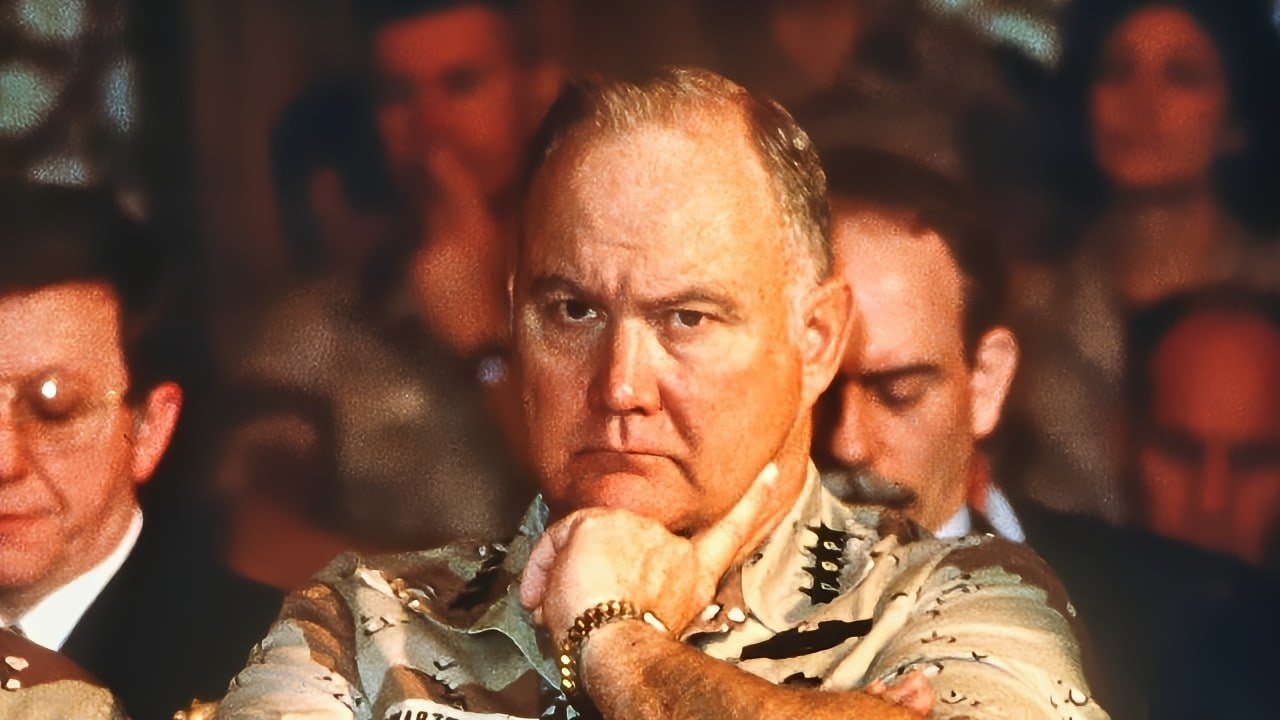
On the afternoon of February 27, 1991, in a hotel ballroom in Riyadh, with the ground war he commanded ending its fourth and final day, General H. Norman Schwarzkopf took a question about whether Saddam Hussein was a great military strategist. His answer, delivered live to the world, remains the most complete demolition of one commander by another ever broadcast.
A product of an official Pentagon briefing, it belongs to the public record and deserves quoting in full:
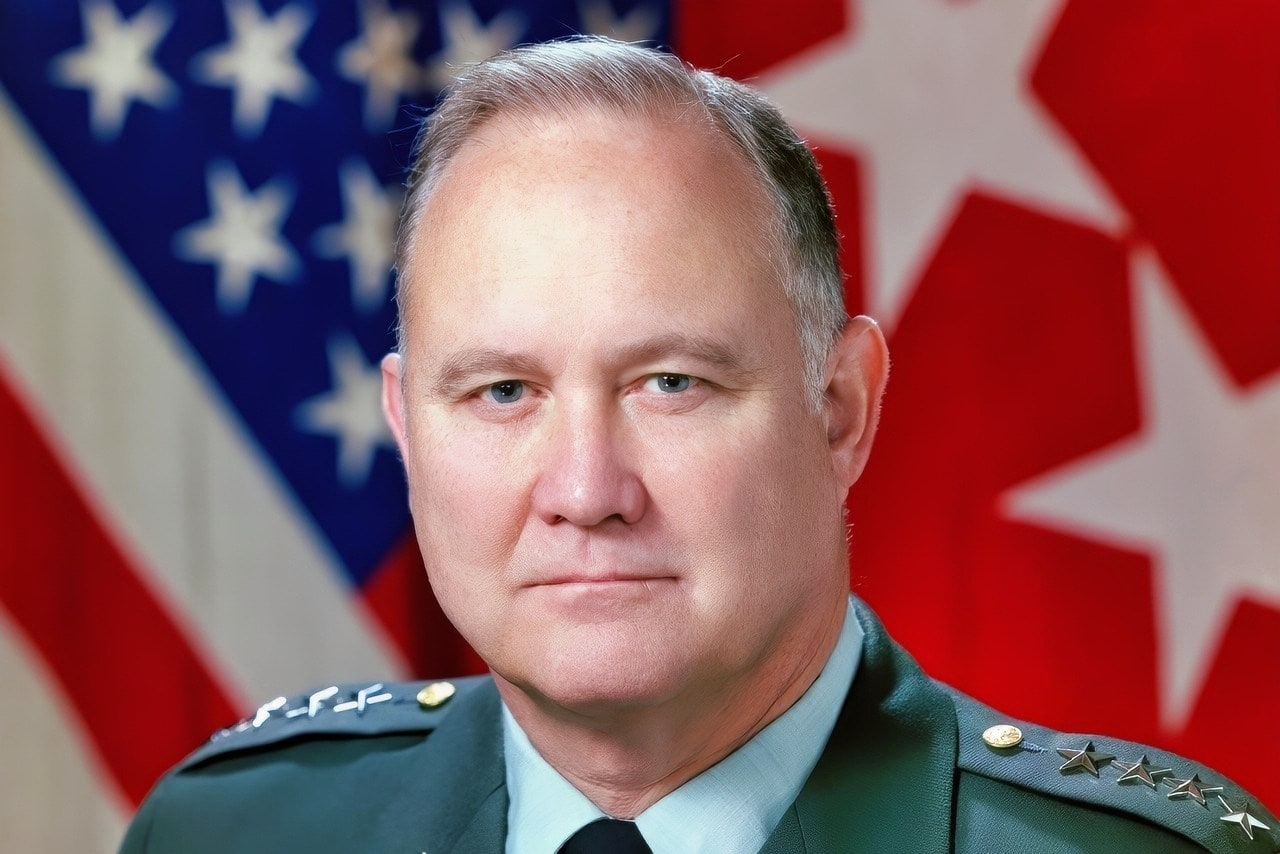
Army General Norman Schwarzkopf.
“As far as Saddam Hussein being a great military strategist, he is neither a strategist, nor is he schooled in the operational art, nor is he a tactician, nor is he a general, nor is he a soldier. Other than that, he’s a great military man, I want you to know that.”
Witnesses recorded the pause before the punchline.
What makes the sentence immortal 35 years later is not the savagery, though the savagery is complete.
It is that the five qualities Schwarzkopf listed, strategy, operational art, tactics, generalship, and soldiering, were precisely the five things the previous hundred hours had demonstrated about the man speaking.
The Education of the Bear
Herbert Norman Schwarzkopf Jr. was born in Trenton, New Jersey, on August 22, 1934, into a household that pointed at the Middle East: his father, founder of the New Jersey State Police, spent years on assignment in Iran, and the son lived there and across Europe as a boy, learning the region most American officers only ever met on maps, along with a working respect for its languages and its politics.

Secretary of Defense Richard Cheney; Gen. Colin Powell, Chairman Joint Chiefs of Staff; and Gen. Norman Schwarzkopf, Commander, U.S. Central Command, during an award ceremony prior to the Welcome Home parade honoring the coalition forces of Desert Storm.
West Point came in 1956, and then the crucible: two tours in Vietnam, where, as a battalion commander in 1970, he walked into a live minefield on the Batangan Peninsula to rescue wounded soldiers, earning one of his three Silver Stars and a reputation his troops trusted.
Like the best of his generation, he came home from that war determined that the Army would never again fight without clear aims, public support, and overwhelming means, and he spent the next two decades helping rebuild the force around that vow.
By 1988, he commanded Central Command, and his planners were war-gaming an Iraqi lunge at the Arabian Peninsula months before it happened.
The Coalition
On August 2, 1990, Saddam Hussein swallowed Kuwait in hours, and Schwarzkopf’s first masterpiece was not a maneuver but a piece of statecraft.
Under Desert Shield, he and Washington assembled and physically deployed a coalition of more than 30 nations, nearly a million personnel in theater at its height, an Everest of logistics his own planners called the hardest part of the entire war, with every gallon of fuel and round of ammunition arriving by sea and air into a theater with no existing American bases to speak of.
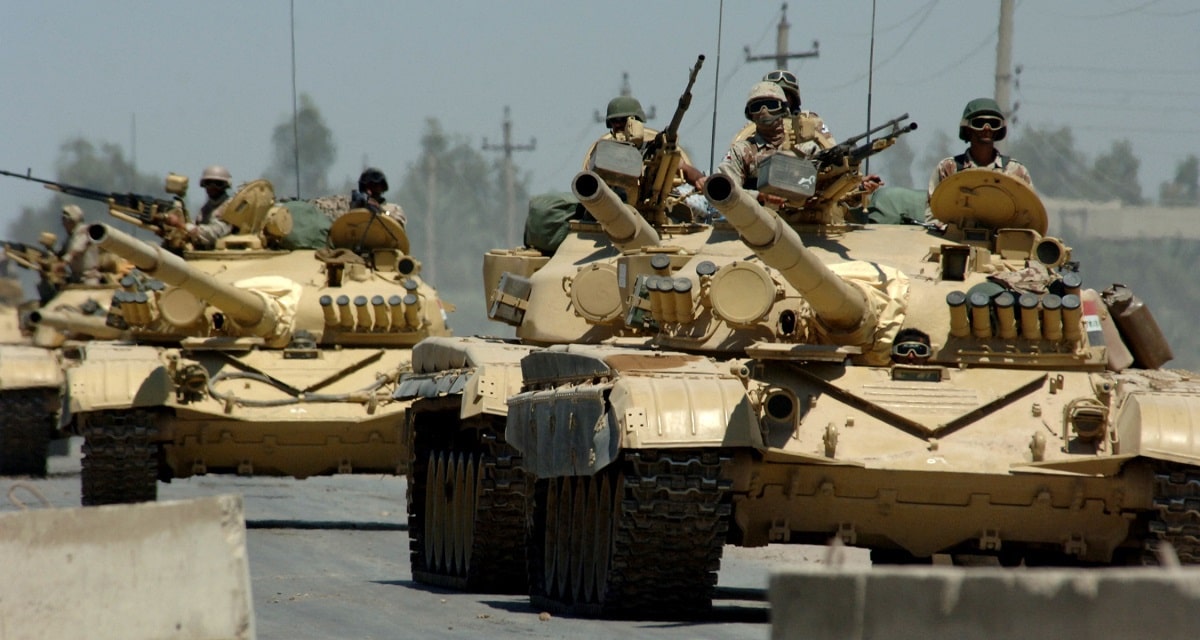
Iraqi Army T-72M main battle tanks. The T-72M tank was a common Iraqi battle tank used in the Gulf War.
The political engineering was as delicate as the supply lines: Arab armies fought inside the coalition, and when Saddam rained Scud missiles on Israel precisely to provoke a response that would shatter Arab participation, the coalition held Israel out of the war and the alliance together, which was the campaign’s first decisive victory, and fired not a shot.
The Left Hook
The air campaign opened on January 17, 1991, and its first order of business was blindness: with Iraq’s air force destroyed or grounded and its reconnaissance eliminated, Saddam could no longer see the desert to his west.
Into that blindness, Schwarzkopf moved an army.
While Marines rehearsed amphibious landings offshore and the press speculated obligingly about a coastal assault, some 200,000 troops shifted 300 miles westward in secret, at night, positioning the XVIII Airborne Corps and the armored fist of VII Corps far beyond the end of the Iraqi defenses.
It was operational art of the classical school; the DoD’s own history quotes a curator calling the sweep “copied directly from General Thomas ‘Stonewall’ Jackson in 1863″ at Chancellorsville.
When the ground assault went in on February 24, the Marines and Arab forces breached the fortified line in Kuwait so fast that Schwarzkopf accelerated the main attack by 14 hours, and the hook swung shut through an out-of-season dust storm, smashing the Republican Guard divisions that stood to fight.
One hundred hours after it began, the ground war was over: Kuwait was free, the Iraqi army was wrecked and streaming north, prisoners were surrendering in numbers too large to count, and American dead numbered fewer than 300 from all causes, well under half of them to enemy action, an asymmetry with no real precedent in modern war between armies of that size.
The Briefing as a Weapon
Schwarzkopf understood something his predecessors in Vietnam never mastered: the camera was terrain.
Through the war he gave near-daily televised briefings in desert camouflage, by turns folksy, technical, and volcanic, dismissing one claim as bovine scatology, and the performances were aimed at an audience of one as much as at the press corps. “Saddam and his bully boys were watching me on CNN,” he wrote in his memoir, and he briefed accordingly.
The February 27 session, the campaign explained with maps and a pointer on live television by the man who ran it, was instantly nicknamed the mother of all briefings, a play on Saddam’s promised mother of all battles, and the famous answer was its crescendo: five negations, a beat, and the deadpan.
It was cruel, quotable, and militarily precise, an after-action report compressed into a joke, delivered by a man who knew the enemy commander would see it.
The Exit
Weeks after the ceasefire, Schwarzkopf told an interviewer he had wanted to keep annihilating the fleeing Iraqi army and had been halted by the president, remarks the White House rebutted and for which he apologized, and history still argues over the ceasefire terms he negotiated at Safwan and what followed inside Iraq.
He publicly agreed with the decision not to drive to Baghdad, a judgment the next decade’s wars did nothing to embarrass.
Then he did the rarest thing available to a victorious, wildly popular general: he went home.
Norman Schwarzkopf: A Real American Hero
A ticker-tape parade, retirement in August 1991, a bestselling memoir, steadfast refusals to run for anything, years of quiet charity work, and the discipline that great men who remain great choose, until his death in Tampa on December 27, 2012, at 78. His war remains the cleanest expression of the doctrine that in war there is no substitute for victory: overwhelming force, limited aims, achieved fast, and then stopped.
About the Author: Harry J. Kazianis
Harry J. Kazianis (@Grecianformula) was the former Senior Director of National Security Affairs at the Center for the National Interest (CFTNI), a foreign policy think tank founded by Richard Nixon based in Washington, DC. Harry has over a decade of experience in think tanks and national security publishing. His ideas have been published in the NY Times, The Washington Post, The Wall Street Journal, CNN, and many other outlets. He has held positions at CSIS, the Heritage Foundation, the University of Nottingham, and several other institutions related to national security research and studies. He is the former Executive Editor of the National Interest and the Diplomat. He holds a Master’s degree focusing on international affairs from Harvard University.