
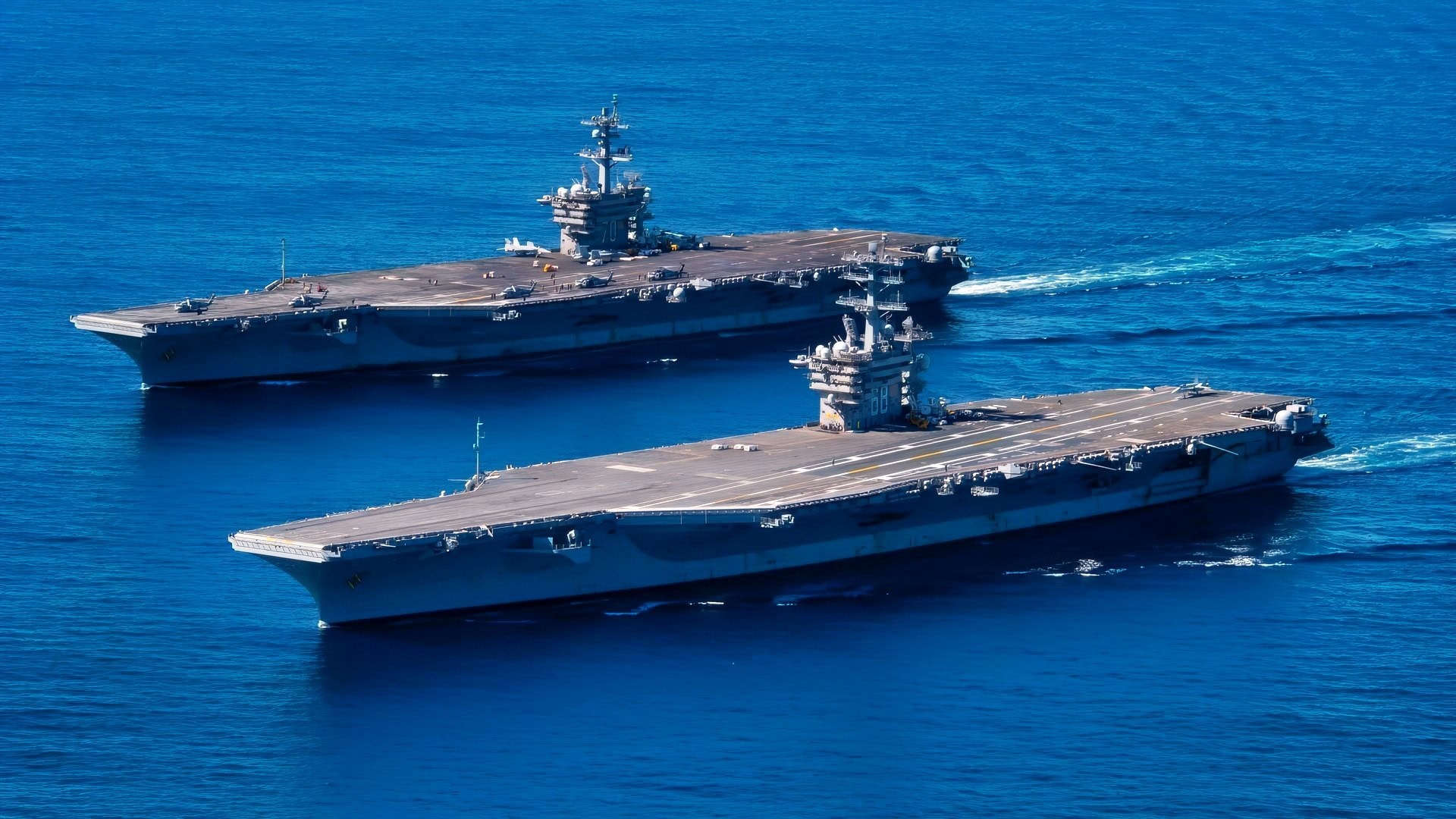
When a nuclear-powered aircraft carrier reaches the end of its life, the Navy doesn’t just tow it to a scrapyard and sell it for parts.
It embarks on a decades-long, billion-dollar odyssey that dwarfs the cost of building the ship itself. The cases of USS Enterprise (CVN-65) and USS Nimitz (CVN-68) show exactly why.
Scrapping a nuclear-powered aircraft carrier is extremely expensive because it involves safely removing nuclear reactors, handling massive amounts of hazardous materials, and managing complex, giant structures
The Enterprise: A $1.4 Billion Bill and Counting
USS Enterprise, the Navy’s first nuclear-powered carrier and the only one ever built with eight separate reactors, was pulled from active service in December 2012 and formally decommissioned in February 2017. Nearly a decade and a half later, she still hasn’t been fully scrapped.
The most complete public accounting of her disposal now totals roughly $1.43 billion: $902 million for the initial inactivation phase, $111 million for years of pier-side storage, and a $418.5 million firm-fixed-price contract awarded in mid-2026 to NorthStar Maritime Dismantlement Services to actually take her apart.
That final phase alone won’t wrap up until around 2030, meaning Enterprise will have sat in some state of limbo for roughly 18 years after leaving service, at a cost that’s more than three times what it took to build her in 1961 ($451 million).
The Nimitz: A Preview of the Next Bill
USS Nimitz, the lead ship of the Navy’s ten-carrier Nimitz class, is following a similar path. After her final deployment, the Navy pushed her decommissioning date to March 2027, and she’s now settled into Norfolk as her last homeport.
The Navy has already committed $95.7 million just for advance planning and long-lead-time material procurement, with $562 million budgeted in the fiscal 2027 plan for the opening phase of inactivation alone, before a single reactor has been defueled or a single ton of steel cut.
Industry estimates put the full inactivation-through-dismantlement bill at up to $1 billion or more, and the Navy hasn’t even published an all-in total yet.
Why Nuclear Changes Everything
A conventionally powered carrier is comparatively simple to retire.
The Navy sold the oil-burning USS Kitty Hawk and USS John F. Kennedy (the earlier ship of that name) to a Texas scrapper for a single penny each, because the contractor could profit just from the recovered steel.
Nuclear carriers flip that math entirely; the government stays on the hook for every gram of radioactive material aboard, and that responsibility is what drives the costs skyward. A few factors explain why:
Defueling is a specialized, dangerous job.
Before a reactor compartment can be approached for cutting, nuclear-qualified personnel must remove all nuclear fuel under strict radiological controls.
Enterprise’s eight reactors made this exceptionally complex; Nimitz has “only” two, but the process still requires secure transport of spent fuel, extensive shielding, and continuous monitoring.
Regulatory turf wars slow everything down.
The Navy and the civilian Nuclear Regulatory Commission have historically disagreed over who has jurisdiction over the commercial dismantlement of a warship’s reactor plant, and unresolved questions like this have increased uncertainty and costs for contractors bidding on the work.
The workforce and yard capacity are in short supply.
Only a handful of shipyards in the country, public or private, are certified to handle naval nuclear work, and that capacity is already backlogged with submarines, cruisers, and other retired reactor-powered vessels waiting in line.
Standing up a brand-new commercial capability, as the Navy did with Enterprise, meant years of environmental review, contract disputes, and first-of-its-kind engineering.
Waste has to go somewhere, and it stays there for a very long time.
Reactor compartments and other irradiated material are typically shipped to a licensed disposal site, such as the Hanford site in Washington State, where they must be handled, transported, and buried under a web of environmental and safety regulations that don’t apply to ordinary scrap steel.
Every step needs paperwork. Environmental Impact Statements, National Environmental Policy Act reviews, congressional reporting, and inter-agency coordination among the Navy, the Department of Energy, and Naval Reactors add years to a timeline a commercial ship-breaker would measure in months.
The Human and Institutional Toll
The toll in time, workforce, and administrative pain is real, and it costs the government dearly.
The Navy recently stood up an entirely new office, the Nuclear-Powered Aircraft Carrier Inactivation and Disposal Program Office, just to manage the wave of retirements coming as the Nimitz class ages out over the next two decades.
Hundreds of sailors and shipyard workers remain assigned to ships like Nimitz for years after they stop deploying, simply to safely power down systems, strip equipment, and prepare reactors for removal. It’s slow, expensive, unglamorous work that rarely makes headlines the way a carrier’s combat deployments do.
The Bottom Line
Enterprise and Nimitz aren’t outliers; they’re a preview of what is to come.
As the rest of the Nimitz-class carriers retire over the coming years, each one will likely require a similar multi-year, multi-hundred-million-to-billion-dollar process.
Building a nuclear supercarrier is an extraordinary feat of engineering and industrial capacity. It turns out that safely putting one to rest is nearly as extraordinary, and, in its own way, even more expensive.
About the Author: Steve Balestrieri
Steve Balestrieri is a National Security Columnist. He served as a US Army Special Forces NCO and Warrant Officer. In addition to writing on defense, he covers the NFL for PatsFans.com and is a member of the Pro Football Writers of America (PFWA). His work was regularly featured in many military publications.