
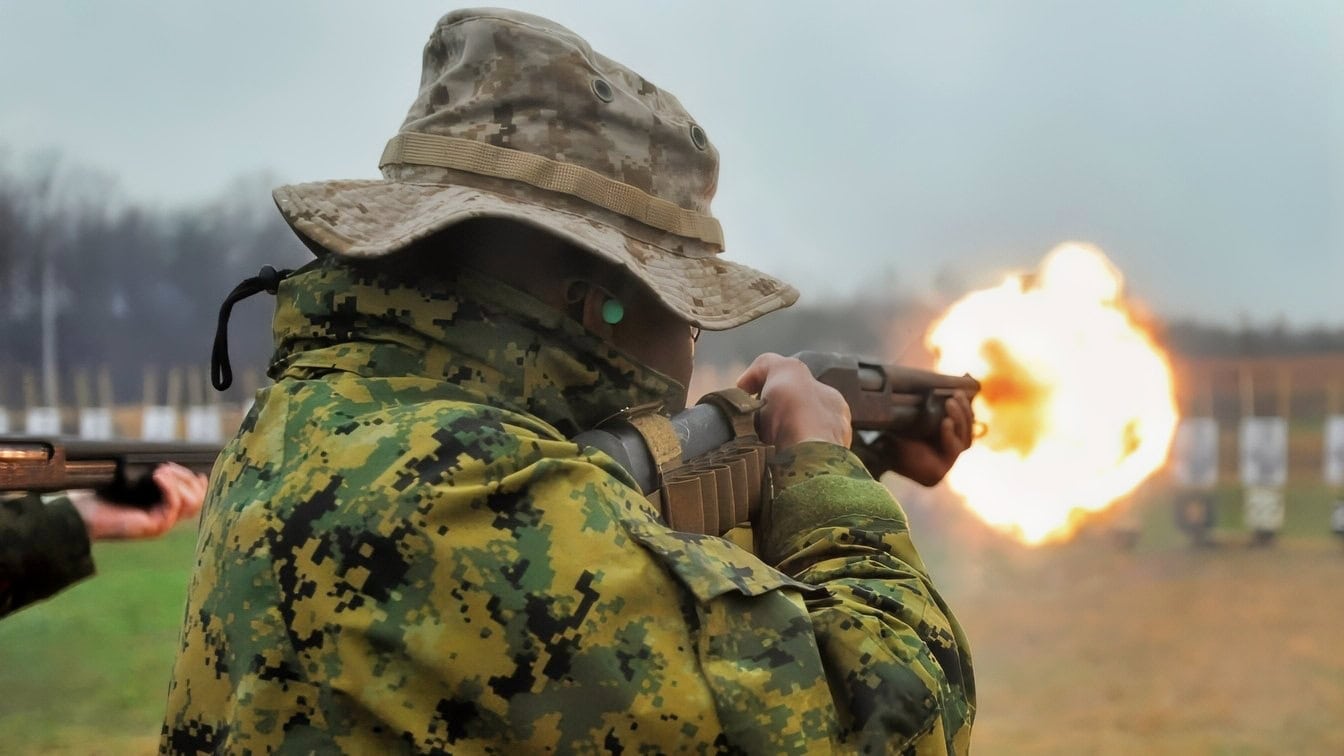
The Remington 870: America’s Enduring Combat Shotgun – I have always had an affinity for shotguns, from single-shot models to semi-automatics (Browning), from over-and-under skeet guns to the very short side-by-side “Lupara” shotguns for hunting and defense, made famous by mob films.
However, few firearms have captured the attention and longevity of the Remington Model 870. Since its introduction in the 1950s, this pump-action shotgun has become a fixture in American gun culture, well known for its use in home defense, law enforcement armories, and military arsenals worldwide.
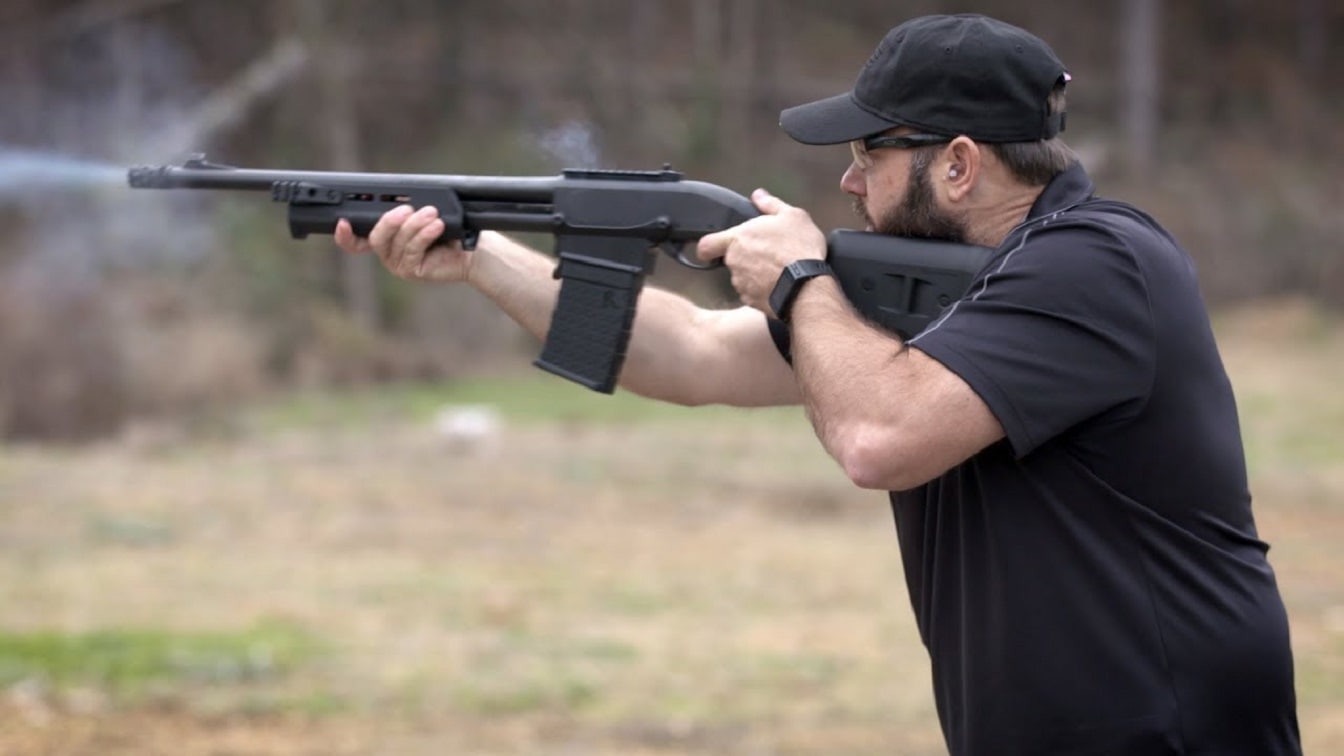
Remington 870 DM Magpul. Image Credit: Creative Commons.
Renowned for its simplicity, durability, and reliability, the 870 has sold well over 11 million units, making it one of the best-selling shotguns in history. Its story is one of engineering pragmatism meeting battlefield necessity, spanning conflicts from Vietnam to the ongoing wars of the 21st century.
The Remington 870 Origins and Development
The Remington 870 emerged from a lineage of pump-action shotguns that Remington had been refining since the early 20th century. Its direct predecessors included the Model 31 and the wartime Model 10, but by the late 1940s, Remington’s engineers set out to design a shotgun that could be manufactured more efficiently while improving on the smoothness and reliability of earlier actions.
Introduced in 1950, the 870 was built around a solid steel receiver machined from a single billet, a design choice that gave the weapon exceptional strength and rigidity compared to the stamped or riveted receivers used in some competing designs.
The dual-action-bar system, in which two parallel bars connect the forend to the bolt, was a key innovation. This design prevented the binding and twisting that could occur in single-bar pump actions, resulting in a famously smooth and reliable cycling action even under heavy use or adverse conditions.
Remington marketed the 870 as a versatile firearm for hunting and sport shooting, but its rugged construction, ease of maintenance, and modular design, which allowed barrels, stocks, and other components to be swapped easily, quickly caught the attention of institutional buyers, including police departments and, eventually, the armed forces.
The US Military Adopted The 870
The U.S. military’s interest in combat shotguns predates the 870 by decades; shotguns had proven useful in the trench warfare of World War I and the jungle and urban fighting of World War II. However, it was during the Vietnam War that the Remington 870 began to see significant use by American forces.
The U.S. Army and Marine Corps procured 870s in various configurations for close-quarters combat, trench clearing, guard duty, and jungle patrols, where the shotgun’s ability to deliver a devastating pattern of shot at close range made it invaluable.
Modified variants, sometimes called “riot guns,” typically featured shorter barrels (18 to 20 inches), extended magazine tubes, and simplified sighting systems suited to rapid, close-range engagement rather than precision shooting at distance.
Following Vietnam, the shotgun’s reputation for reliability in harsh, muddy, and humid conditions cemented its place in U.S. military inventories.
Unlike some semi-automatic designs of the era, which could be finicky with fouling or ammunition variance, the 870’s manually operated pump action gave soldiers a weapon that would fire reliably even when poorly maintained or exposed to sand, mud, and moisture, conditions common in Southeast Asia’s jungles.
I chose an 870 for home defense for two simple reasons. One, that when choosing a pump-action shotgun, it always works, making it easier to train family members in its use. And two, it has the power to stop any intruder in his/her tracks.
Military Variants and Designations
Over the decades, the U.S. military has adopted several specific variants of the 870 under different designations. The Marine Corps has fielded the M870 as the standard combat shotgun, while the Army has used similar variants for military police and specialized infantry roles.
One of the most widely issued modern variants is the Mark 1 (Mk 1), typically finished in a matte parkerized or synthetic coating to resist corrosion, particularly valuable for naval and Marine Corps applications where saltwater exposure is a concern.
These shotguns often feature synthetic stocks, extended magazine tubes holding six to eight shells, and rail systems for mounting flashlights or other accessories.
The shotgun’s role in modern conflicts, including Iraq and Afghanistan, has evolved to reflect changing tactical needs. Beyond its traditional close-quarters combat role, the 870 has been employed for:
Breaching operations: Fitted with specialized breaching barrels and frangible ammunition, the 870 can be used to blow door hinges and locks, allowing entry teams to force their way into buildings without the need for explosives in every scenario. Special Operations units have used it in breaching operations
Non-lethal engagement: Loaded with less-lethal rounds such as beanbag or rubber projectiles, the shotgun has been used in crowd control and situations requiring a graduated use-of-force response.
Guard and installation security: Its intimidating presence and stopping power make it a preferred option for sentries and installation security personnel who may need to respond to close-range threats.
Vehicle and convoy security: Compact variants have been issued to personnel operating in confined vehicle spaces, where a shorter weapon is easier to maneuver than a full-length rifle.
Reliability and Combat Reputation Is Top Notch
Much of the 870’s enduring military appeal comes down to its mechanical simplicity. With relatively few moving parts compared to semi-automatic shotguns, it is easier to field-strip, clean, and repair, even for troops with minimal armorer training.
Its steel receiver and dual action bars mean that, barring serious damage or extreme neglect, the weapon continues to function reliably over tens of thousands of rounds fired.
This reputation for toughness has made the 870 something of a cultural icon within military and law enforcement circles, often mentioned alongside firearms like the M1911 pistol or the AK-47 rifle as a design so effective it has remained in service, largely unchanged in its core mechanics, for over 70 years.
Special operations units, including certain U.S. Navy SEAL teams and other special mission units, have also used variants of the 870, valuing its versatility for specialized tasks like breaching, less-lethal response, and use as a secondary or backup weapon in situations where a shotgun’s short-range firepower is advantageous over a rifle.
Civilian and Law Enforcement Legacy
While we’re focusing mainly on its military applications, it’s worth noting that the 870’s success as a combat and police weapon has been mirrored by its dominance in the civilian market.
It remains a top choice for home defense, as mine had a shorter 18.5-inch barrel. Many opt for the pistol grip to make it even shorter and easier to maneuver, but personally, I wouldn’t recommend that.
The 870 is also used in hunting and sport shooting, with an enormous aftermarket industry supporting accessories, replacement parts, and custom builds.
This dual-use success, excelling in both civilian and military contexts, is relatively rare among firearms and speaks to the fundamental soundness of its original design.
The Remington 870 Remains A Classic
The Remington 870’s journey from a 1950s hunting shotgun to a mainstay of American military arsenals reflects a broader truth about effective weapon design: simplicity and reliability often outlast complexity and sophistication.
Its steel receiver, dual action bars, and modular design have allowed it to adapt to roles its original designers likely never envisioned, from Vietnam’s jungles to modern breaching operations in urban combat zones.
As militaries continue to evaluate newer semi-automatic and even electronically enhanced shotgun designs, the 870’s decades-long service record stands as a testament to the enduring value of a well-engineered, dependable firearm.
I’ve had plenty of experience with shotguns of all sizes and uses. Some of the newer ones are fantastic weapons in all areas of usage. But there is a reason that many shotgun enthusiasts keep coming back to the iconic 870.
More than seventy years after its introduction, the Remington 870 remains in active service around the world, a rare distinction for any weapon system, let alone one built on a design largely unchanged since the Eisenhower administration. It is an outstanding, versatile weapon.
About the Author: Steve Balestrieri
Steve Balestrieri is a National Security Columnist. He served as a US Army Special Forces NCO and Warrant Officer. In addition to writing on defense, he covers the NFL for PatsFans.com and is a member of the Pro Football Writers of America (PFWA). His work was regularly featured in many military publications.