
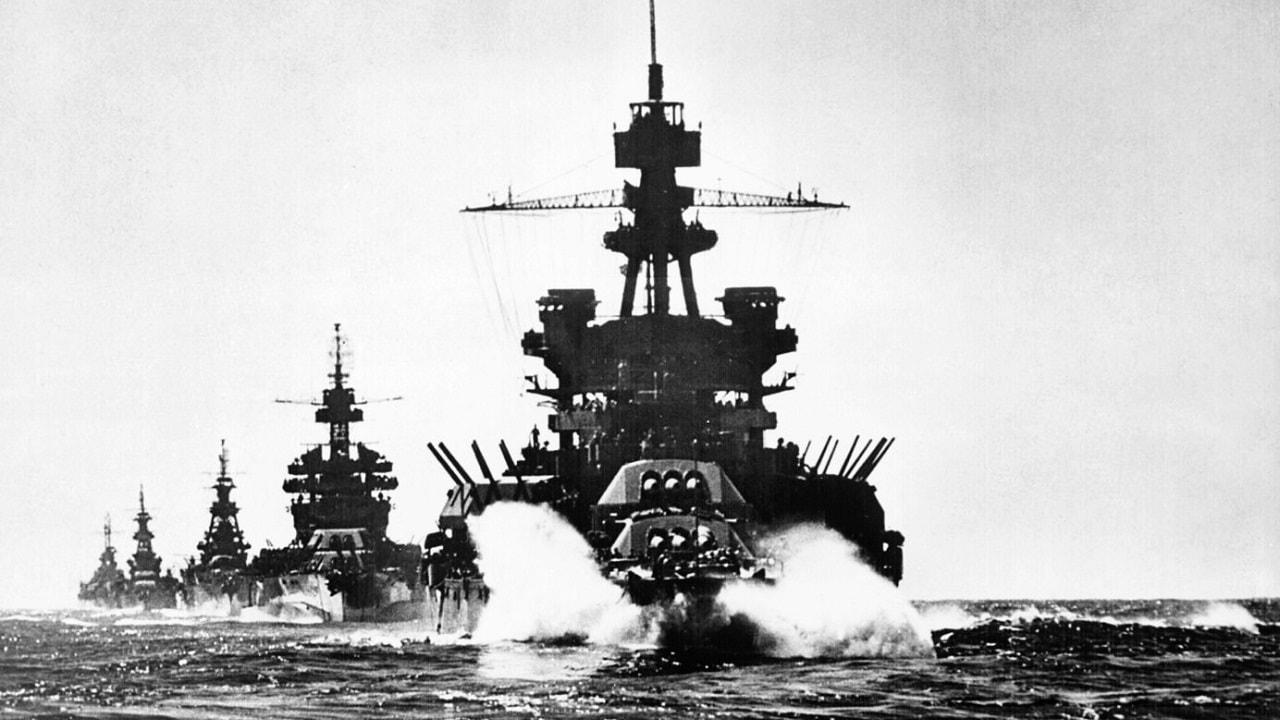
Summary and Key Points: Christian D. Orr profiles the battleship USS Pennsylvania (BB-38), Newport News-built lead ship of the two-ship class that included USS Arizona, commissioned in 1916 with twelve 14-inch guns. Drydocked at Pearl Harbor on December 7, 1941, she took one bomb, fought from the Aleutians to Surigao Strait, was torpedoed at Buckner Bay, Okinawa, on August 12, 1945, survived both Operation Crossroads atomic tests at Bikini in July 1946, and was scuttled off Kwajalein in 1948.
Battleship Pennsylvania Summed Up in 1 Word: Atomic?
The State of Pennsylvania is officially nicknamed “The Keystone State” due to its status as the middle colony of the original thirteen colonies, so it’s appropriate that the United States Navy would key in on this by naming a battlewagon in honor of the state, that being the battleship USS Pennsylvania (BB-38).
BB-38 was present during the Imperial Japanese Navy (IJN) raid on Pearl Harbor on December 7, 1941. Pennsylvania not only survived the raid and lived to see the war’s end, but she also displayed a stubborn refusal to die easily that eerily paralleled another Pearl Harbor survivor, the USS Nevada (BB-36).
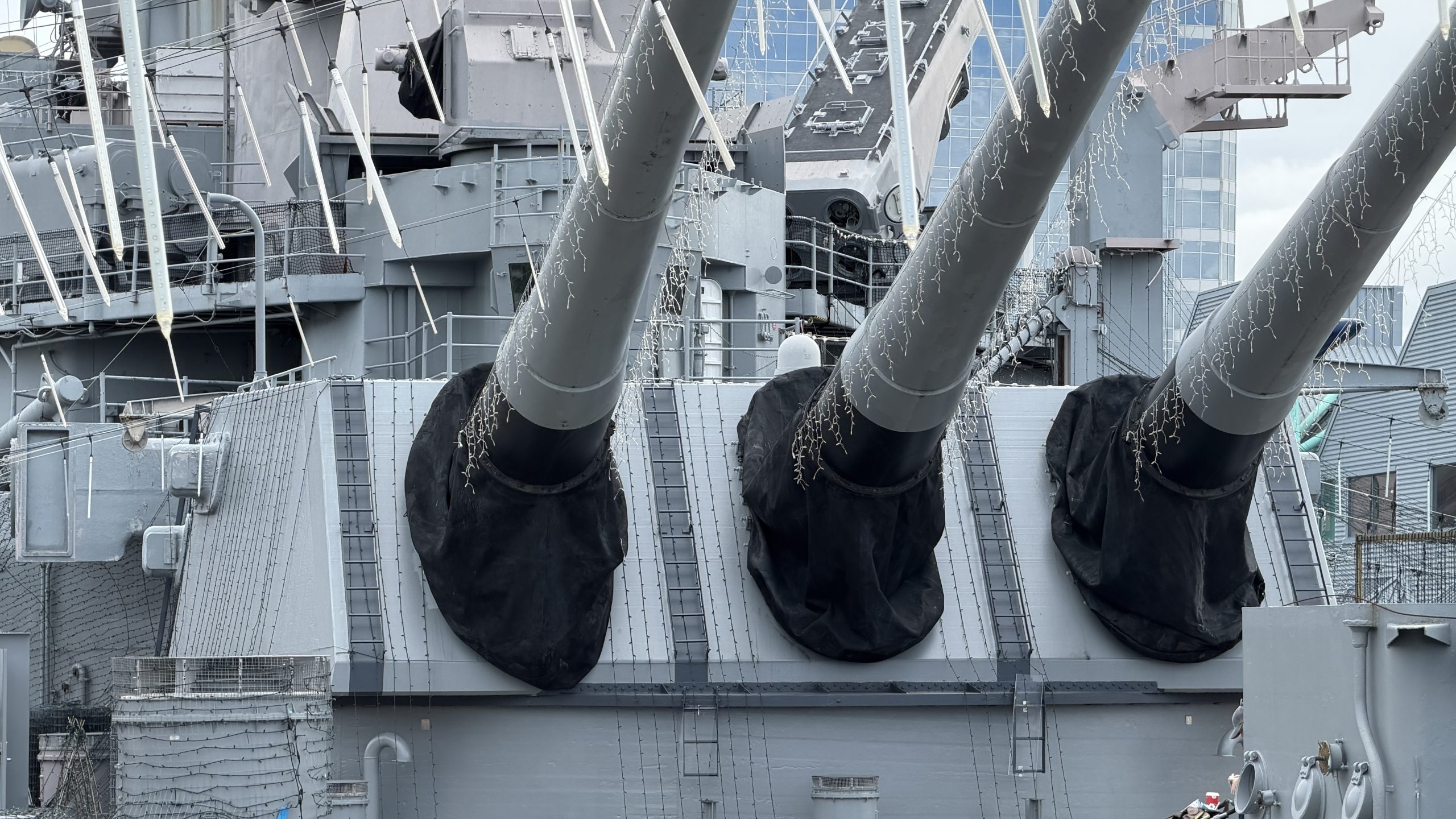
USS Wisconsin Iowa-Class Battleship Tour. Photo by 19FortyFive Reporter Christian D. Orr.
We now take a brief look at USS Pennsylvania’s proud, pugnacious, and pugilistic history.
WWII USS Pennsylvania (BB-38) Initial History and Vital Stats
BB-38 was the fourth USN warship to bear the USS Pennsylvania moniker and the lead vessel of the two-ship-strong Pennsylvania class of super-dreadnoughts, along with her sister ship, the ill-fated USS Arizona (BB-39). Newport News Shipbuilding in Virginia built her; they laid her keel on 27 October 1913, launched her on 16 March 1915, and commissioned her on 12 June 1916. She was affectionately nicknamed the “Pennsy.”
Her main battery consisted of a dozen 14-inch/45 caliber guns, divvied evenly between two triple turrets fore and aft.
At its thickest point, the main armor belt was 13.5 inches.
Secondary armament consisted of 22 5-inch/51 caliber guns, and tertiary armament consisted of four 3-inch/50 caliber anti-aircraft (AA; “ack-ack”) guns. Oh yes, it also carried two 21-inch torpedo tubes with a total capacity of 24 “tin fish.”
Additional key stats included a hull length of 608 feet, a beam width of 97 feet, a draft of 28.9 feet, and a standard displacement of 29,000+ tons. Max speed was 21 knots.
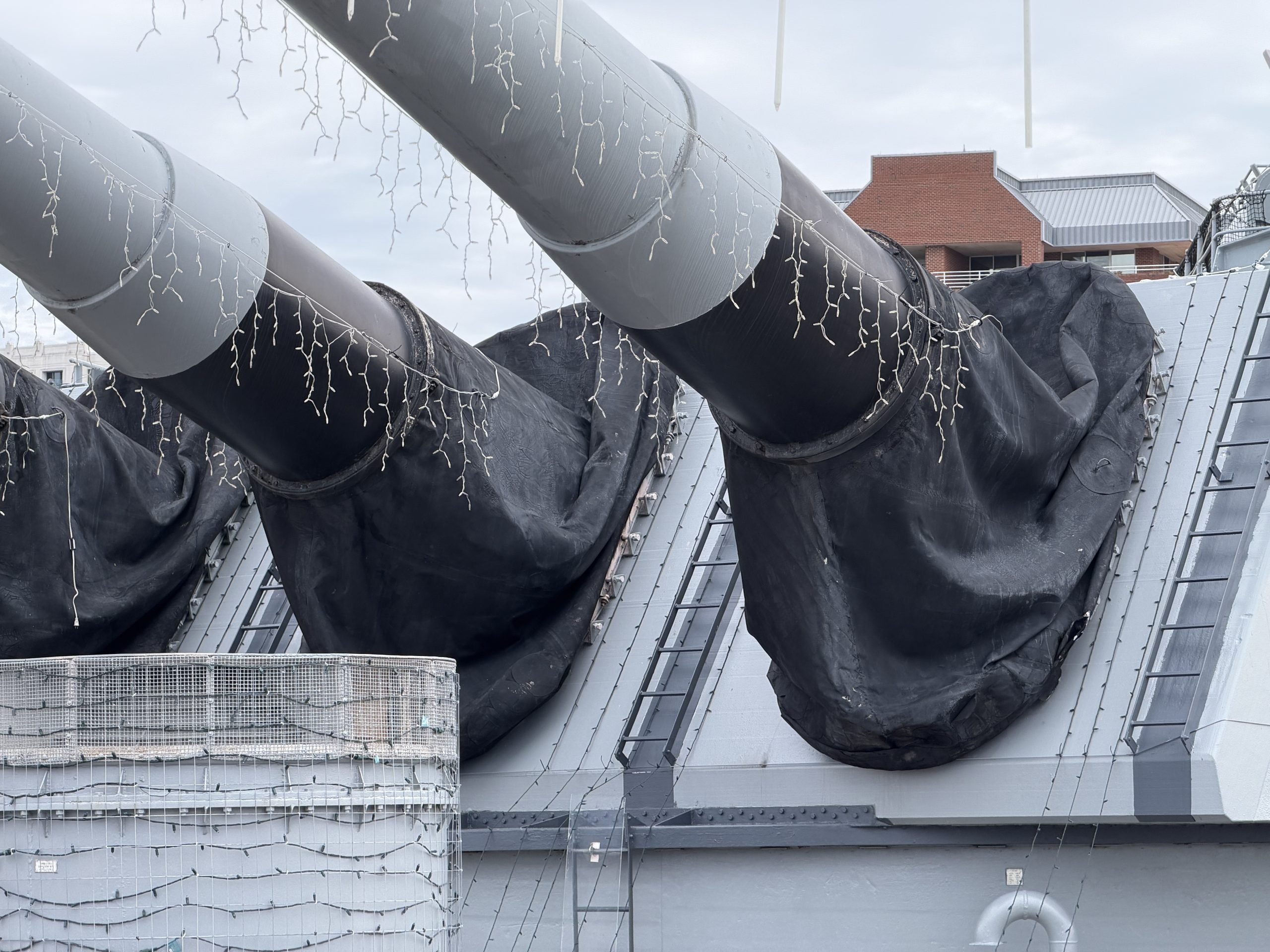
USS Wisconsin Iowa-Class Battleship Tour. Photo by 19FortyFive Reporter Christian D. Orr.
The crew complement included 56 commissioned officers, 1,031 enlisted seamen, and 72 Marines.
Operational History Part I: World War I and Interwar Years
“Pennsy” served during the First World War.
She didn’t deploy to European waters during that so-called “Great War” because of a shortage of the necessary fuel oil, so she settled for training exercises in home waters.
That said, she escorted then-President Woodrow Wilson to France to take part in the 1918 peace negotiations.
Between the two World Wars, the Pennsylvania held two prestigious titles: first as flagship of the Atlantic Fleet, then as part of the Battle Fleet, which merged the Atlantic and Pacific Fleets.
She spent most of this time harbored in the San Pedro Harbor of Los Angeles, California.
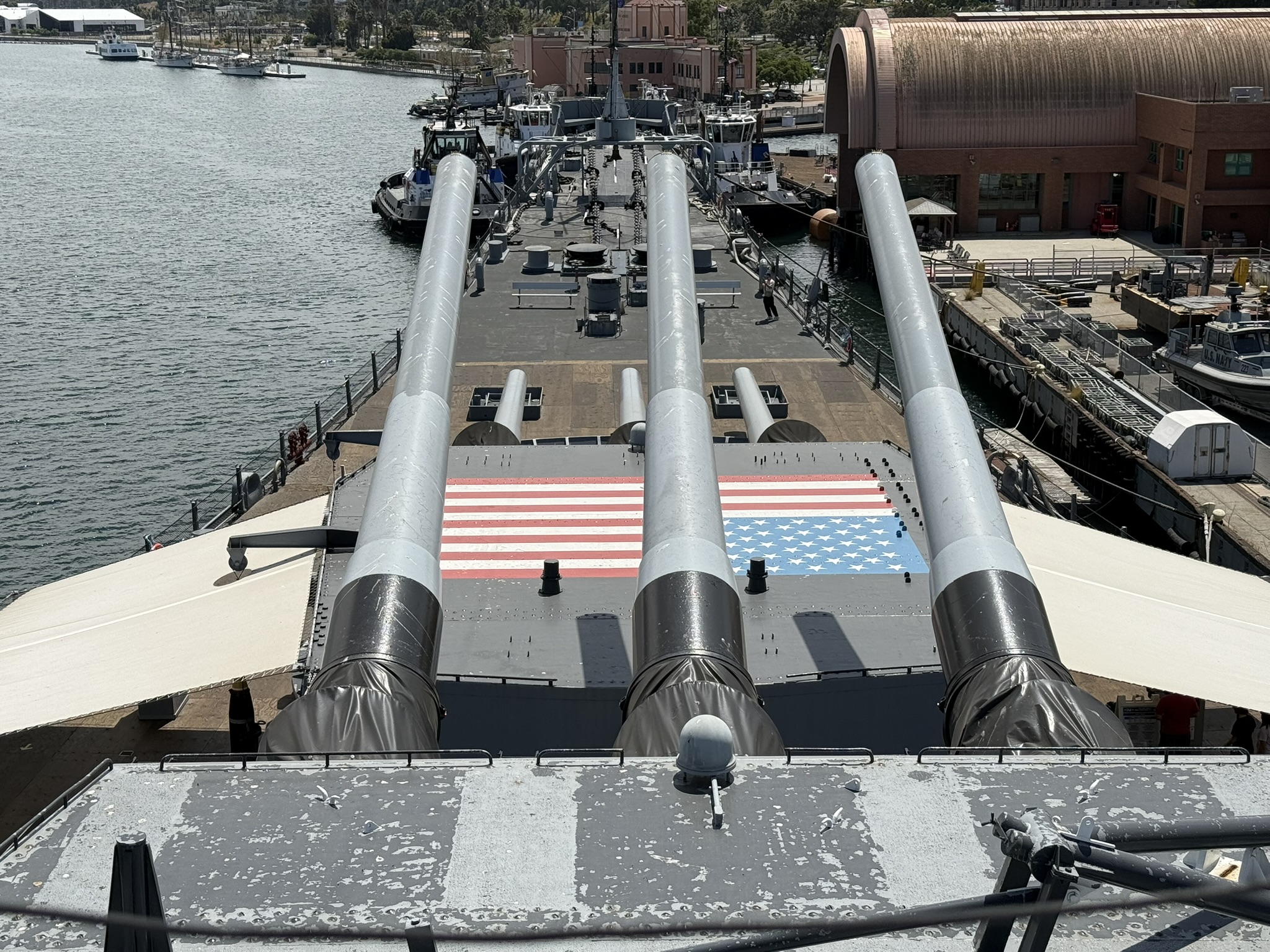
USS Iowa Battleship tour taken by 19FortyFive in August 2025.
Operational History Part Deux: Pearl Harbor and Entry into WWII
During that “date which will live in infamy,” USS Pennsylvania was comparatively lucky: she was drydocked with a pair of destroyers when the IJN attackers arrived, leaving her untouched by the Nakajima “Kate” torpedo bombers, but she was still hit by a 500-lb.
bomb from an Aichi “Val” dive bomber; that bomb struck a 5-inch gun position, with resultant casualties amounting to 14 killed, 15 missing, and 29 wounded.
In return, her AA gunners initially claimed to have shot down six enemy planes, but the after-action report (AAR) noted that only two had “fairly good proof of having been hit by the ship…”
The warship was seaworthy again in April 1942.
Operational History Part III: WWII Pearl Harbor Payback
“Pennsy” started collecting payback against the Rising Sun in May 1943, whereupon she provided shore bombardment to support amphibious landing troops during “Operation Landcrab,” the Aleutian Islands Campaign.
But her ultimate act of revenge came during history’s last battleship-vs .-battleship rumble, the Battle of Surigao Strait, on 25 October 1944.
Therein, Pennsylvania teamed up with several other Pearl Harbor survivors, namely USS California (BB-44), Maryland (BB-46), Tennessee (BB-43), and West Virginia (BB-48), to “cross the T” of the Japanese fleet, resulting in the sinking of two IJN battleships and three cruisers.
In a tragically ironic twist, after surviving the torpedoes of the Pearl Harbor attack at the *beginning* of America’s war, a Japanese torpedo finally caught up with “Pennsy” a mere three days before the *end* of the war; on 12 August 1945, that IJN “tin fish” struck the battlewagon whilst she was anchored at Buckner Bay in Okinawa and inflicted 20 KIA.
After the crew brought the flooding under control, they towed her to shallower waters to allow salvage operations.
Over the course of the war, BB-38 steamed over 150,000 miles and arguably fired more ammunition than any ship in history. Payback is one mean mother.
On the flip side, she also made history as the last major U.S. warship damaged during WWII.
Brief Life After WWII: Refusing to Die Quietly
Though not saved as a floating museum. BB-38 sure went out with one helluva bang…and this is where the aforementioned crazy parallels with fellow Pearl Harbor survivor USS Nevada resume.
Both of these warships were selected as guinea pigs for the Operation Crossroads A-bomb testing that took place at Bikini Atoll in July 1946; both of them refused to sink despite the atomic blasts.
Pennsylvania was first subjected to an air-burst atomic explosion—Test Able—on 1 July 1946, which, amazingly, did *not* contaminate the hardy ship with radiation, and her crew was allowed back aboard from the 3rd to the 24th of that month.
Next came an underwater detonation—Test Baker—on 25 July 1946, whereupon Pennsylvania was moored just 1,100 yards from ground zero.
Remarkably, she suffered little physical damage; however, this time she *did* suffer significant radioactive contamination from the tainted seawater.
Accordingly, the scrappy Pennsylvania was towed to Kwajalein on 21 August 1946 by attack transport USS Niagara (APA-87).
Eight days later, she was decommissioned and afterward underwent radiological and structural studies for the next 18 months.
On 10 February 1948, she was finally scuttled and sent to her watery grave somewhere off that same Kwajalein Atoll.
Where Is She Now?
BB-38’s wreck has evidently not yet been discovered. Fortunately, at least some parts of her have been preserved for posterity:
-Her bell is on display at Penn State University near the main entrance of the Wagner Building, which houses the school’s ROTC programs.
-Two of her 14-inch guns that had been replaced during a 1945 overhaul are on outdoor display at the Pennsylvania Military Museum in Boalsburg, Pennsylvania, which acquired them in 2009.
About the Author: Christian D. Orr
Christian D. Orr is a Senior Defense Editor. He is a former Air Force Security Forces officer, Federal law enforcement officer, and private military contractor (with assignments worked in Iraq, the United Arab Emirates, Kosovo, Japan, Germany, and the Pentagon). Chris holds a B.A. in International Relations from the University of Southern California (USC) and an M.A. in Intelligence Studies (with a concentration in Terrorism Studies) from American Military University (AMU). He is also the author of “Five Decades of a Fabulous Firearm: Celebrating the 50th Anniversary of the Beretta 92 Pistol Series,” whose second edition was recently published.