
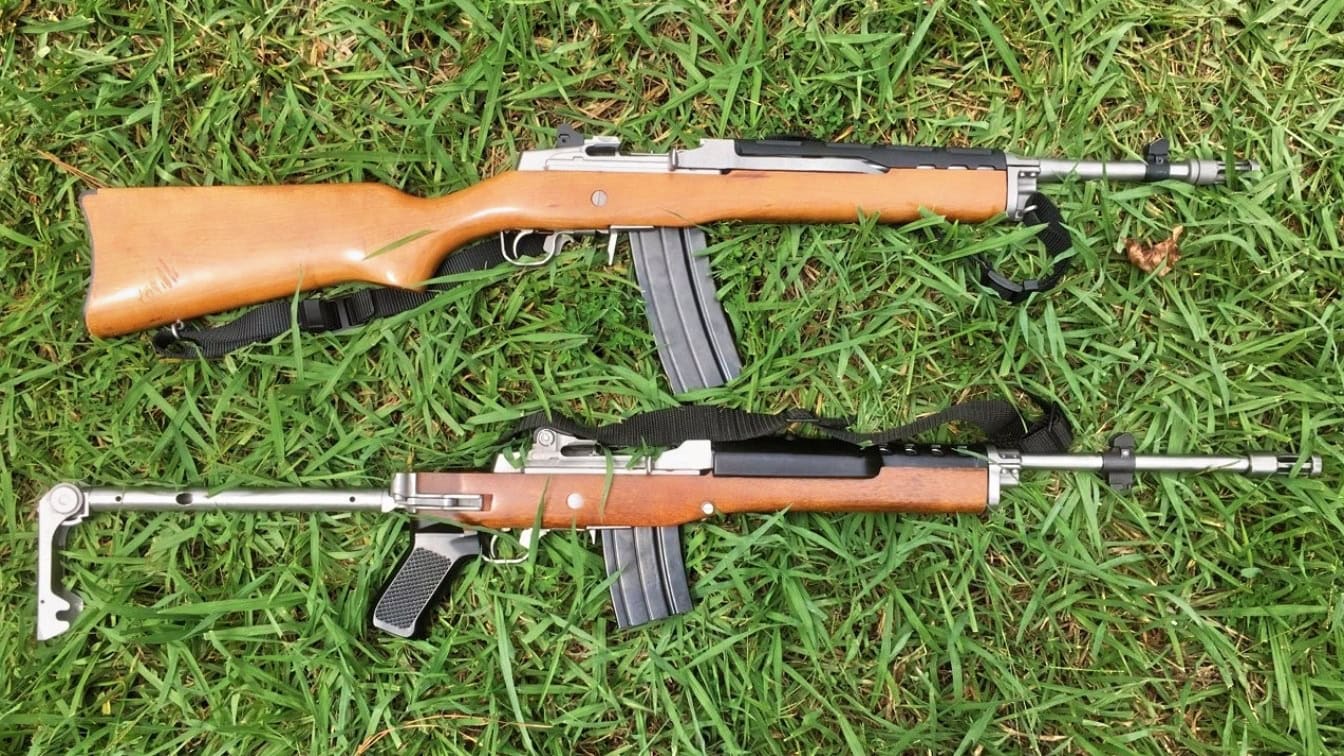
The Ruger Mini-14: A Compact Classic in American Rifle Design – For more than five decades, the Ruger Mini-14 has occupied a distinctive niche in the American firearms landscape.
Neither a battle rifle nor a dedicated target gun, it has instead built its reputation as a versatile, reliable, and unmistakably compact semi-automatic rifle that draws heavily on military lineage while carving out its own civilian identity.
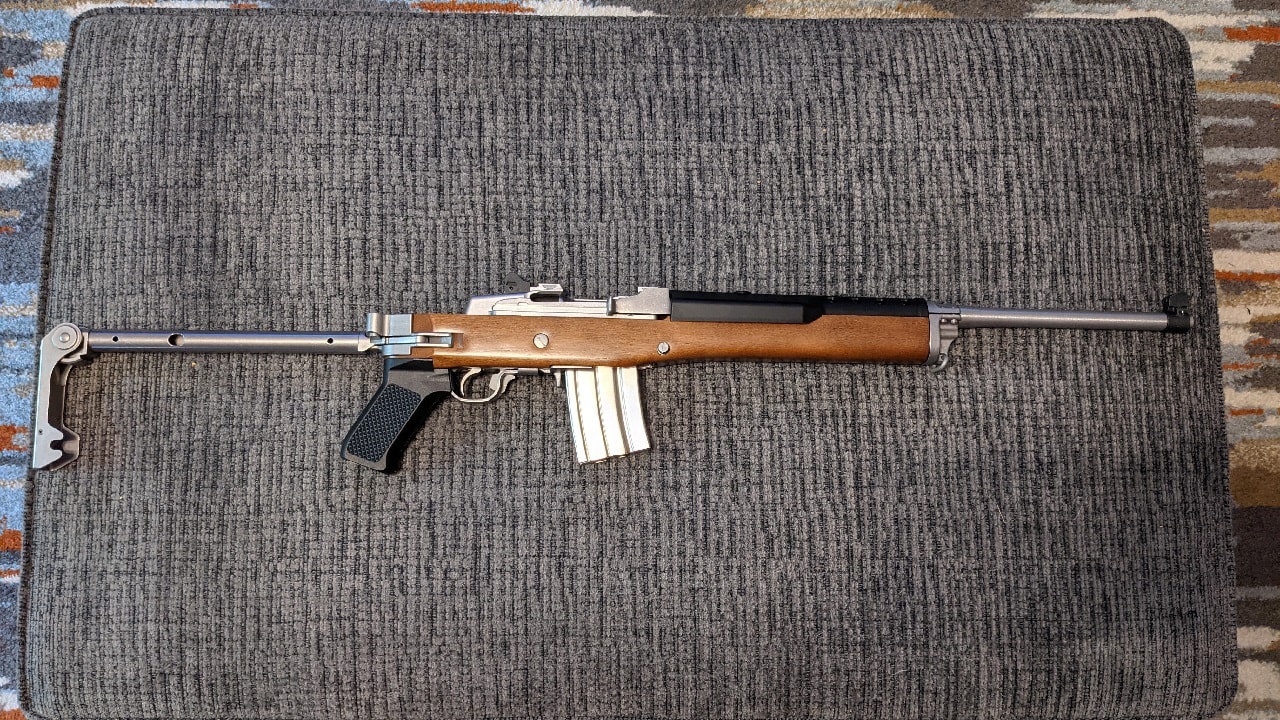
Ruger Mini-14. Image Credit: Creative Commons.

Image: Creative Commons.
It is an outstanding light hunting or ranch rifle that excels on the range and can double as an excellent home-defense weapon, packing a solid punch with 5.56×45 mm NATO ammunition.
I purchased one because I loved the rotating bolt and a fixed piston gas system similar to the historic M1 Garand, and M14, for which it was aptly named. It had that touch of history that I love, while providing a light modern caliber.
And while spending every waking hour around black plastic weapons in the military (M16/M4, SAW, etc.), something about the wooden stock with a touch of military design, the M1 action, and the M14-type flash hider made a nice touch.
Oh, and it shoots and handles like a champ.
Origins and Design Philosophy
The Mini-14 was introduced by Sturm, Ruger & Co. in 1973, the product of designer L. James Sullivan, who worked alongside the company’s founder, William B. Ruger.
As its name suggests, the rifle was conceived as a scaled-down version of the M14 battle rifle, itself a descendant of the aforementioned M1 Garand, which had served American forces through a world war and the Korean War.
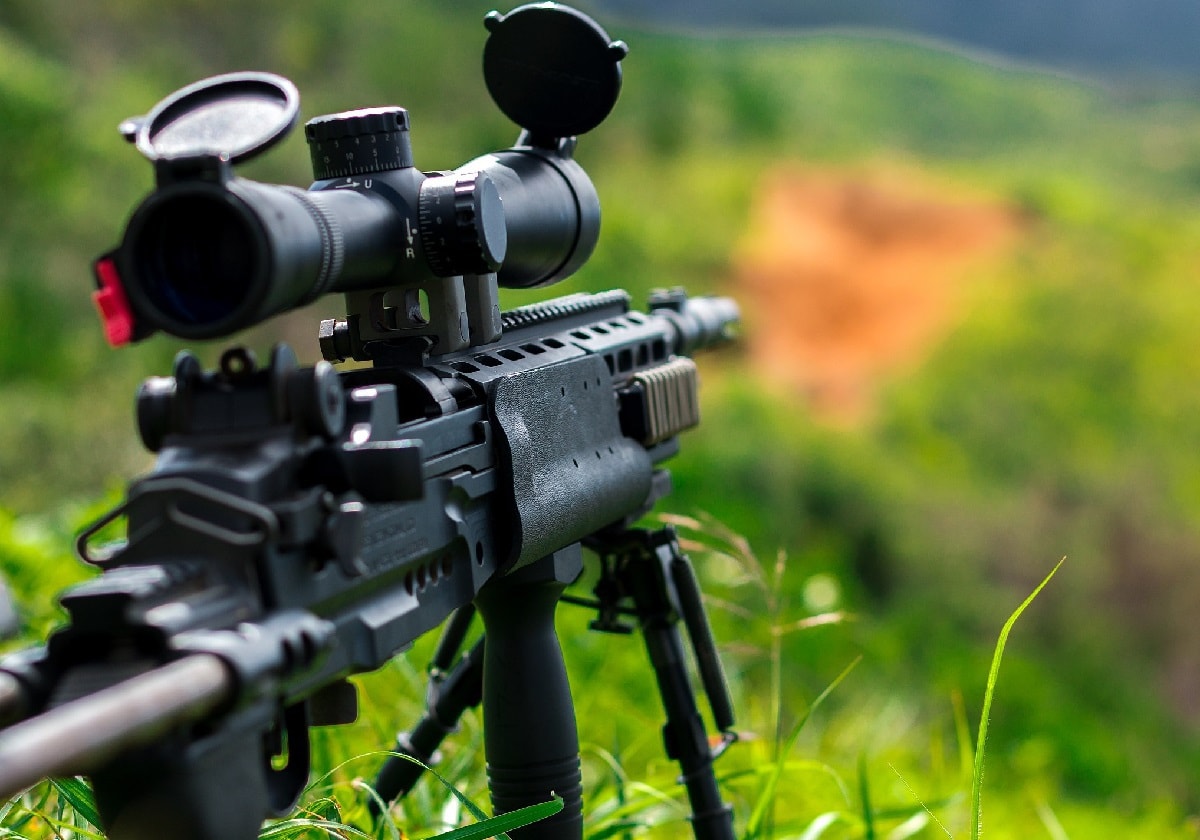
M14. Image: Creative Commons.

PACIFIC OCEAN (Feb. 12, 2012) Aviation Ordnanceman Airman Justin Fortuno fires an M-14 rifle during a live-fire exercise aboard the Nimitz-class aircraft carrier USS John C. Stennis (CVN 74). John C. Stennis is operating in the U.S. 7th Fleet area of responsibility while on a seven-month deployment. (U.S. Navy photo by Mass Communication Specialist 3rd Class Kenneth Abbate/Released)
Ruger wanted to capture the mechanical DNA of that lineage, the same basic gas-operated, rotating-bolt action, while trimming the size, weight, and cost to make the rifle more approachable for civilian shooters, law enforcement agencies, and ranch or farm use.
The result was a rifle roughly 20 percent lighter and considerably shorter than its military forebear, chambered in the .223 Remington/5.56x45mm NATO cartridge rather than the full-power 7.62x51mm round used in the M14.
This choice of caliber made the Mini-14 more manageable in recoil, less expensive to feed, and better suited to varmint hunting and general-purpose shooting, while still offering enough range and accuracy for practical use.
Mechanical Features
At its core, the Mini-14 uses a fixed-piston, self-cleaning gas system with a rotating bolt, a mechanical approach that traces its roots directly to the Garand and M14 family.
This design is prized for its reliability under adverse conditions, tolerating dirt and dust and requiring minimal maintenance better than many rifles built around more delicate direct-impingement gas systems.
The rifle typically feeds from detachable box magazines, most commonly holding 5, 20, or 30 rounds, providing flexibility for hunting, recreational shooting, or home defense.
Its stock has traditionally been styled in a wood or synthetic traditional-rifle profile, giving the Mini-14 a more classic, sporting silhouette than many of the black rifles that dominate today’s market.
This aesthetic choice made it a favorite among shooters who wanted the practicality of a semi-automatic rifle without the aforementioned tactical appearance associated with AR-pattern firearms. They make several models.
Mine was the wood-stocked “Ranch” model with an 18.5-inch barrel, rails on top for accessories, a 30-round magazine, and an M-14-type flash hider. The Mini-14 has a simple yet outstanding safety.
The safety only operates when the rifle is cocked. To engage the safety, pull the safety back into the trigger guard with the trigger finger. Then, to take it off, push it forward with the trigger finger. It is extremely positive, simple, and quick.
Reputation and Use
The Mini-14’s relatively light weight and manageable recoil made it popular with a broad range of users. Ranchers and farmers appreciated it as a utilitarian tool for dealing with predators and pests.
Many law enforcement agencies adopted it during the 1970s and 1980s as a patrol rifle, valuing its compact size and reliability, although many of those agencies eventually transitioned to AR-15 platform rifles as that design became the dominant standard in American law enforcement and civilian markets.
Hunters have long used the Mini-14 for varmint control and small-game hunting given its light report and modest recoil compared to larger-caliber rifles.
I never had the accuracy and shot-grouping issues that many shooters complained about due to its barrel harmonics and gas-system design. And I only shot it with iron sights.
The Mini-14’s Continuing Legacy
Despite the absolute explosion of AR-pattern rifles as the default choice for many American shooters, the Mini-14 has maintained a loyal following.
Its distinct profile, reliable operation, and connection to the storied M14 and M1 Garand lineage give it a sense of historical continuity that appeals to traditionalist shooters.
Ruger built a fantastic weapon for civilian use that is an outstanding target, varmint-hunting, and home-defense weapon. I loved mine and put thousands of rounds through it. There’s still something to be said about the feel of a wooden-stock weapon.
About the Author: Steve Balestrieri
Steve Balestrieri is a National Security Columnist. He served as a US Army Special Forces NCO and Warrant Officer. In addition to writing on defense, he covers the NFL for PatsFans.com and is a member of the Pro Football Writers of America (PFWA). His work was regularly featured in many military publications.