
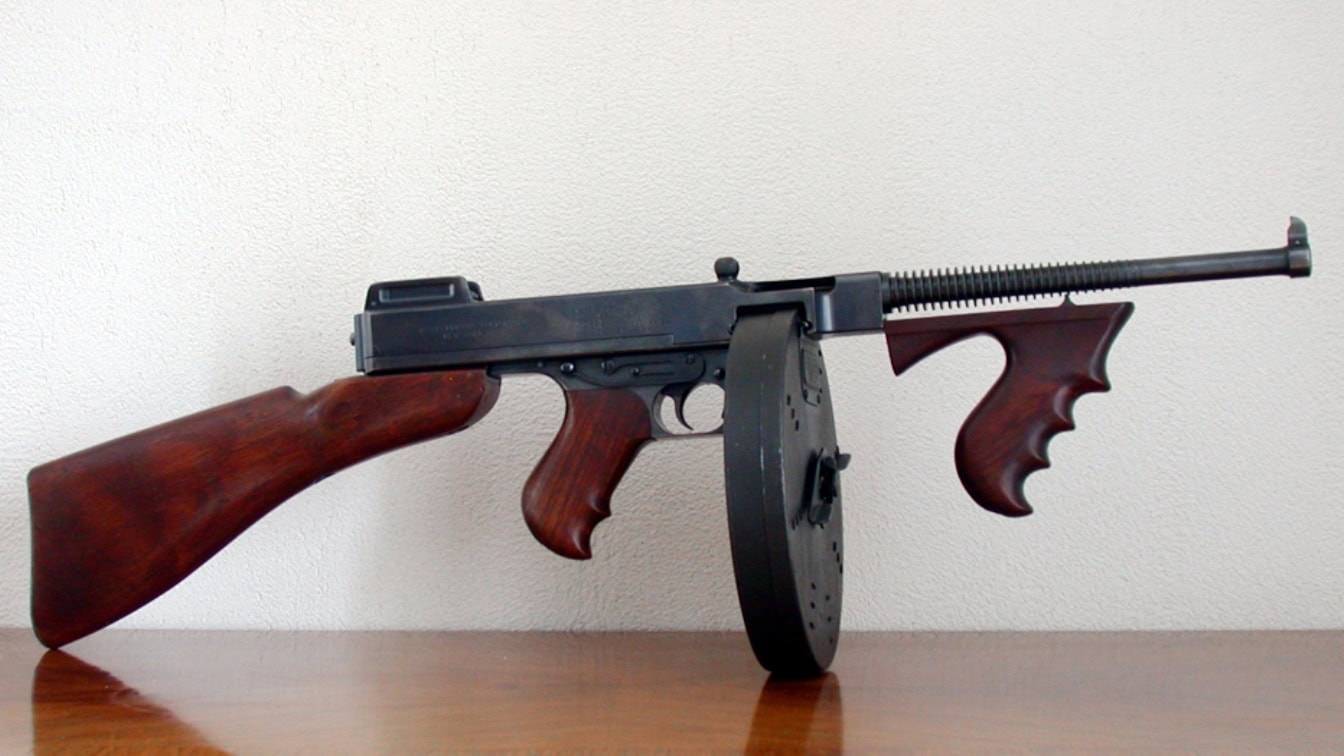
The Thompson Submachine Gun: An American Icon – One of the best parts of being in a Special Forces unit was the variety of foreign and legacy weapons in the unit’s arms room.
Special Forces frequently work alongside or train indigenous forces, requiring familiarity and a stock of foreign weapon systems (such as AK-pattern rifles), and the older weapons were frequently found in Third World nations that still use them. I’ve mentioned in previous articles the iconic M79 grenade launchers and M2 carbines, to name just a few.

Tommy Gun used at the range. Image Credit: 19FortyFive.
However, few firearms occupy as vivid a place in popular imagination as the Thompson submachine gun.
Nicknamed the “Tommy Gun,” “Chicago Typewriter,” and “Trench Broom,” it became one of the most recognizable weapons of the 20th century, associated equally with Prohibition-era gangsters, law enforcement, and World War II soldiers.
And firing it was… an experience that took my respect for our “Greatest Generation” to new heights.
Origins Of The Thompson
The Thompson was the brainchild of U.S. Army General John T. Thompson, who began developing the weapon during the final years of World War I.
Thompson envisioned a lightweight, fully automatic “trench broom” that infantry could use to clear enemy trenches at close range, filling a gap between the pistol and the rifle.
He founded the Auto-Ordnance Company in 1916 to pursue the project, working with engineer Theodore H. Eickhoff and others to design a compact automatic weapon chambered for the powerful .45 ACP pistol cartridge, already standard in the U.S. military sidearm.
The weapon relied on a delayed blowback mechanism based on a patent by John Bell Blish, which used friction between an angled bolt and receiver to slow the bolt’s rearward movement enough for safe cycling.
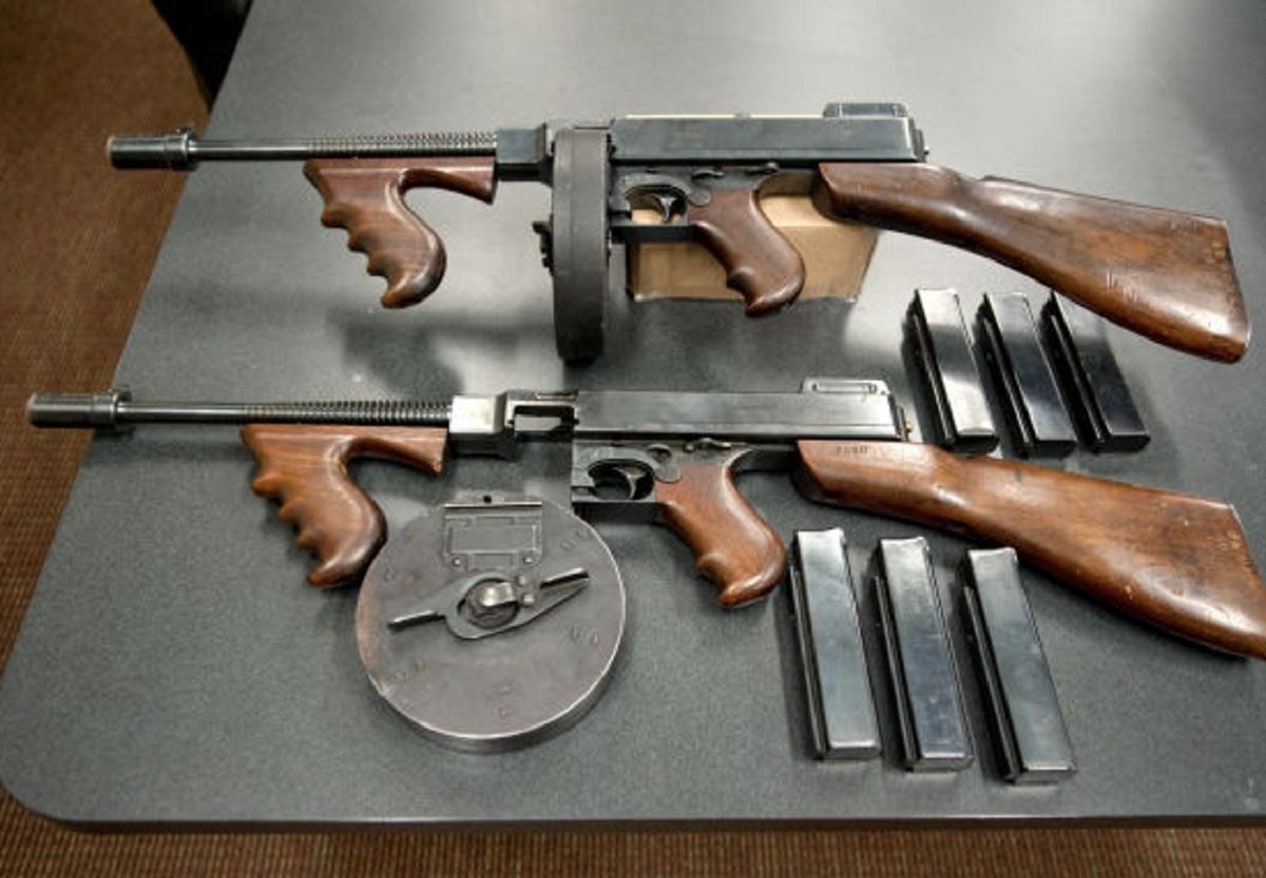
Tommy Gun-style Machine Gun. Image Credit: Creative Commons.
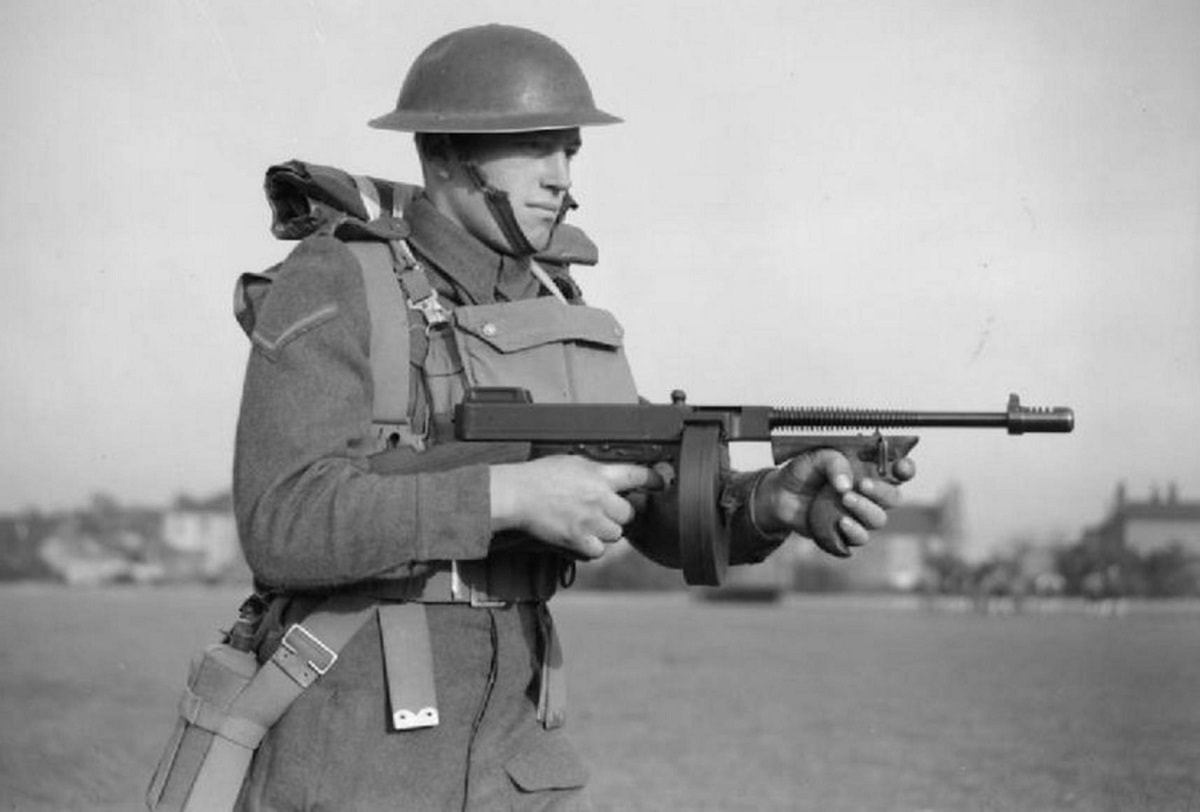
Tommy Gun
The design was finalized too late for World War I combat use, with the first production models, the Model 1921, entering the commercial market rather than the battlefield.
Design and Features
The Thompson was distinguished by its distinctive horizontal box or drum magazines, pistol grip, and, on early models, a forward vertical foregrip that gave it an unmistakable silhouette. Our arms room had both the horizontal and vertical foregrip models.
It fired at a cyclic rate of roughly 600 to 725 rounds per minute, depending on the model, and its .45-caliber rounds delivered significant stopping power at close range, though its effective range was limited compared to rifle-caliber weapons.
Early Thompsons could accept 20- or 30-round box magazines as well as 50-round drum magazines, the latter becoming a visual trademark of the weapon. The drum magazines were noisy, heavy, and prone to jamming, however.
The gun’s precision machining, use of high-quality steel, and complex internal mechanism made it expensive to produce, with early commercial models costing roughly $200, a substantial sum in the 1920s. For instance, the average price of an M1 Garand a decade later was $26.
Commercial Struggles and the Gangster Era
Despite its engineering pedigree, the Thompson initially struggled to find a military buyer. The U.S. Army, having just concluded a major war, had little appetite for new small-arms procurement, and the weapon’s high cost limited interest among police departments and civilian buyers.
This left an unfortunate market opening: the Thompson became infamous during Prohibition as the weapon of choice for organized crime figures, most notoriously in the 1929 Saint Valentine’s Day Massacre in Chicago.
Its portability, high rate of fire, and ability to be concealed under a coat made it attractive to bootleggers and rival gangs alike, cementing its “Chicago Typewriter” nickname in the public consciousness.
In response to the violence associated with such weapons, Congress passed the National Firearms Act of 1934, which imposed heavy taxation and registration requirements on automatic weapons, including the Thompson.
Military Service
The Thompson finally found its intended purpose with the outbreak of World War II. The U.S. military, along with British and other Allied forces, adopted the weapon in large numbers.
The M1928A1 saw early wartime service, while simplified variants, the M1 and M1A1, were developed to speed production and reduce manufacturing costs, eliminating features like the Blish compensator lock and drum magazine compatibility in favor of a simpler straight blowback design and box magazines only.
Thompsons were used extensively by American paratroopers, infantry squad leaders, and Marine Raiders throughout the Pacific and European theaters, valued for their close-quarters firepower in jungle fighting and urban combat alike.
Over 1.75 million Thompsons were manufactured during the war by Auto-Ordnance and Savage Arms.
The Thompson’s Legacy
After World War II, the Thompson was gradually phased out of frontline U.S. military service in favor of lighter, cheaper weapons like the M3 “Grease Gun,” though it remained in limited use in later conflicts including Korea and Vietnam.
The author’s father, in Germany near the end of WWII, wearing the Mayor’s top hat and tails, carrying an M3 Grease Gun, issued to tank destroyer crews. The medic pictured was a pitcher for the Boston Red Sox before the war.
Firing the Thompson was awesome. Loading up a noisy, heavy 50-round drum, you can appreciate the weight: about 15 pounds fully loaded. A word to the wise, when you rock and roll the Thompson, you are best served by leaning forward.
In World War II, the troops were taught to use short bursts. That isn’t just to conserve ammo. Firing 3-to-4-round short bursts allowed the troops (who weren’t as big as today’s) to fire fairly accurately at their targets.
Of course, we weren’t interested in that. Holding the trigger down on fully auto, the shooter has virtually no chance of emptying the 50-round drum magazine of the M1928A1 anywhere close to the target. The M1A1 Thompson wants to climb even more, IMO, hence the leaning forward.
Few weapons have so thoroughly bridged the worlds of military history, criminal folklore, and American pop culture as the Tommy gun. If you ever get the chance to fire one at a range or expo, try it.
You’ll be glad you did.
About the Author: Steve Balestrieri
Steve Balestrieri is a National Security Columnist. He served as a US Army Special Forces NCO and Warrant Officer. In addition to writing on defense, he covers the NFL for PatsFans.com and is a member of the Pro Football Writers of America (PFWA). His work was regularly featured in many military publications