
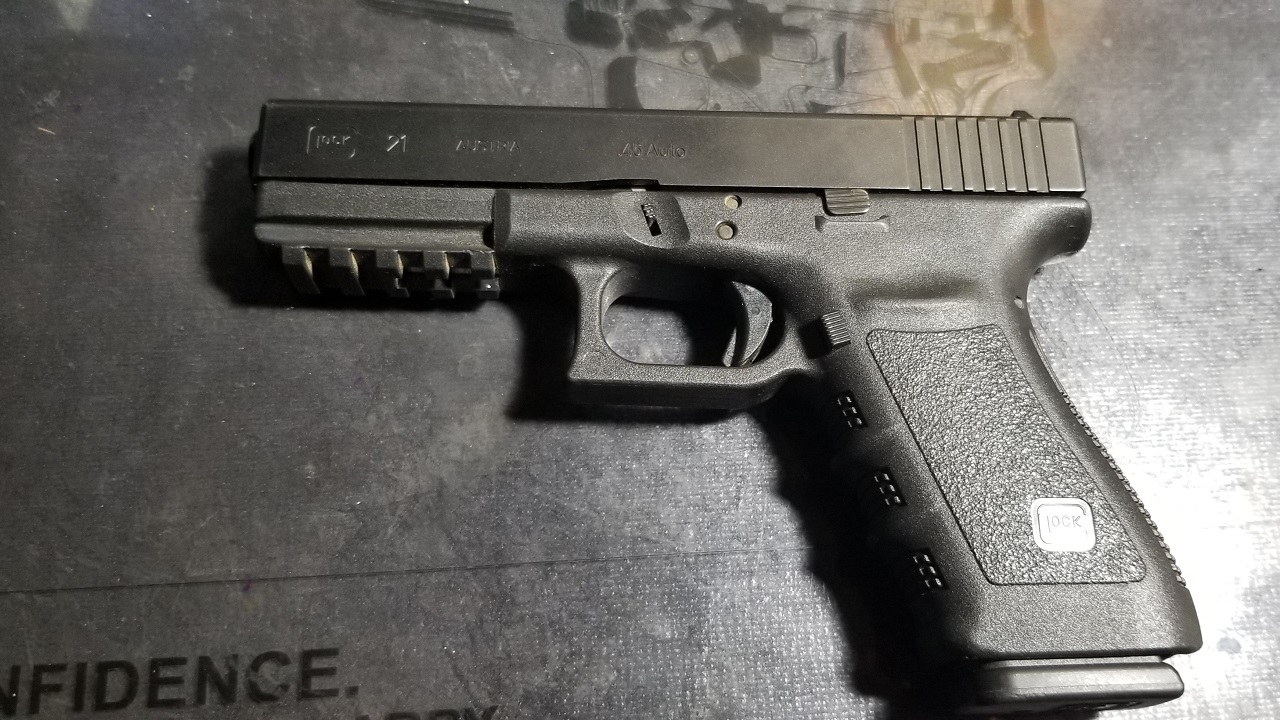
Summary and Key Points: The Glock 45 is chambered in 9mm. The pistol that fires .45 ACP is the Glock 21. That is not a typo, and it is the single most confusing thing about Glock’s model numbering, which mostly reflects patent sequence and magazine capacity rather than caliber. The Glock 21 arrived in 1990 as the big-bore answer to the Glock 17, and its argument was simple arithmetic: 13 rounds of .45 ACP plus one in the chamber, at a time when the standard .45 was a 1911 carrying seven or eight.
The Glock 21: A Duty and Concealed Carry .45 Caliber Option
Glock pistols remain the most popular pistols in the world. Glocks inspire that kind of loyalty for a good reason. They are reliable, shoot well every time you pull the trigger, are durable, and are versatile.
These specialized striker-fired polymer pistols have seen widespread adoption across various government agencies, from law enforcement (local, state, and federal) to the Armed Forces, where Glocks have become quite popular with SOCOM’s special operators.
However, the nomenclature used for Glock models can be confusing at times. While the Glock 17 refers to the magazine capacity, the Glock 45 is chambered in 9mm Parabellum, not .45 ACP. This can cause confusion at first. However, the Glock 21 is chambered in .45 ACP for those keeping score at home.
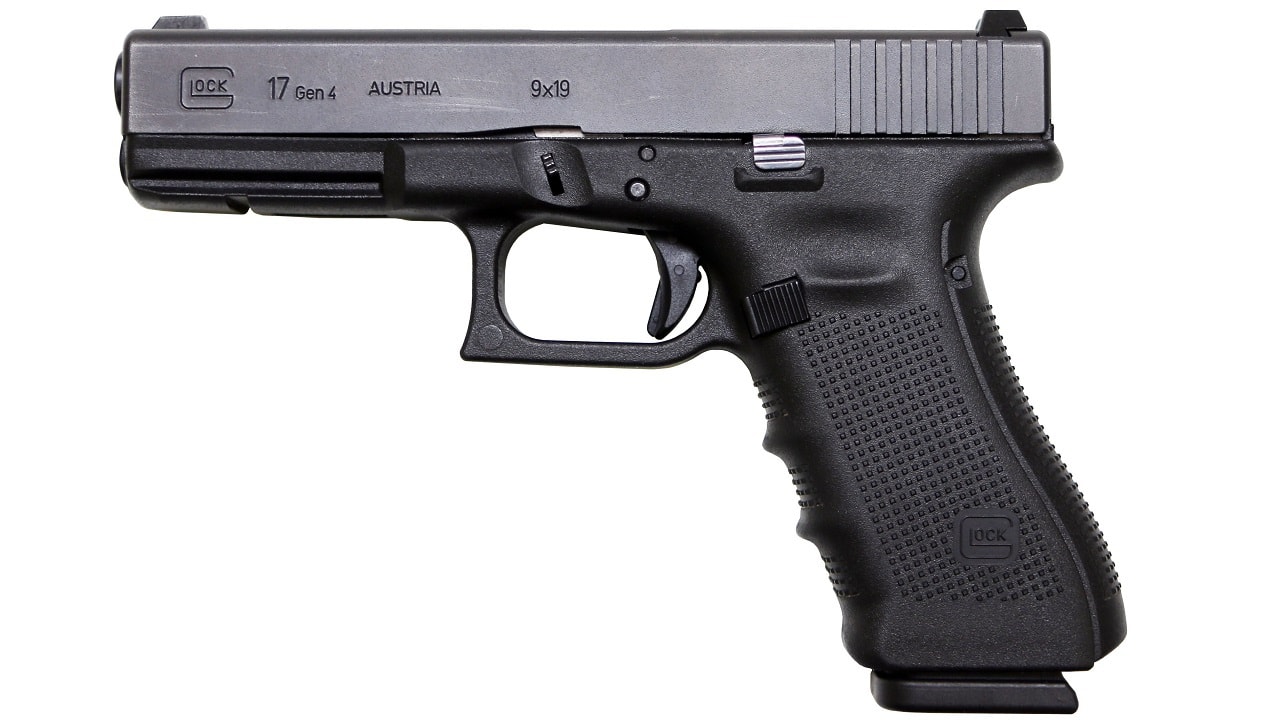
Pictured is the GLOCK 17 Gen 4 Pistol. Creative Commons Photo.
Brief Overview Of The Glock 21
As mentioned above, the Glock 21 is chambered in .45 ACP. The magazine holds 13+1 rounds, and as Glock says, it is well-known for its accuracy and light recoil. The Glock 21 Gen5 MOS delivers the power of the 45 ACP round with high magazine capacity.
The Gen5 model has the finger grooves removed from the frame, front serrations, and the MOS system for easy installation of a red dot sight. The pistol’s ergonomics have definitely improved, and it feels much better in your hand.
This pistol shoots well, is highly accurate, and has very manageable recoil for a .45 ACP. Although I have never owned one of these, I did have the opportunity to put two magazines of ammo downrange, and as a well-known fan of the .45 caliber, I found it a really nice shooting pistol, as any Glock is.
This particular pistol was fitted with a Holosun SCS MOS with a green reticle that mounts directly to the slide, no adapter plate needed.
The Glock 21 is a full-size, polymer-framed semi-automatic pistol that was first introduced in 1990. Designed as a larger-caliber companion to the 9mm Glock 17, the G21 was built to appeal to American law enforcement and civilian shooters who favored the stopping-power reputation of the .45 ACP cartridge.

Glock 21. Image Credit: Creative Commons.
It uses Glock’s standard Safe Action trigger system, a polymer frame, and a steel slide, and it typically ships with a 13-round magazine — a notably high capacity for a .45-caliber pistol at the time of its release.
Over the decades, Glock has released several variants, including the G21 Gen4 and Gen5-style updates (though the G21 has largely been folded into Glock’s broader Gen4/Gen5 lineup), as well as the G21SF (“Short Frame”), aimed at shooters with smaller hands.
The pistol has seen use by various police departments, the FBI’s Hostage Rescue Team at one point, and a substantial civilian following.
Pros as a Duty Pistol
Stopping power and caliber preference. The .45 ACP round has long enjoyed a reputation among some officers and departments for its terminal performance, particularly with modern hollow-point defensive ammunition. The .45 is a big, slow chunk of lead with knock-down power a 9mm doesn’t have.
While ballistic gel testing over the years has narrowed the practical performance gap between quality 9mm and .45 ACP loads, some agencies and individual officers still prefer the larger diameter round.
Reliability. Glocks are widely known for their reliability in adverse conditions — dirt, mud, minimal lubrication, and the G21 is no different. For a duty weapon that may see rough treatment, this is a meaningful advantage.
For those shooters with larger hands, the G21 feels perfect, like an extension of the shooter’s arm.
Simplicity of the platform. The Safe Action trigger, lack of an external manual safety, and minimal controls make the G21 straightforward to train on, which matters for departments running large numbers of officers through qualification courses.
Magazine capacity. A 13+1-round standard magazine in .45 ACP was, and largely remains, high capacity for the caliber, giving officers more rounds on tap than many traditional .45 pistols (such as the 1911, which typically holds 7-8 rounds).
Cons as a Duty Pistol
Size and weight. The G21 is a large, wide-gripped pistol. Its grip circumference is often cited as a fit problem for officers with smaller hands, which is part of why Glock introduced the SF (Short Frame) variant.
Departments issuing sidearms to a diverse population of officers may find one-size-fits-all sizing an issue.
Recoil and follow-up shots. The .45 ACP round generates more recoil than 9mm in a comparably sized gun, which can slow follow-up shot accuracy for some shooters, particularly under stress. But in an albeit very limited shooting experience, the recoil felt less like a snap and more like a smoother push.
Many agencies have moved back to 9mm in recent years partly for this reason, alongside advances in 9mm defensive ammunition that have reduced the performance gap.
Cost and ammunition considerations. .45 ACP ammunition is generally more expensive than 9mm, which matters for training budgets when departments are putting officers through thousands of practice rounds per year.
Trend away from .45 in law enforcement. Many agencies that once fielded .45 ACP duty guns (including the FBI, historically) have shifted to 9mm platforms, citing capacity, controllability, training costs, and modern ammunition performance. This broader trend is worth factoring in for any department considering the G21 today.
Pros as a Concealed Carry Weapon
Caliber confidence. For those who prioritize a larger-diameter round for personal defense, the G21 offers that in a package that’s more reliable and higher-capacity than many other .45 options.
Proven reliability. The same durability that makes it attractive for duty use also benefits a concealed-carry gun that may not receive frequent maintenance.
Aftermarket support. As a Glock, the G21 benefits from an enormous aftermarket of holsters, sights, triggers, and other accessories, making concealment customization easier than with more niche platforms.
Cons as a Concealed Carry Weapon
Size. This is the G21’s biggest drawback for concealed carry. It’s a large, thick, heavy pistol, not an easy gun to conceal under normal clothing, especially for smaller-framed carriers or in warmer climates where clothing options are limited.
Weight when loaded. A G21 loaded with 14 rounds of .45 ACP (13+1) is heavy to carry all day (38.6 ounces), which makes it uncomfortable.
Grip size for concealment. The wide grip, which can be a duty-gun fit issue, is even more relevant for concealment, as it tends to print more easily under clothing than slimmer single-stack or subcompact designs.
The Glock 21 Balances Power With Concealment
The Glock 21 is a very reliable, well-supported .45 ACP pistol with a loyal following. As a duty weapon, it offers solid stopping power and dependability, though its size and the broader law-enforcement trend toward 9mm are real considerations.
As a concealed carry option, its size and weight are significant drawbacks that push many carriers toward more compact Glock models (such as the G30 or G36) or a 9mm alternative if all-day concealment is the priority.
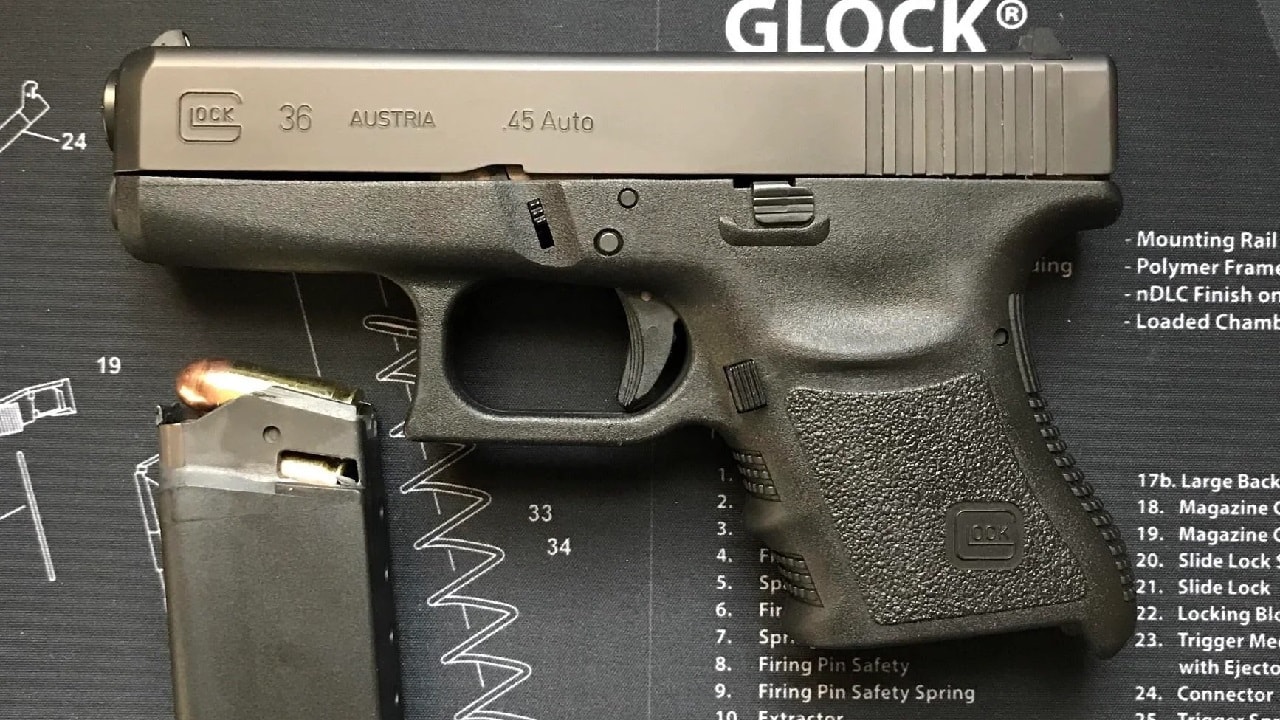
Glock 36. Image Credit: Creative Commons.
About the Author: Steve Balestrieri
Steve Balestrieri is a National Security Columnist. He served as a US Army Special Forces NCO and Warrant Officer. In addition to writing on defense, he covers the NFL for PatsFans.com and is a member of the Pro Football Writers of America (PFWA). His work was regularly featured in many military publications.