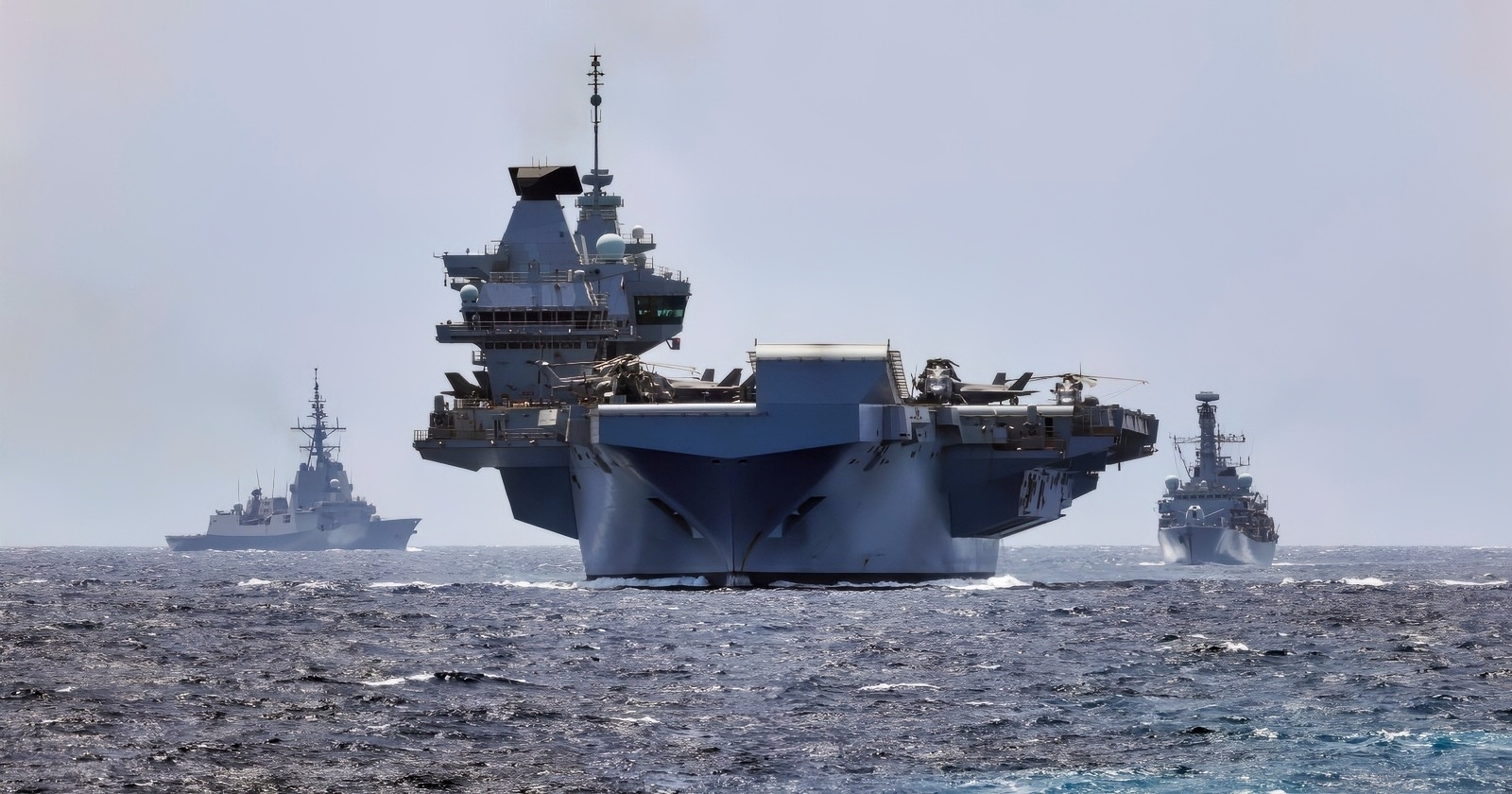
The Royal Navy’s Queen Elizabeth-class has been more expensive and less available than anticipated, thanks to a host of design and construction problems. While the two carriers of the Queen Elizabeth-class were originally budgeted at about £3.9 billion, program costs rose precipitously to about £7.6 billion.
Much of the cost increase has been driven by slipping construction and maintenance schedules, partly due to the 2008 financial crisis, as well as a very expensive—and ultimately abandoned—plan to convert one of the flattops to a CATOBAR launch configuration before reverting to the original STOVL design.
In addition to several mechanical breakdowns, the program has been extensively reworked while simultaneously attempting to mature several new technologies.
The Queen Elizabeth
For the Queen Elizabeth, one of the earlier problems was a propeller shaft seal leak which became apparent during sea trials in late 2017.
During that incident, about 200 liters of seawater ingress per hour forced a return to port.
Though it did not sideline the carrier for long, it was nevertheless a significant embarrassment for the Royal Navy.
But a more consequential breakdown occurred in 2024.
That mishap was a propeller shaft coupling failure which became apparent during pre-sailing checks ahead of Steadfast Defender, a NATO exercise.
The aircraft carrier was, thanks to the issue, forced to withdraw from the exercises and return to port for repairs to the shaft coupling.
That incident was a major issue for the Royal Navy, as the Queen Elizabeth was to play a central role in Steadfast Defender.
Another significant issue the Queen Elizabeth has had to contend with was a general maintenance issue that affected onboard quality of life.
In 2023 and 2024, the ship’s Showergate scandal came to light. Media reports revealed a number of plumbing defects on the ship, including issues with showers onboard.
Though not as operationally significant as propulsion problems, Showergate drew attention to the very basic issue of habitability on the ship and added to the list of issues that the ship had to rectify.
The HMS Prince of Wales
The HMS Prince of Wales has had a rougher go of it than its sister ship.
In the summer of 2022, the ship broke down mere days after leaving Portsmouth.
The issue was an external coupling failure that damaged the starboard shaft and a 22-ton propeller, leaving the ship out of action for about nine months while repairs were completed at Rosyth.
The failure was ultimately attributed to build-quality defects, specifically a misalignment during construction and the incorrect installation of several crucial components.
But that was not the last of the ship’s incidents.
In February 2024, the ship suffered a last-minute departure delay, preventing it from stepping in for the HMS Queen Elizabeth and taking over her role during Steadfast Defender.
But the following year, in 2025, the HMS Prince of Wales successfully completed Operation Highmast, an eight-month deployment to the Indo-Pacific.
Operational Implications
The implications of the classes’ multiple breakdowns are consequential for operational readiness.
Repair cycles reduce the time ships are available for training or out on operations and exercises, and the Royal Navy has, on repeated occasions, found itself with only a single aircraft carrier available — or worse, with neither ship available.
This places a massive constraint on sustaining deployments, increases pressure on support and escort ships, and requires careful scheduling to avoid aircraft carrier unavailability.
Keeping the ships at port consumes scarce and valuable dockside real estate as well as engineering attention, potentially pushing other pressing repairs and maintenance to other Royal Navy warships aside.
Smoother Seas Ahead?
The future of the class is seemingly a bit more assured.
The aforementioned shaft and coupling defects have been rectified, and the HMS Prince of Wales 2025 deployment is evidence of the class’s improved reliability.
But aircraft carriers are, by nature, large, complex, and maintenance-hungry ships, factors that constrain availability.
Their future prospects for operational availability are probably better than their current records suggest.
But the class’ reputation is nonetheless somewhat tarnished by their previous mishaps and misadventures.
In the future, the Royal Navy will be hard-pressed to ensure it can project air power from the sea worldwide.
While the warships are apparently on the right course, only time will tell if other, additional issues come to light that put the kibosh on other deployments.
About the Author: Caleb Larson
Caleb Larson is an American multiformat journalist based in Berlin, Germany. His work covers the intersection of conflict and society, focusing on American foreign policy and European security. He has reported from Germany, Russia, and the United States. Most recently, he covered the war in Ukraine, reporting extensively on the war’s shifting battle lines from Donbas and writing on the war’s civilian and humanitarian toll. Previously, he worked as a Defense Reporter for POLITICO Europe. You can follow his latest work on X.