Summary and Key Points: The Royal Navy’s King George V-class battleships, commissioned 1940–1942, carried ten 14-inch guns. HMS King George V opened fire on the Bismarck from 25,500 yards on May 27, 1941, three days after the Bismarck sank HMS Hood, and the Bismarck sank that morning. HMS Duke of York sank the Scharnhorst in 1943; HMS Prince of Wales was lost off Malaya to Japanese aircraft. Britain scrapped the survivors in the 1950s.
King George V-Class: Not as Well Known as the US Navy’s Iowa-Class, But Still a Powerhouse
Before its decline, the British Royal Navy was the most powerful and innovative navy the world had ever seen. We’re not just talking historically.
We are talking about a time that is in the living memory of some older adults today.
One of the most iconic classes of ships the Royal Navy built in its final years as the world’s dominant naval force was the King George V-class battleship.
Many naval historians consider the King George V-class battleships the most important British warship of the Second World War. They might be as well known as say the US Navy’s Iowa-Class battleships, nontheless, they were still powerful and historic.
These great ships were designed during the 1930s and commissioned between 1940 and 1942. They combined heavy armor with powerful naval artillery.
These ships even had modern fire-control systems.
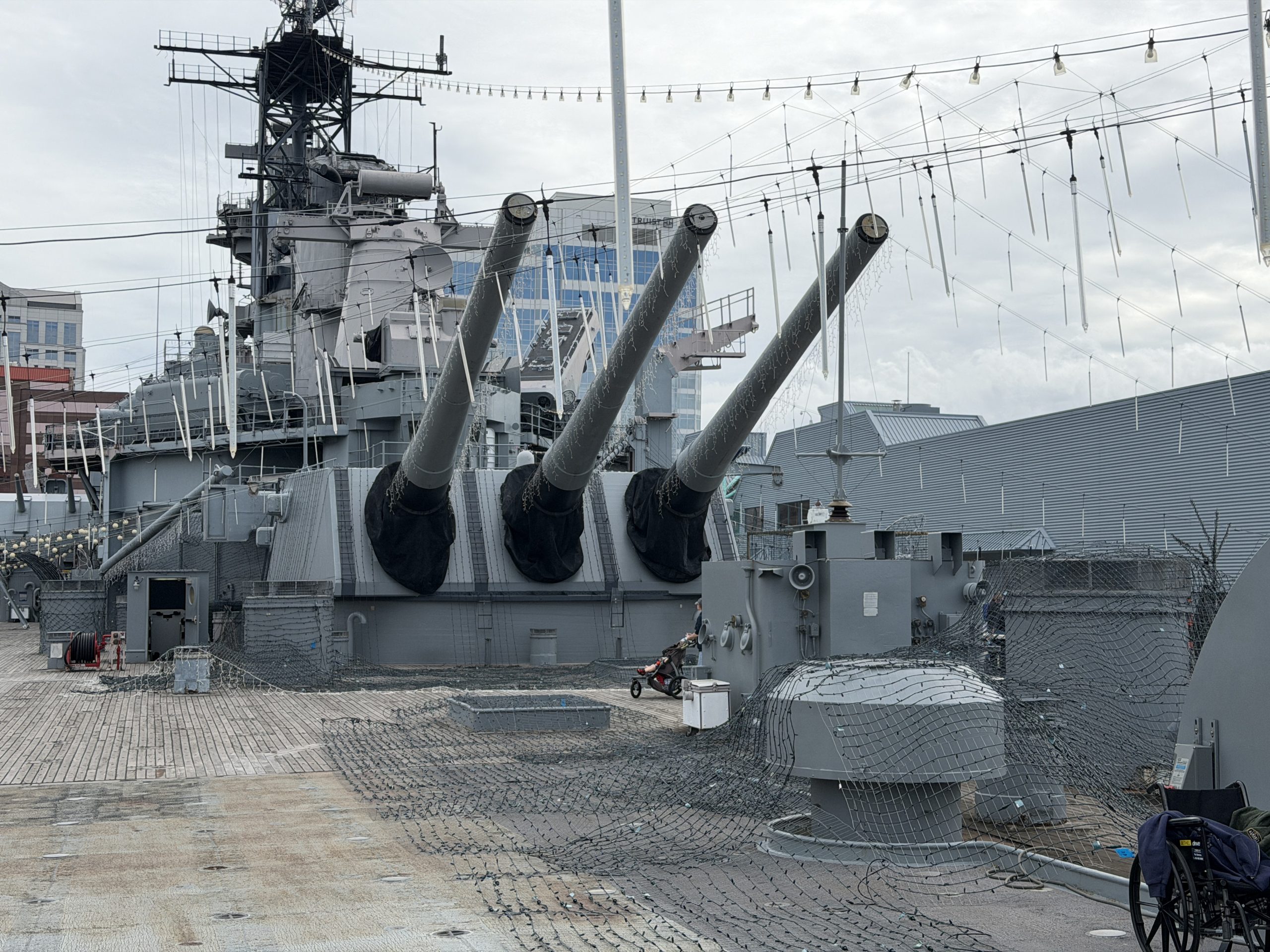
USS Wisconsin Iowa-Class Battleship Tour. Photo by 19FortyFive Reporter Christian D. Orr.
In fact, that fire-control system was technologically interesting. They included optical rangefinders and increasingly sophisticated radar equipment.
For example, the HMS King George V carried Type 279 air-warning radar and Type 284 main-armament fire-control radar during her initial trials.
What’s more, the King George V-class battleships participated in some of the most important naval battles of World War II.
They weren’t relegated to the Battle of the Atlantic (where they did make quite a name for themselves).
Some King George V-class battleships also made key contributions to the Pacific Theater against the Imperial Japanese Navy.
The Background
When the British designed this class of ships, the Washington Naval Treaty of 1922 and the subsequent Second London Naval Treaty of 1936 were still in effect. Britain wanted to limit new battleship armament to just 14-inch guns (while other naval powers ultimately moved toward larger weapons).
The British kept true to their treaty obligations and built these new battleships with only 14-inch guns. Naval designers prioritized protection and rapid production over heavier firepower.
These battleships could displace up to 42,000 tons when fully loaded.
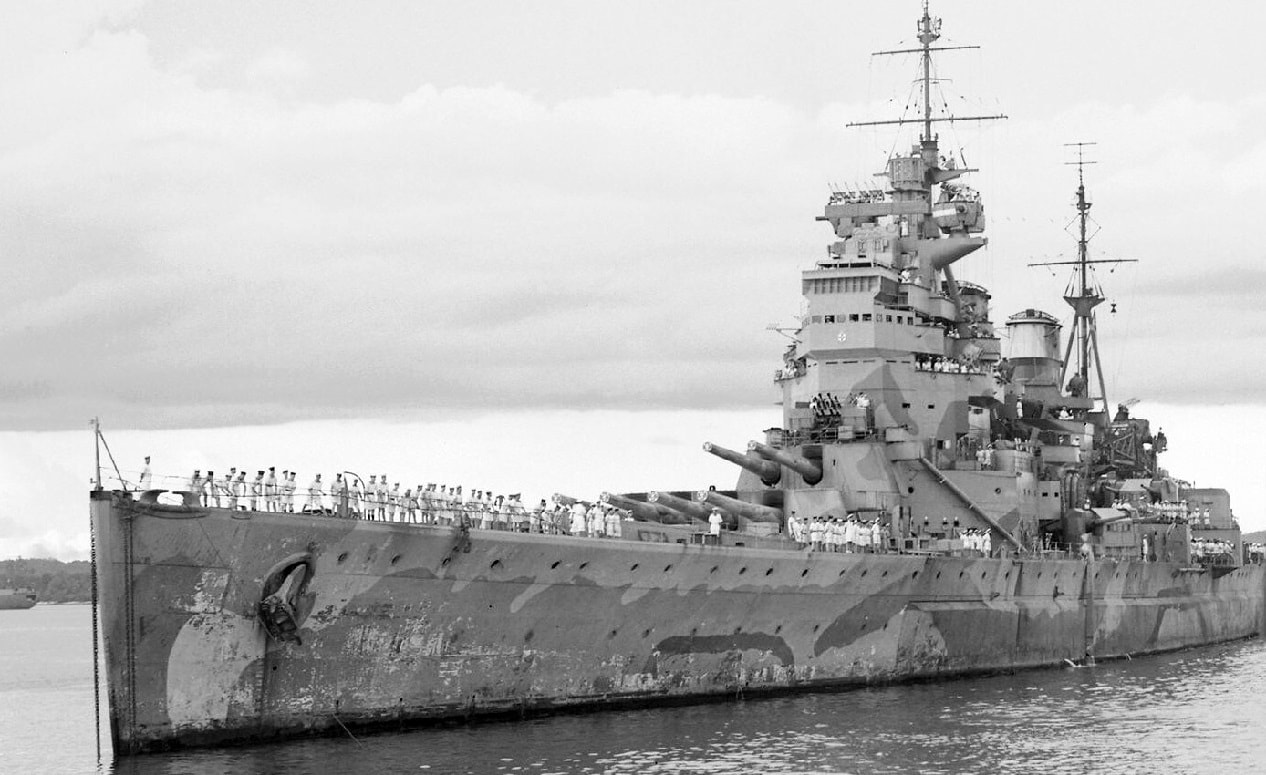
Image of Battleship HMS Prince of Wales. Image Credit: Royal Navy.
Eight Admiralty three-drum boilers supplied steam to four Parsons geared turbines, producing 110,000 shaft horsepower; that power drove four propellers, pushing the ships to speeds up to 28 knots.
At 18 knots, the King George V-class battleships had an operational range of 5,400 nautical miles.
These ships carried ten 14-inch Mark VII naval guns arranged in triple turrets.
British naval designers placed two more quadruple turrets forward and aft, while a twin turret occupied a forward superfiring position. Each gun could fire 1,590-pound armor-piercing shells.
Those quadruple turrets, however, presented some real problems for the Royal Navy. They struggled with many mechanical issues, notably a loading-system failure that could interrupt firing.
Secondary batteries included 16 five-point-two-five-inch dual-purpose guns mounted in eight twin turrets.
These weapons were meant to engage enemy destroyers (and smaller surface combatants), as well as aircraft.
But the Royal Navy wasn’t done with anti-aircraft defenses.
The Royal Navy installed multiple eight-barreled two-pounder pom-pom mounts.
As the war continued and the service’s needs changed, the Royal Navy eventually installed heavier anti-aircraft batteries.
A thick 14.7-inch armor belt protected the ship, especially around the vulnerable magazines, while six-inch horizontal armor covered other vital areas.
These battleships also had extensive underwater protection against the constant threat of torpedo attack.
An Impressive Record
One of HMS King George V’s most significant missions was against the infamous German battleship Bismarck in May 1941.
Three days after the Bismarck sank the iconic British battlecruiser HMS Hood during the Battle of the Denmark Strait, the HMS King George V and HMS Rodney engaged the Bismarck in what would be the German battleship’s final confrontation.
On May 27, King George V opened fire on the Bismarck from 25,500 yards away.
Both the King George V and the HMS Rodney subjected the Bismarck to a sustained, devastating bombardment that degraded much of the German battleship’s fighting capacity.
A British cruiser then joined the fight, with HMS Dorsetshire launching torpedoes that crippled the Bismarck. The German battleship sank that morning.
This battle established King George V as one of the Royal Navy’s most important surface-warfare ships.
It also elevated the entire class of battleships to which the King George V belonged.
Tragedy In the Pacific
Later that year, HMS Prince of Wales, another member of the King George V-class, operated off Malaya with HMS Repulse, a Royal Navy battlecruiser.
These two ships unexpectedly came under sustained attack by Imperial Japanese land-based bombers and torpedo aircraft.
The Japanese attack damaged the Prince of Wales’ propulsion and electrical systems, grievously compromising the great ship’s defenses.
Both the Prince of Wales and Repulse were ultimately lost.
Reclaiming Honor in the Atlantic
But the King George V-class wasn’t done making a name for itself.
Another member of this legendary class, HMS Duke of York, scored a major victory on December 26, 1943, during the Battle of the North Cape.
The Duke of York engaged the German battlecruiser Scharnhorst off Norway and eventually sank the Scharnhorst.
HMS King George V, Howe, and Anson served in operations in both the Atlantic and Pacific during WWII.
King George V took part in the Allied invasion of Sicily in 1943 and later joined the British Pacific Fleet, helping with the attack on Japan in 1945.
The End of an Era
After Japan surrendered, though, Britain put the surviving battleships into reserve as aircraft carriers became the primary focus of surface naval warfare in the post-World War II era.
The British ultimately scrapped these ships in the 1950s.
But their service was significant.
And they represented the last of the truly great imperial battleships.
In the decades to come, the British would lose their empire, and the Royal Navy would continue to decline, leading to one of its most humiliating periods.
About the Author: Brandon J. Weichert
Brandon J. Weichert is the Senior National Security Editor at 19FortyFive.com. He also manages The Weichert Brief on Substack. Weichert is the co-host for The Mario Nawfal Show on Twitter/X. He is the author of four bestselling national security books, most recently A Disaster of Our Own Making: How the West Lost Ukraine (Encounter Books). His next book, Fortress Americas: A New Monroe Doctrine (Tucker Carlson Books), is due out December 8. Follow him via Twitter/X @WeTheBrandon.