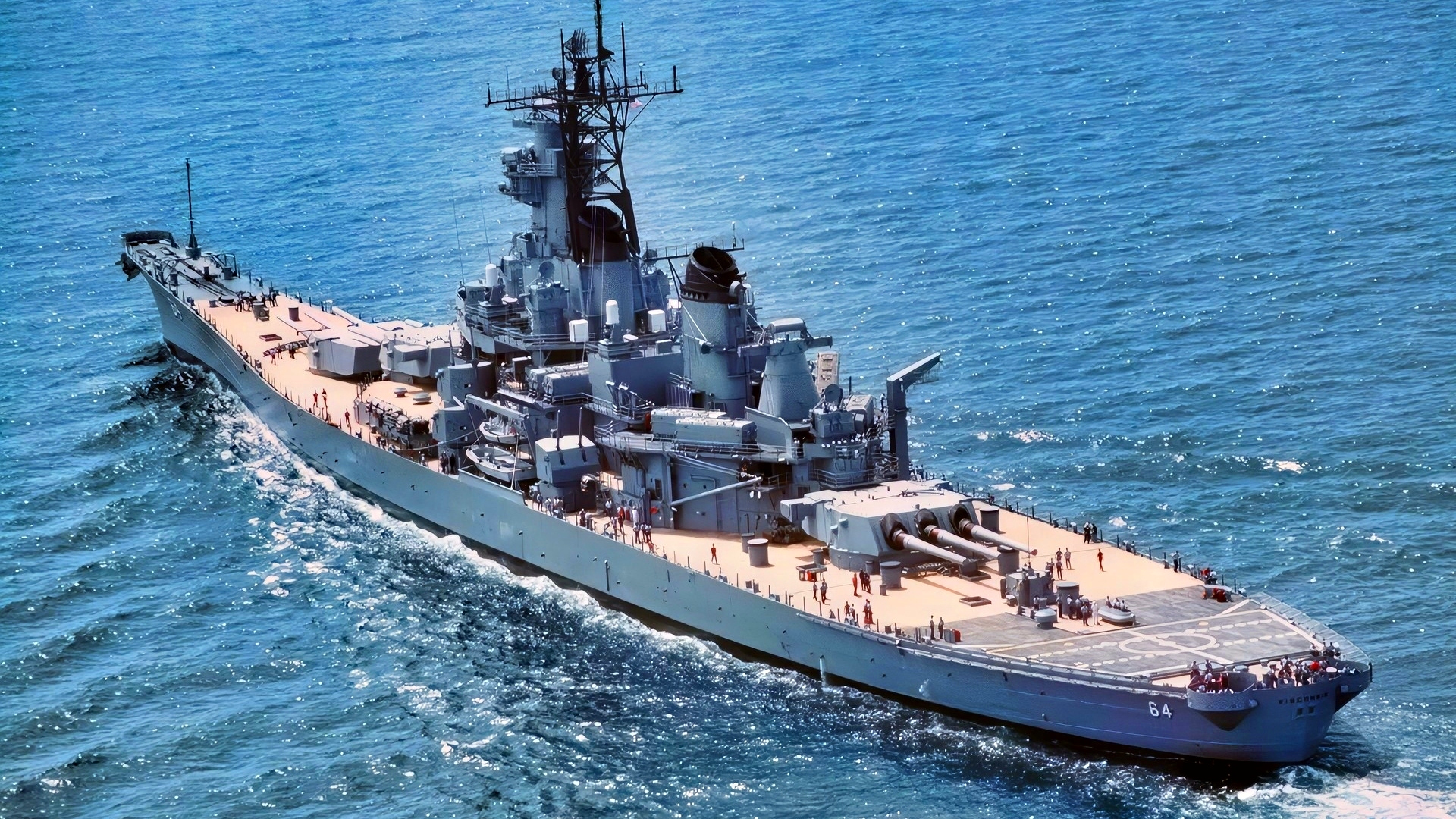
Summary and Key Points: Sean Spoonts recounts May 6, 1956, when the Iowa-class battleship USS Wisconsin, steaming in fog off the Virginia Capes with the carrier Coral Sea and cruiser Des Moines, struck the radar-less Fletcher-class USS Eaton (DDE-510) at 17 mph after a false man-overboard call, breaking her keel and crumpling 68 feet of her own bow. Norfolk Naval Shipyard grafted on a 68-foot, 150-ton bow from the unfinished USS Kentucky in 16 days, earning the nickname “WisKY.”
In 1956, Battleship USS Wisconsin Almost Cut A Destroyer In Two And Lost Her Bow –
On Sunday, May 6, 1956, the Fletcher-class Destroyer Escort USS Eaton (DDE-510) sailed in heavy fog with a small task force. At the center of the task force was the aircraft carrier USS Coral Sea (CVA-134), accompanied by the battleship Wisconsin (BB-63), the heavy cruiser Des Moines (CA-134), and three more destroyer escorts of Destroyer Division 22. The Eaton served as the division’s flagship, with the Commodore aboard. Cruising off the Virginia Capes in the fog, the task force was not looking for the Soviet Navy that day. It was just out for the weekend to entertain politicians with a demonstration of the Navy’s power and capabilities at sea. That morning’s fog reduced visibility so much that the politicians aboard saw little of the other ships in the formation.
Aboard the Eaton, the fog was especially troublesome. Her radar had been out of service for the last 4 days. She navigated within the formation, keeping her position by watching the other ships fade in and out of the fog.
They could catch glimpses of the Coral Sea 5,400 yards to their right, but somewhere out there in the fog were a battleship and a heavy cruiser they couldn’t see, and without radar to mark their locations, that was cause for worry. As long as they held their position off the Coral Sea, they should be all right.
A Nightmare In The Fog, The USS Wisconsin
At 3:10 PM, as sailors aboard the Eaton were preparing for a live-fire demonstration of their 5” guns, a report reached the bridge that a lookout on the Coral Sea had seen a sailor in the water.
The little destroyer escort’s position may not have been ideal for recovering the lost sailor, but the Commodore aboard was in charge of the escorts. He ordered the Eaton to make a hard turn to starboard and increase speed to 27 knots. The crew, already at battle stations for the gunnery exercise, prepared a boat to be lowered as all available hands scanned the waters for the missing man.
The Eaton was picking up speed rapidly, the fog rolling by like low clouds. To the right, the fog suddenly darkened to reveal a nightmare: the towering bow of the 57,500-ton battleship Wisconsin emerged from the mist and bore down on the tiny destroyer.
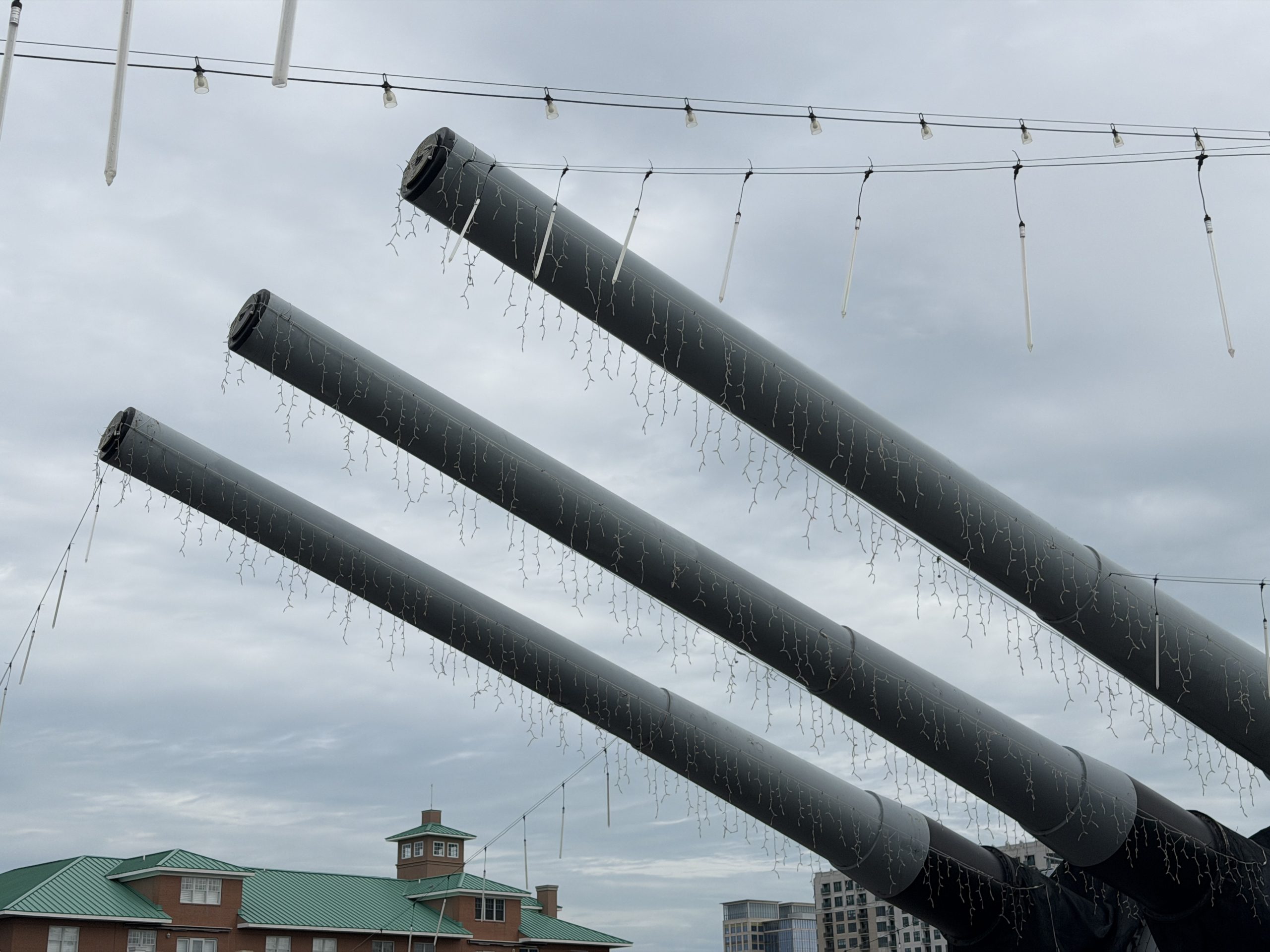
USS Wisconsin Iowa-Class Battleship Tour. Photo by 19FortyFive Reporter Christian D. Orr.
USS Wisconsin, The Last Of Her Kind
The Wisconsin was the last of four Iowa-class battleships to be built. The Navy planned to build six of these battleships, but by the end of WWII, it had completed only four. Experienced workers built Wisconsin, believed to be the best of the four in build quality, and launched it on December 7, 1943. Wisconsin holds the distinction of being the last battleship the United States ever built.
The Iowa class was also incredibly fast for a battleship. In 1968, battleship New Jersey established the world speed record for a battleship at 35.2 knots during sea trials.
Incredibly, New Jersey set this record with 22-year-old steam turbines. Wisconsin could easily make 33 knots at flank speed. The secret to this speed was a long, tapered bow that sliced through the water like a knife, cleaving away the ocean along the 887-foot length of her hull. The bow section was purposely unarmored, as nothing vital to the ship’s survival in battle lay that far forward. Other battleships at flank speed tended to “bury their nose” in the ocean, limiting their speed, but the long, light bow of Wisconsin and other Iowa-class battleships added lift at speed.
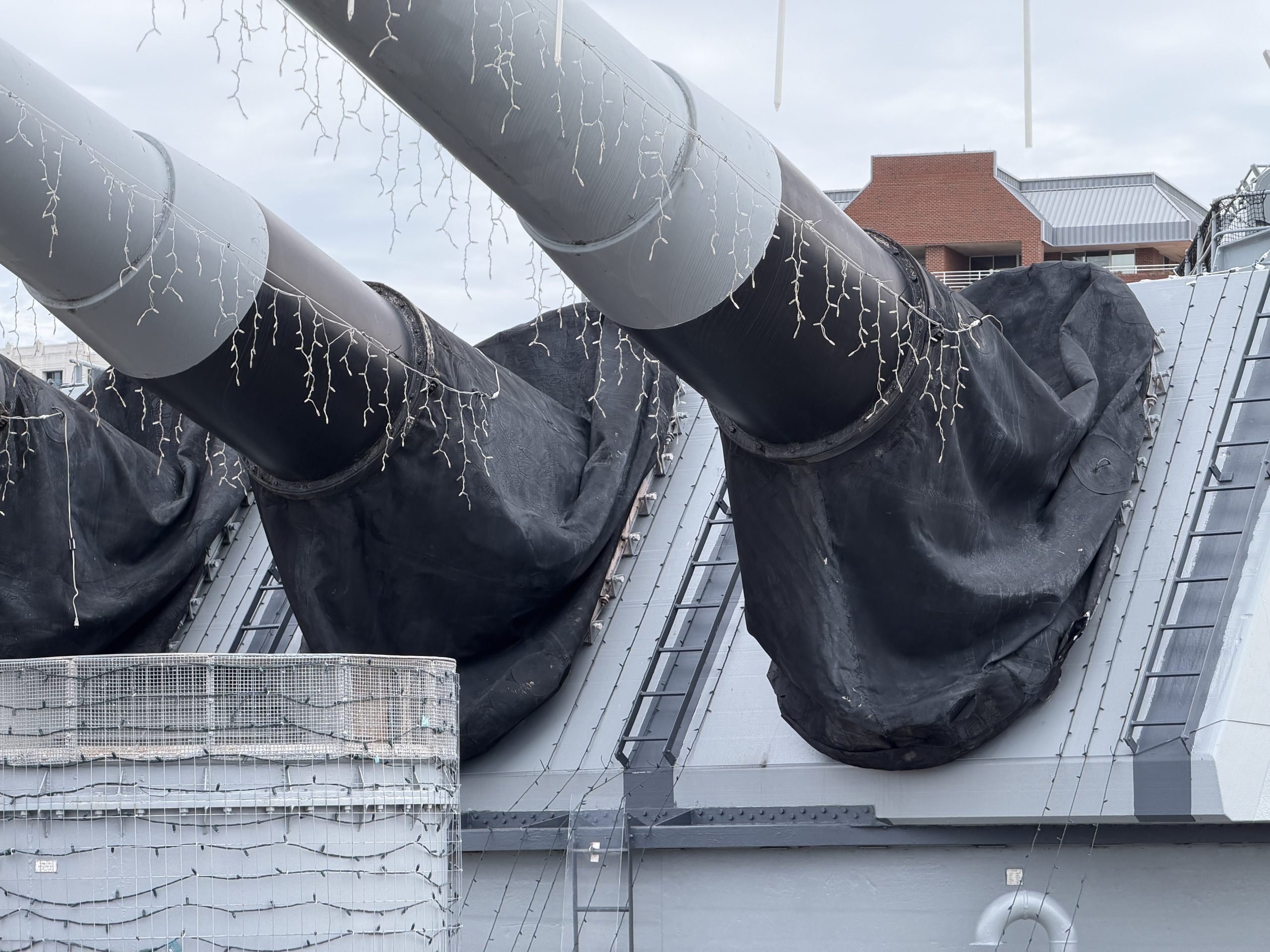
USS Wisconsin Iowa-Class Battleship Tour. Photo by 19FortyFive Reporter Christian D. Orr.
USS Wisconsin Breaks The Back Of The USS Eaton
The Wisconsin struck the right side of the Eaton at the forward 5” inch gun mount at a speed of 17 mph, destroying it. Below deck, the bow punched through the Chief’s Mess, the crew’s galley, the forward fireroom, and severed her keel, the backbone that holds a ship together. The impact severed steam release pipes in the mast, sounding like rapid gunfire as white clouds sputtered and billowed out.
Miraculously, only two people were injured. Her interior compartments were mostly empty, and the crew on deck looked for a man in the water who wasn’t there. A lookout on the Coral Sea spotted a Navy white hat in the fog, triggering a false alarm. Eaton would survive just barely. With her keel broken, the ship’s bow flopped up and down with the swells. Damage control parties rigged her anchor chains as suspended braces to keep the ship together as the Easton limped back to Norfolk.
USS Wisconsin’s Bow Was Twisted Like A Boxer’s Nose
Damage to Wisconsin’s light bow structure was considerable after hitting a 2,000-ton object at 17 mph. The front of her bow twisted to the right like a boxer’s nose broken in a prize fight, and she took a nasty 68-foot cut in her hull that ended at the heavier framing aft.
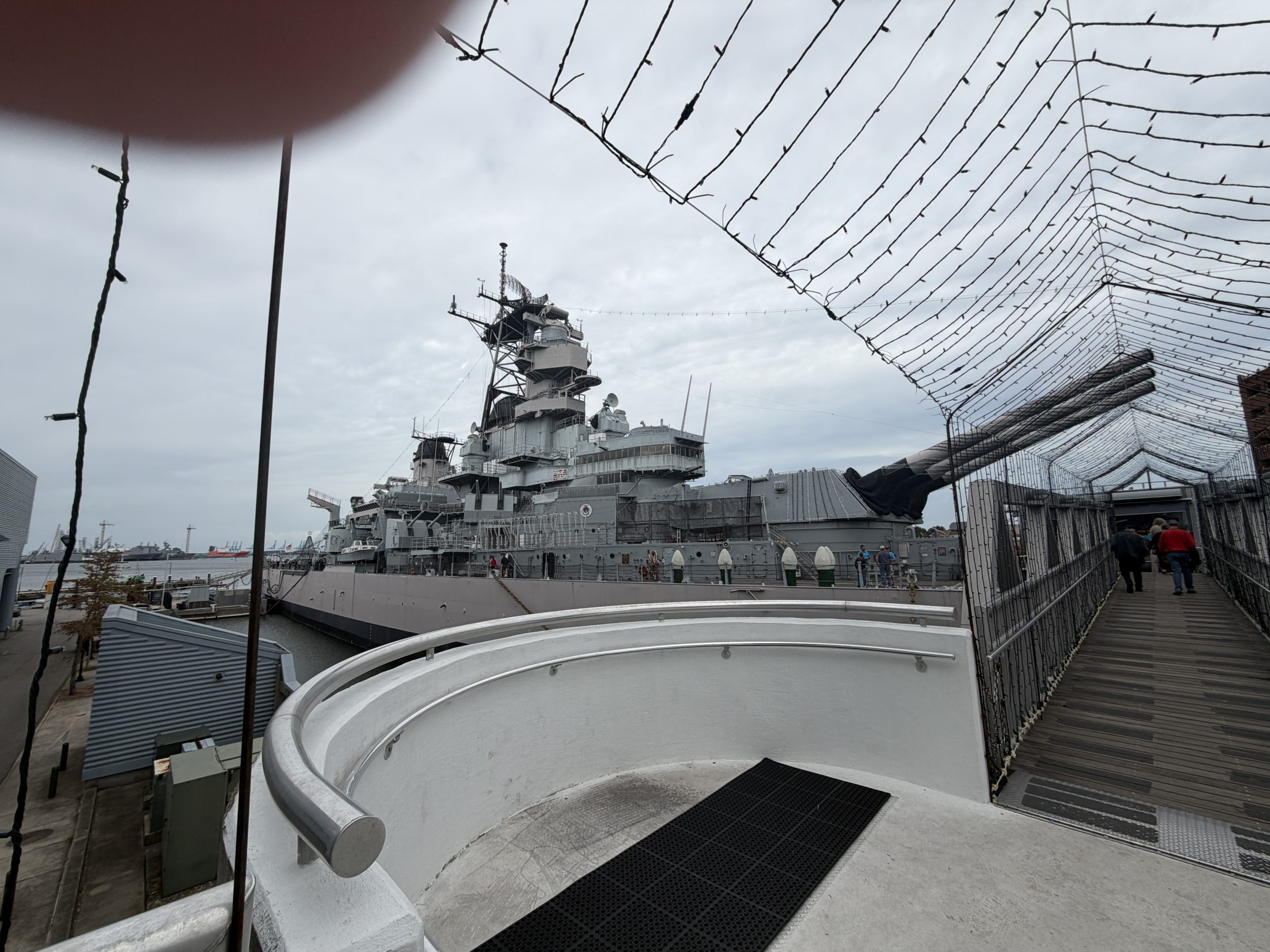
USS Wisconsin Iowa-Class Battleship Tour. Photo by 19FortyFive Reporter Christian D. Orr.
The light construction of Wisconsin’s bow might have saved the Eaton from being cut in half like a hoagie sandwich in a deli.
The bow steel was only about 1.5 inches thick, and the first 80 feet of the bow acted like a “Crumple zone” in a modern car, deforming and absorbing impact forces. Aside from a mangled bow, the Wisconsin was undamaged and not in danger of sinking.
A Miracle In The Shipyard For USS Wisconsin
So, what do you do with a battleship missing 70 feet of bow?
In 1956, plenty of parts were on hand for Fletcher-class destroyers like the USS Eaton; the Navy had built 175 of them during WWII, and many experienced shipyard workers still knew how to work on them. Wisconsin presented a few more problems. Of the six Iowa’s originally planned, only four were built, and Wisconsin was the last, completed in 1943.
After WWII, the unfinished battleships Illinois and Kentucky slowly rusted away in shipyards.
The Illinois was only 22% complete and was mostly an empty shell.
The Kentucky was 77% complete, and the Navy occasionally took pieces from her to repair the four Iowa-class battleships still in service. Kentucky did have a complete bow section, however, and the Navy decided to cut it free and fit it to Wisconsin. This was easier because the bow of Iowa-class battleships was welded, not riveted.
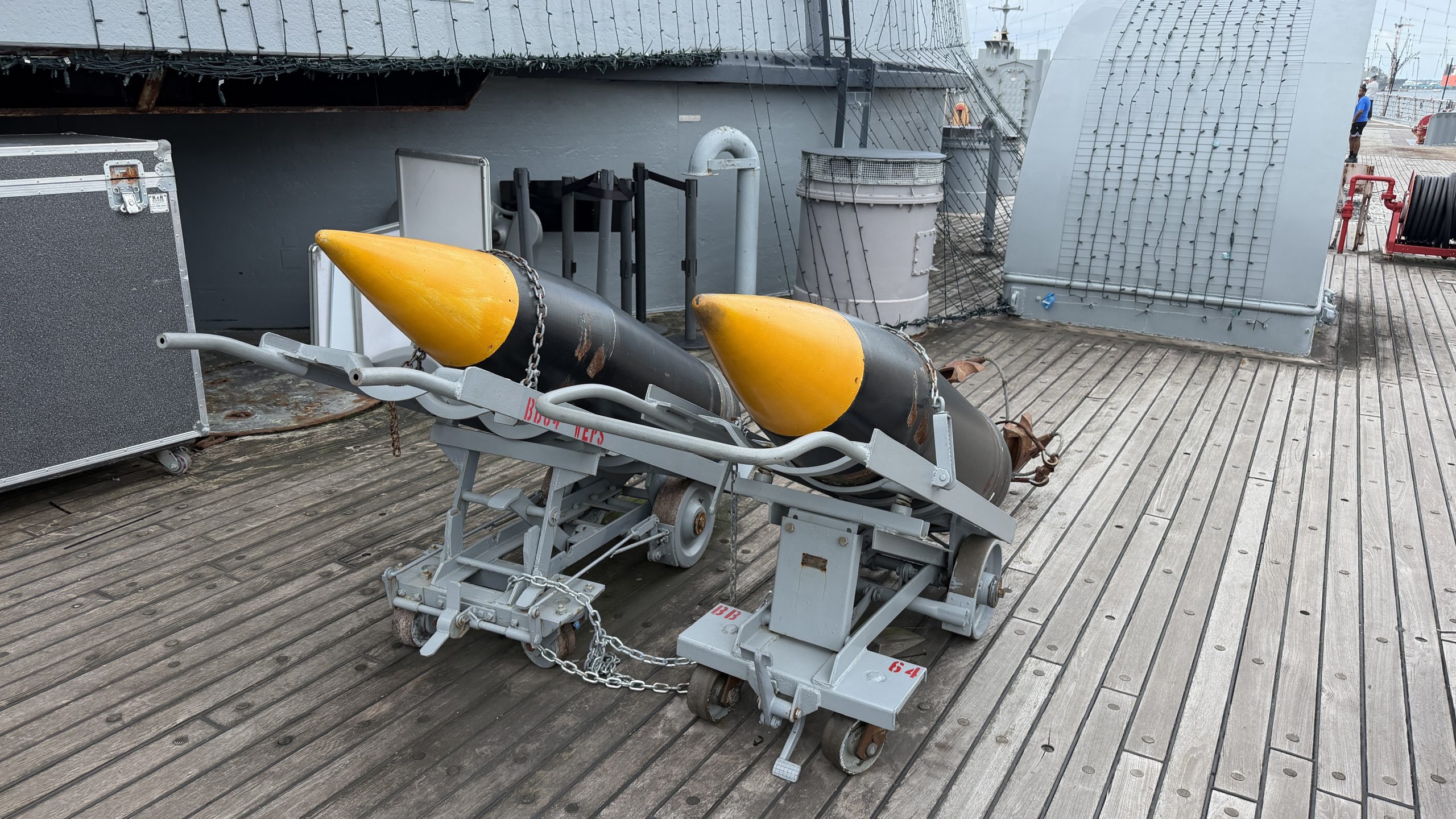
USS Wisconsin Iowa-Class Battleship Tour. Photo by 19FortyFive Reporter Christian D. Orr.
Workers cut away a 68-foot, 150-ton section of Kentucky’s bow and barged it from Hampton Roads to the Norfolk Naval Shipyard, where Wisconsin waited. In today’s world, where repairs to Navy ships can take years, something miraculous happened.
They replaced Wisconsin’s bow in just 16 days.
The “Big Wisky” Returns To Sea
Along with her new bow, USS Wisconsin got a new callsign.
Her crew previously called her “The Big Wisky”; now, with a new bow from the Kentucky, she became “WisKY” in memory of her unfinished sister ship.
Wisconsin returned to duty, taking a piece of the Kentucky with her on every cruise, and remained in service off and on until she was finally decommissioned in 1991, when she returned to Norfolk as a museum ship.
As you might have guessed, the interior photos in this article are from a visit last week to USS Wisconsin.
About the Author: Sean Spoonts
Sean Spoonts is the former Editor-In-Chief of SOFREP.com. He is a military analyst, writer, and commentator whose work has appeared in Newsweek, CNS News, Ukrinform, and various military/veteran media networks and professional publications, including the Military Intelligence Professional Bulletin. He is a U.S. Navy veteran, having served as an Aviation Anti-Submarine Warfare Operator and Search and Rescue Helicopter Aircrewman.