Summary and Key Points: Sean Spoonts recounts the November 2, 1985, grounding of the aircraft carrier USS Enterprise (CVN-65) on Bishop Rock, the near-surface peak of the 6,000-foot Cortez Bank 100 miles west of San Diego, as Capt. Robert L. Leuschner’s bridge handled a false active-shooter report.
USS Enterprise and A Date with What Could Have Been a Military History Disaster
On November 2, 1985, Captain Robert L. Leuschner of the USS Enterprise (CVN-65) was very busy. His 90,000-ton nuclear aircraft carrier and its embarked air wing were conducting training exercises about 100 miles West of San Diego. The air group ran simulated bombing runs, and Enterprise constantly launched and recovered her aircraft. To keep herself pointed into the wind for recovery, Enterprise needed near-constant course corrections from the Navigation Officer and his team.
Perhaps these maneuvers distracted the Navigation team, but ahead of them loomed a danger they had missed on their charts and radar plot: the Cortez Bank.
Had they known what lay before them, the name Cortez Bank on a chart would have arrested their attention instantly, for it is not a reef in shallow water. It is the top of a submerged mountain that rises 6,000 feet from the seafloor, the outermost of the Channel Islands off San Diego. The ridge at the top of this undersea mountain lies about 3-6 feet below the surface but spans 13 miles, and its peak is called Bishop Rock. The Cortez Bank got its name from the skipper of the paddle steamer SS Cortez, who mistook the boiling seas over it as a submerged volcano in 1853. Bishop Rock is named for the Clipper Ship SS Stillwell S. Bishop, which limped into San Francisco Bay with a patched hull after grazing the Cortez Bank just two years later in 1855. By 1985, this was a well-charted shoal, marked with danger buoys, and all ships near knew to give it a wide berth.
An Active Shooter On The USS Enterprise Helps Cause The Collision
While recovering aircraft, a report reached the captain and his bridge team that an active shooting was occurring on the decks below.
His reaction would be to activate the Force Protection plan immediately.
First, the General Quarters alarm would sound, alerting the crew to the danger and issuing movement instructions, lockdown, or shelter-in-place orders.
The Enterprise’s Security Reaction Force, comprised of Marines and Navy Master-at-Arms, would immediately mobilize and move to the danger area to confront the shooter. This process would take several minutes, and flight operations would be suspended.
As this happened, Enterprise continued to steam toward the Cortez Bank at 25 knots.
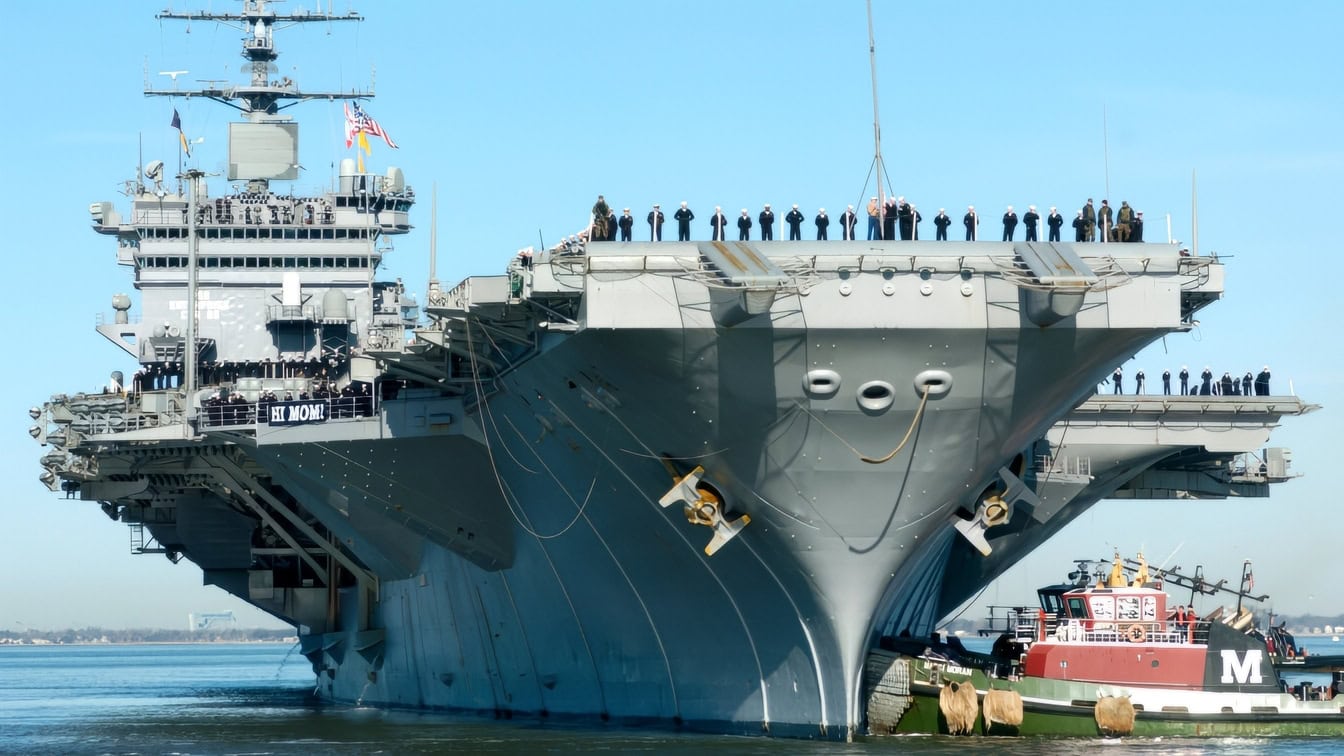
Naval Station Norfolk, Va. (Feb. 29, 2004) – The crew “mans the rails” aboard the nuclear powered aircraft carrier USS Enterprise (CVN 65) as she approaches pier 12 where thousands of family members await. The carrier completed a six-month deployment in support of the global war on terrorism. U.S. Navy photo by Chief Journalist (SW/AW) Dave Fliesen, Fleet Combat Camera, Atlantic. (RELEASED)
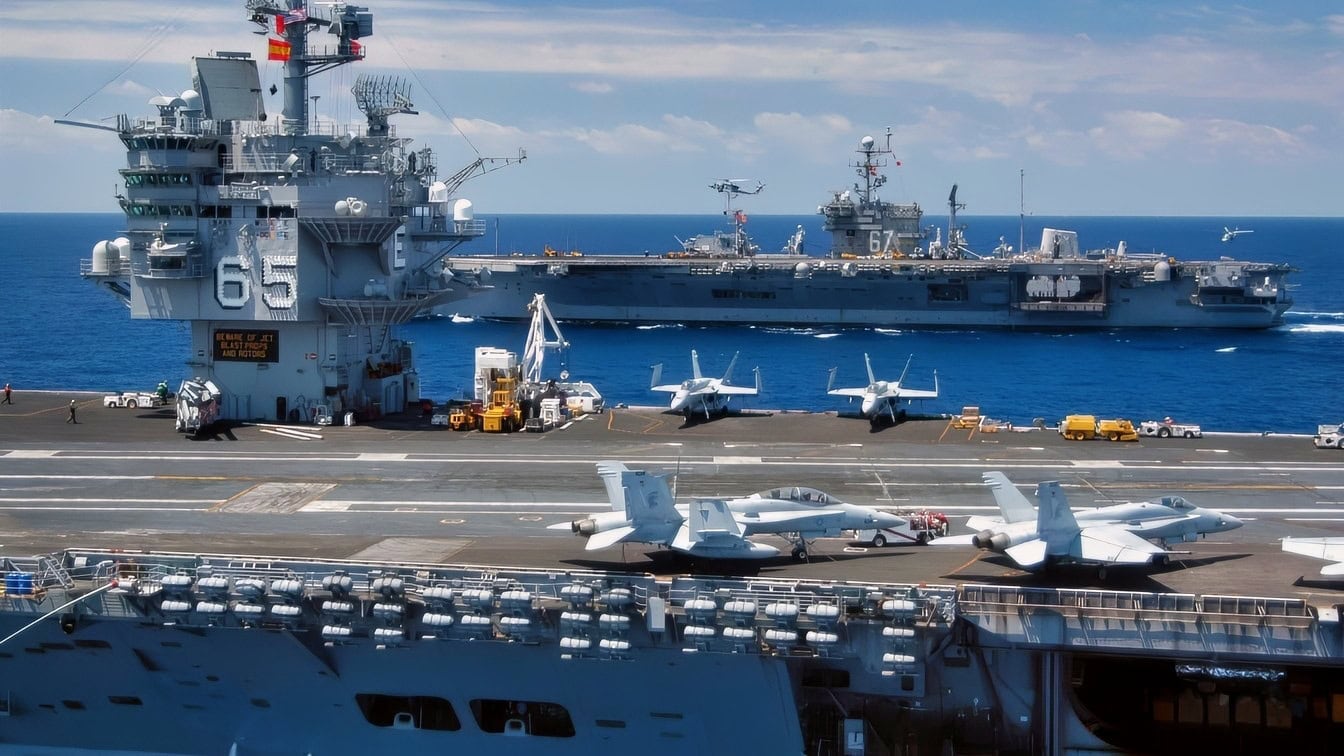
Atlantic Ocean April 23, 2004 – The USS Enterprise (CVN65) and the USS John F. Kennedy (CV67) steam along side each other while transferring ammunitionin in the Atlantic Ocean on April 23,2004. The Kennedy received ordnance from from the USS Enterprise (CVN65) and the USS Seattle (AOE3) in preperation of an upcoming deployment.
US Navy photo by: Photographers Mate Third Class (AW/SW) Joshua Karsten
It was later discovered that the report was in error; no active shooter was present.
USS Enterprise Takes A Near Crippling Blow
In the darkness of late evening, the Enterprise took a glancing blow from the barely submerged Bishop Rock on her port side.
The gash it left in the outer hull ranged from 40 to 60 ft.
The ship’s forward speed pulled thousands of tons of seawater through her slashed-open side, fouling 24 of her aviation fuel tanks in the outer hull void spaces and mangling one of her propellers. Enterprise began listing dangerously to port.
The ship was once again brought to General Quarters, and all hands now went to their Damage Control Stations to prevent Enterprise from taking on more water and risking capsizing.
The damage had not reached the inner hull, so the crew balanced the flooding by counter-flooding the outer hull on the right side to put Enterprise back on an even keel, and there were no fires to deal with. Those Damage Control Parties did an exceptional job saving Enterprise.
USS Enterprise Takes A Day To Assess The Damage.
Captain Leuschner ordered a Safety Stand-Down to assess the damage Bishop Rock had done to Enterprise.
Because the gash in the outer hull was not accessible from inside the ship, divers were sent over the side to do the dangerous work of inspecting and probing the outer-hull void spaces. Once they determined that Enterprise had not suffered severe structural damage, she returned to San Francisco and the drydock at Hunters Point under her own power.
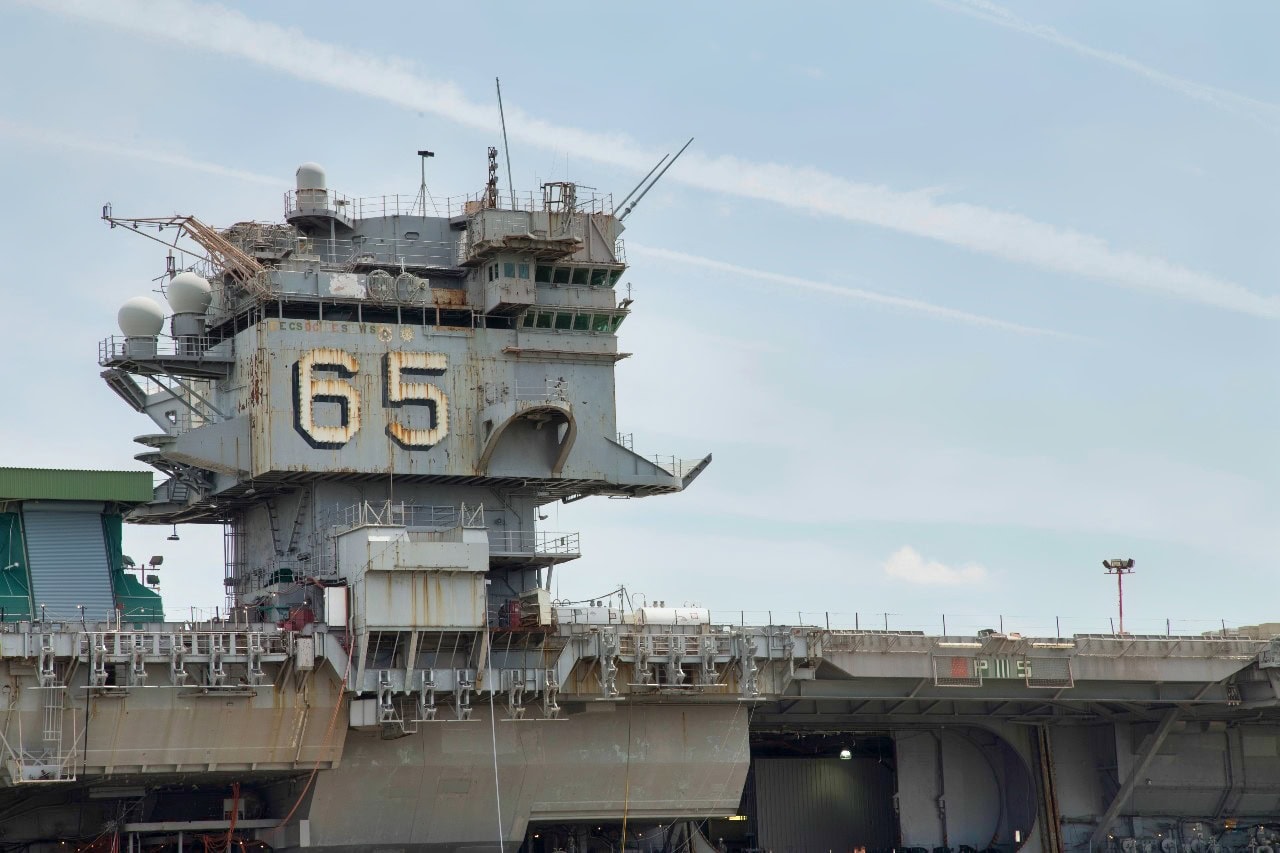
NEWPORT NEWS, Va. (July 15, 2018) — USS Enterprise (CVN 65) sits pierside at Newport News Shipbuilding following its decommissioning in February 2017. (U.S. Navy photo by Mass Communication Specialist 2nd Class Cat Campbell/RELEASED)
After divers logged about 400 hours underwater, damage estimates reached the equivalent of $53 million in 2026 dollars.
As Enterprise Is Repaired, A Hammer Falls On The Captain
As the Navy prepared to start using air-hammers to repair Enterprise’s hull, a different kind of hammer was about to fall on her Skipper, Captain Leuschner.
Any significant damage to a Navy ship triggers a board of inquiry of line naval officers to determine the mishap’s causes and ultimate responsibility. In 1983, the Navy convened a board on the previous Enterprise Skipper, Robert Kelly, after the carrier ended up on a sandbar 1,000 yards from its berth in San Francisco when an engine failure and dragging prop drew the 90,000-ton carrier out of a narrow channel. Now they would be looking at a new collision involving Enterprise.
A Navy captain aboard ship commands authority that is all but absolute, but it also comes with absolute responsibility for everything that happens under his command. Everything from a sailor who gets in trouble on liberty to colliding with a submerged mountain falls on the captain. He trains and certifies every officer under him as ready and capable of carrying out their duties as department heads or watch officers. That includes the Navigation Officers.
Captain Leuschner of the USS Enterprise Was A Good Officer Who Found Himself In A Bad Situation
Captain Leuschner was not an incapable or bad officer. He entered the Navy in 1957 through the ROTC program at Rice University, where he earned a degree in Chemical Engineering.
As an aviator, he flew a variety of aircraft and deployed to Vietnam, where he flew combat missions. He had served on five other aircraft carriers before coming to Enterprise. He was selected for a star and promotion to Commodore. He was experienced and ready for his command.
Ultimately, the Navy board found the collision directly attributable to the navigation officer. He failed to maintain an accurate plot of Enterprise’s location, failed to notice warnings on the charts about Cortez Bank, and failed to caution the captain about obstacles near the carrier. While he faced the board’s discipline for his individual failure, Captain Leuschner still bore ultimate responsibility as the officer who trained and certified the Navigation Officer for his post.
The Navy relieved Captain Leuschner of his command of the Enterprise on January 27, 1986, ending his career.
The Enterprise was repaired and continued to sail under new captains without serious mishap until 1998, when an EA-6B Growler attempting a night landing collided with an S-3 Viking on deck, killing the Growler’s crew of 4.
Enterprise made her final cruise in 2012 and was “stricken from the rolls” as a commissioned ship that same year.
About the Author: Sean Spoonts
Sean Spoonts is the former Editor-In-Chief of SOFREP.com. He is a military analyst, writer, and commentator whose work has appeared in Newsweek, CNS News, Ukrinform, and various military/veteran media networks and professional publications, including the Military Intelligence Professional Bulletin. He is a U.S. Navy veteran, having served as an Aviation Anti-Submarine Warfare Operator and Search and Rescue Helicopter Aircrewman.