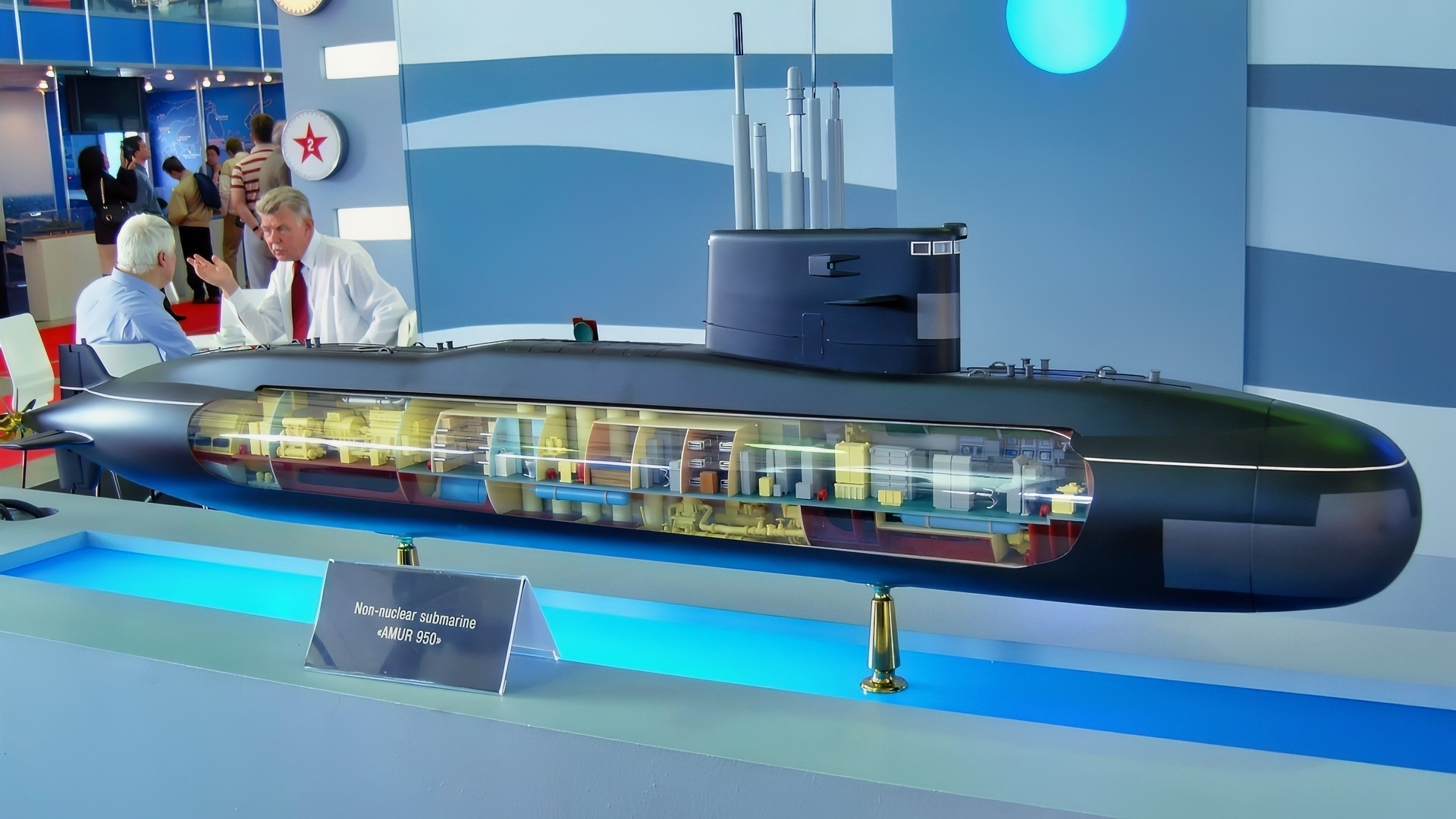
Summary and Key Points: The Amur-class was Russia’s bid to stay in the export submarine business. Derived from the Navy’s Project 677 Lada-class and designed by the Rubin bureau in St. Petersburg, it was offered from 1996 in six sizes, from the Amur 550 to the Amur 1850. A single hull and heavy automation cut the crew to 18 to 35 sailors, and a 10-cell vertical launch system could fire supersonic BrahMos or Kalibr-PL cruise missiles from underwater.
The Amur-Class Russian Navy Submarine Mistake?
Before the war in Ukraine began, Russia was the world’s 2nd-largest major arms dealer, with a market share of 20-21% of sales.
If you were in the market for diesel-electric submarines, there was nothing in the American arms catalog to buy after 1973, when it sold the last of its WWII-era subs.
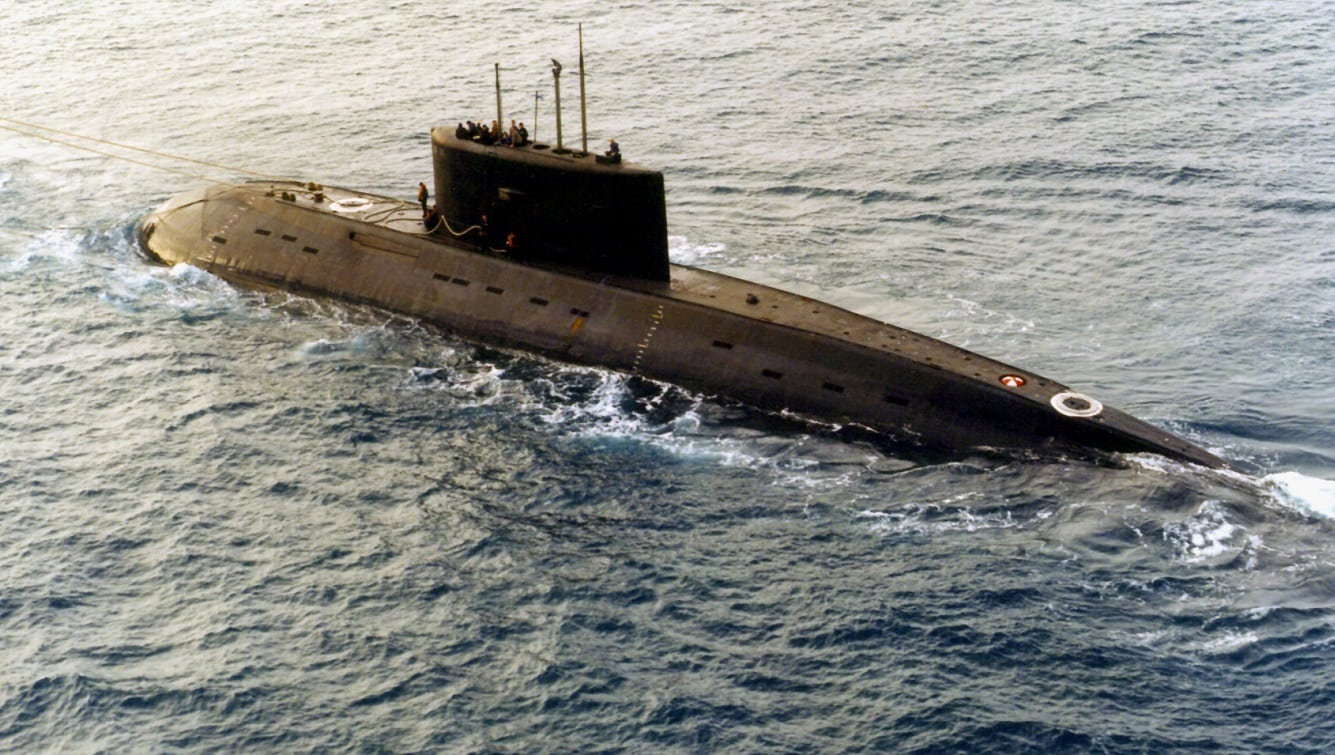
A Russian-built, Kilo-class diesel submarine purchased by Iran, is towed by a support vessel in this photograph taken in the central Mediterranean Sea during the week of December 23. The submarine and the support ship arrived at Port Said, Egypt, on Tuesday and were expected to begin transiting the Suez Canal today, Jan. 2, 1996. Ships and aircraft from the U.S. NavyÕs Sixth Fleet are tracking the submarine, which has been making the transit on the surface. This is the third Kilo-class submarine the Iranians have purchased from Moscow. DoD photo
Your choices were limited to Russia, Germany, France, S. Korea, Sweden, and later China.
Among the choices available, the Russian Kilo-class was among the best sellers, with more than 40 units sold to navies around the world.
By this point, the Kilo-class program was roughly 45-52 years old, and sales were trailing off in favor of newer offerings from other sellers.
So in 1996, Russia began tooling up for a new class of export submarines as the Amur-class. The design was derivative of the Russian Navy’s Project 677 Lada-class by the Rubin Central Design Bureau in St. Petersburg, Russia.
Rather than offer the Amur-class as a single take-it-or-leave-it model, it was offered in six sizes with names that roughly approximated their displacement: the Amur 550, 750, 950, 1450, 1650, and 1850.
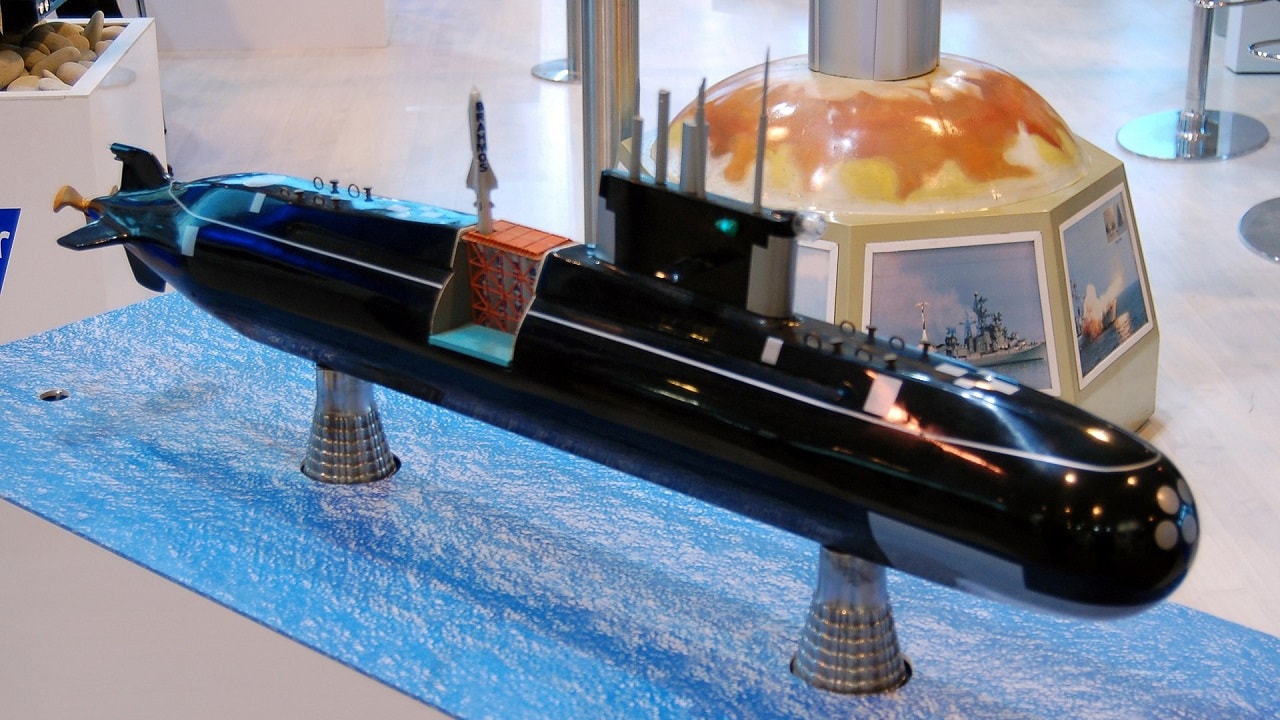
BrahMos missiles on Lada class non-nuclear submarine maquette. MAKS-2009.
Across those displacement choices, almost any nation could find the right size for its own navy.
Initially, sales focused on the Amur 950 and 1650 models.
The new Amur had some interesting features that made it very different from the old Kilo models. The Amur would be of single-hull construction.
Previous Russian submarine designs preferred double- or even triple-hull designs for toughness.
But these double hulls were more expensive and time-consuming to build and added a great deal of weight.
US nuclear subs were almost exclusively single-hull designs, as the US had mastered the more complicated metallurgy and precision welding techniques required for deep-diving single hulls.
A smaller, more streamlined hull also reduced the sub’s acoustic cross-section, making it a smaller target for active sonar.
The smaller single hull also made the submarine more agile at depth.
It also had a better shape for attaching modern rubber-polymer anechoic coatings to quiet the sub further.
A Smaller Crew Means A Lower Operating Cost For The Amur-class
The Amur-class would cut the crew size of other conventionally powered submarines by almost half.
With a high degree of automation, it would require only 18-35 sailors aboard.
The space saved in crew accommodation and food storage would be used to carry more fuel and machinery, increasing capability and endurance.
The Amur-class Would Offer AI-Enhanced Signal Processing and Combat Management
A reduced crew size would require a mostly automated combat management system, an AI, to process digital information coming from its large conformal sonar and radar arrays.
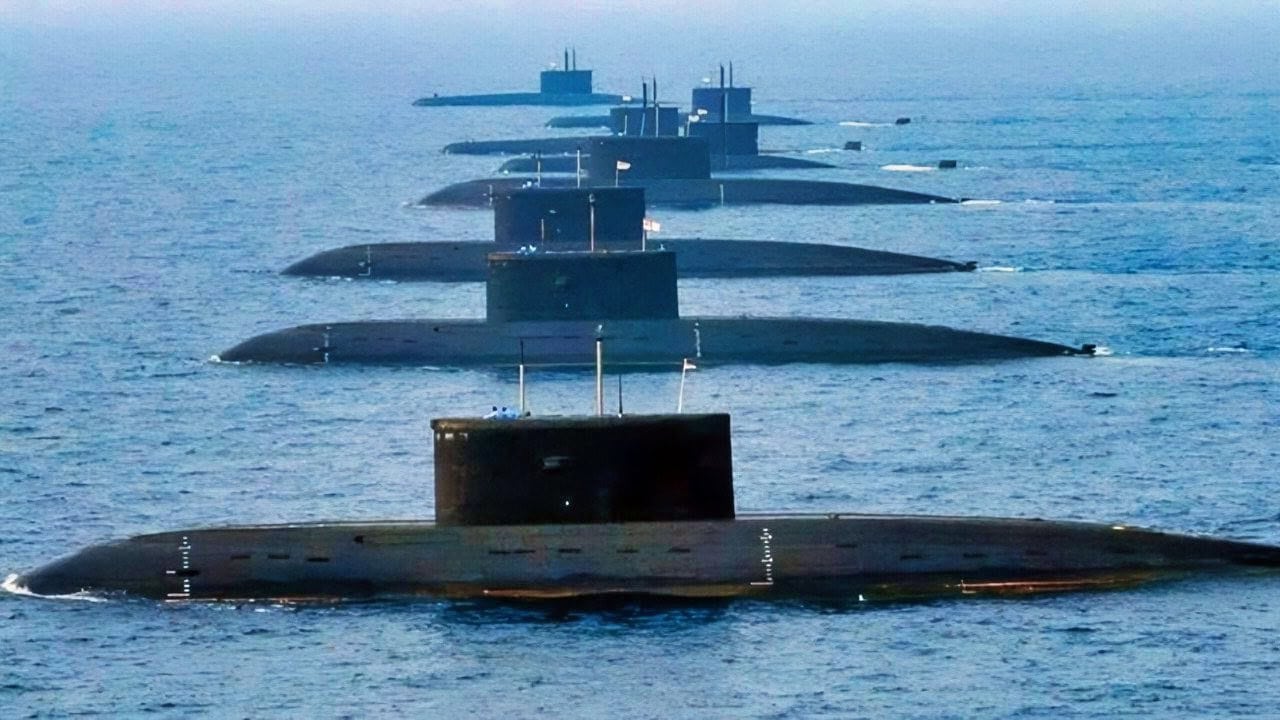
Kilo-Class Submarines All Together. Image Credit: Creative Commons.
Rather than relying on experienced crews to analyze data through training and experience, computers would identify enemy acoustic threats, suggest optimal target lock, and even recommend evasive tactics.
Human operators monitoring the screen would only need to agree or disagree and take an alternative course of action.
Foreign Countries Could Buy The Amur With The Mach 3 Cruise Missile Accessory
What made the Amur a unique sales pitch to foreign buyers was its 10-cell vertical launch system (VLS) for firing supersonic BrahMos cruise missiles (a joint Russia/India project) or Russian-made Kalibr-PL missiles.
The Amur could fire these submerged.
Rather than serving as a defensive platform for home-water protection, the Amur 950 model could serve as an offensive weapons platform capable of hitting targets hundreds of miles away at Mach 3 speeds.
The Amur could carry Mach 3 cruise missiles as an accessory.
For propulsion, the Amur offered either a tried-and-true diesel/electric configuration or a newly developed air-independent Propulsion system using hydrogen fuel cells.
The AIP system would increase submerged endurance from 15 days to 45-60.
The Amur-class Submarine Should Have Put Russia Back In The Submarine Business Again
All in all, the Amur looked to be a winner, with various size options, good acoustics, agility, reduced operating expenses, and even offensive punch.
It was also $200 million less than what the Germans were selling. Foreign buyers should have flocked to it; India considered buying as many as 20.
The Amur Was Reduced To A WWII Drive Train
Then the problems started showing up.
Because of sanctions and other supply bottlenecks, Russia struggled to deliver the hydrogen fuel cell propulsion system.
The one installed in the initial Lada-class Amur never seemed to work right, and it had to be replaced with a diesel/electric system.
This also negatively affected the VLS system. 15 days of submerged endurance was good enough for a coastal defense submarine, but it would be fatal for an offensive platform trying to fire hypersonic cruise missiles at an adversary.
A submarine running on electric power might only be able to run at top speed for an hour at 20 kts before it had to come near the surface and deploy its snorkel to recharge.
If it had just fired its missiles, an adversary would know the submarine that fired them was within 20 miles of where those missiles left the water and couldn’t get much farther away without coming near the surface, where it could be easily detected and destroyed.
In One Word: Failure
Only a single Amur-1650 hull was begun at the shipyard in St. Petersburg, where it has languished at 47% completion since the 2000s without a buyer.
If it is ever finished, it may not be seen until the 2030s.
Some of that can be blamed on the financial drain on Russia that the War in Ukraine has caused.
Some of it certainly relates to sanctions imposed on it by Western countries.
A submarine with as many automated systems as the Amur would require thousands of microprocessor chips that Russia is locked out of buying.
As Russia has been effectively removed from the export submarine market, the US recently announced it is reentering it by selling three Los Angeles-class submarines to Australia.
The US does not offer a warranty, but Australia gets an Engineering Support Helpline it can call day or night.
About the Author: Sean Spoonts
Sean Spoonts is the former Editor-In-Chief of SOFREP.com. He is a military analyst, writer, and commentator whose work has appeared in Newsweek, CS News, Ukrinform, and various military/veteran media networks and professional publications, including the Military Intelligence Professional Bulletin. He is a U.S. Navy veteran, having served as an Aviation Anti-Submarine Warfare Operator and Search and Rescue Helicopter Aircrewman.