
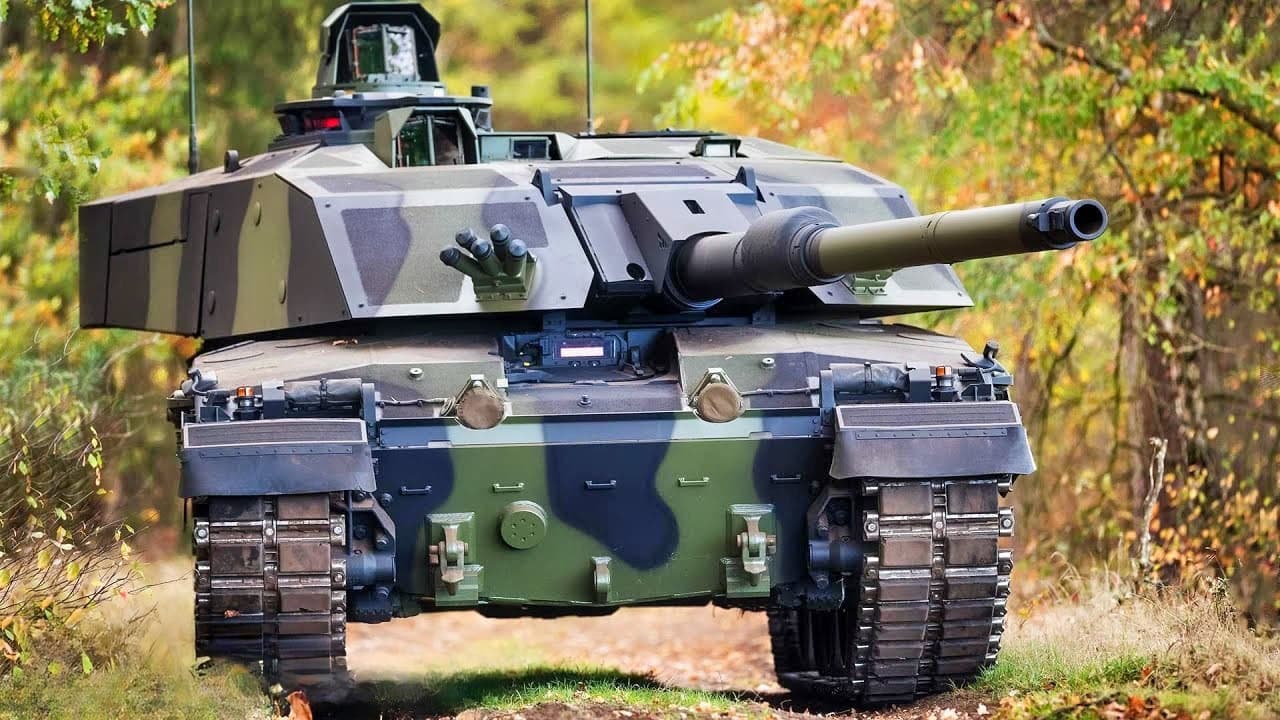
The British have taken a significant step forward with their Challenger 3 main battle tank design. It will replace the aging and outdated Challenger 2 main battle tank (MBT), which has been in service since 1998 and is now in need of either a significant upgrade or outright replacement.
Challenger 3 vs. T-14 Armata
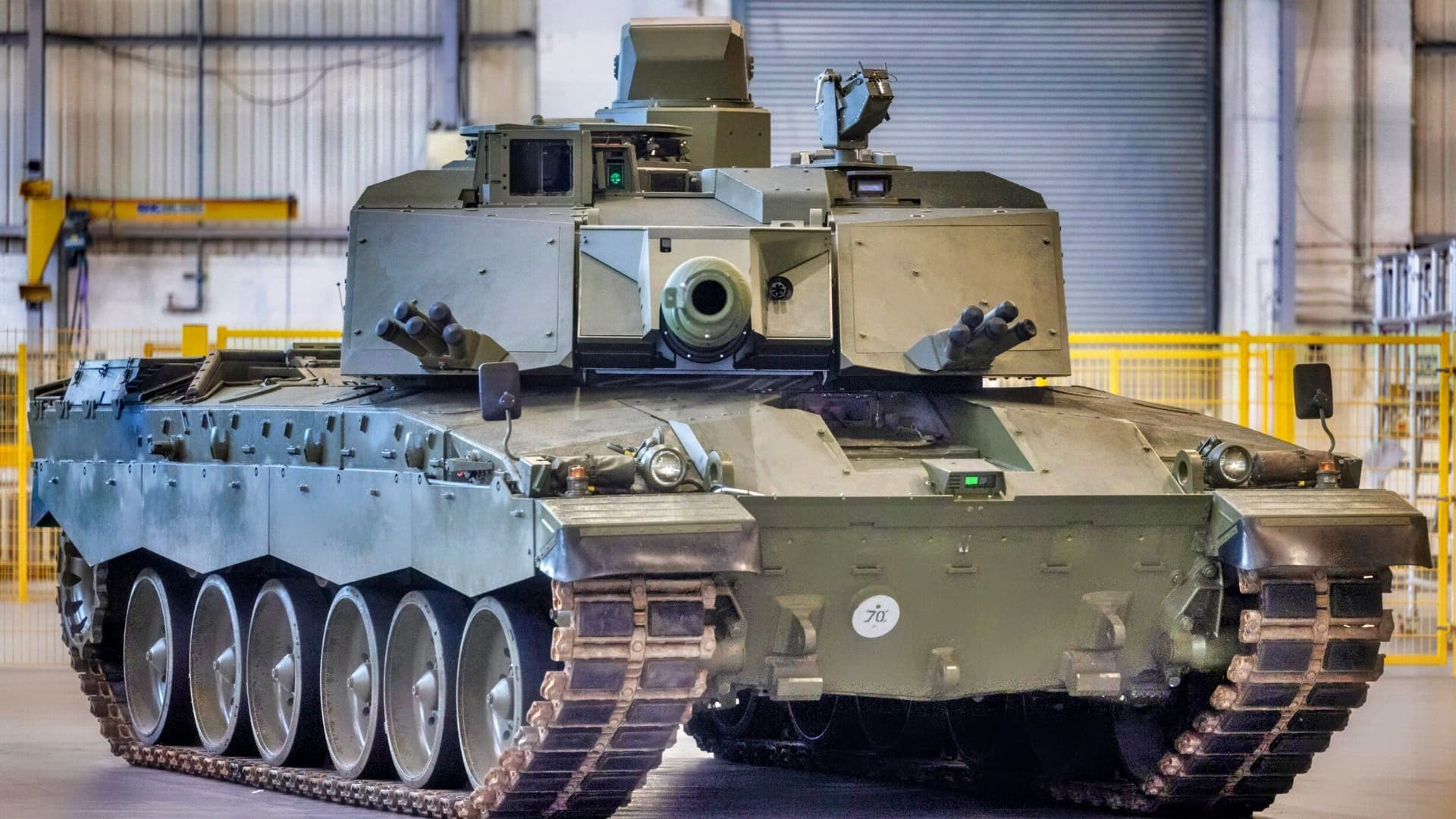
Challenger 3 Tank. Image Credit: British Government.
A major issue with the tank was the Challenger 2’s main gun, a rifled L30A1 that no other NATO military force operates. The solution was to bring Rheinmetall’s L55A1 120mm smoothbore gun into service, which has become widely used throughout the NATO alliance.
The T-14 Armata is a microcosm of the Russian military. Heavily hyped and beset by problems, production was nearly non-existent and unused during a war that had been going on for more than three years.
Challenger 3 Is A Major Leap Forward For British Armor
In May 2021, Rheinmetall BAE Systems Land (RBSL) was awarded an £800m ($995.9m) contract by the UK Ministry of Defence (MoD) to upgrade 148 Challenger 3 (CR3) MBTs for the British Army.
The Challenger 3 main battle tank represents a giant leap forward in military technology. It boasts advanced armor, active protection, and a powerful new 120mm smoothbore cannon.
Defence Procurement Minister Maria Eagle said, “We are confident that Challenger 3 will continue to match potential threats throughout its lifecycle.
“But we will continually review the performance of its specification to ensure that it remains world-leading.”
She pointed out how the Challenger 3 main battle tank would significantly improve capability over its predecessor, the Challenger 2. “Enhancements include a digitalised turret fitted with the latest 120mm smoothbore gun paired with the most lethal ammunition available, world-class UK-designed armour and an Active Protection System, and improved automotive performance,” she added.
“New advanced sighting systems, sensors, and processing capabilities will improve situational awareness and interoperability with other units.”
The T-14 Armata, Touted As the Best Tank In the World, Now Missing
When the Russians unveiled the T-14 Armata tank at Moscow’s 2015 Victory Day Parade, it was touted as the most advanced main battle tank in the world. It boasted a suite of technological innovations that, on paper, placed it a generation ahead of its Western counterparts.
Unlike the Challenger 3, it has an uncrewed turret, reducing the crew to three. Its 125mm main gun is also smoothbore and is capable of firing both conventional ammunition and anti-tank guided missiles.
The West was supposed to play catch-up, boasting active protection systems and cutting-edge sensors. The reality was quite different from the typical Russian hype.
T-14 Armata’s Design Was Different From Former Tanks
In a departure from the historical tradition of Russian tanks being pragmatically designed and easily mass-producible, the T-14 Armata is technologically ambitious and, theoretically, very impressive.
The tank’s primary weapon is a 125mm smoothbore gun in its unmanned turret, which is controlled electronically from a protected crew compartment located in the center of the tank.
An autoloader feeds the main gun. In addition to traditional rounds, it can also fire the Sprinter Anti-Tank Guided Munition (ATGM), an effective guided missile. The autoloaders have proved to be a major issue with Russian tanks. When the turret is penetrated by enemy fire, the 125mm rounds usually explode, launching the turret skyward and dooming the crew.
The Armata, by contrast, embraces a Western-style emphasis on crew protection and advanced sensor integration. It features an unmanned turret, an active protection system (APS) to intercept incoming projectiles and a suite of digital battlefield networking capabilities.
A February 2015 Rossiyskaya Gazeta article by Sergey Ptichkin states, “The forward (protected crew shell) has multilayered, combined armor protection that can withstand a direct hit from any type of round that exists today.”
Additional protection comes in the form of an Afghanit Active Protection System (APS), which is designed to track incoming projectiles and use charges to detonate them before they hit the tank’s armor.
Due to the war in Ukraine and Western sanctions, the much more expensive T-14 has taken a backseat to legacy tanks that are being upgraded and shipped off to the meat grinder that is in Ukraine. Russian tank losses in the war (Special Military Operation) are reported to be more than 2,000, and possibly more.
The T-14 probably numbers only about 50 tanks or less. The Russians sent it to Syria to get a combat baptism, but it didn’t go well, and it was withdrawn. The Russians aren’t even bothering to send it to Ukraine for fear that it will fall into Western hands.
This begs the question of why Russian commanders are so loathe to use it in battle. If it was truly the best tank in the world, why not use it when Russian armored doctrine has fallen flat, and they are beginning to revert back to Soviet tactics?
So, in this scenario, I’d give the edge to British Challenger 3. It isn’t as fast as the Armata, but the fact that the T-14 has been around for a decade, has barely been produced, and hasn’t sniffed combat speaks volumes.
About the Author:
Steve Balestrieri is a 19FortyFive National Security Columnist. He served as a US Army Special Forces NCO and Warrant Officer. In addition to writing for 19FortyFive, he covers the NFL for PatsFans.com and is a member of the Pro Football Writers of America (PFWA). His work was regularly featured in many military publications.