
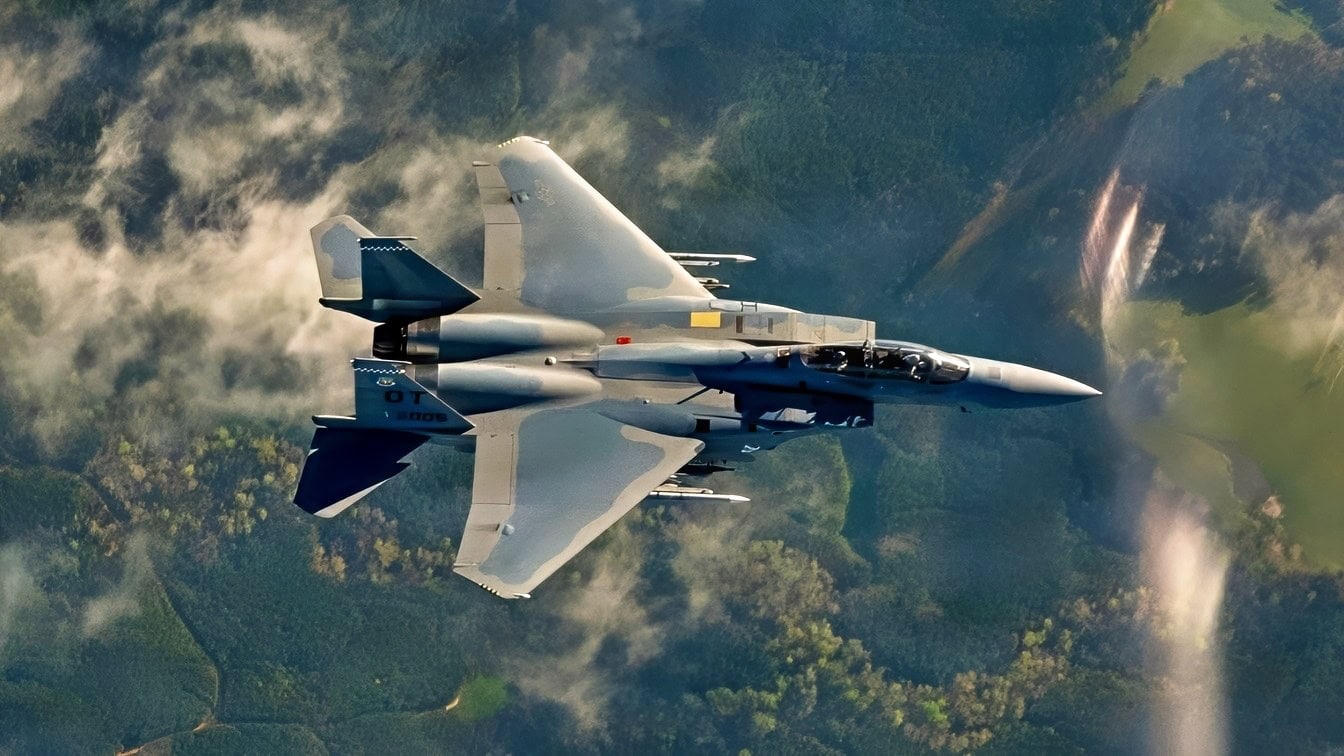
On September 13, 1985, a U.S. Air Force F-15A Eagle executed a 3.8g vertical zoom climb over the Pacific Ocean, accelerated to Mach 1.22 above 38,000 feet, and launched a Vought ASM-135A anti-satellite missile that destroyed the defunct Solwind P78-1 satellite at 345 miles altitude — the first and only time in history an aircraft has shot down a satellite. The two-stage missile’s Miniature Homing Vehicle used infrared seeking and destroyed its target kinetically at roughly 15,000 miles per hour, with no explosive charge. Congress killed the ASAT program in 1988, and 41 years later — with Russia and China now both operating their own anti-satellite capabilities — no other aircraft has repeated the achievement.
F-15: Satellite Killer
On September 13, 1985, the US Air Force used an F-15 Eagle to destroy an orbiting satellite.
This use of an aircraft to shoot down a satellite was the first such event in history, showing our adversaries that space, in which the Soviets were attempting to build “killer satellites,” was an area that the US would also compete for.
The test served as a warning to the Soviets of the strategic dangers of weaponizing space in the decades to come.
The F-15 used a Vought ASM-135A Anti-Satellite Missile to destroy the U.S. Solwind P78-1 satellite at an altitude of 345 miles above Earth. The satellite was defunct and, at the time, caused controversy due to the space junk it left behind.
What Was The Vought ASM-135A Anti-Satellite Missile?
The Vought ASM-135A Anti-Satellite (ASAT) missile was a 1980s U.S. Air Force air-launched weapon designed to destroy enemy satellites in low Earth orbit using a “hit-to-kill” kinetic warhead.
Carried by F-15 Eagle fighters, it proved successful, destroying an orbiting U.S. satellite in 1985, demonstrating the capability to neutralize orbital threats.
The weapon was a two-stage rocket equipped with a Miniature Homing Vehicle (MHV). In lieu of explosives, the MHV used an infrared sensor to identify the target and collide with it at roughly 15,000 mph, using the kinetic energy of its collision to destroy the satellite.
To achieve this, the F-15 fighter pilot had to execute a 3.8g vertical “zoom climb” to over 38,000 feet at Mach 1.22, and then release his missile.
Background On Anti-Satellite Warfare
Both the United States and the Soviet Union were heavily using satellites during the Cold War. The space race between the two superpowers began in 1957 with the Soviet launch of Sputnik, the first artificial satellite. The Soviets were the first to put a human into space as well.
The US and NASA then embarked upon an ambitious program that culminated with the US landing on the Moon in 1969.
And then both countries were also developing anti-satellite capability.
The Soviets, and now Russia, continue to be actively developing and deploying co-orbital, maneuverable satellites—often dubbed “killer satellites”—designed to track, approach, and potentially disable U.S. spy satellites.
Key programs include the Nivelir and Burevestnik initiatives, with specific satellites such as Cosmos-2558 and 2576 observed in suspicious, close-proximity, and, in some cases, spawning maneuvers near Western assets.
The US Developed Its Own ASAT Program
At the height of the Cold War, spanning from the 1960s to the present, the US developed its own capabilities, emphasizing “hit-to-kill” mechanisms.
While developing the aforementioned direct-ascent missiles (such as the F-15-launched ASM-135) to counter Soviet threats, the modern US focus has shifted towards rendezvous and proximity operations (RPO) and non-kinetic “soft” capabilities, such as jamming and cyber, rather than destructive kinetic testing.
Congress cut funding for the ASM-135A and the ASAT program in 1988.
US Bans Direct Ascent Anti-Satellite Weapons
In April 2022, the US became the first nation to formally ban the testing of destructive, direct-ascent anti-satellite missiles that create a vast amount of space debris.
The US ban was a unilateral commitment made by the Biden administration rather than a legally binding international treaty, though it encourages others to join in banning the weapons.
The move by the US was prompted by Russia’s 2021 destructive ASAT test, which created over 1,500 pieces of trackable debris, and in 2007, China used a ground-based SC-19 ballistic missile to destroy a weather satellite.
In 2008, the United States used a modified ship-based Standard Missile-3 missile defense interceptor to destroy a failed U.S. intelligence satellite.
“This commitment is verifiable and attributable by many parties, and we encourage other countries to make similar commitments to build international support against…destructive direct-ascent [ASAT] missile tests,” the US stated in its press release of the ban.
The Golden Dome Missile Defense Initiative
In 2025, President Trump announced that the US was developing a $175 billion missile defense initiative called the Golden Dome.
The plan calls for the US to leverage many of its satellites and sensors to detect a ballistic missile launch early and use space-based interceptors to destroy missiles in their “boost phase” (initial ascent).
It is currently only in the conceptual phase of development, and the technology required to build such a missile shield is still far off.
However, as Reuters points out, “Golden Dome’s funding remains uncertain. Republican lawmakers have proposed a $25-billion initial investment for it as part of a broader $150-billion defense package.”
About the Author: Steve Balestrieri
Steve Balestrieri is a National Security Columnist. He served as a US Army Special Forces NCO and Warrant Officer. In addition to writing on defense, he covers the NFL for PatsFans.com and is a member of the Pro Football Writers of America (PFWA). His work was regularly featured in many military publications.