In February 1942, with Bataan and Corregidor about to fall to Imperial Japan, President Roosevelt ordered General Douglas MacArthur to evacuate the Philippines — and on arrival in Australia he made the most famous promise of the Pacific War: “I shall return.” Keeping that promise took two and a half years, the largest naval battle in history at Leyte Gulf, and a brutal urban fight against more than 287,000 Japanese defenders under General Tomoyuki Yamashita. The last Japanese garrison did not surrender until July 1945, after a “minor cleanup” phase that killed another 27,000 enemy troops.
Quote of the Day by Douglas MacArthur
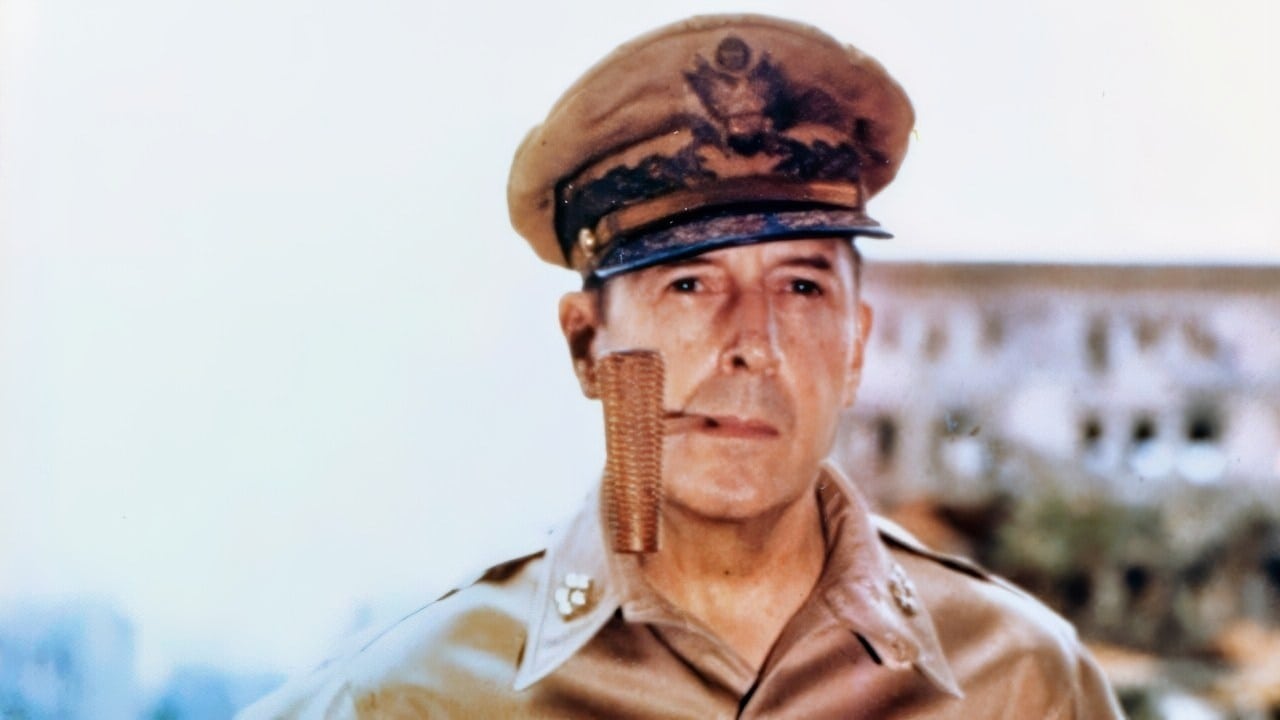
General Douglas MacArthur. Image Credit: Creative Commons.
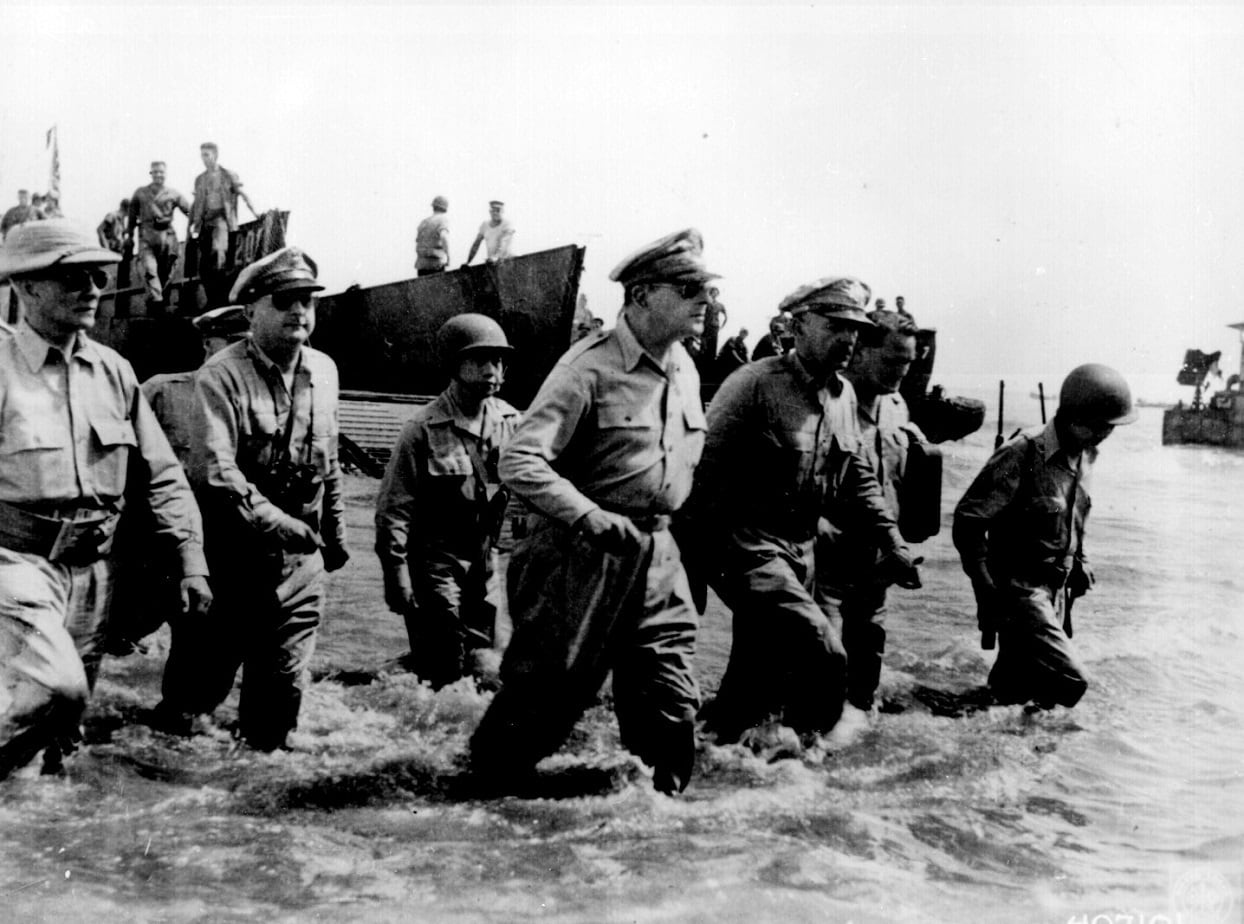
“General Douglas MacArthur wades ashore during initial landings at Leyte, P.I.” October 1944.
“Whoever said the pen is mightier than the sword obviously never encountered automatic weapons.” – Douglas MacArthur
General Douglas MacArthur was one of the most influential leaders in the Pacific theatre during the Second World War. He was an exceptionally gifted tactician who was pivotal in the Papua New Guinea and Philippine campaigns, and in the eventual occupation of Japan. The Philippines was especially important to MacArthur thanks to his many personal connections there. Although he failed to defend the Philippines against the initial Japanese offensive, he promised to return, and just two years later, he fulfilled that promise after a long, grueling battle.
MacArthur and the Philippines
Prior to the Second World War, MacArthur helped supervise the creation of the Philippine Army. When the Philippines achieved semi-independence in 1935, President Manuel Quezon, a personal friend of MacArthur, asked him to assist in creating the newly formed army. He was officially appointed field marshal of the Philippine Army in 1936 and immediately instituted conscription for the new army.
He also established the Philippine Military Academy to train officers, modeled closely after West Point’s training regimen. Prior to MacArthur’s arrival, the small defense force that the Philippines had was poorly trained and motivated, and its equipment was obsolete. With Eisenhower’s approval, MacArthur set out to modernize and rebuild the army almost from the ground up.
By 1941, MacArthur had retired from the U.S. Army, still serving with the Philippine Army, but as tensions with Imperial Japan increased, he was recalled to active duty. Immediately after the Pearl Harbor attacks in December, General George Marshal ordered MacArthur to execute Rainbow Five, the Army’s contingency plans for a war in the Pacific.

George C. Marshall Smithsonian Portrait. Creative Commons Image.
However, due to miscommunications or perhaps stubbornness on MacArthur’s part, the plans were not immediately executed. On several occasions, the Air Force requested permission to bomb Japanese forward bases in Formosa, now modern-day Taiwan, but was denied each time and instead ordered to take up defensive patrols.
Invasion and Initial Retreat
These delays proved fatal to the defense of the Philippines.
When the Japanese finally attacked, they did so with near complete surprise and attacked the airbases in the Philippines. As a result, the majority of American air assets were taken out within the first hours of the fighting before MacArthur could even respond. His initial plans to hold the Japanese at Luzon were discarded as it left the American and Philippine forces stretched too thin. He then ordered the retreat to Bataan, as dictated by the pre-war defensive plans. During the retreat, however, many supplies were hastily abandoned and later recovered by the Japanese.
By January 1942, it became abundantly clear that the Philippines was lost. The troops in Bataan fought valiantly, but they knew that they were fighting a losing battle. In February, Roosevelt ordered MacArthur to retreat from the Philippines to Australia. He left with his staff, his family, and a few others. Upon arriving in Australia, he issued his first statement, declaring that he would return to the Philippines.
Immediately, this phrase became a rallying cry in the Pacific theatre. The Pacific War had gotten off to a shaky start for the U.S., but MacArthur was determined to keep fighting.
Meanwhile, the last surviving American forces in the Philippines continued to hold out in Bataan and Corregidor but were forced to surrender in April and May, respectively.
MacArthur’s Return to the Philippines
After the campaign in New Guinea, MacArthur set his sights back on the Philippines. He believed that he had a moral obligation to liberate the Philippines and rectify his mistakes at the beginning of the war.
After gaining approval from Roosevelt, he began preparations for a landing on Leyte. Admiral Halsey had erroneously concluded that the Japanese garrison was weak and argued for an immediate landing on the island. In October 1944, after U.S. troops had cleared a beachhead, MacArthur landed on shore and declared to the Philippines that he had finally returned.
The Japanese, however, were not so eager to give up their defense of the Philippines and soon counterattacked. The Battle of Leyte Gulf was one of the largest and most intense naval battles of the entire war and almost ended in disaster for the Americans. Along the shores, heavy rains had complicated air base construction and led to a lack of air support for the beachhead.
The Japanese sent in wave after wave to dislodge the Americans, but were narrowly repulsed every time. In December, MacArthur declared that the main garrison on Leyte was all but destroyed and that the campaign was a success, except for some minor cleanup operations. These “minor clean-up operations” would kill another 27,000 Japanese defenders before the campaign finally ended.
Invasion of Luzon and Final Liberation of the Philippines
After pushing the Japanese out of Leyte, MacArthur turned his sights to Mindoro and Luzon. At Luzon, he again underestimated the number of Japanese defenders. His forces were greeted warmly by a Japanese force consisting of more than 287,000 troops led by General Tomoyuki Yamashita. The Americans fought a hard and grueling battle for Manila, which was ordered to be held to the last man.
The city was finally liberated, and the port of Manila and the airbase at Clark Field were in American hands. At this point, all that was left were mop-up operations in the Southern Philippines. The last Japanese defenders surrendered in July 1945, marking the final end of the Philippine campaign.
About the Author: Isaac Seitz
Isaac Seitz, a Defense Columnist, graduated from Patrick Henry College’s Strategic Intelligence and National Security program. He has also studied Russian at Middlebury Language Schools and has worked as an intelligence Analyst in the private sector.