
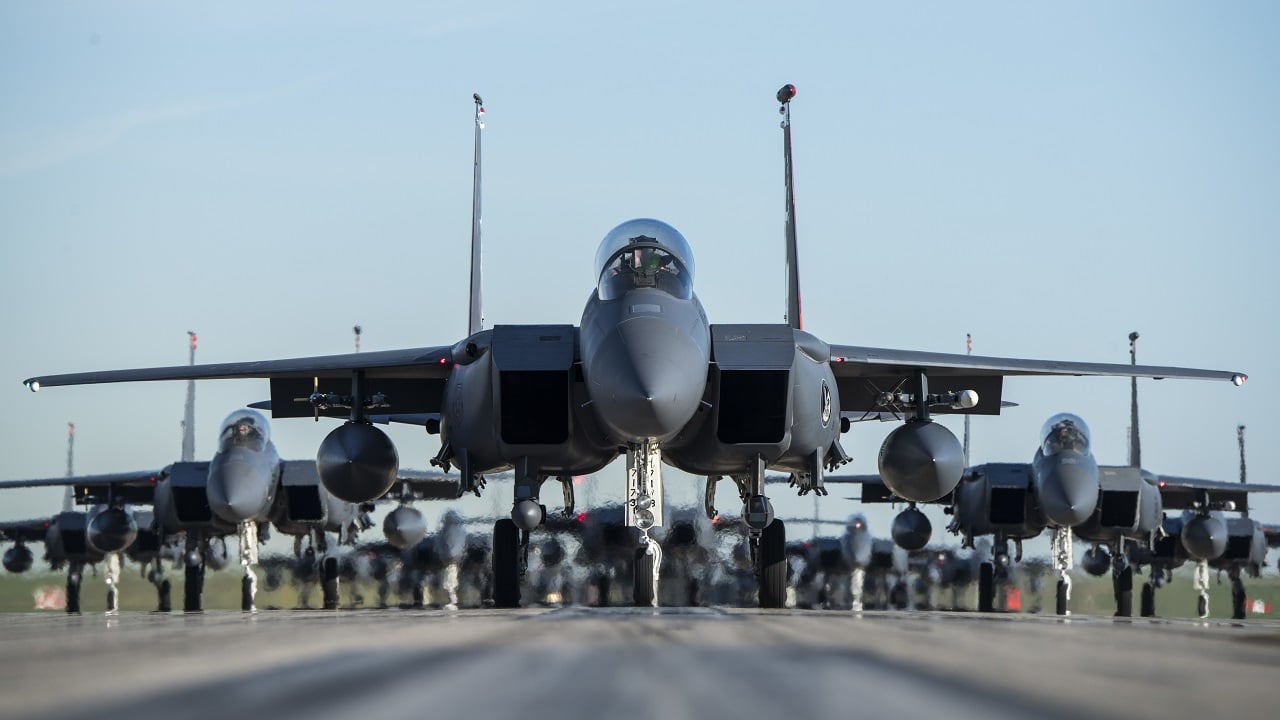
Key Points and Summary – The F-15E Strike Eagle may lack stealth, but it still holds one crucial title: fastest fighter in the U.S. inventory.
-Powered by twin Pratt & Whitney F100 engines producing up to 58,000 pounds of thrust, the F-15E can hit Mach 2.5 while hauling a heavy multirole weapons load.
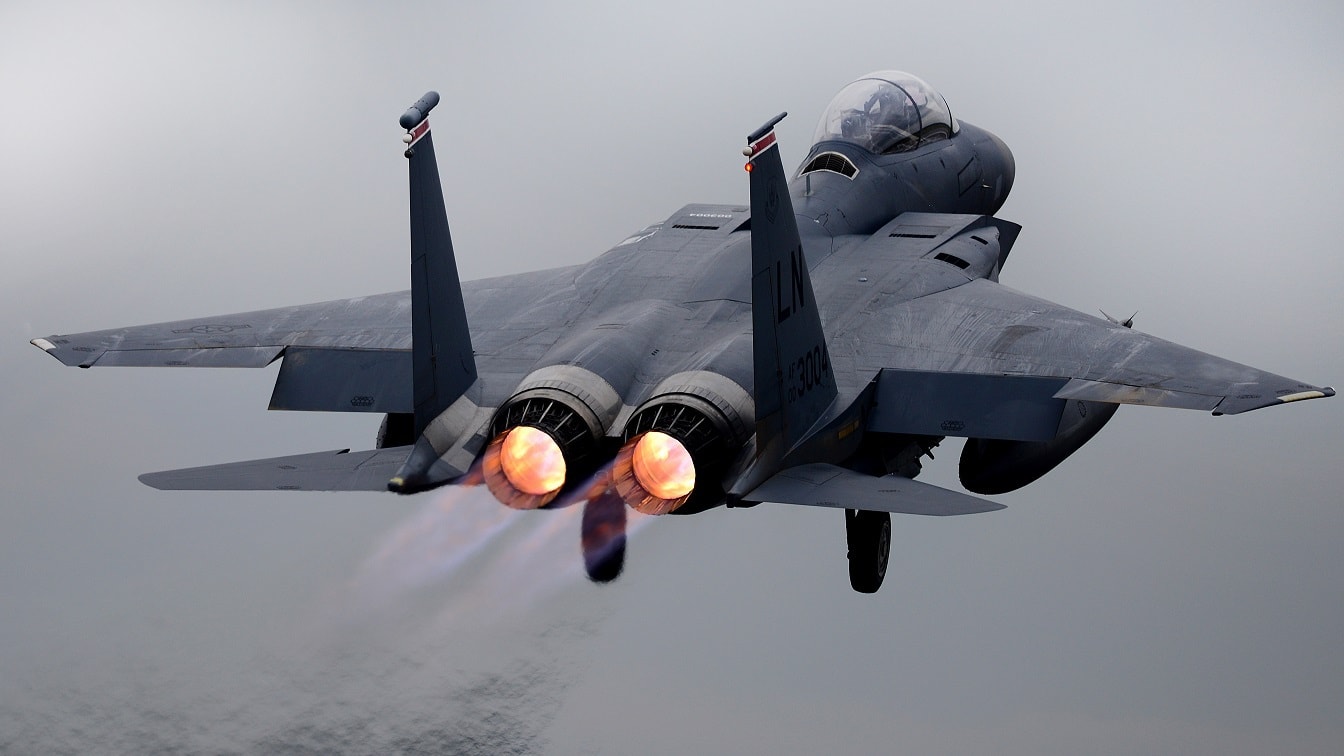
An F-15E Strike Eagle assigned to the 494th Fighter Squadron takes off for a training sortie at Royal Air Force Lakenheath, England, Oct. 26, 2018. The 494th trains regularly to ensure RAF Lakenheath brings unique air combat capabilities to the fight. (U.S. Air Force photo/ Tech. Sgt. Matthew Plew)
-Its combat record is unmatched, with the F-15 family boasting 104 air-to-air kills and zero losses.
-A new evolution, the F-15EX Eagle II, pushes the concept further with fly-by-wire controls, modern avionics, huge payload capacity, and potential electronic-attack roles that could make this non-stealth “missile truck” indispensable in a China fight.
F-15E Strike Eagle Remains The Fastest US Fighter
Fighter jets are designed to fly at high supersonic speeds, avoid radar detection, and carry advanced weapons. Modern jets use stealth technology, smart sensors, and sometimes artificial intelligence. These features enable pilots to identify enemies quickly and strike them first.
The United States leads the world in fighter jet technology. The F-22 Raptor and F-35 Lightning II are the most technologically advanced fighters today.
However, speed is also important. And the fastest fighter aircraft in the U.S. inventory remains the F-15E Strike Eagle.
Meet The F-15E Strike Eagle
The F-15E Strike Eagle is a two-seat dual-role fighter designed to perform air-to-air and air-to-ground missions. An array of avionics and electronics systems gives the F-15E the capability to fight at low altitude, at all hours and in all weather.
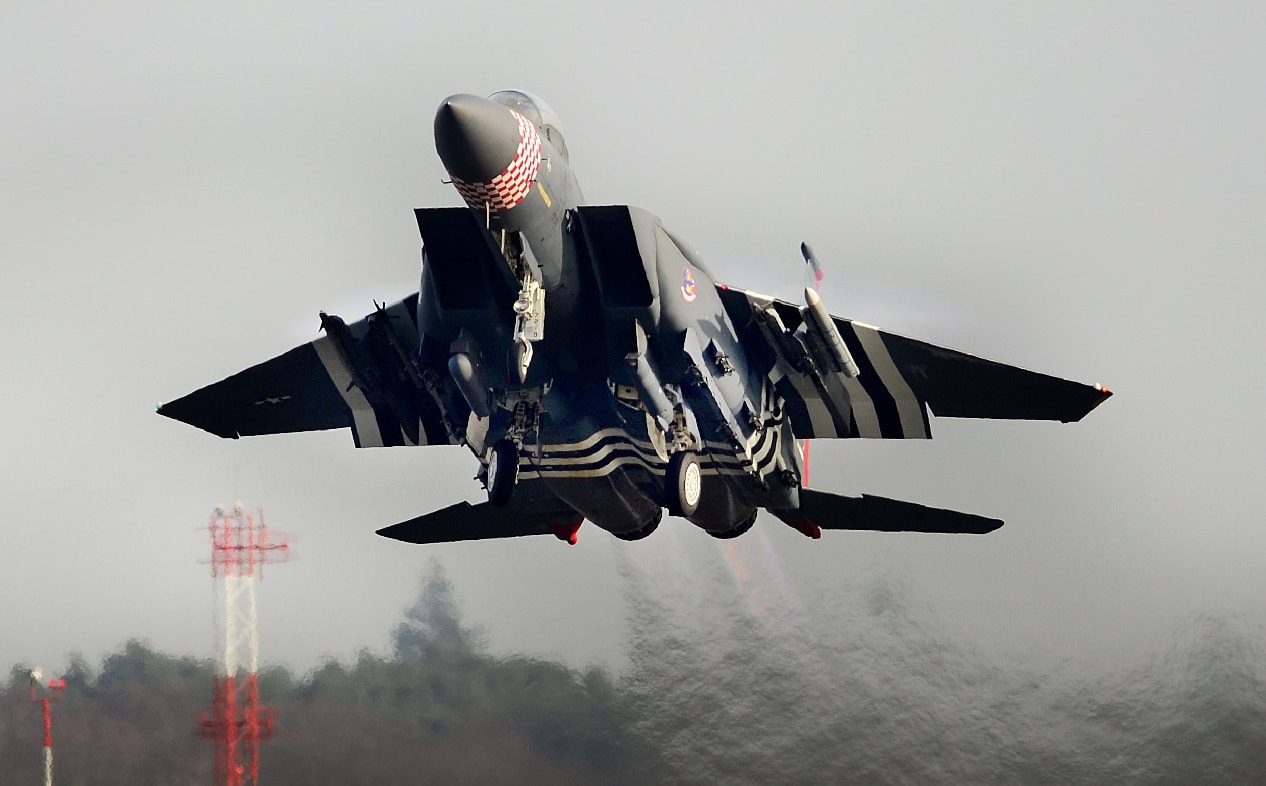
An F-15E Strike Eagle painted in the heritage colors of it’s P-47 Thunderbolt predecessor takes off from Royal Air Force Lakenheath, England Feb 6. The 48th Fighter Wing officially unveiled the aircraft publicly during a ceremony on Jan 31. (U.S. Air Force photo/Tech. Sgt. Matthew Plew)
The aircraft uses two crew members, a pilot and a weapon systems officer. While previous models of the F-15 are assigned air-to-air roles, the “E” model is a dual-role fighter. It has the capability to fight its way to a target over long ranges, destroy enemy ground positions, and fight its way out.
The F-15E’s Power Plant
The F-15E is powered by two Pratt & Whitney F100-PW-220 or 229 engines that incorporate advanced digital technology for improved performance. F-15E pilots can accelerate from idle power to maximum afterburner in less than four seconds, a 40 percent improvement over the previous engine control system.
Faster engine acceleration means quicker takeoffs and crisper response while maneuvering. The F100-PW-220 engines can produce 50,000 pounds of thrust, while the F100-PW-229 engines combine to produce 58,000 pounds of thrust. The F-15E’s maximum speed is Mach 2.5, or 1,875 miles per hour.
In comparison, the F-35 Lightning II has a top speed of Mach 1.6, and the F-22 Raptor, while also incredibly fast, is slightly slower than the Strike Eagle at Mach 2.2.
The F-15E Strike Eagle’s thrust-to-weight ratio varies depending on its specific configuration and loadout, but it runs from approximately 1.17:1 to 1.30:1 under various conditions. When configured in an air-to-air loadout, the ratio is about 1.28:1; with an afterburner and full load, it can reach the max of 1.30:1. This high ratio allows the aircraft to accelerate vertically and offers superior maneuverability.
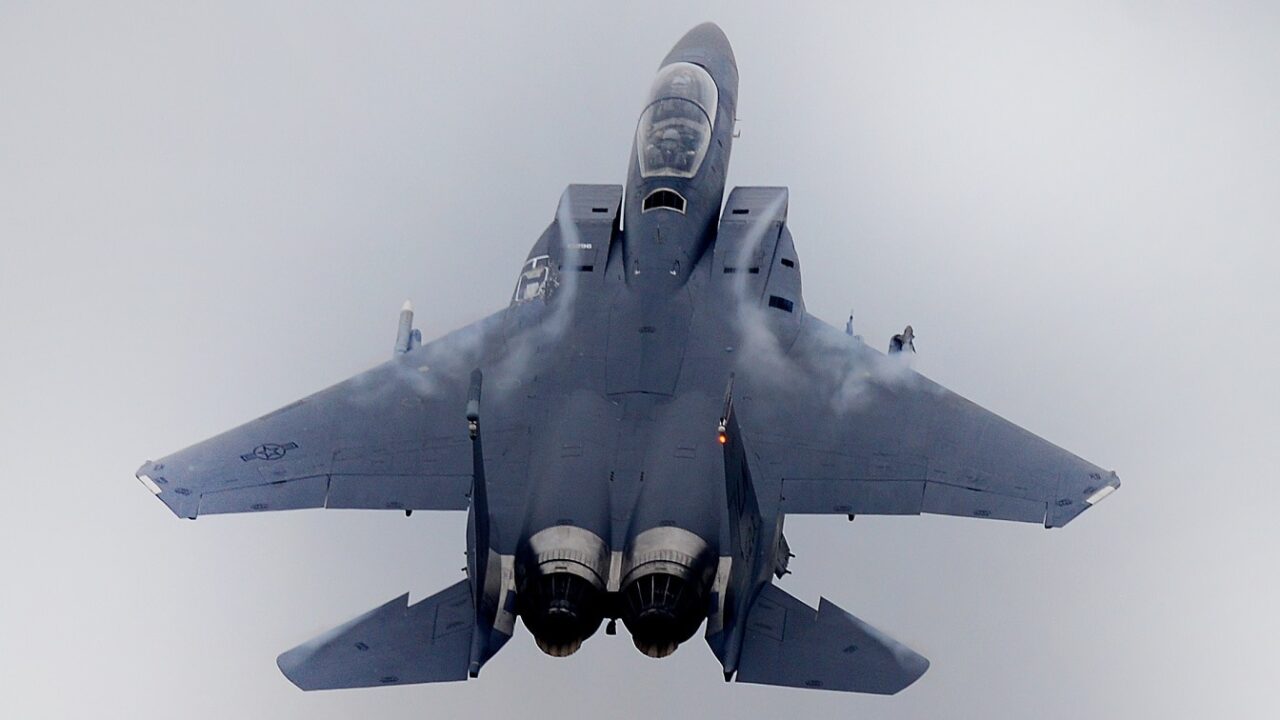
An F-15E Strike Eagle assigned to the 494th Fighter Squadron takes off for a training sortie at Royal Air Force Lakenheath, England, Oct. 26, 2018. The 494th trains regularly to ensure RAF Lakenheath brings unique air combat capabilities to the fight. (U.S. Air Force photo/ Tech. Sgt. Matthew Plew)
The engineering and design of the F-15E make it highly competitive with the F-22 and the F-35 for air superiority and ground attack missions, during which high-altitude capabilities and high-speed performance are crucial to success.
The F-15’s Outstanding Combat Record
The F-15 has a remarkable air-to-air combat record of 104 victories with zero losses. This dominance stems from its superior performance, powerful engines, advanced avionics, and air-to-air missiles.
During Operation Desert Storm, the F-15 tallied 36 of the U.S.’ 41 air-to-air victories, including kills against MiG-29s, MiG-25s, and Mirage F1s. The United States also utilized its F-15 fleet to significant effect in conflicts throughout the Middle East in the 2000s and 2010s.
While no F-15s have been shot down in air-to-air combat, some have been lost to ground fire or accidents—but the overall record remains unmatched. The Air Force plans on keeping the F-15 relevant for years to come, as it is developing the F-15EX Eagle II.
F-15 EX Eagle II
The Eagle II will carry a massive payload, including up to 22 air-to-air missiles, making it capable of both air-to-air and air-to-ground missions.
Key upgrades include a fly-by-wire system, a modernized cockpit with touchscreen displays, and advanced Electronic Warfare capabilities. The modernized version is designed as a cost-effective complement to stealth aircraft such as the F-35.
The F-15EX Eagle II has a maximum speed of Mach 2.5 at high altitude, although earlier reports give a max speed of Mach 2.9.
Alex Hollings of Air Power has always been a go-to source for information about military aircraft. He suggests a couple of scenarios in which the F-15EX could thrive in a potential war against modern Chinese air defenses.
While the F-15EX is a non-stealth aircraft, Hollings believes that the F-15EX could replace the E/A-18 Growler—the Navy is ceasing production on the Growler in 2027.
“The U.S. Navy’s EA-18G Growler has nine total hardpoints for weapons, fuel tanks, and jamming equipment with the ability to fly with as much as 17,750 pounds of weapons and gear slung beneath it,” Hollings writes.
“The Eagle II has 12 hardpoints that it could potentially be used for these sorts of systems (though it can be expanded to a whopping 23 for other weapons) and is capable of taking to the sky with a mind-boggling 29,500 pounds of ordnance and gear onboard,” he adds.
Boeing said in June 2024 that they were considering integrating the Growler’s new Next Generation Jammer Pods into the Eagle II to convert the fighter into an electronic attack platform. The Eagle II would thus be capable not only of penetrating contested airspace, but of increasing the survivability of friendly aircraft along the way.
About the Author: Steve Balestrieri
Steve Balestrieri is a National Security Columnist. He served as a US Army Special Forces NCO and Warrant Officer. In addition to writing on defense, he covers the NFL for PatsFans.com and is a member of the Pro Football Writers of America (PFWA). His work was regularly featured in many military publications.