
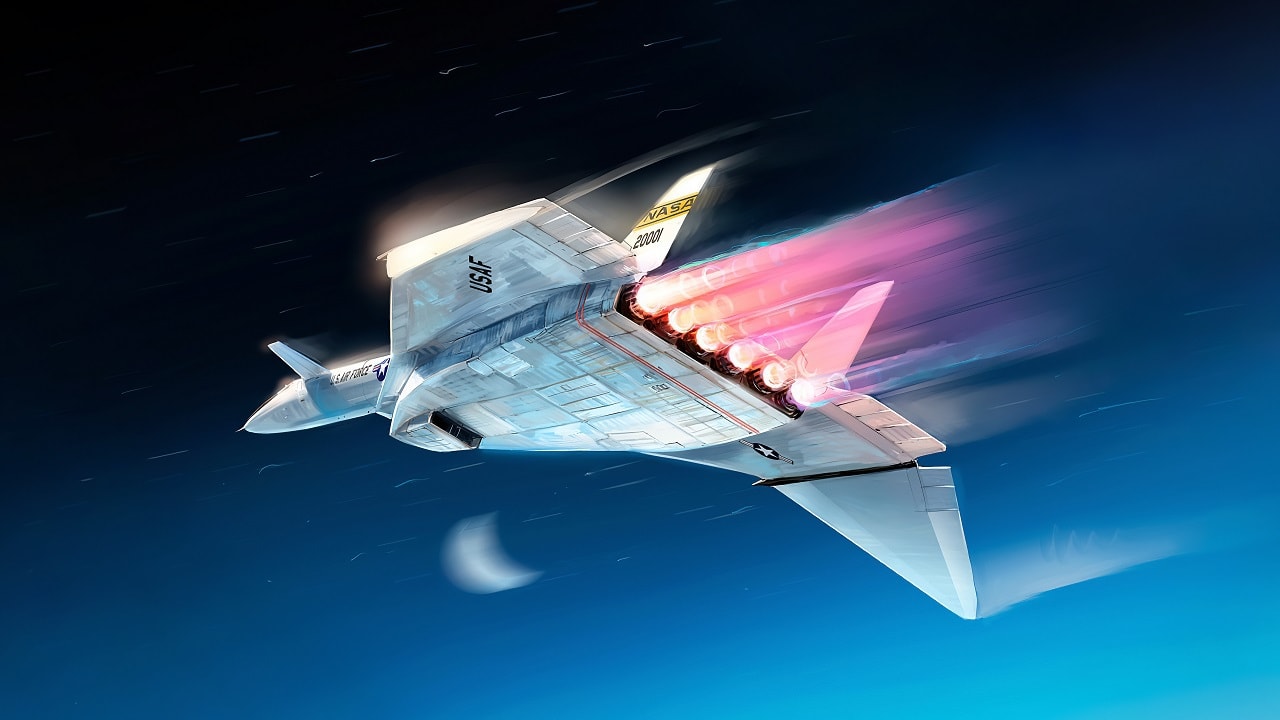
Key Points and Summary – The XB-70 Valkyrie was the U.S. Air Force’s audacious answer to Soviet air defenses: a six-engine, Mach 3, 70,000-foot bomber designed to outrun surface-to-air missiles and replace both the B-52 and B-58.
-Conceived in the 1950s, it didn’t fly until 1964—by which time Soviet SAMs, rising ICBM capabilities, and changing U.S. strategy had undercut its purpose.
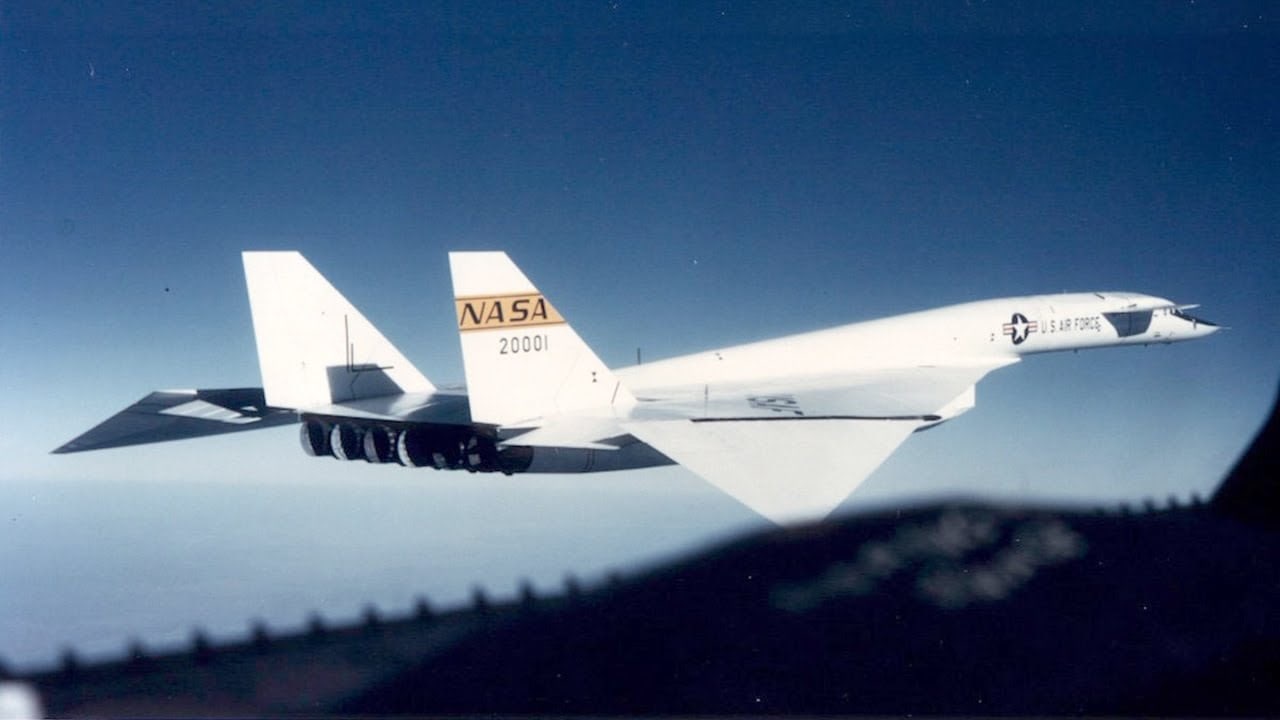
XB-70. Image Credit: Creative Commons.
-With eye-watering unit costs, President Kennedy downgraded the program to pure R&D, and a fatal midair collision in 1966 sealed its fate.
-Retired in 1969, the lone surviving XB-70 now rests in the Air Force museum, a monument to a cancelled era of speed-based deterrence.
The Air Force XB-70 Bomber Was Built to Outrun Soviet Missiles. Politics Beat It First
One way to win against the Soviet Union in aerial combat and bombing runs was to fly faster than the surface-to-air missiles could intercept you. That was the thinking behind the XB-70 Valkyrie.
The U.S. Air Force figured the B-52 and other American fighter-bombers were too slow for Soviet air defenses. Enter the XB-70 that could fly at MACH 3 with a nuclear or conventional weapons payload.
The XB-70 was conceptualized in the 1950s during the height of the Red Scare when fears about Communism and the influence of the Soviet Union were at a crescendo.
Six Powerful Engines Pushed Out that High-Speed
The XB-70, made by North American Aviation, had a whopping six General Electric YJ93s turbojet engines mounted in delta wings with 30,000 pounds of thrust each with afterburner. This enabled over 2,076 miles per hour at an elevation of 73,000 feet. Nothing the Soviets had in the 1950s could catch it or shoot it down. Its range was nearly 4,300 miles. The XB-70 was a little over 185 feet long, 30 feet in height, and weighed a gargantuan 534,000 pounds when loaded. Its wingspan was 105 feet.
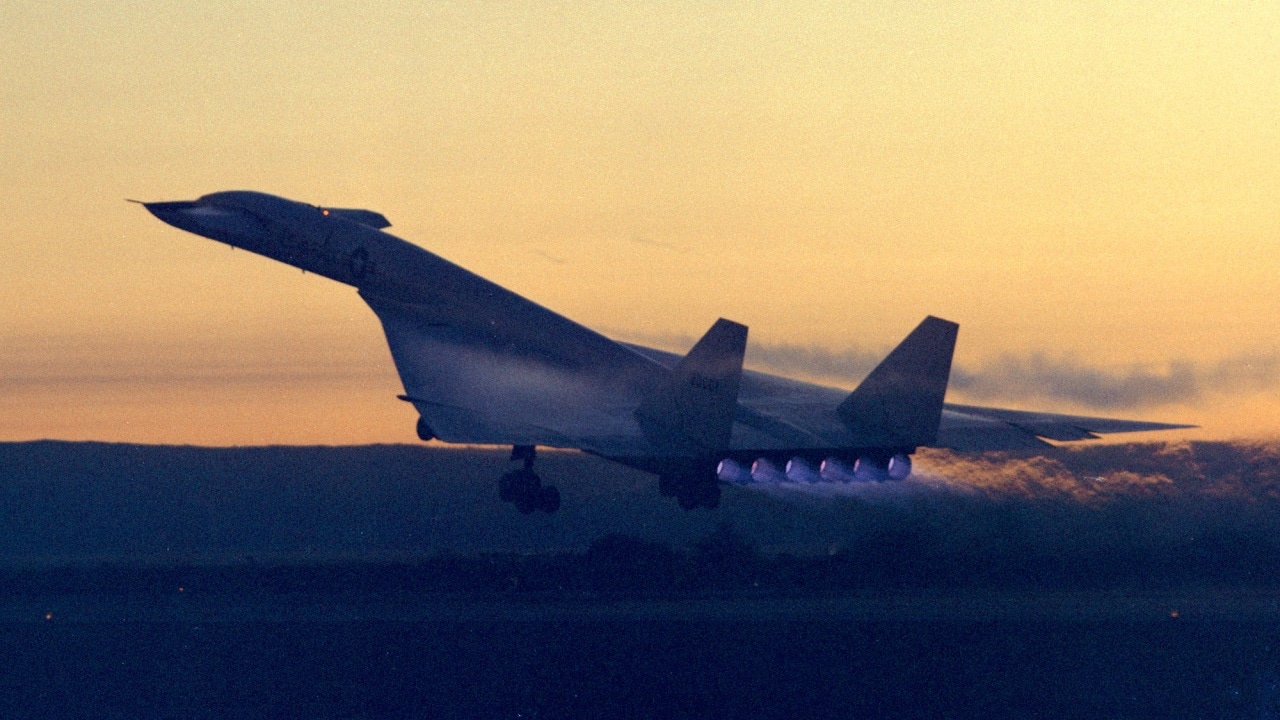
Image is of a an XB-70, another Cold War experimental bomber.
The Valkyrie had four crew – pilot, copilot, bombardier, and defensive systems operator.
The Russians Countered with the MiG-25
The Soviets got wind of the experimental jet and designed the MiG-25 Foxbat to intercept the Valkyrie should it ever fly over the skies of Mother Russia. The MiG-25 was the world’s fastest interceptor at the time.
The XB-70 Did Not Fly Until the 1960s
The Valkyrie spent a significant amount of time in development. It didn’t make its first flight until 1964. By then, air defenses had evolved to enable more speed and elevation for the intercepting missiles. The XB-70 lost its main advantages.
What If the XB-70 Had Replaced the B-52?
It’s too bad because the XB-70 could have replaced the B-52, which has since flown for 70 years. It is difficult to imagine a time when the B-52 wouldn’t have been the Air Force’s main non-stealth strategic bomber. Could the XB-70 have overtaken the B-52?
After all, the Stratofortress was slow and also vulnerable to SAMs, and unlikely to defend itself against Soviet fighter-interceptors. One great thing about the B-52 is that the airframe was so strong it could be updated many times. The XB-70 did not have this kind of versatility.
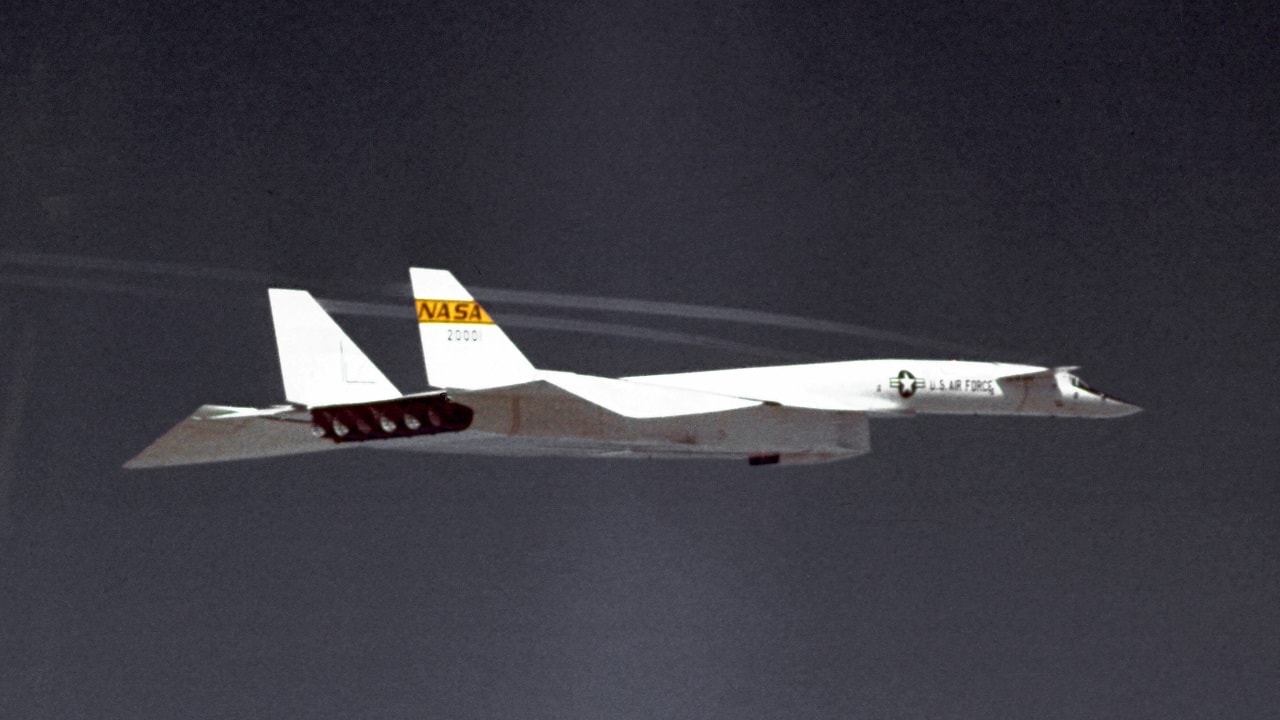
In this view the #1 XB-70A (62-0001) is in a level cruise flight mode at a relative high altitude judging from the darkness of the sky. The XB-70A, capable of flying three times the speed of sound, was the world’s largest experimental aircraft in the 1960s. Two XB-70A aircraft were built. Ship #1 was flown by the NASA Flight Research Center (now NASA Dryden), Edwards, California, in a high speed research program.
The XB-70 was also supposed to replace the B-58 Hustler supersonic bomber. The XB-70 was faster and able to climb higher with greater range.
But It Went Up Against an Idealistic New President
Unfortunately, the XB-70 was a victim of politics and struck down by a new presidential administration. President John F. Kennedy was not enamored with the experimental bomber and reduced the program’s objective to research and development only. The biggest reason for this change was the price of $700 million per unit. At the time, that eye-watering cost was just too much to even ponder as the Vietnam War was raging, and the Department of Defense was trying to keep up with that contingency with less spending on experimental airplanes.
ICBMs Were Seen As a Better Alternative
The other issue was the advent of Intercontinental Ballistic Missiles. These were unmanned of course, and able to travel at greater speeds than the Valkyrie. ICBMs were also difficult if not impossibl,e to shoot down.
XB-70 Bomber: Bad Luck Doomed the Airplane
The XB-70 was also somewhat cursed. A lousy luck accident killed two pilots and destroyed a XB-70A-2 and an F-104 in 1966. That sealed the fate of the XB-70.
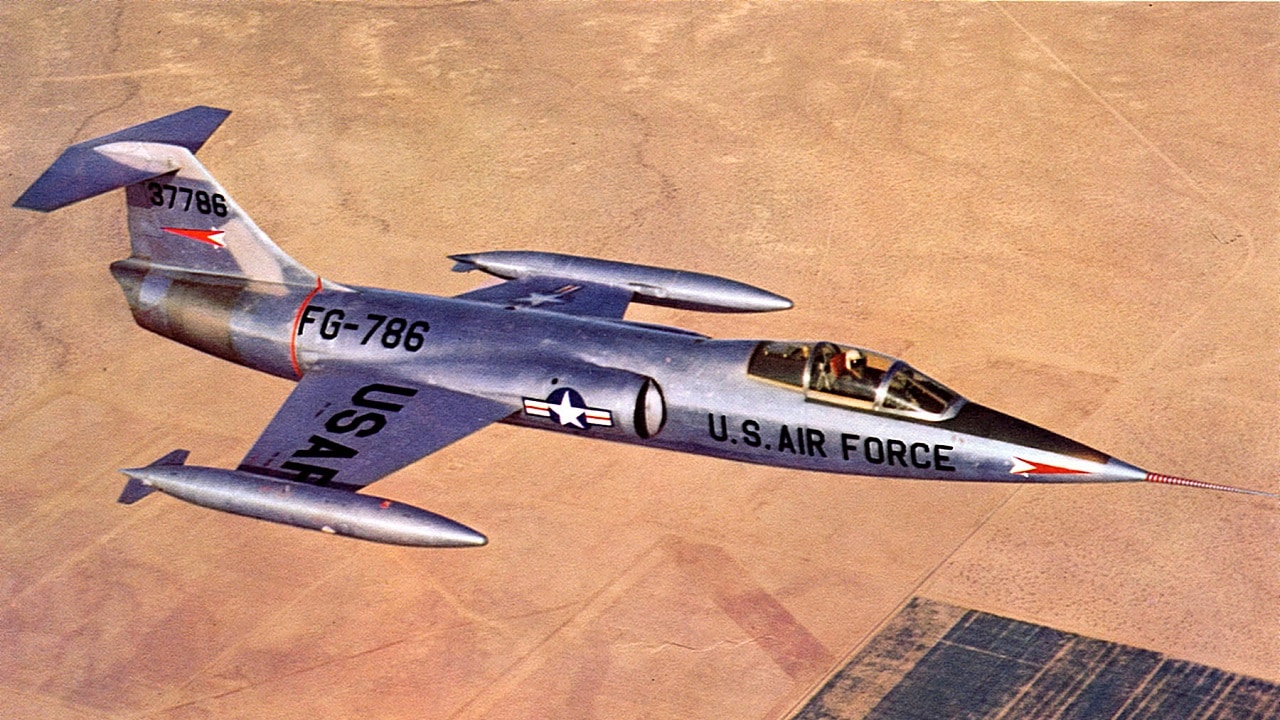
Lockheed XF-104 (S/N 53-7786) in flight. This aircraft crashed on 11 July 1957 due to uncontrollable tail flutter. The pilot, Bill Park, ejected safely.
The Valkyrie was too expensive and overcome by new technologies, better Soviet surface-to-air missiles, a new cost-cutting president, and the development of ICBMs.
The XB-70 was finally retired in 1969. You can still see an XB-70 Valkyrie up close at the Research & Development (R&D) Gallery of the National Museum of the United States Air Force at Wright-Patterson Air Force Base near Dayton, Ohio.
About the Author: Dr. Brent M. Eastwood
Brent M. Eastwood, PhD, is the author of Don’t Turn Your Back On the World: a Conservative Foreign Policy and Humans, Machines, and Data: Future Trends in Warfare, plus two other books. Brent was the founder and CEO of a tech firm that predicted world events using artificial intelligence. He served as a legislative fellow for U.S. Senator Tim Scott and advised the senator on defense and foreign policy issues. He has taught at American University, George Washington University, and George Mason University. Brent is a former U.S. Army Infantry officer. He can be followed on X @BMEastwood.