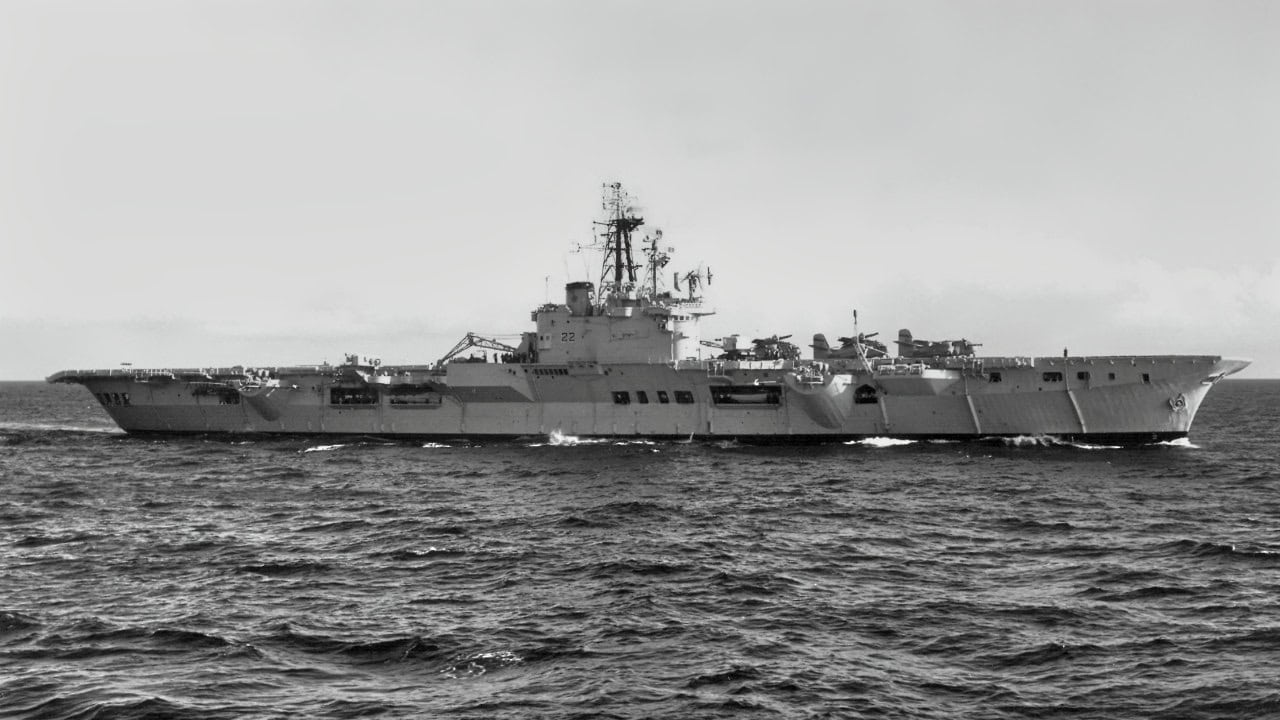
Key Points and Summary: While Canada has no aircraft carriers today, the Royal Canadian Navy (RCN) once operated a specialized carrier fleet vital to NATO’s anti-submarine warfare (ASW) strategy.
-The Mission: Carriers like HMCS Magnificent and Bonaventure were tasked with hunting Soviet submarines in the North Atlantic gap, preventing them from threatening shipping lanes.
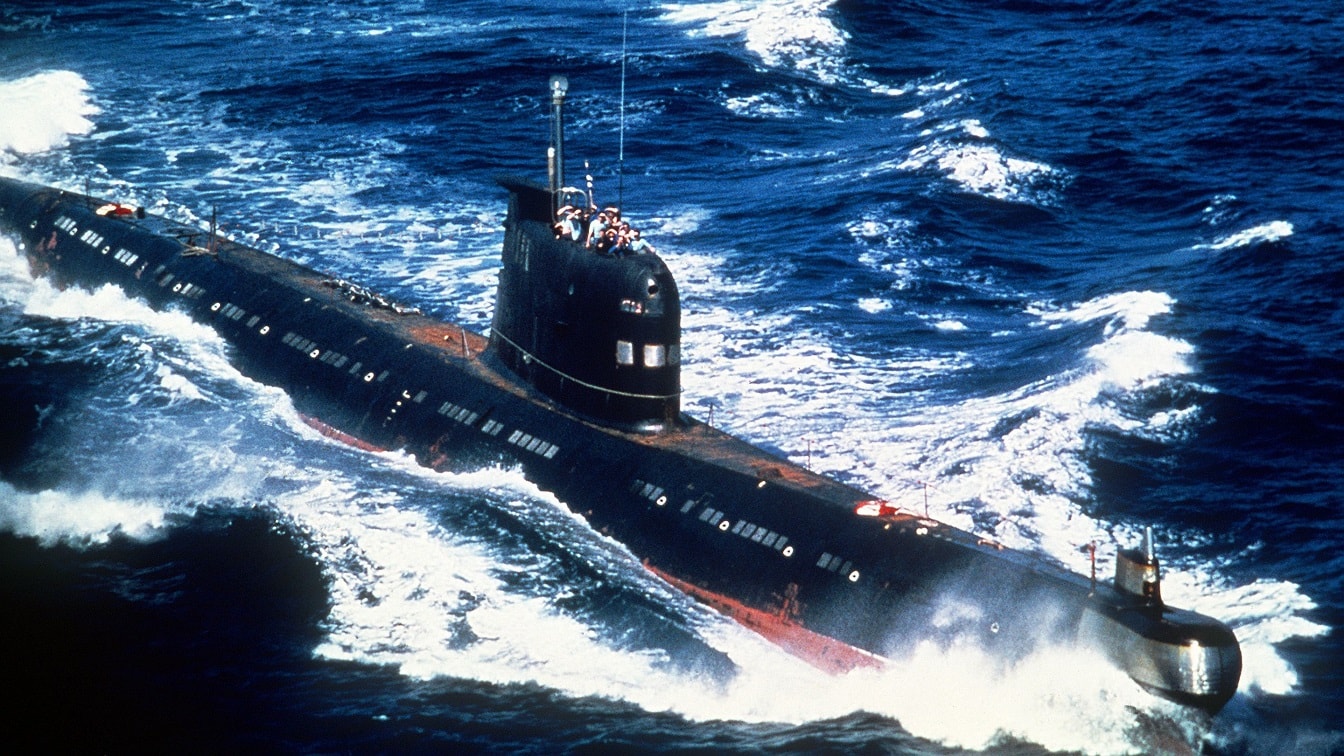
Russian Foxtrot-class Submarine. Image Credit: Creative Commons.
-The Ships: Bonaventure, a modified Majestic-class carrier, featured an angled deck and steam catapult to launch jet aircraft like the Banshee and ASW Trackers.
-The End: Rising costs and the efficiency of helicopter-equipped destroyers (using the Sea King) rendered the carriers obsolete, leading to the fleet’s retirement in 1970.
The Royal Canadian Navy Had Aircrft Carriers
Canada does not operate any aircraft carriers today, although it did for much of the Cold War. The fleet was highly specialized, tasked with finding and tracking Soviet submarines and preventing their unnoticed breakout into the North Atlantic.
Though Canada does not operate any aircraft carriers today, the Royal Canadian Navy has operated naval air wings and carriers in the past, playing a highly specialized role within NATO.
From the late 1940s to the early 1970s, Canadian aircraft carriers acted as highly mobile anti-submarine warfare platforms in the North Atlantic and Norwegian Sea.
These areas were places where NATO expected Soviet diesel ships and submarines to break out toward vital Atlantic maritime shipping lanes.
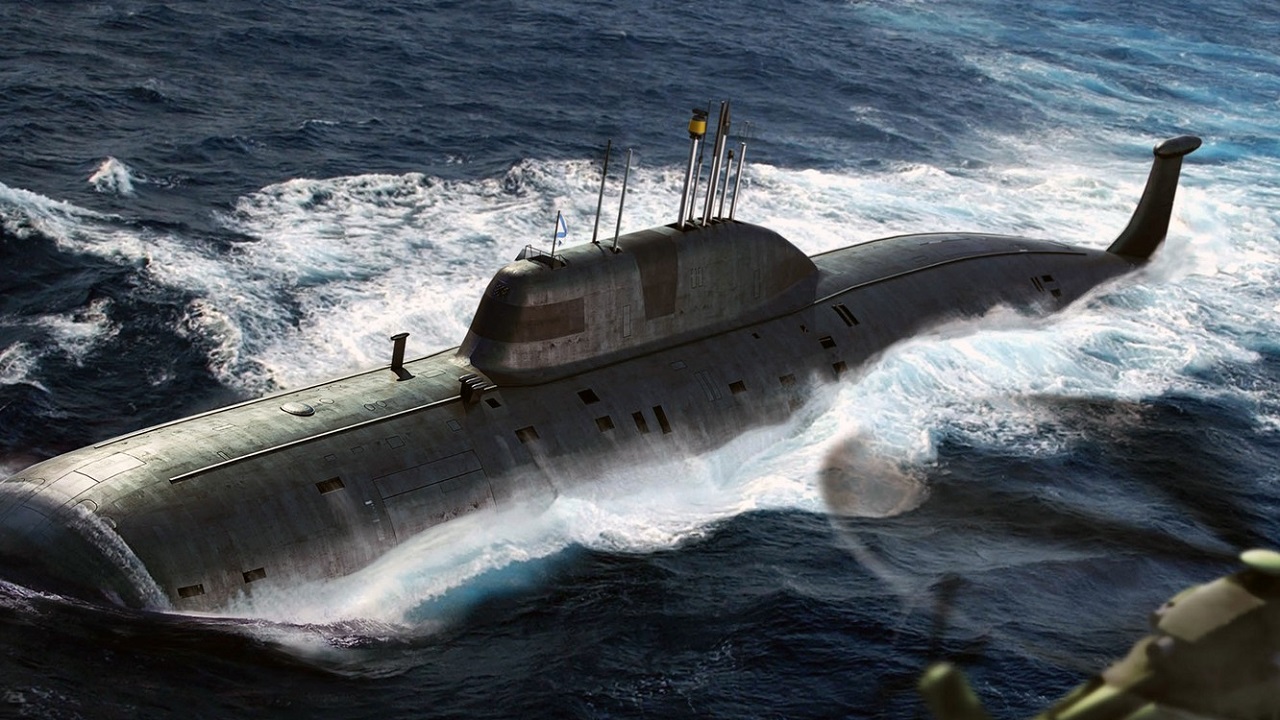
Akula-Class Submarine. Image Credit: Computer Generated Image, Screenshot.
Like their counterparts in the American, British, and Dutch Navies, the carriers filled gaps left unseen by land-based patrol aircraft, providing long-range patrol.
Although Canada’s aircraft carriers were not meant to engage a Soviet fleet, they were a vital component of NATO’s defenses against Soviet submarines.
HMCS Warrior and HMCS Magnificent
The first Canadian submarine, the HMCS Warrior, began life in the British Royal Navy and was used by Canadian crews for familiarization. It was quickly discovered that the ship was unsuited to the harsh North Atlantic climate, forcing its retirement from Canadian service.
Though the first carrier in the Royal Canadian Navy, Canadian sailors had manned several carriers in the Royal Navy, though those ships remained in Royal Navy service rather than Canadian service.
The Warrior’s successor, HMCS Magnificent, was tasked with anti-submarine warfare but also performed humanitarian missions, notably delivering supplies to Halifax following the city’s inundation by Hurricane Able in 1950. Lessons from the Warrior were incorporated into the Magnificent’s design, improving its performance in cold-weather conditions.
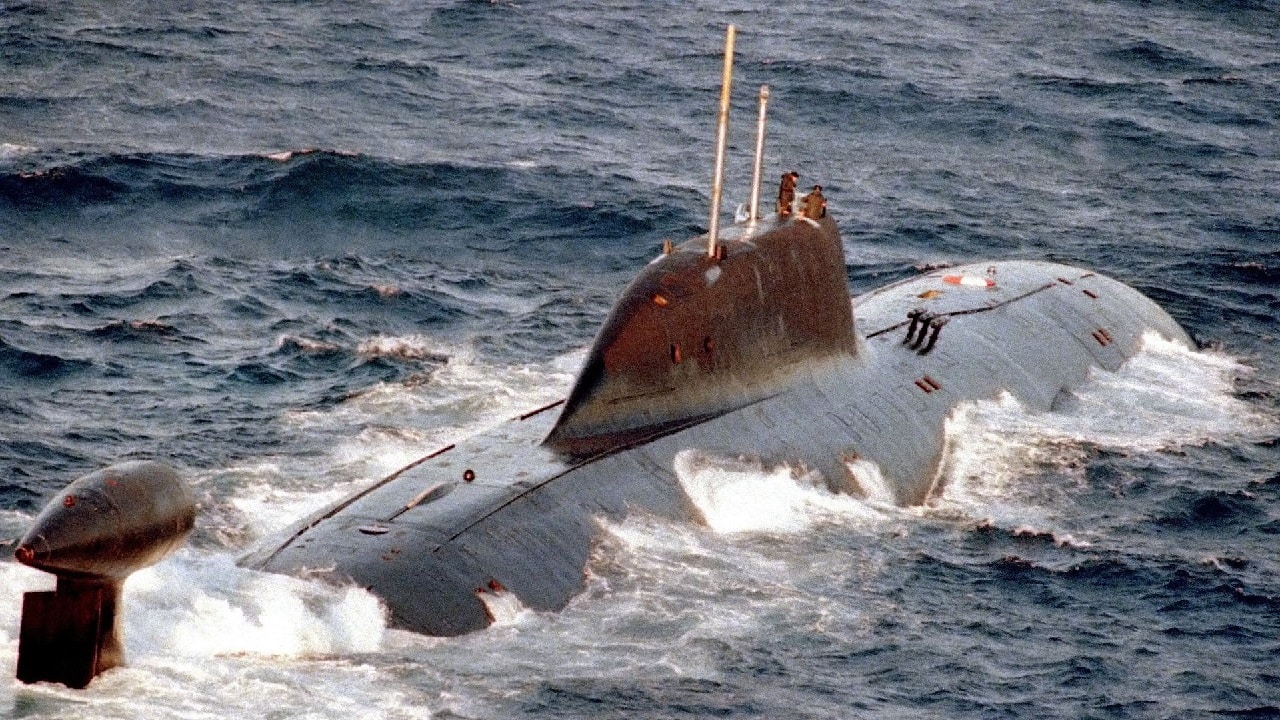
K-322 Cachalot, Akula class submarine underway. A port quarter aerial view of the Russian Northern Fleet AKULA class nuclear-powered attack submarine underway on the surface.
Like the Warrior, the ship’s retirement in the mid-1950s was driven by increasing maintenance costs and advances in aircraft and anti-submarine warfare techniques and technologies.
HMCS Bonaventure
The HMCS Bonaventure was Canada’s last aircraft carrier, commissioned in 1957 and decommissioned in 1970. It was in service at a moment of intense transition for the Royal Canadian Navy, one that saw a dispersal of Canadian anti-submarine warfare assets across the fleet, from aircraft carriers to smaller surface ships.
The HMCS Bonaventure began life in the Royal Navy as the HMS Powerful, a Majestic-class light aircraft carrier. That aircraft carrier was laid down during the Second World War, but work on the carrier did not finish in time for the ship to serve in that war. Later, Canada bought the unfinished hull, but with extensive modifications and upgrades.
One of the most significant alterations to the carrier was its flight deck, angled at five degrees, and a steam catapult to launch modern jet aircraft, which did not yet exist when the hull was initially laid down.
When the carrier entered service with the Royal Canadian Navy as HMCS Bonaventure, it had a small but robust air group whose primary mission was anti-submarine warfare—a particularly important mission and a relatively new one during the early years of the Cold War. The cornerstone of the Canadian air wing was the Grumman CS2F Tracker, a license-built copy of the American Grumman, a fixed-wing aircraft complemented by the Sikorsky HO4S and, later, the CHSS-2 Sea King helicopter.
While HMCS Bonaventure’s fighters were never among the highest-performing, the carrier could operate at sufficient speeds and with sufficiently modern fighters to serve as NATO’s North Atlantic anti-submarine warfare screen at a time when Soviet submarines — initially diesel, later nuclear-powered — were a significant security concern.
Despite the modernizations, the HMCS Bonaventure was an aircraft carrier built for a different kind of war, one when carrier air wings were made up of piston-driven propeller planes. With a displacement of around 16,000 tons and just over 700 feet long, the HMCS Bonaventure was big enough to perform its anti-submarine warfare role, but crowded. Maintaining the older aircraft carrier proved to be challenging.
The Sea King helicopter’s anti-submarine warfare performance ultimately put the kibosh on the HMCS Bonaventure. By the late 1960s, just a single Sea King onboard a destroyer could offer robust anti-submarine warfare capabilities with significant reach.
Parallel to this was HMCS Bonaventure’s high operational costs and its share of the maintenance budget. The HMCS Bonaventure’s mid-life refit was to take place from 1966 to 1967, but after $11 million and 16 months, it was deemed too costly. Following the 1968 unification of the Canadian Forces and Canada’s shifting strategic priorities, the aircraft carrier was retired and scrapped in 1970.
Despite HMCS Bonaventure’s rather abrupt service life, it holds a unique place in Canadian naval history as the last time Ottawa had a true blue-water naval capability, albeit one optimized for anti-submarine warfare.
About the Author: Caleb Larson
Caleb Larson is an American multiformat journalist based in Berlin, Germany. His work covers the intersection of conflict and society, focusing on American foreign policy and European security. He has reported from Germany, Russia, and the United States. Most recently, he covered the war in Ukraine, reporting extensively on the war’s shifting battle lines from Donbas and writing on the war’s civilian and humanitarian toll. Previously, he worked as a Defense Reporter for POLITICO Europe. You can follow his latest work on X.