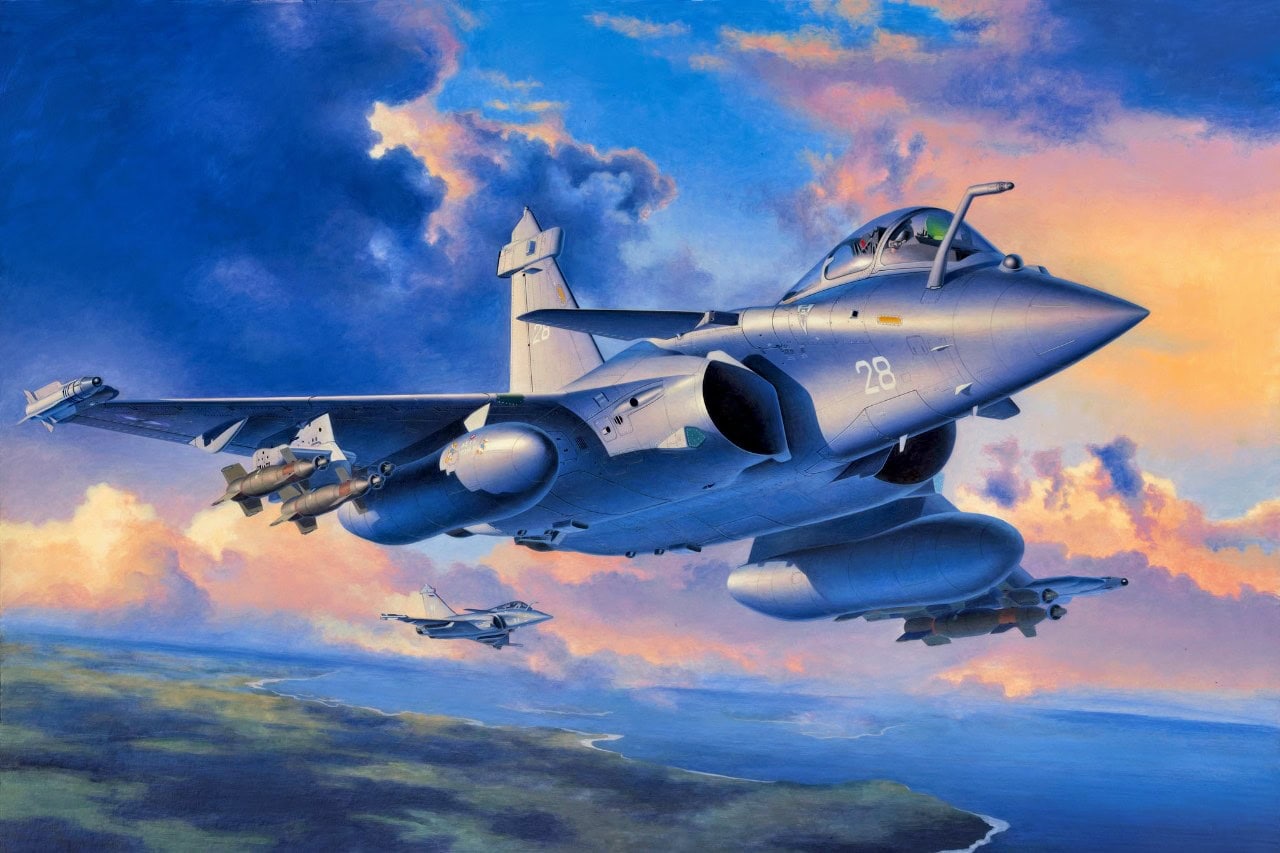
Key Points and Summary – Europe’s two flagship 4.5-generation fighters often get lumped together, but the Rafale and Eurofighter Typhoon are built on very different philosophies.
-Typhoon is a multinational program optimized for speed, thrust-to-weight, and continuous weapons and software upgrades that can keep it relevant into the 2040s.
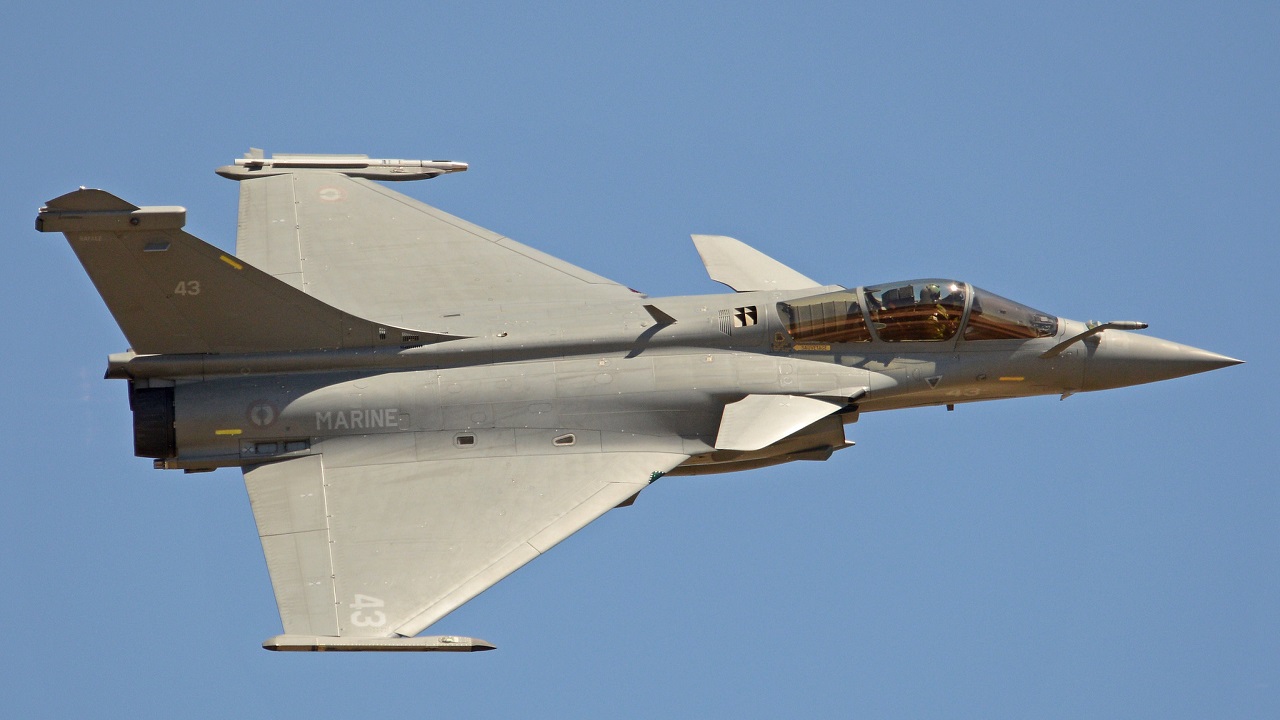
Operated by Flottille 12F, Aeronavale, based at Landivisiau. Seen during a practice display routine at Zaragoza Air Base, Spain, during the 2016 NATO Tiger Meet (NTM).
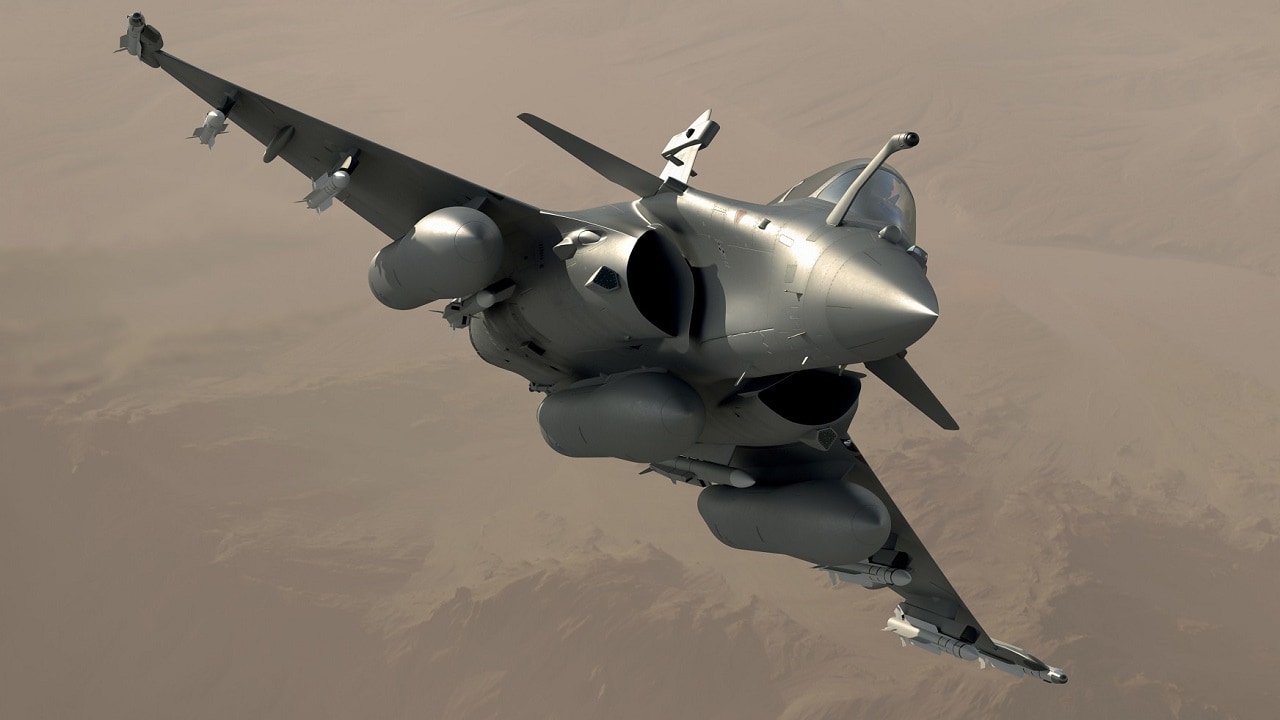
Dassault Rafale. Image Credit: Industry Handout.
-Rafale, born after France left the Eurofighter partnership, is an all-French ecosystem—radar, sensors, electronic warfare, engines, and weapons—packaged into a true multirole jet, including a carrier variant.
-Both lack fifth-generation stealth, so survivability increasingly depends on sensors, standoff weapons, and modernization cadence. For buyers, the choice comes down to industrial independence, upgrade paths, and mission priorities.
Eurofighter Typhoon vs. Dassault Rafale: An Analysis from Expert Kris Osborn
The French Dassault Rafale and the Eurofighter Typhoon may share a mission intent or an overall concept of operation. Yet, the two European aircraft are very different in most key respects.
The famous multinational Eurofighter Typhoon fighter jet entered service 20 years ago, just a few years before the arrival of the US F-22 in 2005. Yet, it has received such a high volume of advanced weapons and technology upgrades that it is expected to remain in service into the 2040s and beyond.
The French Dassault Rafale fighter jet is named “gust of wind” or “burst of fire” in English, a concept that seems to have gained traction worldwide because more than nine countries fly the French-built twin-engine fighter, including France.
The French fighter was actually originally part of a European teaming arrangement to build the Eurofighter. France, however, exited the collaborative initiative with the UK, Italy, Spain, and Germany and built its own Dassault fighter.
The Dassault has its own distinct look, with two wings on each side, a semi-smooth, rounded, blended wing body, and a thin, angular front section. Described as a 4.5-gen aircraft, the Dassault Rafael incorporates the widely used Active Electronically Scanned Array (AESA) radar to search for and lock down targets in close coordination with frontal “infrared search and track” sensors. Unlike the multinational European Typhoon, the French Dassault’s sensors, electronic warfare (EW), avionics, and weapons systems were all built entirely within France.
There are many variants of the aircraft, including a single-seat carrier-launched airplane. The platform has a top speed of Mach 1.8, slightly below that of the Typhoon and F-22; the Dassault is identified as a multi-role fighter capable of air-to-air, air-to-surface, and air-to-ground attack.
Which Fighter Is Better in One Word: Depends
Neither the Dassault nor the Typhoon is as stealthy as the 5th-generation F-22. However, both are engineered with nearly F-22-like speeds (the F-22 can reach Mach 2 or higher) and an impressive thrust-to-weight ratio.
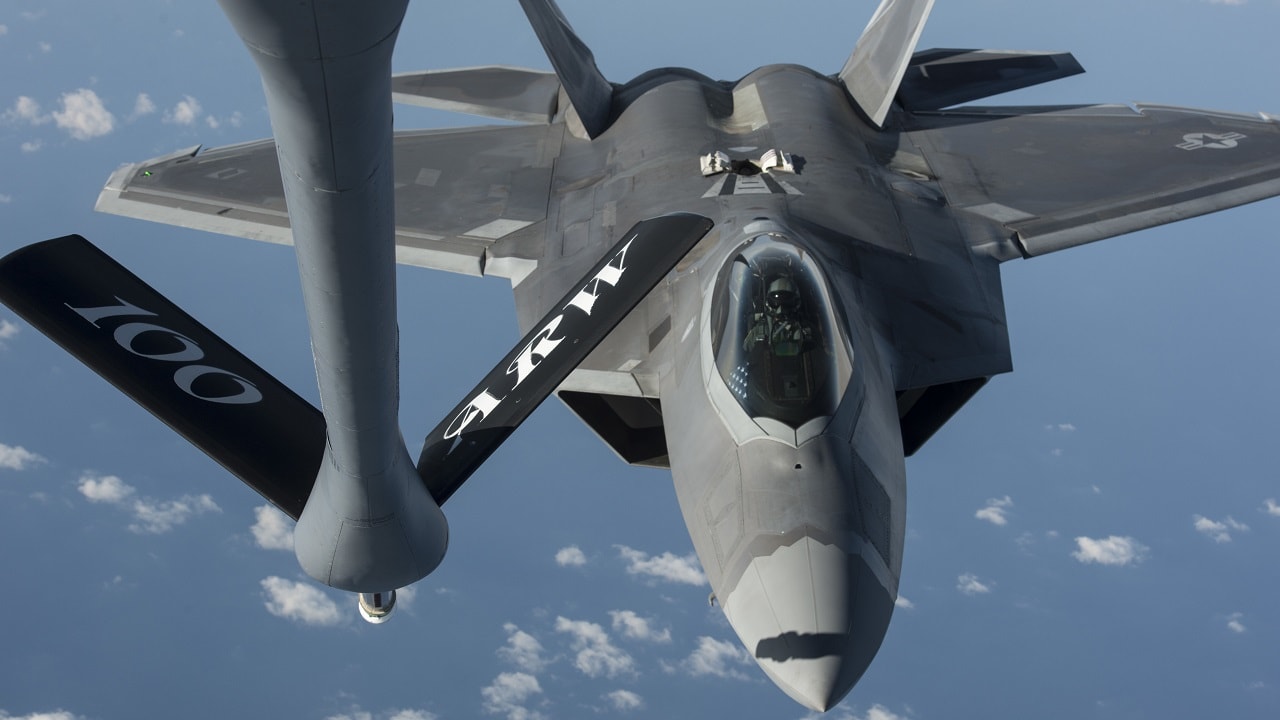
A U.S. Air Force F-22 Raptor from the 95th Fighter Squadron, Tyndall Air Force Base, Fla., moves into position behind a KC-135 Stratotanker from the 100th Air Refueling Wing, RAF Mildenhall Air Base, England, to conduct aerial refueling Sept. 4, 2015, over the Baltic Sea. The U.S. Air Force has deployed four F-22 Raptors, one C-17 Globemaster III, approximately 60 Airmen and associated equipment to Spangdahlem Air Base, Germany. While these aircraft and Airmen are in Europe, they will conduct air training with other Europe-based aircraft. (U.S. Air Force photo by Tech. Sgt. Jason Robertson/Released)
While the Typhoon’s airframes can be traced back several decades, they have remained quite viable and have received maintenance and sustainment in recent years.
Although described as a multi-role fighter, the Dassault Rafale may not possess the US’s 5th-generation technology achieved by the F-35. The Dassault has 14 external hard points and can take off with a full complement of weapons, including air-dropped precision bombs, air-launched Storm Shadow Missiles, air-to-air weapons, and a nuclear-capable cruise missile, the ASMP-A.
While built by French companies Dassault Systèmes, Thales, and Safran, the fighter has become a successful international platform. It is in service with India, Egypt, Qatar, Greece, Croatia, Indonesia, the United Arab Emirates, and Serbia. The fighter has been used in combat in Afghanistan, Libya, Iraq, and Syria.
The airframes themselves can remain viable for decades, provided they receive sufficient and regular maintenance, with structural reinforcement as needed. There is evidence supporting this concept with both the Dassault Rafale and the Typhoon.
With a solid airframe, a fighter jet can be upgraded with new weapons, software, sensors, computing, avionics, and communications technology, making it almost an entirely different aircraft from its inception. For example, the Typhoon aircraft originally operated with the UK, Germany, Italy, and Spain, but has since flown with many other countries, including Austria, Saudi Arabia, and Kuwait.
Thrust-to-Weight Ratio
The Typhoon achieves an F-22-like thrust-to-weight ratio with its lightweight materials and Eurojet 2000 engines. Seventy percent of the airframe is built from carbon fiber composites. Software upgrades to the Typhoon have enabled what is called a “swing-roll” capability, which a Typhoon pilot told me at the Farnborough airshow in 2014. Swing-roll allows the fighter to perform multiple functions at once, such as firing missiles and dropping bombs.
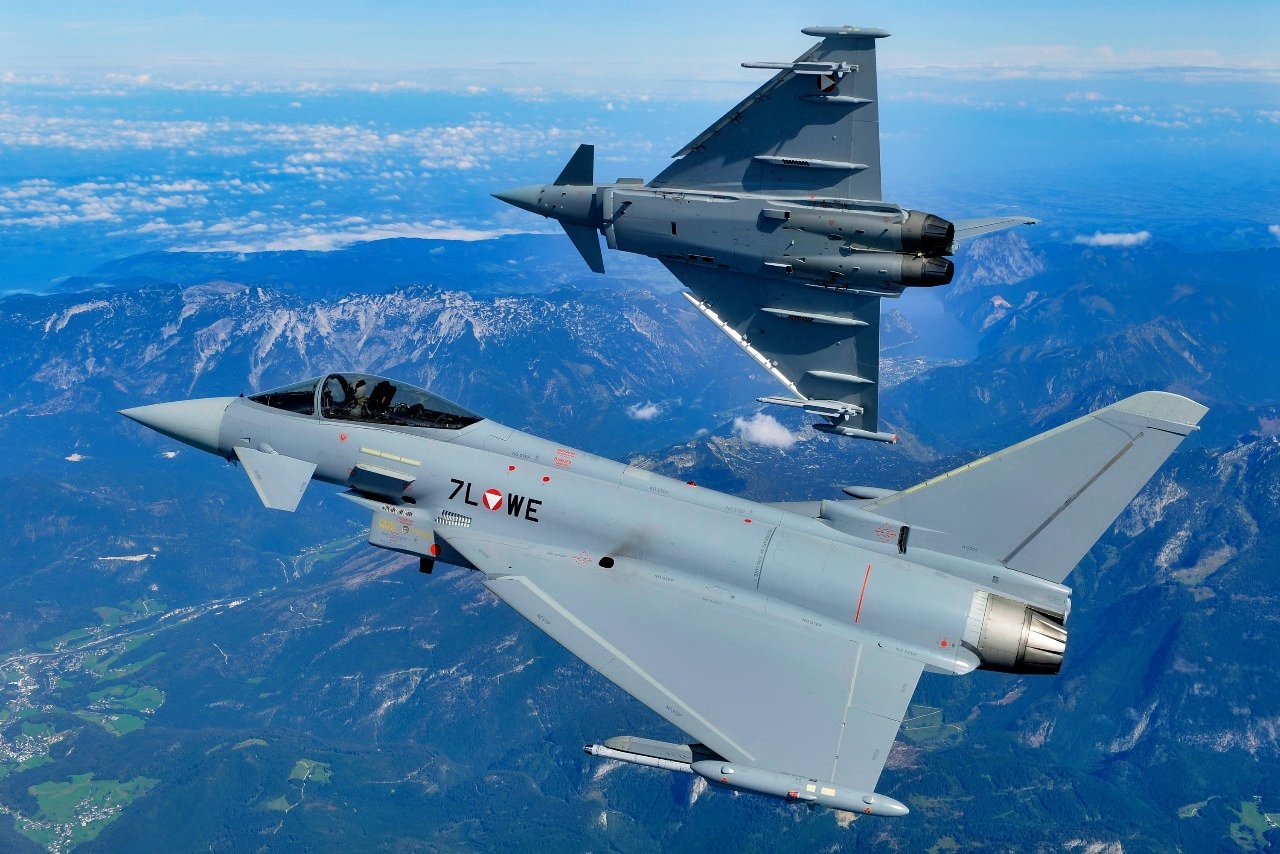
Eurofighter Typhoon. Image Credit: Creative Commons.
Eurofighter Typhoon Weapons
The Eurofighter Typhoon has received new weapons in recent years, technologies that have drastically improved its range, reach, accuracy, and lethality. The aircraft has 13 hardpoints, and the Typhoon’s GPS- and laser-guided bombs include 2,000-, 1,000-, and 500-pound GBUs, as well as the Paveway IV, a 500-pound laser-guided bomb.
The Typhoon has, for instance, been armed with a European missile referred to as the Storm Shadow, a highly lethal air-launched missile used to destroy Saddam Hussein’s bunkers at the beginning of Operation Iraqi Freedom in 2003.
Known for its accuracy, the Storm Shadow can achieve precision targeting and fire two missiles through the exact same hole in an enemy bunker target. The weapon used a special double-charge explosive effect, called a BROACH warhead, which includes an initial penetrating blast followed by a controlled detonation of the main warhead using a variable-delay fuze.
The Storm Shadow, also on the Royal Air Force’s Tornado aircraft, is built with a stealthy external configuration and a precision-guidance system that uses multi-mode GPS and inertial navigation.
Eurofighter was armed with a European missile called Meteor, which significantly increases what pilots refer to as the “no-escape range” – the distance or point at which an air-to-air adversary cannot fly away from or “escape” an approaching missile.
Typhoon & Dassault Rafale Service Life
The Typhoon enhancements have also included the addition of a short-range standoff missile, Brimstone II. This precision-guided weapon has also been in service on the British Tornado aircraft. Designed initially as a tank-killer weapon, Brimstone II is engineered with an all-weather, highly precise millimeter wave seeker. In Afghanistan many years ago, a Brimstone was used to destroy an Al Qaeda traveling at 60km per hour.
The Typhoon has also been armed with the Meteor, which significantly increases what pilots refer to as the “no-escape range”—the distance or point at which an air-to-air adversary cannot fly away from or “escape” an approaching missile.
The Dassault is newer than many 4th-gen aircraft, which emerged in the 1980s, such as the F-15 and F-16, yet its continued relevance hinges upon the extent to which it has been upgraded.
If the Dassault Rafale has been upgraded, undergone modernization, or implemented a Service Life Extension Plan, it could indeed prove extremely worthwhile in conflicts against 4th-generation aircraft.
There have been so many technological breakthroughs in the last 20 years that the Dussault Rafale would have had to receive regular upgrades to compete in a modern threat environment.
About the Author: Kris Osborn
Kris Osborn is the President of Warrior Maven – Center for Military Modernization. Osborn previously served at the Pentagon as a highly qualified expert in the Office of the Assistant Secretary of the Army—Acquisition, Logistics & Technology. Osborn has also worked as an anchor and on-air military specialist at national TV networks. He has appeared as a guest military expert on Fox News, MSNBC, The Military Channel, and The History Channel. He also has a Masters Degree in Comparative Literature from Columbia University.