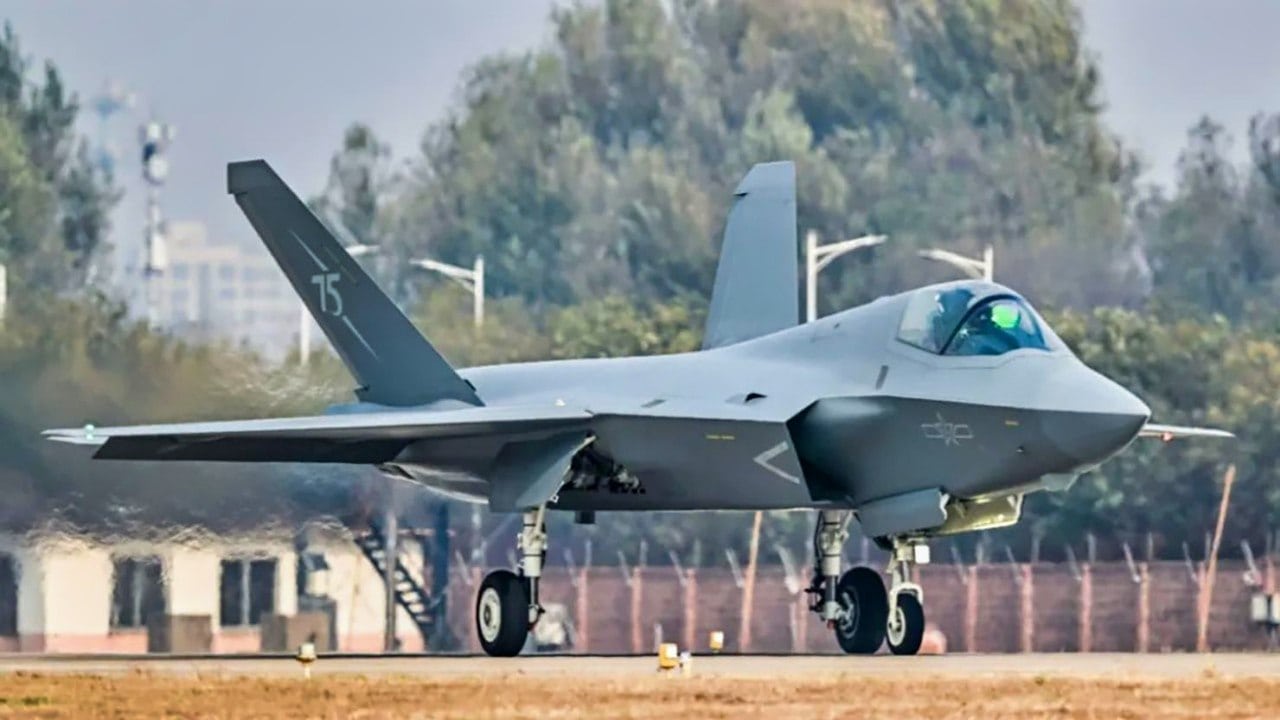
Key Points and Summary – New close-up imagery of China’s WS-21 turbofan offers the clearest look yet at the engine powering Shenyang’s J-35 variants, including a carrier-capable model intended to replace the J-15.
-The photos highlight low-observable design cues—most notably serrated exhaust geometry—suggesting Beijing is applying mature stealth-propulsion thinking to a navalized fighter.
J-35A Fighter from China PLAAF. Image Credit: Creative Commons.
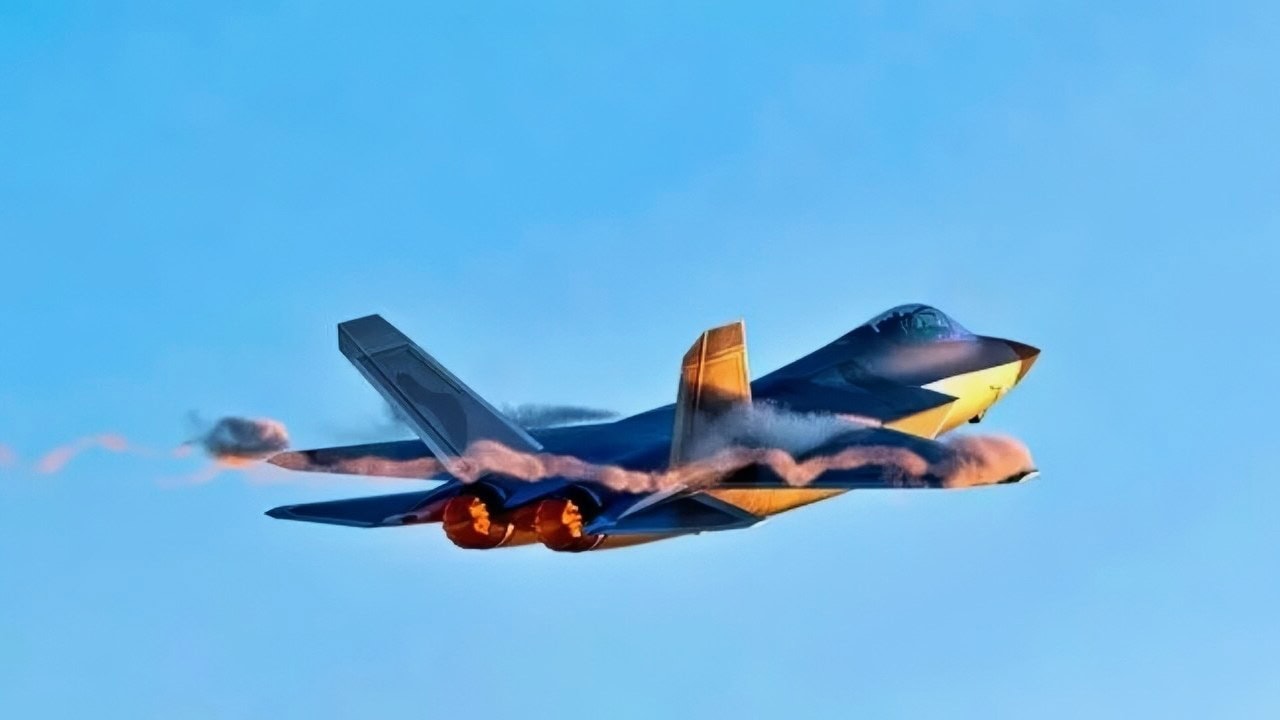
China J-35 Naval Stealth Fighter. Image Credit: PLAN.
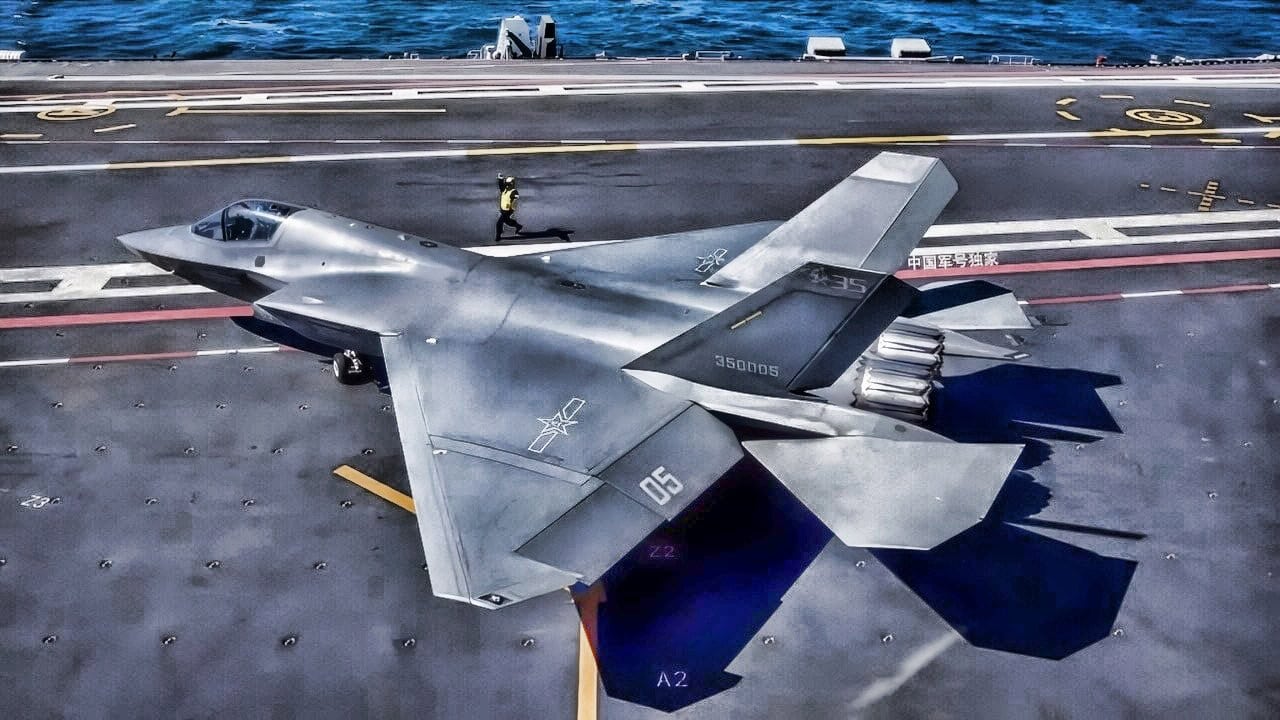
J-35 Fighter. Image Credit: Chinese Internet.
-Reporting frames WS-21 as a modernized evolution of the WS-13, potentially an interim solution that accelerates J-35 fielding while a more advanced engine matures, mirroring the J-20’s evolutionary propulsion path.
-The broader signal: China is prioritizing fleet availability and carrier aviation experience over “perfect” propulsion.
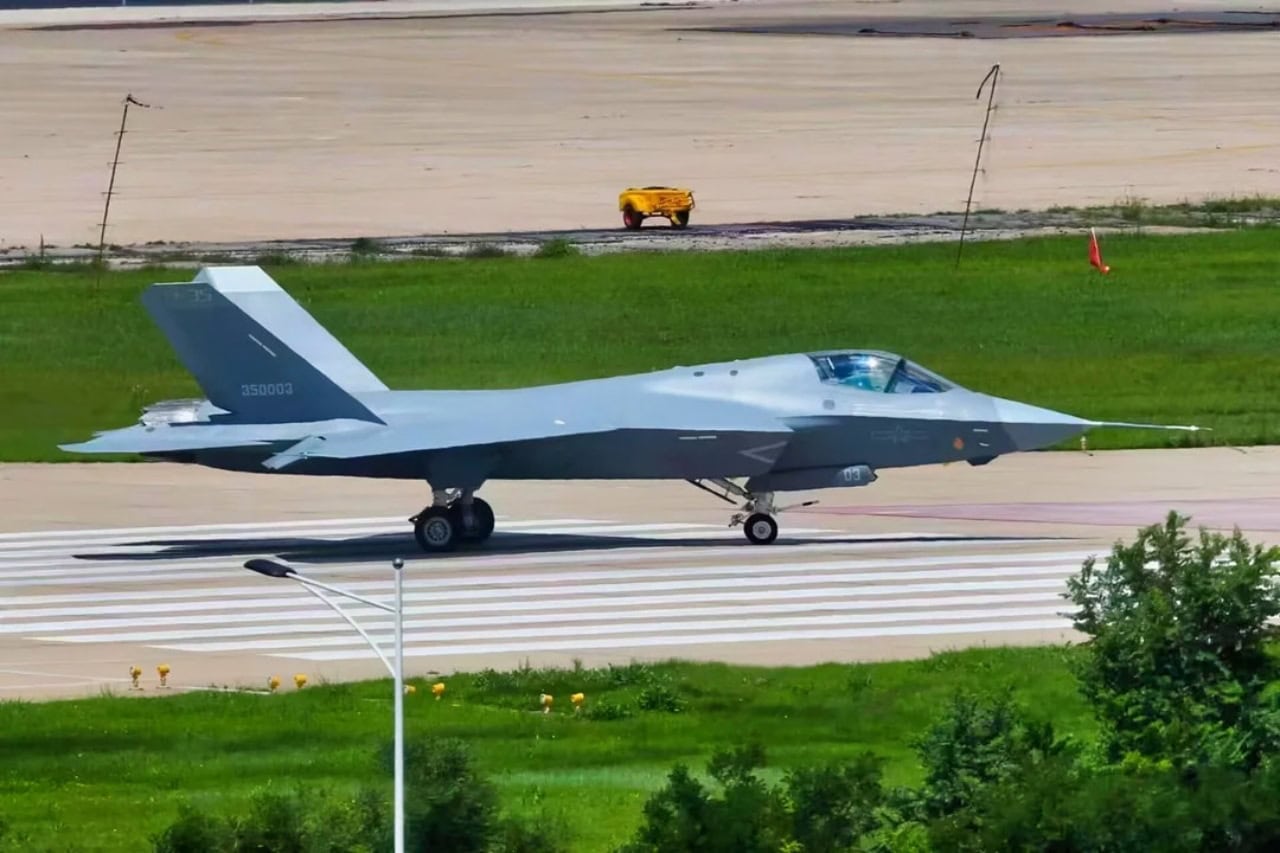
-We have included many photos in this article to show the evolution of the J-35 fighter platform.
China’s J-35 Fighter Has a Message: China’s New WS-21 Engine Is the Real Story
Earlier in December saw the release of the first detailed and close-up photos of the Guizhou Aircraft Industry Corporation’s WS-21 turbofan engine, which is the power plant for the Shenyang J-35A land-based and J-35B carrier-capable stealth fighters. This image is the first real look inside what had previously been a closed box about which very little was known.
The J-35 aircraft variants and the engine are two of Beijing’s most sensitive aerospace programmes. They also represent the first real attempts by the Shenyang Aircraft Corporation (SAC) to create a stealthy tactical fighter aircraft.
The People’s Republic of China’s (PRC) defense and aerospace sector is a close parallel to that of the former Soviet Union, meaning some of its design and production centers are focused almost exclusively on fighter jet programs. Like their counterparts at Mikoyan and Sukhoi in Russia, they also compete with one another but have developed different approaches to the design and development of military aircraft.
Since 1990, Shenyang has largely focused on the design and production of reverse-engineered copies of the Russian-made Su-27, Su-30, and Su-33 fighter aircraft. These are the J-11, J-16, and J-15, respectively. Their competing fighter design house in the PRC is the Chengdu Aircraft Research and Design Institute (CADI), which developed the famous J-20 stealth fighter.
More than a decade after the J-20 first flew, Shenyang has finished making copies of Russian aircraft. They are instead developing their own modern aircraft based on the stealth-like design concepts, which have produced the J-35.
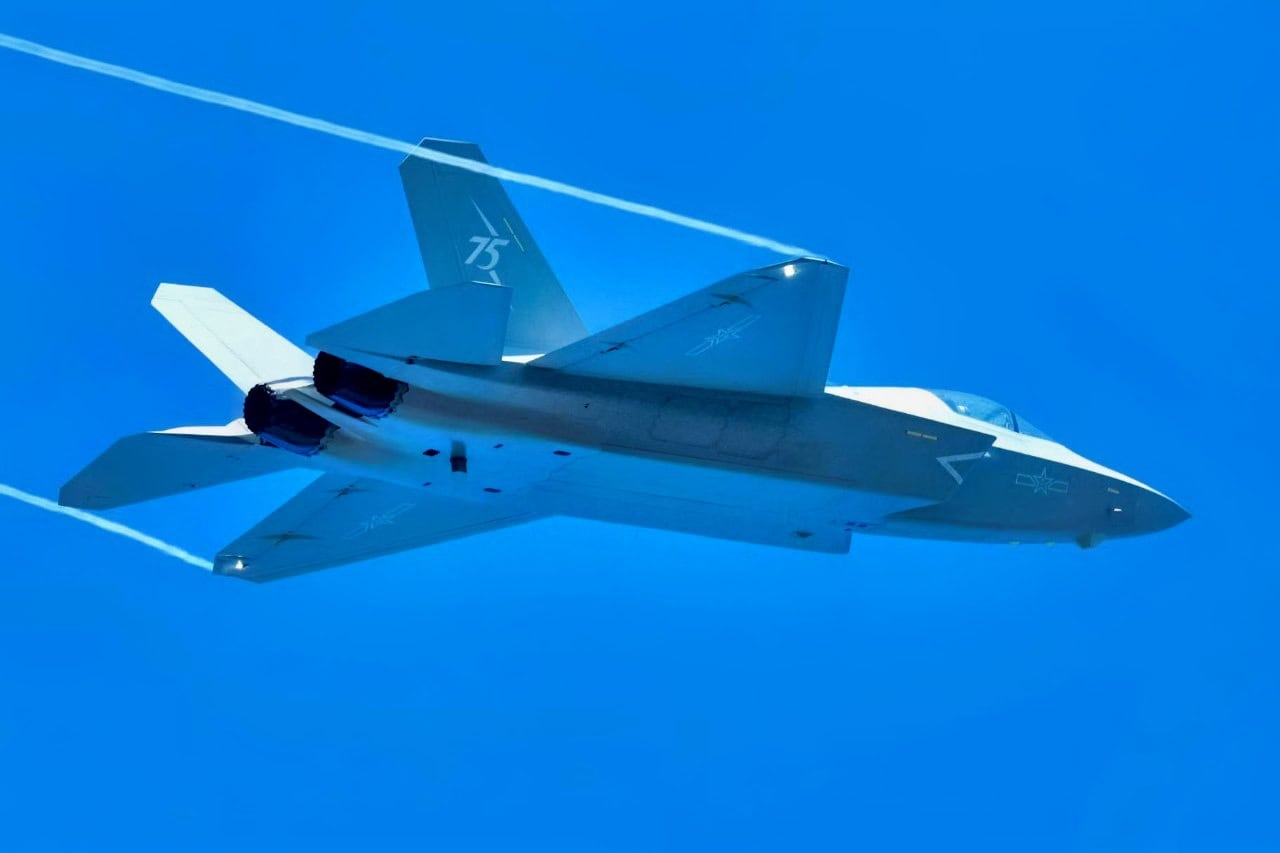
J-35 Fighter. Image Credit: Chinese State Media.
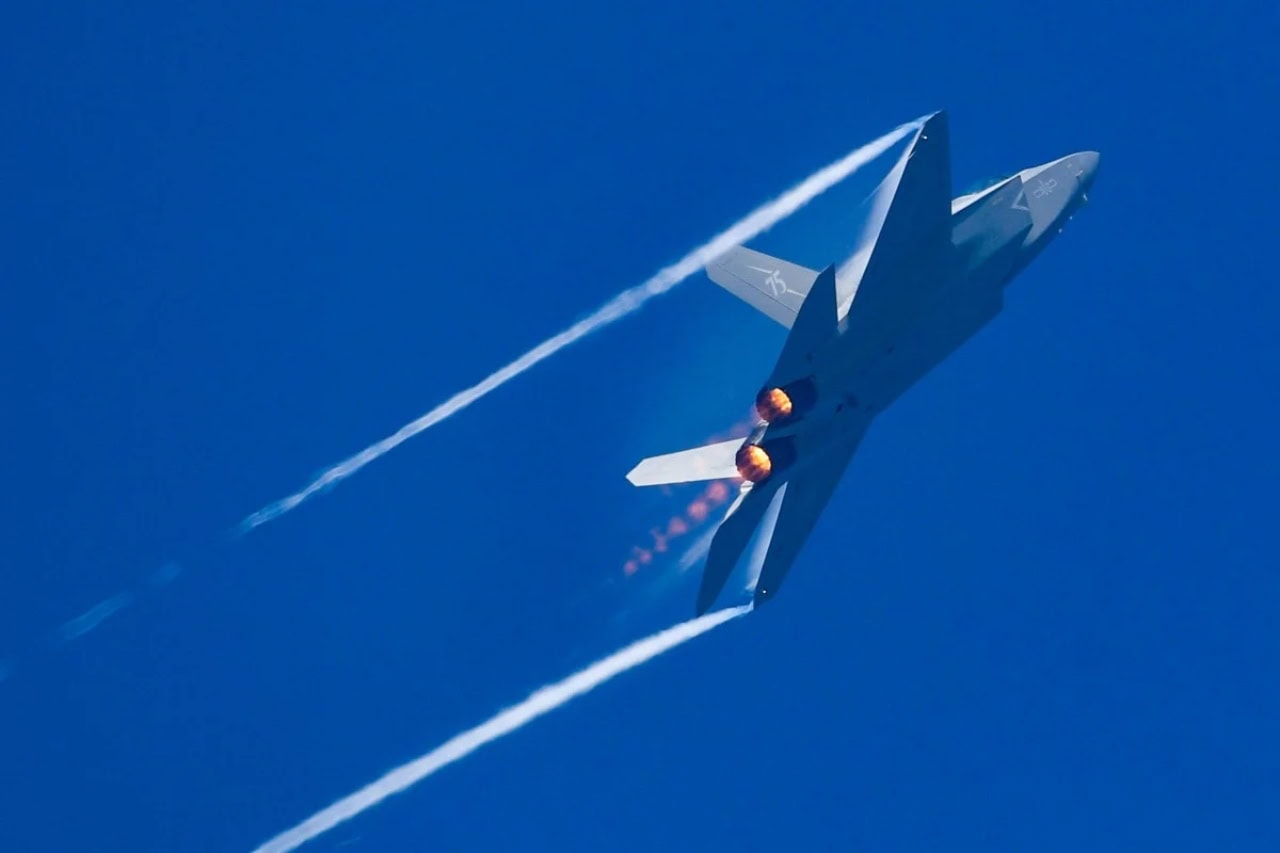
J-35. Image Credit: Chinese State Media.
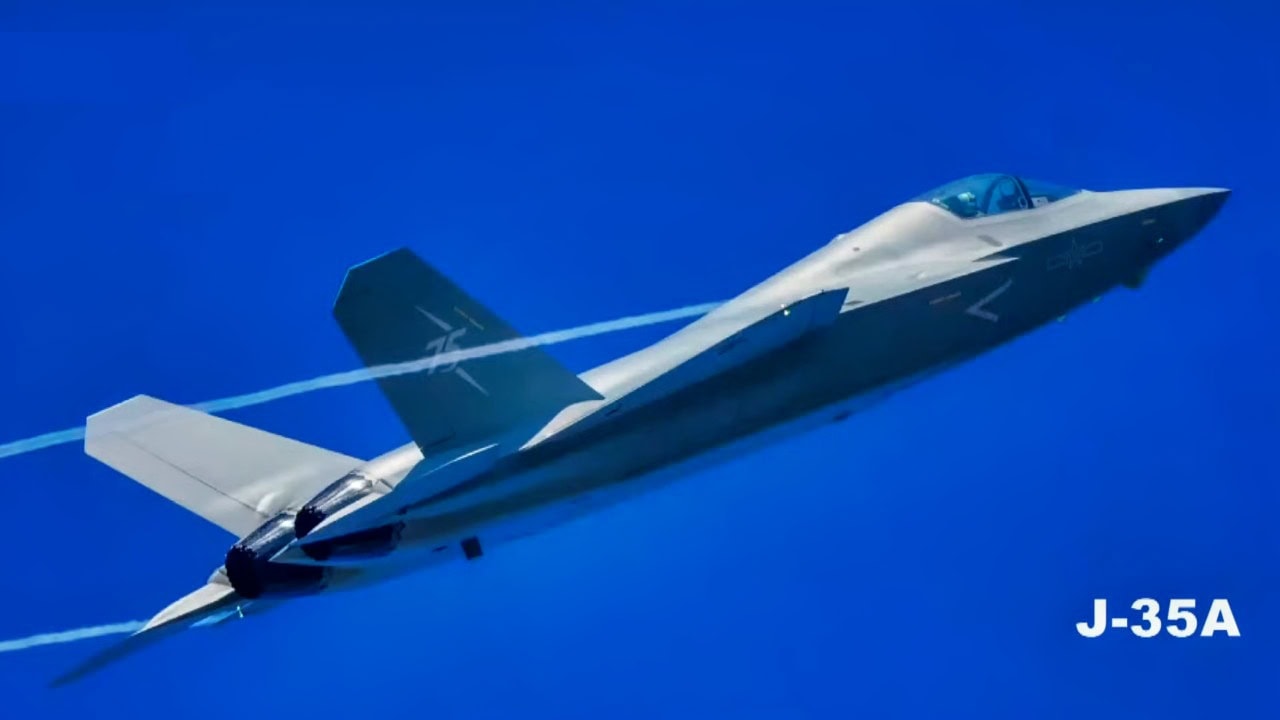
China J-35 Fighter. Image Credit: Creative Commons.
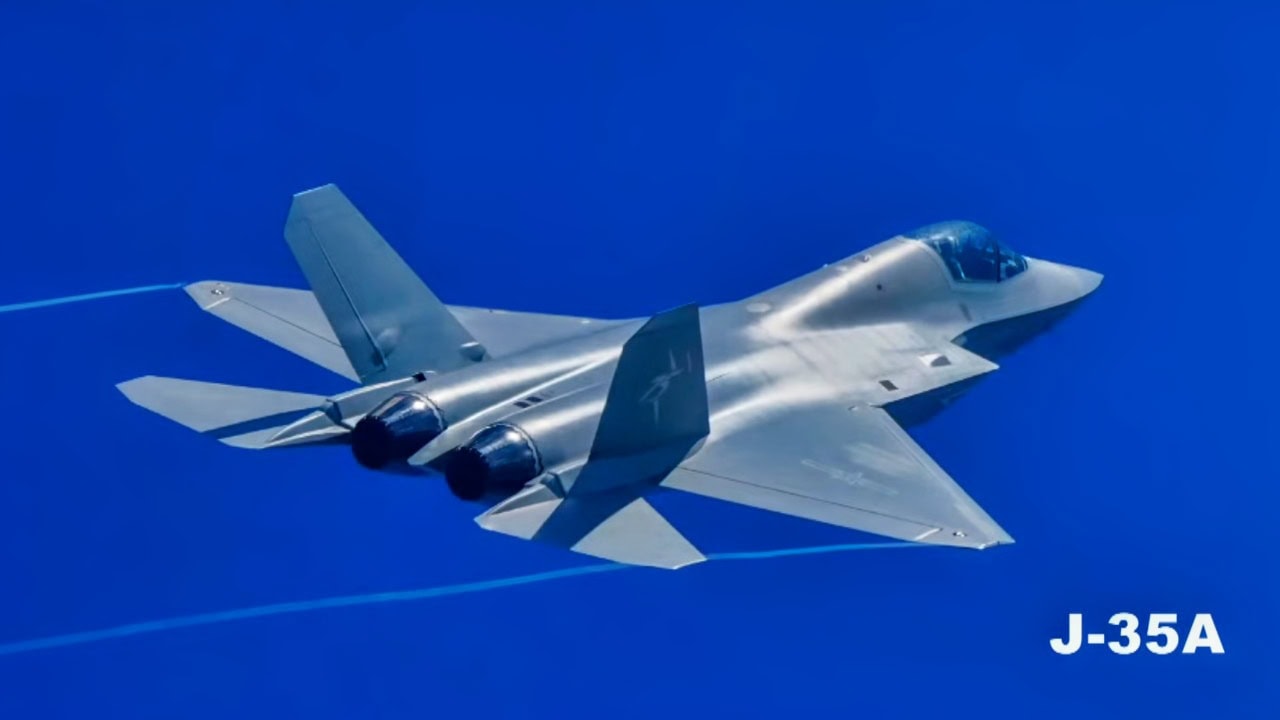
J-35 flying at Zhuhai Airshow 2024.
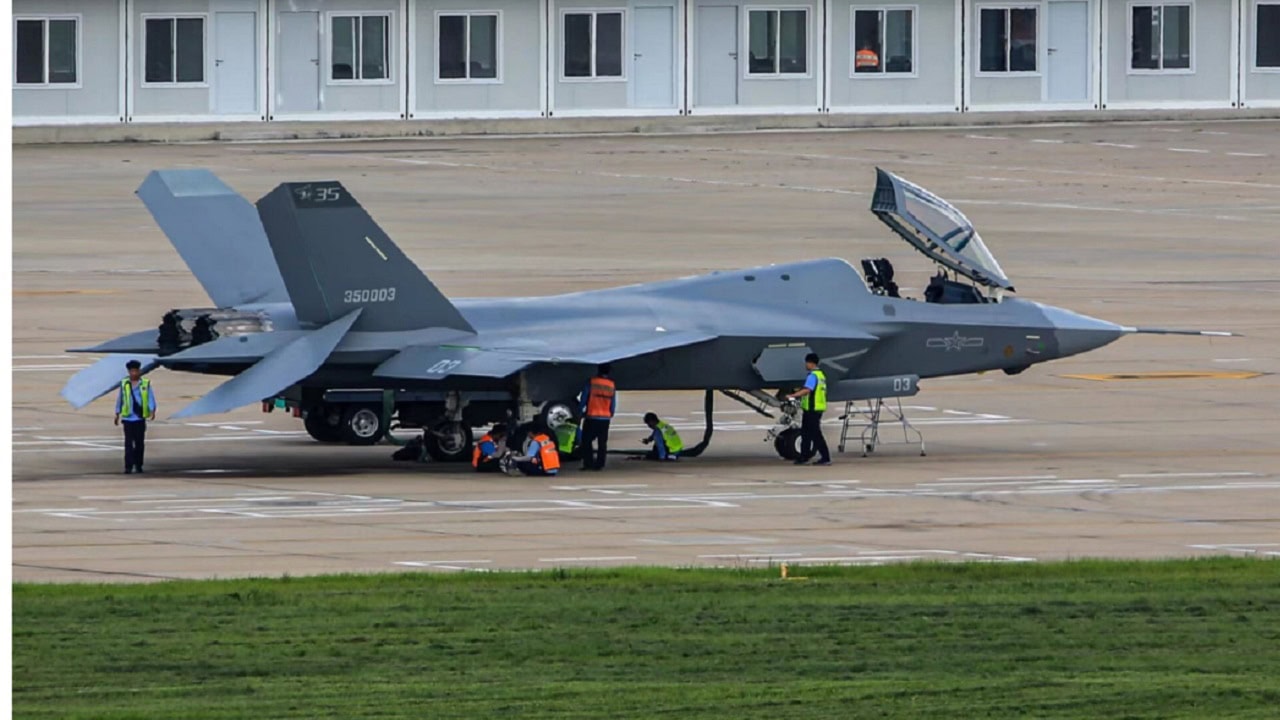
J-35 Stealth Fighter. Image Credit: Chinese Internet.
The aircraft is sometimes referred to as an analogue to the US F-35, as it is being produced to address both a People’s Liberation Army Air Force (PLAAF) requirement for an air force fighter and a People’s Liberation Army Navy (PLAN) need for a carrier fighter to replace the J-15.
As a lengthy profile on the engine released last week correctly describes the current state of affairs, the J-35 is the PLAN’s “future carrier-borne strike and air-dominance platform at a moment when Indo-Pacific airpower balances are entering a period of accelerated structural change.”
More Stealth for J-35 Fighter: Design For Low Observability
Imagery of the WS-21 reveals features that are key to reducing the radar cross-section (RCS) signature in a previously unseen clarity. Namely, the photos show the kind of serrated exhaust nozzles that are a standard feature in stealth-optimized design methodology.
Other details of the WS-21 design have led to the conclusion that, while “the engines or at least the exhaust nozzles are totally different” from previous designs, the WS-21 could be “an interim engine enabling faster induction of the J-35 while more advanced propulsion matures.” The point being that the J-35 might pass through a series of different engines used in conjunction with the airframe – the same evolutionary approach taken with the J-20 programme – until the power plant ultimately designated for it appears.
This assessment is supported by the fact that the WS-21 is an upgraded, modernized version of the older-generation WS-13 engine. It is logical to expect a new, clean-sheet design for a next-generation engine sometime in the future. This engine is to the J-35 what the WS-15 Emei is to the J-20.
Accelerated Development for J-35 Fighter from China
The PRC defense sector has historically been willing to invest personnel, resources, and political capital to move the development of weapon systems from one generation to the next – and to do so at an accelerated rate that outstrips that of almost all Western nations.
Beijing, according to the same lengthy profile, has shown an increasing focus on efforts that can “compress development timelines, de-risk fifth-generation force generation, and sustain momentum across contested maritime theatres stretching from the Taiwan Strait to the South China Sea and beyond.”
The WS-21 design is also proof that the PRC’s tactical aircraft industry has achieved a feat that most experts on the PLA believed would be impossible in the near future. That is, the ability to meld the expertise needed for the design of a stealthy propulsion system, but at the same time maintain compliance with the structural requirements of carrier-compatible designs.
This is a combination of disciplines that are difficult to stream into a single activity. In the case of the US and other nations with a long history of carrier-based aviation, this is a process that required literally generations to perfect. Yet the Chinese appear to have achieved fluency with it in a remarkably short time.
It should also be acknowledged that, as with the use of Russian AL-31F models and later advanced versions of the Chinese-made WS-10 design in the J-20 before the WS-15 became available, the WS-21 is not just a temporary solution for the J-35.
It shows that the PLAN has calculated that having a suitable number of carrier aircraft available sooner rather than later, and then perhaps introducing a newer engine later, is preferable to waiting for the optimal propulsion solution to be developed.
Having pilots and ground crew who are capable and experienced with the J-35A and J-35B designs, and building a set of core competencies, are the primary goals they see as superseding other considerations. “Propulsion perfection is less strategically decisive than fleet-level availability, sortie generation rates, and the rapid accumulation of carrier aviation experience under real-world maritime conditions,” concludes the in-depth profile on the WS-21.
About the Author: Aviation Expert Reuben F. Johnson
Reuben F. Johnson has thirty-six years of experience analyzing and reporting on foreign weapons systems, defense technologies, and international arms export policy. Johnson is the Director of Research at the Casimir Pulaski Foundation. He is also a survivor of the Russian invasion of Ukraine in February 2022. He worked for years in the American defense industry as a foreign technology analyst and later as a consultant for the U.S. Department of Defense, the Departments of the Navy and Air Force, and the governments of the United Kingdom and Australia. In 2022-2023, he won two awards in a row for his defense reporting. He holds a bachelor’s degree from DePauw University and a master’s degree from Miami University in Ohio, specializing in Soviet and Russian studies. He lives in Warsaw.