
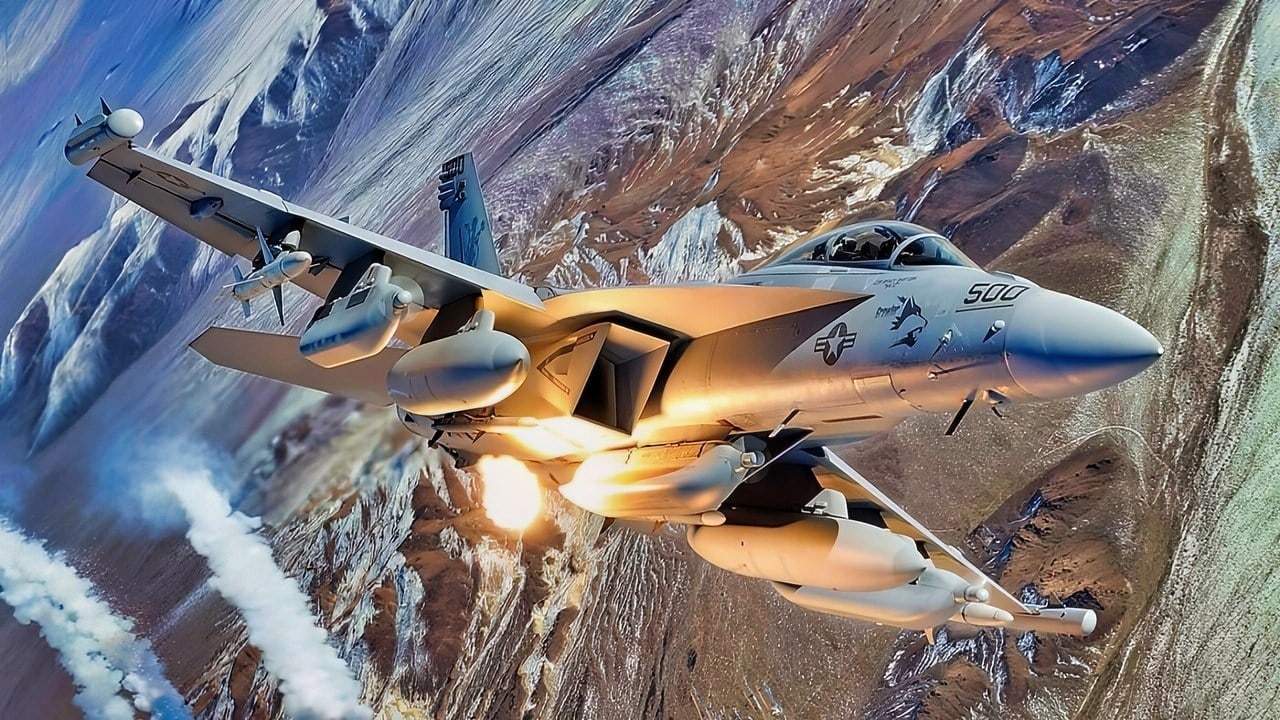
Key Points and Summary – The EA-18G Growler is the U.S. Navy’s premier carrier-based electronic attack aircraft, derived from the F/A-18F Super Hornet and built to replace the EA-6B Prowler.
-With a two-person crew, powerful F414 engines, and a sophisticated EW suite—including ALQ-218 receivers, ALQ-99 jamming pods, and AGM-88 HARM missiles—the Growler suppresses enemy air defenses and protects strike packages in high-threat environments.
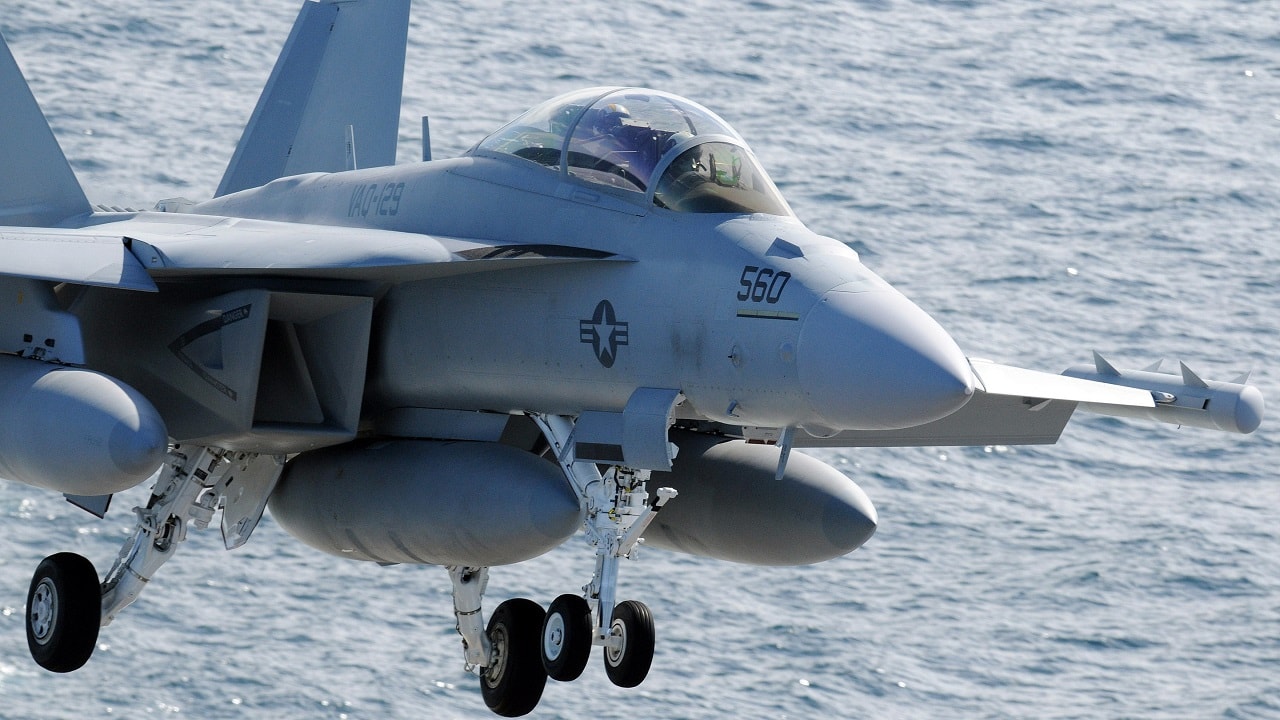
(Feb. 17, 2009) An EA-18G Growler assigned to the “Vikings” of Tactical Electronic Warfare Squadron (VAQ) 129 aligns itself for an at sea landing aboard the Nimitz-class aircraft carrier USS Ronald Reagan (CVN 76). The Growler is the replacement for the EA-6B Prowler, which will be replaced in the 2010 timeframe. Ronald Reagan is underway performing Fleet Replacement Squadron Carrier Qualifications in the Pacific. (U.S. Navy photo by Mass Communication Specialist 3rd Class Torrey W. Lee/Released).
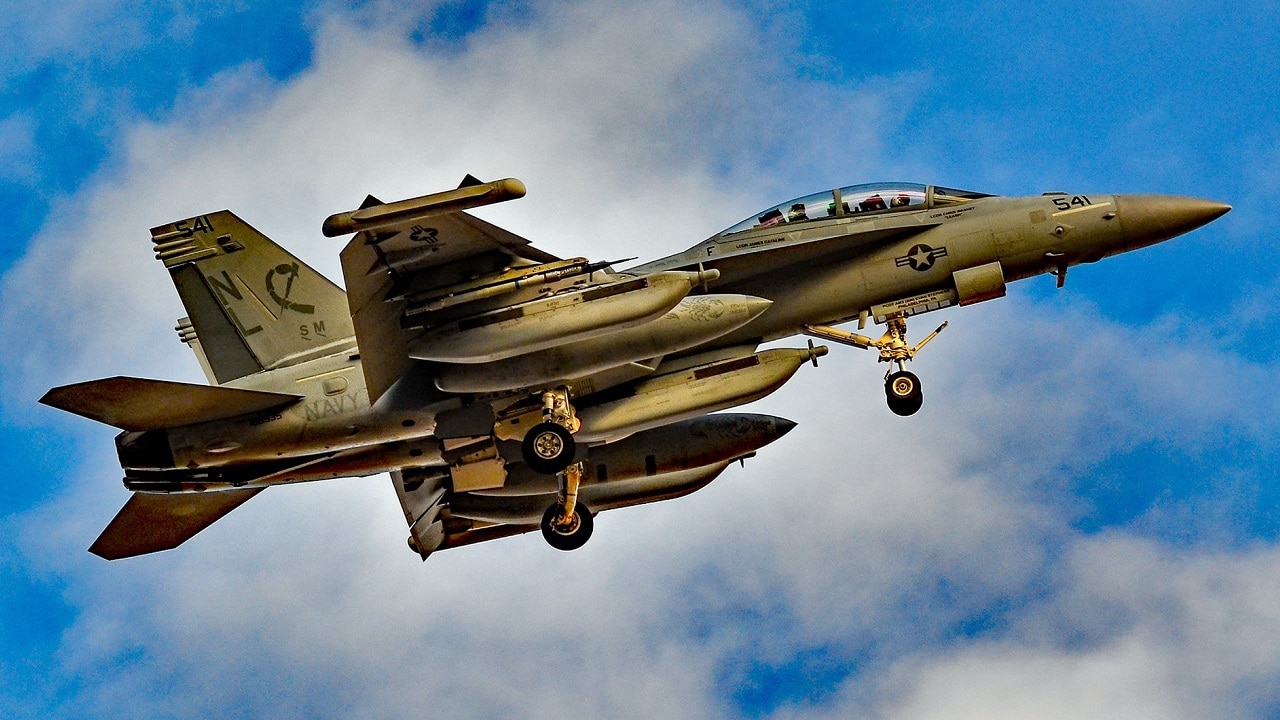
EA-18G Growler. Image Credit: Creative Commons.
-First deployed in 2010 and blooded over Libya, it now serves with both the U.S. Navy and Australia. Even as Super Hornet production winds down, the Growler shows no sign of leaving the carrier deck anytime soon.
EA-18G Growler: The Navy’s Electronic Warfare Bulldog of the Skies
In addition to being the name of a fish—better known as the largemouth bass (Micropterus nigricans)—the name “Growler” is proud in the annals of United States Navy history.
Warship-wise, there were two such bearing the name USS Growler during the War of 1812, one a sloop and the other a schooner.
Fast-forward to World War II, and there the Gato-class submarine USS Growler (SS-215), which sank 15 enemy vessels for a total of 74,900 tons and damaged seven other ships for 34,100 tons on her 11 war patrols before being tragically sunk in November 1944.
Last but not least, there’s the Cold War-era cruise-missile submarine USS Growler (SSG-577), which was decommissioned in 1964 but has thankfully been preserved for posterity as a floating museum.
Nowadays, it’s a Naval Aviation asset that carries on the Growler moniker in the USN arsenal. We’re talking about the E/A-18G Growler, the electronic warfare (EW) version of the F/A-18F Super Hornet supersonic fighter-bomber.
E/A-18G Growler Initial History
Built by Boeing since October 2004, the E/A-18G made its maiden flight on August 15, 2006, and attained initial operational capability (IOC) on September 22, 2009. As Boeing’s official product info page proudly proclaims, “The EA-18G Growler is the most advanced airborne electronic attack (AEA) platform and is the only one in production today…the Growler provides tactical jamming and electronic protection to U.S. military forces and allies around the world. Industry and the U.S. Navy continue to invest in advanced Growler capabilities to ensure it continues to protect all strike aircraft during high-threat missions for decades to come.”
The Growler serves as the replacement for the Navy’s previous carrier-borne EW platform, the Northrop Grumman EA-6B Prowler, which was retired in 2019 after 48 years of faithful service.
This writer has not been able to ascertain whether the folks at Boeing or the Department of the Navy were intentionally trying to employ tongue-in-cheek rhyming wordplay with the moniker of the Prowler’s successor.
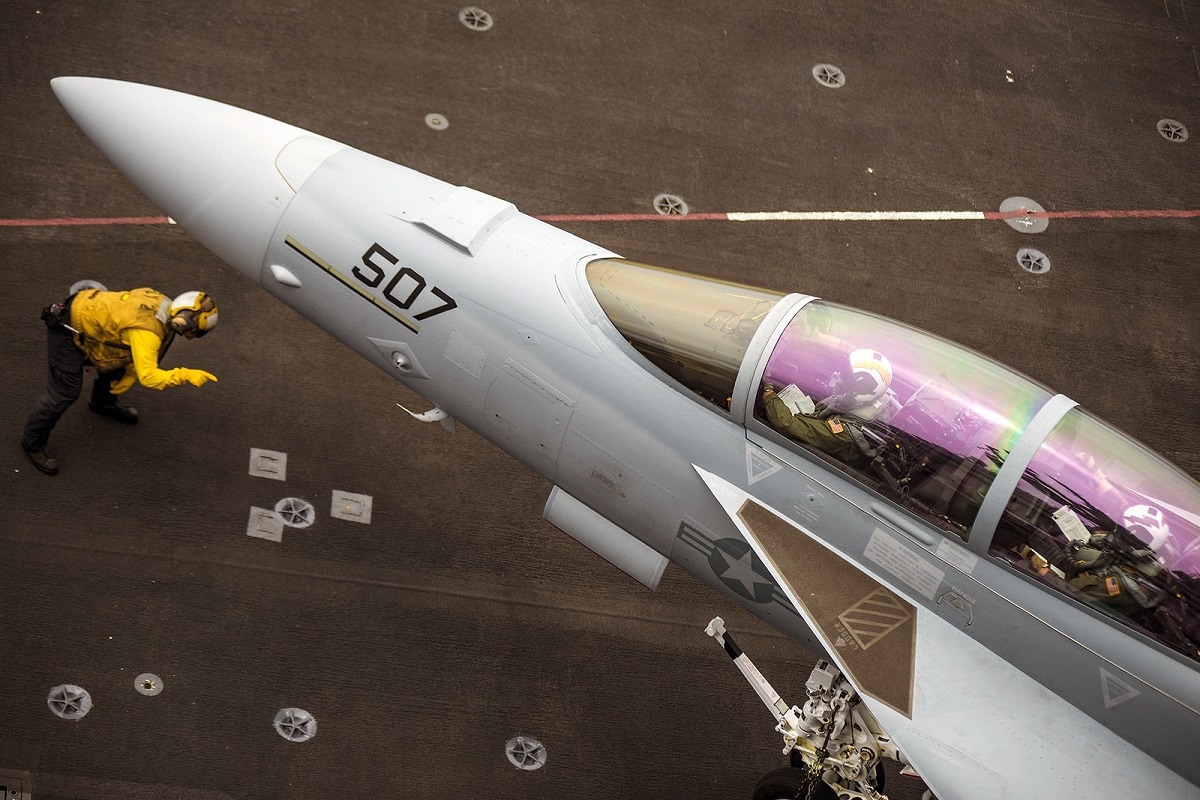
PACIFIC OCEAN (July 31, 2017) An E/A-18G Growler assigned to the Vikings of Electronic Attack Squadron (VAQ) 129 is inspected prior to launch aboard the Nimitz-class aircraft carrier USS Carl Vinson (CVN 70). Carl Vinson is underway conducting carrier qualifications off the coast of Southern California. (U.S. Navy photo by Mass Communication Specialist 2nd Class Zackary Alan Landers/Released)170731-N-GD109-068
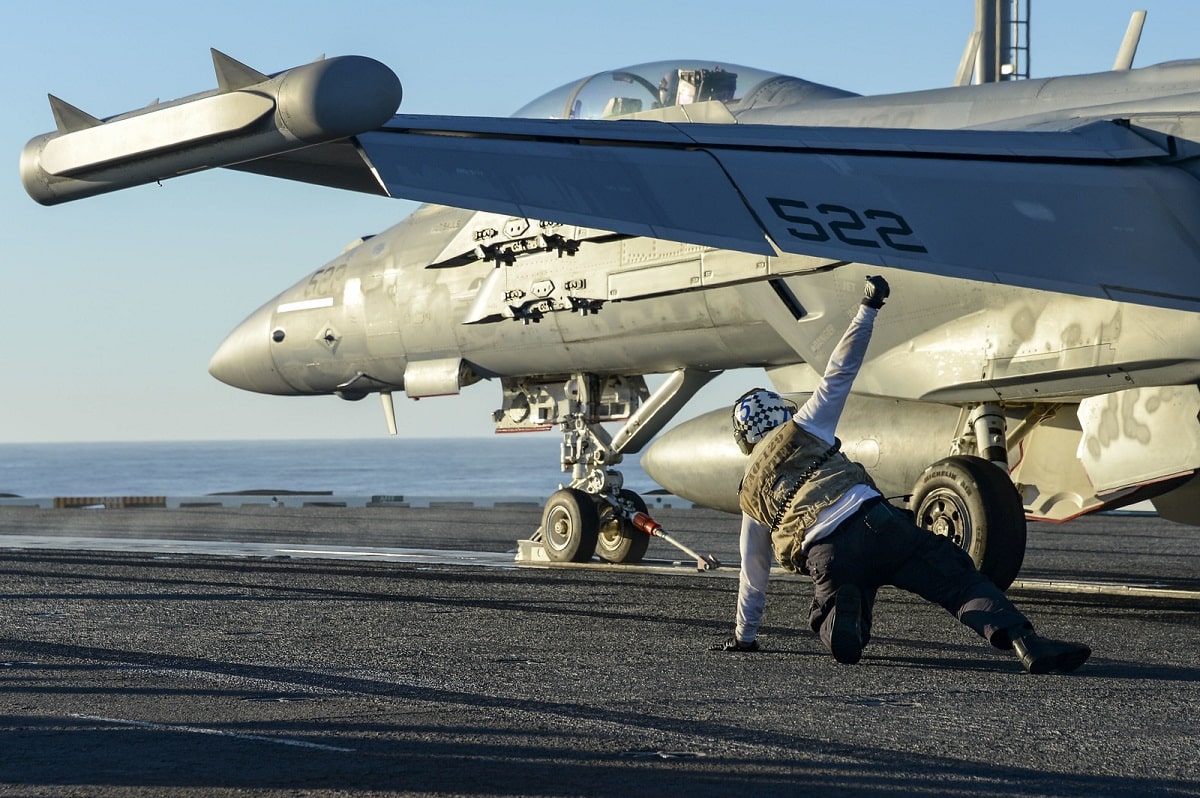
PACIFIC OCEAN (Nov. 16, 2020) Aviation Machinist’s Mate 2nd Class Ryan Rogers, from St. George, Utah, shoots an EA-18G Growler from the “Vikings” of Electronic Attack Squadron (VAQ) 129 on the flight deck of the Nimitz-class aircraft carrier USS Carl Vinson (CVN 70). Carl Vinson is currently underway conducting routine maritime operations. (U.S. Navy photo by Mass Communication Specialist 3rd Class Aaron T. Smith) 201116-N-SS900-1640
What is known, however, is that in service, the EA-18’s radio name during flight operations will be “Grizzly,” to avoid confusion (Carl von Clausewitz’s infamous “fog of war”).
However, to show that rival competing defense firms can still cooperate now and then, Northrop Grumman continues to have a proverbial dog in the USN’s EW fight even after the retirement of its Prowler, as the company still produces most of the Growler’s electronic warfare package suite.
E/A-18G Tech Specs and Vital Stats
Courtesy of the official U.S. Navy Fact Files:
Crew: 2 (pilot, EW officer)
Fuselage Length: 60.2 feet (18.5 meters)
Wingspan: 44.9 feet (13.68 meters)
Height: 16 feet (4.87 meters)
Empty Weight: 33,094 pounds
Recovery Weight: 48,000 pounds
Powerplant: 2 × F414-GE-400 turbofan engines. 22,000 pounds (9,977 kg) static thrust per engine
Maximum Speed: Mach 1.8
Combat Range: 850+ nautical miles with two AIM-120, three ALQ-99, two AGM-88 HARM, two 480 gallon external fuel tanks in place
Service Ceiling: 50,000 feet
Armament: 2 x AIM-120 AMRAAM (Advanced Medium Range Air-to-Air Missiles; affectionately nicknamed the “Slammer”), 2 x AGM-88 HARM (High-speed Anti-Radiation Missiles)
The electronic attack package includes the ALQ-218 receiver, ALQ-99 tactical jamming pods, ALQ-227 Communication Countermeasures Set, and Joint Tactical Terminal – Receiver (JTT-R) satellite communications.
An estimated 172 E/A-18 airframes have been built as of October 2021. According to the World Directory of Modern Military Aircraft (WDMMA), in addition to the 153 possessed by the U.S. Navy, the Royal Australian Air Force (RAAF) has 12 Growlers. (We’re not sure where the remaining seven went.)
Growlers Grinding It Out: Operational History and Combat Performance (in Brief)
The E/A-18G had its first deployment with Electronic Attack Squadron (VAQ) 132 (“Scorpions”) in November 2010.
The warbird was first “blooded” in combat during Operation Odyssey Dawn over Libya in 2011, and since then, “has spanned the globe in support of all major and rapid reaction action” (in the Navy’s words). To date, as far as we can tell, no Growlers have yet been lost in combat action.
The Way Forward for the Growler?
The fighter-bomber version of the F/A-18 Super Hornet is nearing the end of its service life, with production scheduled to end in 2027 and plans to replace it with the F/A-XX.
But as far as we can tell, the USN has no specific plans in place to retire or replace the Growler just yet. (If any of our dear readers know otherwise, please let us know in the Comments section below!)
In fact, back in March, the Navy refused to even move its E/A-18G from Washington State’s NAS Whidbey Island to NAF El Centro in the Southern California desert, let alone retire them.
In other words, this warbird will be uttering its fierce growl on behalf of the USN and RAAF alike for some time to come.
About the Author: Christian D. Orr, Defense Expert
Christian D. Orr is a Senior Defense Editor. He is a former Air Force Security Forces officer, Federal law enforcement officer, and private military contractor (with assignments worked in Iraq, the United Arab Emirates, Kosovo, Japan, Germany, and the Pentagon). Chris holds a B.A. in International Relations from the University of Southern California (USC) and an M.A. in Intelligence Studies (with a concentration in Terrorism Studies) from American Military University (AMU). He is also the author of the newly published book “Five Decades of a Fabulous Firearm: Celebrating the 50th Anniversary of the Beretta 92 Pistol Series.”