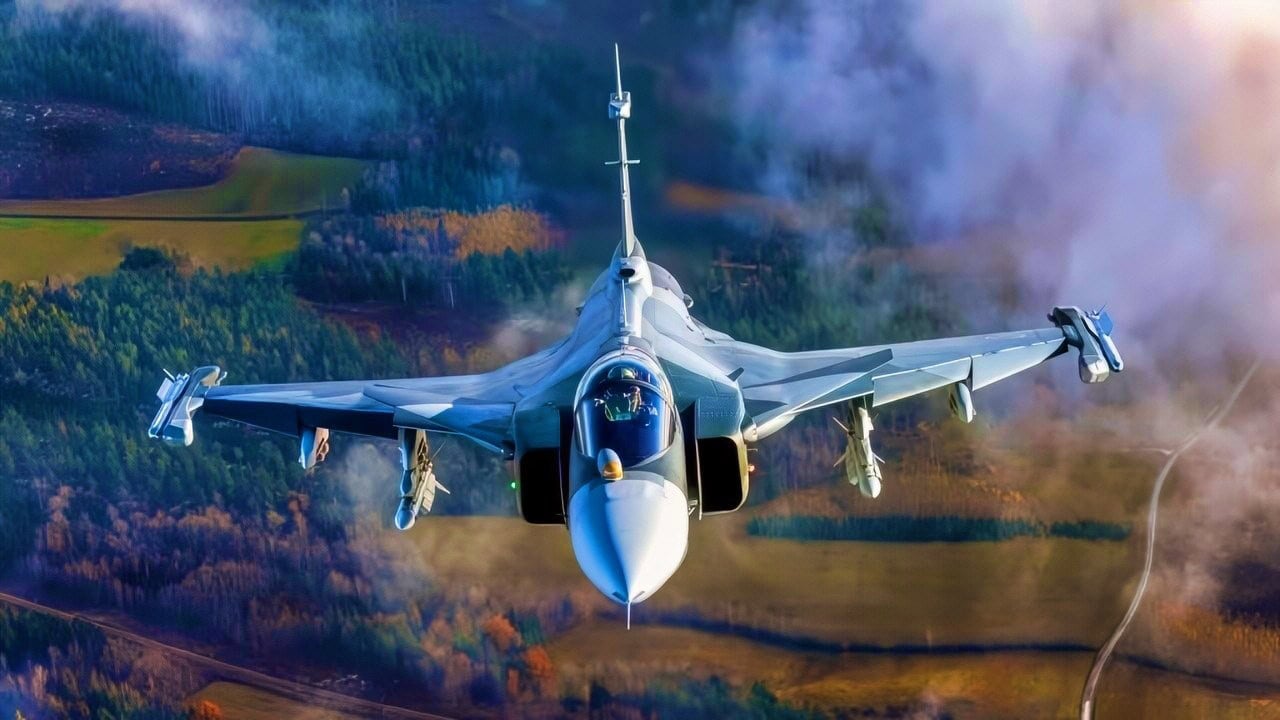
Key Points and Summary – Canada’s JAS 39 Gripen E vs. F-35 Debate Take a New Turn
-A leaked Canadian evaluation report shows the U.S. F-35 decisively beating Sweden’s JAS 39 Gripen E in every major category, scoring 95 percent to the Gripen’s 33 percent across mission performance, upgradability, sustainment, technical criteria, and capability delivery.
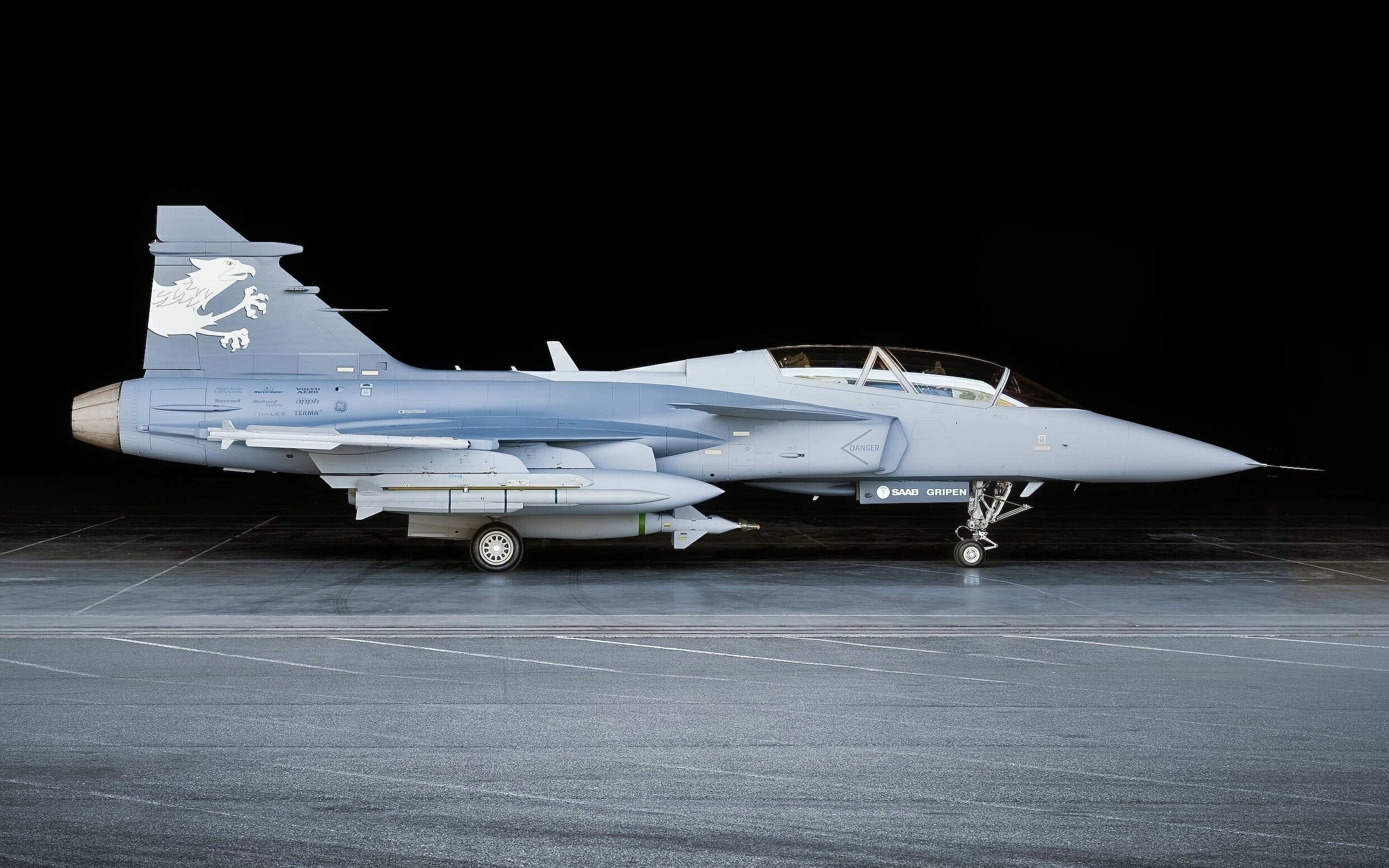
JAS 39 Gripen. Image Credit: Creative Commons.
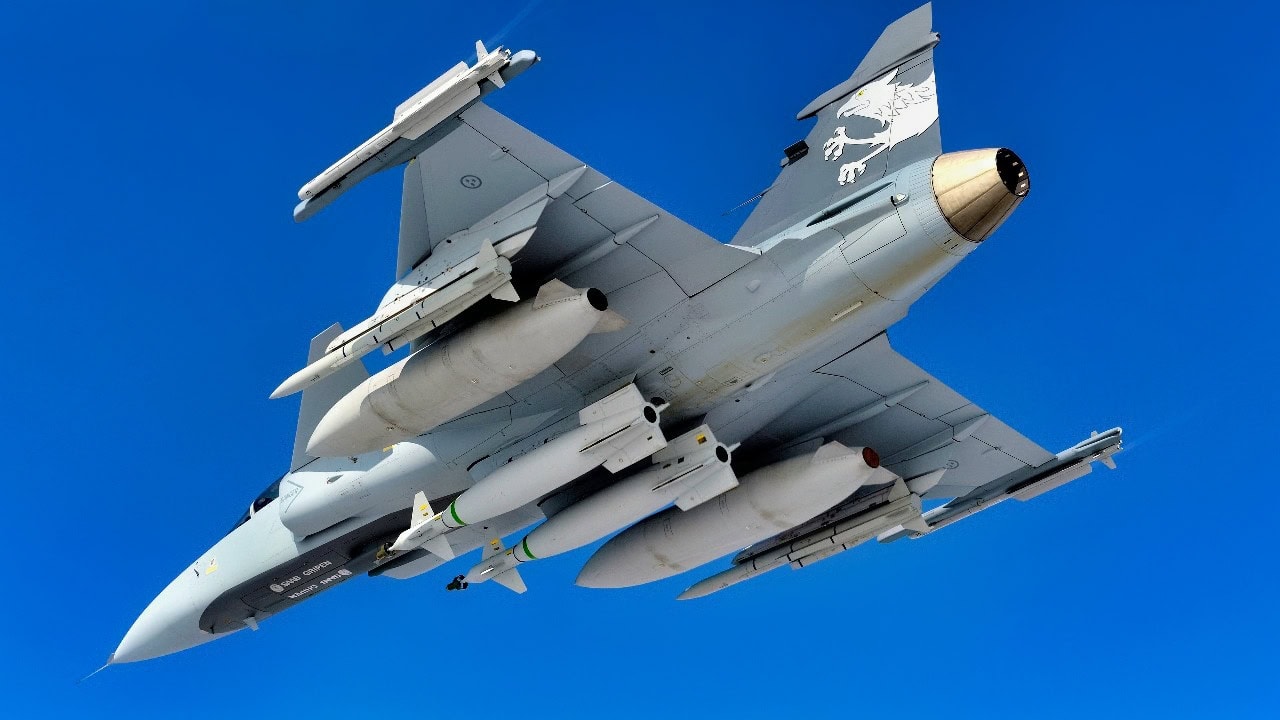
JAS 39 Gripen. Image Credit: Creative Commons.
-The findings undercut Saab’s marketing pitch that advanced electronic warfare makes up for the Gripen’s lack of stealth, even as every major power is doubling down on low-observable designs.
-Proposals for a mixed F-35/Gripen fleet would add cost and complexity for the RCAF, despite Saab’s promises of 9,000–10,000 Canadian jobs and rapid local production.
-In upgrade potential and survivability, the F-35 clearly wins.
The JAS 39 Gripen E Has a New Canada Problem
A bombshell document leaked to the Canadian press shows that the American F-35 stealth fighter beat the Swedish Gripen E in a head-to-head competition, and handily outperformed Saab’s fighter in every single category in which the two aircraft were evaluated.
The document shows the results of a 2021 evaluation of the two jets, listing five categories: mission performance, upgradability, sustainment, technical criteria, and capability delivery. The F-35 missed just a few points during the competition and scored a green “pass” rating of 95 percent. The Gripen, while also scoring a “pass,” scored significantly lower, at 33 percent.
Perhaps cognizant of the Gripen’s significant shortcomings compared to the F-35 in terms of stealth capabilities, Saab touts what it dubs the Gripen E’s electronic warfare capabilities. “In a world obsessed with stealth aircraft,” Saab quips, “fighters constantly upgrade their systems to stay undetected. Instead of focusing on stealth, Saab, however, chose to focus on electronic warfare or EW systems.”
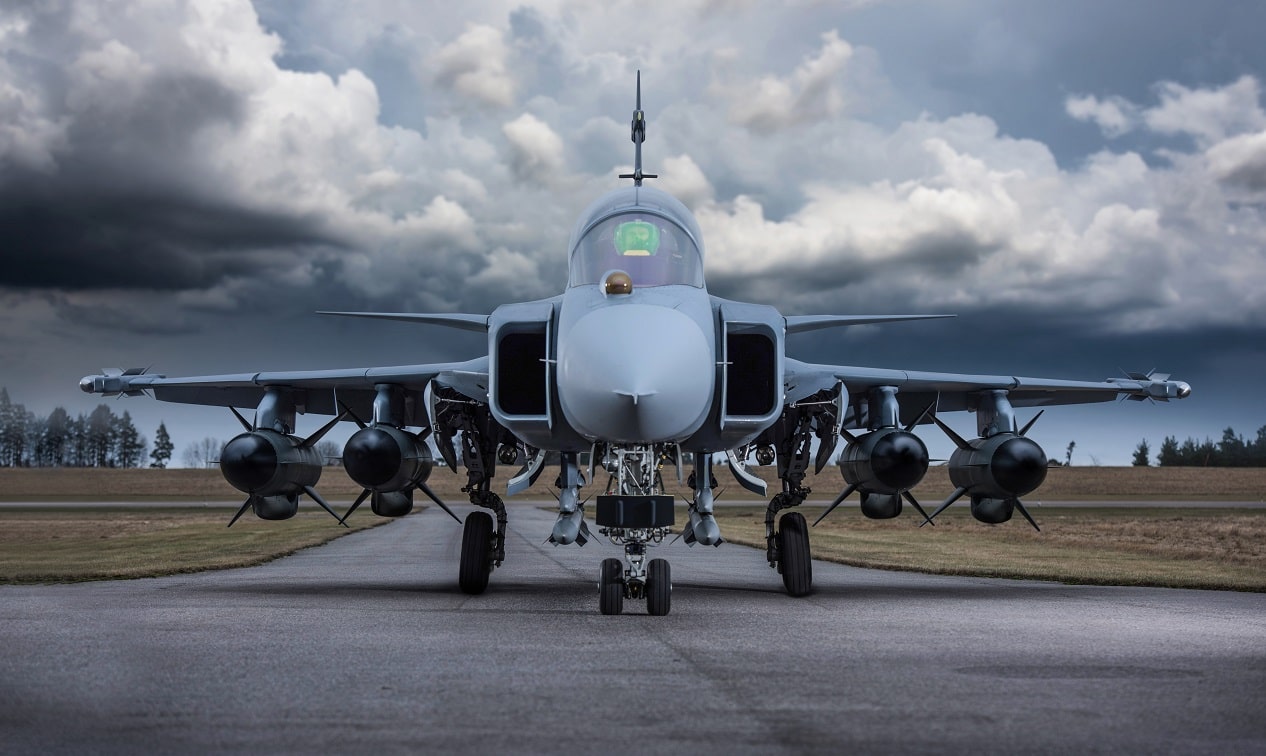
Gripen Figher Jet. Image Credit: Creative Commons.
The assertion, however, appears to be more a retroactive justification of Saab’s decision to eschew stealth.
“The most important reason behind [Saab’s] shift in focus [lack of stealth capabilities] is evolving technology which tends to render stealth useless in the face of advances in radars,” the company writes.
“Even the most stealthy aircraft of today have parts with detectable radar signature. Another unavoidable factor is the high development, production, and maintenance cost incurred to build stealth.”
And while that assertion is factually accurate, it glosses over the fact that multiple independent aircraft programs across various countries have invested billions of dollars’ worth of research and development into not only developing fifth-generation stealth fighters and bombers, but are, in fact, doubling down on radar-mitigating hardware and technologies for cutting-edge, upcoming aircraft.
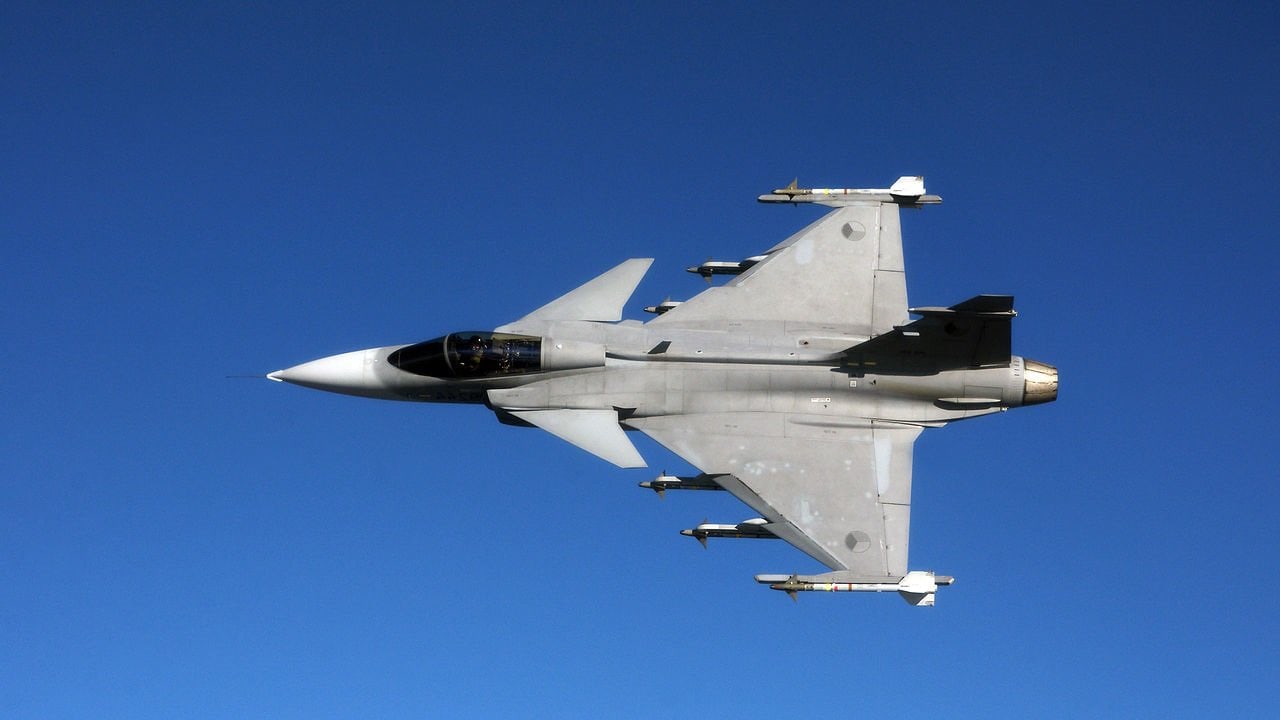
JAS 39 Gripen. Image Credit: Creative Commons.
The F-35 is clearly the world’s most successful fifth-generation stealth fighter, with nearly 2,500 airframes slated for build for dozens of countries around the globe.
Is Saab’s assertion then that the technologies that went into the F-35 program — as well as the more capable F-22 Raptor air superiority fighter, the B-2 Spirit stealth bomber, and its upcoming replacement, the sixth-generation B-21 Raider — were for naught?
Is the Swedish firm correct in saying that its Gripen, which first flew nearly four decades ago, is superior to all other stealth aircraft that have come after it? If that is the company’s assertion, it is quite a tall order.
A Mixed Fighter Fleet?
Several Canadian lawmakers, as well as the habitually online Twitterati, have suggested that Canada could operate a mixed fleet of aircraft as part of a broader effort to minimize Canada’s exposure to the whims and fancies of the current American administration. Doing so would bring complications to the Royal Canadian Air Force, however.
The logistical burden of operating a two-airplane fighter fleet on the Royal Canadian Air Force would assuredly increase.
Instead of training pilots, maintainers, and other support personnel on a single aircraft, expanding the Canadian fleet to include Sweden’s Gripen E fighter would necessitate a second training stream for those personnel, with potentially little useful overlap with the F-35 stealth fighter.
The Swedish Pitch: JAS Gripen E Fighter
Still, in an effort to make the Swedish pitch as rosy as possible, Saab’s CEO, Micael Johansson, said that his company could get Gripen E fighters assembled and ready three years after Ottawa places an order for the aircraft — in part by building the fighters in Canada.
We can start delivering across to Canada if they select a dual slate in three years’ time,” Mr. Johansson said during an interview with CBC, the Canadian broadcaster. And once a Saab factory is ready in Canada, Gripe’s could be ready to go in “roughly, between, three and five years depending on the setup.”
To sweeten the deal, Mr. Johansson added that manufacturing Gripens in Canada would be a significant economic boost to the country, with 9,000 to 10,000 jobs created in the process. If successful, the Swedish initiative would echo Saab’s strategy in South America.
Saab has already built a factory in Gavião Peixoto, Brazil, following that country’s selection of the Gripen E as their next fighter. According to Johansson, the first of Brazil’s locally-made Gripens is now moving off the assembly line, around two years after the production line was built and finalized.
Aside from questions about stealth characteristics, another burningly important question in the Gripen E versus F-35 debate is to what extent either jet can be upgraded in the future as new technologies become available.
As a newer aircraft, the F-35 has room to grow, while the nearly forty-year-old Gripen is, in terms of future upgrades, a dead end.
Saab’s Fighter Pitch in Canada Looks Strange Now
Despite Saab’s seeming assertion that stealth is dead, the fact of the matter is that the Chinese, the Russians, the Americans, as well as the British, Italian, German, Japanese and others are not looking for stealth alternatives but instead doubling down on increasingly stealthier aircraft and making Saab’s claim look increasingly like an ex post facto justification — in essence, a sales spin.
About the Author: Caleb Larson
Caleb Larson is an American multiformat journalist based in Berlin, Germany. His work covers the intersection of conflict and society, focusing on American foreign policy and European security. He has reported from Germany, Russia, and the United States. Most recently, he covered the war in Ukraine, reporting extensively on the war’s shifting battle lines from Donbas and writing on the war’s civilian and humanitarian toll. Previously, he worked as a Defense Reporter for POLITICO Europe. You can follow his latest work on X.