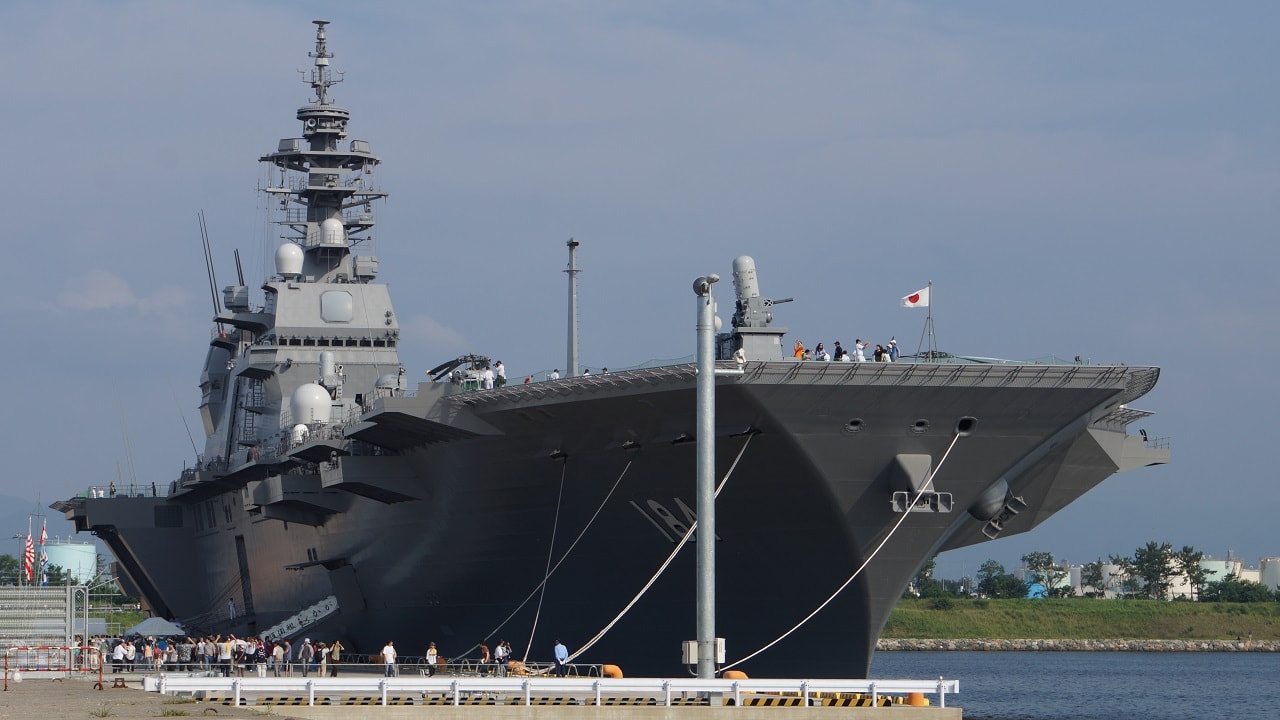
Key Points and Summary – Japan’s Izumo-class “helicopter destroyers” are becoming true light carriers, able to operate the STOVL F-35B and extend airpower beyond vulnerable land bases.
-After Tokyo approved conversions in 2018, Izumo received deck reinforcement and hosted U.S. Marine Corps F-35B trials in 2021—Japan’s first fixed-wing carrier operations since World War II.
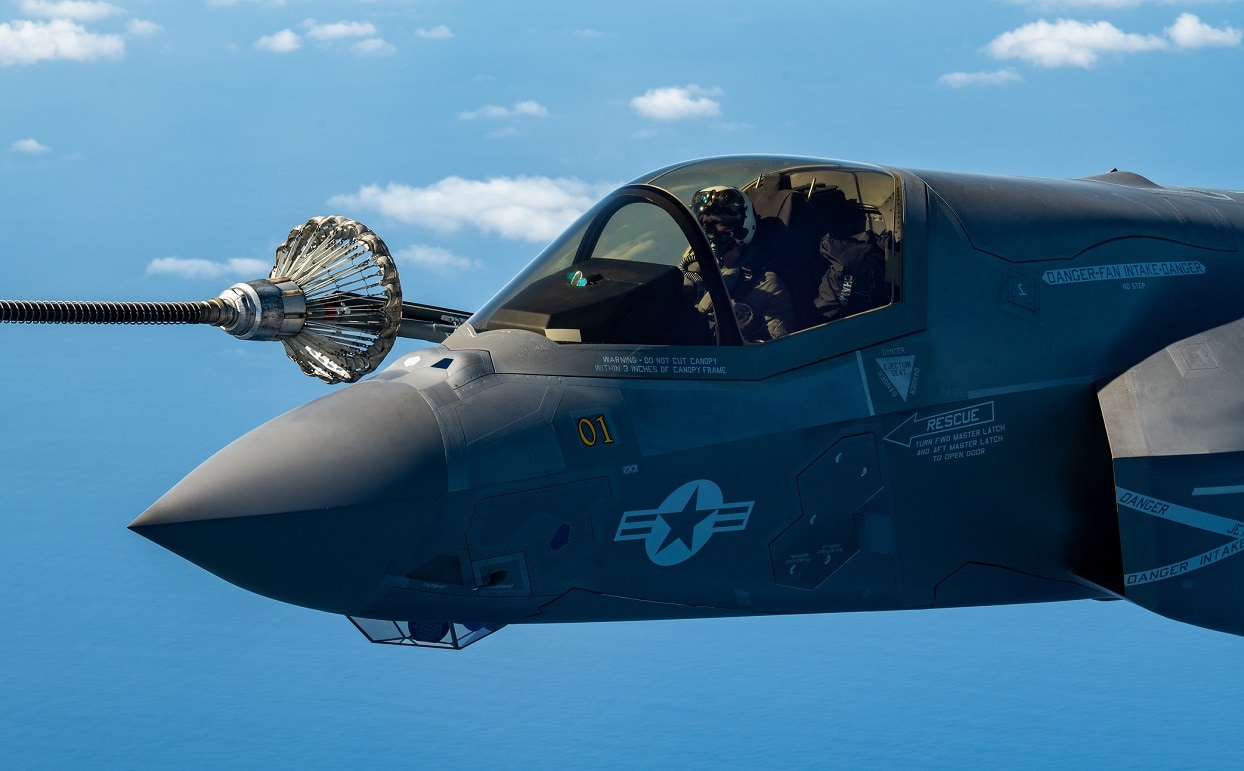
A U.S. Marine Corps F-35B Lighting II aircraft with Marine Fighter Attack Squadron (VMFA) 242 conducts aerial refueling operations with Marine Aerial Refueler Transport Squadron (VMGR) 152 off the coast of Japan, Oct. 3, 2021. VMGR-152 provided aerial refueling to VMFA-242 during a capability test of U.S. Marine Corps F-35B Lightning II aircraft landing on the Japanese Ship Izumo. (U.S. Marine Corps photo by Cpl. Evan Jones)
-Kaga’s larger rebuild adds a reshaped bow and expanded aviation support spaces, setting the stage for Japan’s own F-35B force later this decade.
-The shift reflects a harsher regional environment, with Chinese carrier activity near Japan driving demand for mobile, survivable sea-based airpower. It also keeps ASW punch with SH-60K helicopters.
Japan Has Aircraft Carriers Again—And China Is the Reason Why
Japan has officially restored its carrier aviation capabilities for the first time since 1945, completing the transformation of its Izumo-class helicopter destroyers into fully carrier-capable warships. And the timing is perfect, with the completion of the upgrade project arriving amid the most challenging security environment Tokyo has faced in generations.
The first ship of the class, JS Izumo, entered service in March 2015, followed by her sister ship JS Kaga in March 2017. At the time, Japan insisted the 248-meter vessels were not aircraft carriers but helicopter destroyers, designed primarily for anti-submarine warfare and disaster relief missions.
That definition began to change in 2018 when the Japanese Cabinet approved plans to convert both ships to operate the short-takeoff and vertical-landing F-35B as part of the National Defense Program Guidelines and Mid-Term Defense Plan. Izumo then entered the first phase of modernization in 2020, receiving a reinforced, heat-resistant flight deck. Then, in October 2021, U.S. Marine Corps F-35Bs conducted the first-ever landing and takeoff from a Japanese vessel since World War II.
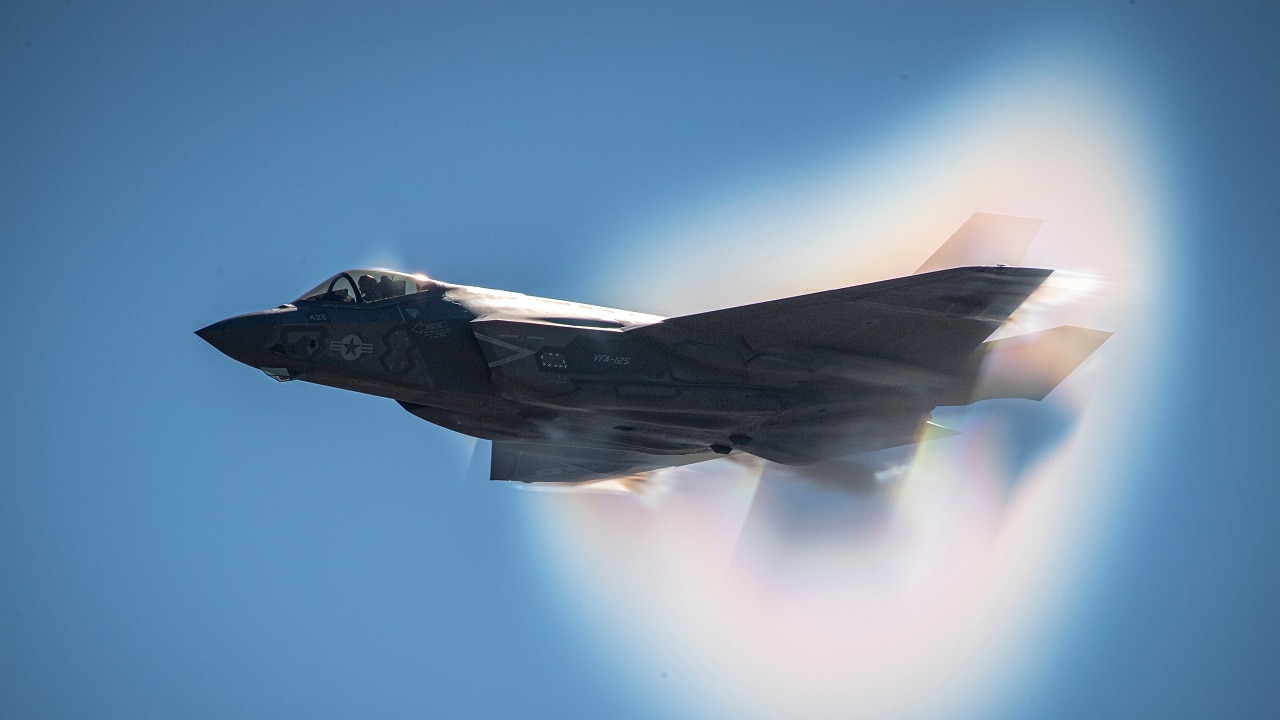
A U.S. Navy F-35C Lightning II fighter jet performs during the California International Air Show in Salinas, California, Oct. 29, 2021. The F-35C has a larger wingspan and internal fuel capacity as well as stronger landing gear than the F-35A and F-35B variants. (U.S. Air Force photo by Staff Sgt. Andrew D. Sarver)
Kaga began her own more significant conversion in 2022, including structural changes to support F-35B storage and maintenance, with Japan’s Ministry of Defense (MOD) confirming the work as part of the FY2022-FY2023 budget cycle.
The conversion of both ships is significant, coinciding with the revision of the National Security Strategy in December 2022. That strategy warns that Japan faces the “most severe and complex security environment since the end of World War II,” explicitly stating that China is its “greatest strategic challenge.”
Recent developments reflect this reality and prove why Tokyo now views carrier capability as essential.
Chinese carrier groups have repeatedly operated near Japanese territory, including a December 2023 Liaoning carrier aviation exercise involving more than 200 aircraft sorties. In recent days, similar exercises resulted in diplomatic tensions between China, Japan, and the United States.
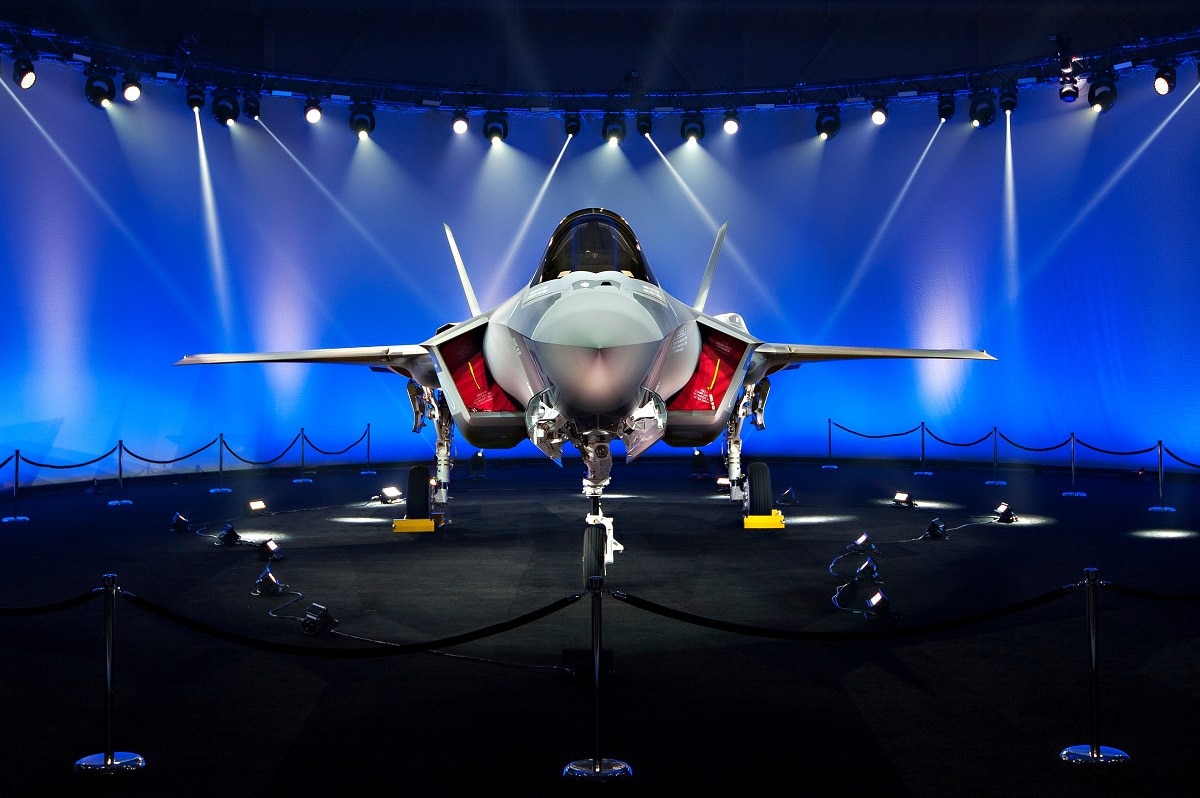
Japan F-35B Rollout Ceremony.
For Japan, Chinese carriers and other vessels operating near its waters indicate that China is building a blue-water carrier force, and now Japan must field its own in response.
How the Izumo-Class Was Born
The Izumo class was born during Japan’s early 2010s effort to modernize its anti-submarine warfare fleet. Izumo was laid down in 2011 and launched in 2013, while Kaga was laid down in 2015 and launched in 2016.
Tokyo repeatedly emphasized at the time that the ships were not aircraft carriers and would therefore not host fixed-wing aircraft. This position was deliberately calculated to avoid domestic political backlash and constitutional debate over Article 9, Japan’s pacifist clause.
The design of the ships raised immediate questions, however. With full-length flight decks and large internal hangars, the configuration resembled light carriers used by U.S. allies.
As regional tensions worsened, the potential of these ships to become carriers became increasingly hard to ignore. China commissioned Liaoning in 2012, Shandong in 2019, and by the mid-2020s was fielding carrier groups near Japan’s southwest islands.
Japanese airpower, which is overwhelmingly land-based, faced two growing vulnerabilities: limited range and the risk of early strikes on its runways in a conflict scenario. Carriers were finally becoming necessary. And it was these pressures that pushed Japan to embrace a capability that it had avoided for decades.
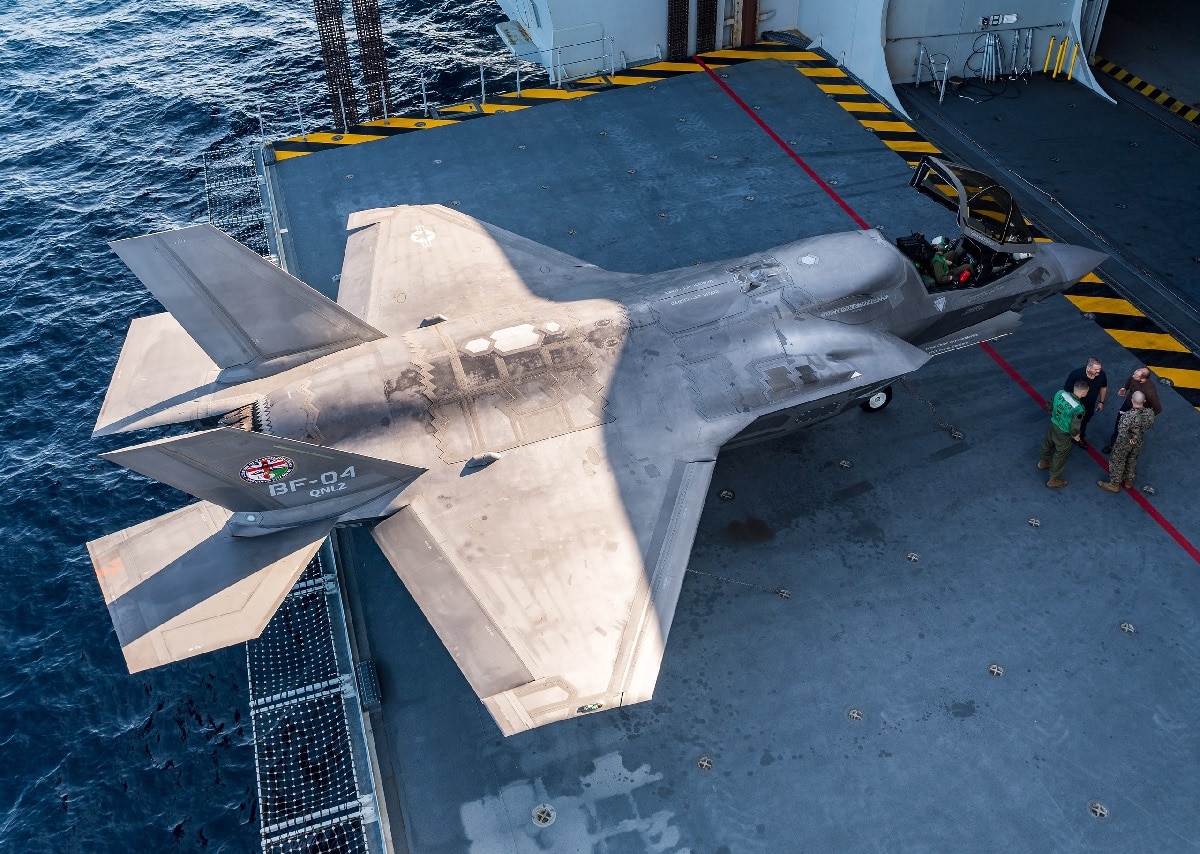
F-35B during First of Class Flight Trials (Fixed Wing) on HMS Queen Elizabeth, Oct. 8, 2018.
The 2018 decision to convert both ships into aircraft carriers coincided with Tokyo’s approval to acquire 42 F-35B fighters, confirmed in the following year’s budget submission.
The first phase of modification for the Izumo began in 2020 and concluded in 2021. The second phase, which involved more comprehensive structural changes, is expected to take place later in the decade. Kaga’s rebuild, however, is more extensive, including a reshaped bow and expanded internal spaces.
The 2021 flight trials with American F-35Bs demonstrated that the conversion is viable. Japan’s own F-35Bs will enter service later in the 2020s, forming the country’s first power-projecting shipborne air wing – and that’s significant because it’s an unprecedented development that fundamentally changes the nature of Japan’s Maritime Self Defense Force.
Japan’s coming carrier capability also comes as the country invests more broadly in its naval force. The MoD’s Defense Buildup Program calls for expanding ammunition stockpiles, hardening bases in the Nansei Islands, and strengthening joint ISR networks to support carrier-enabled operations.
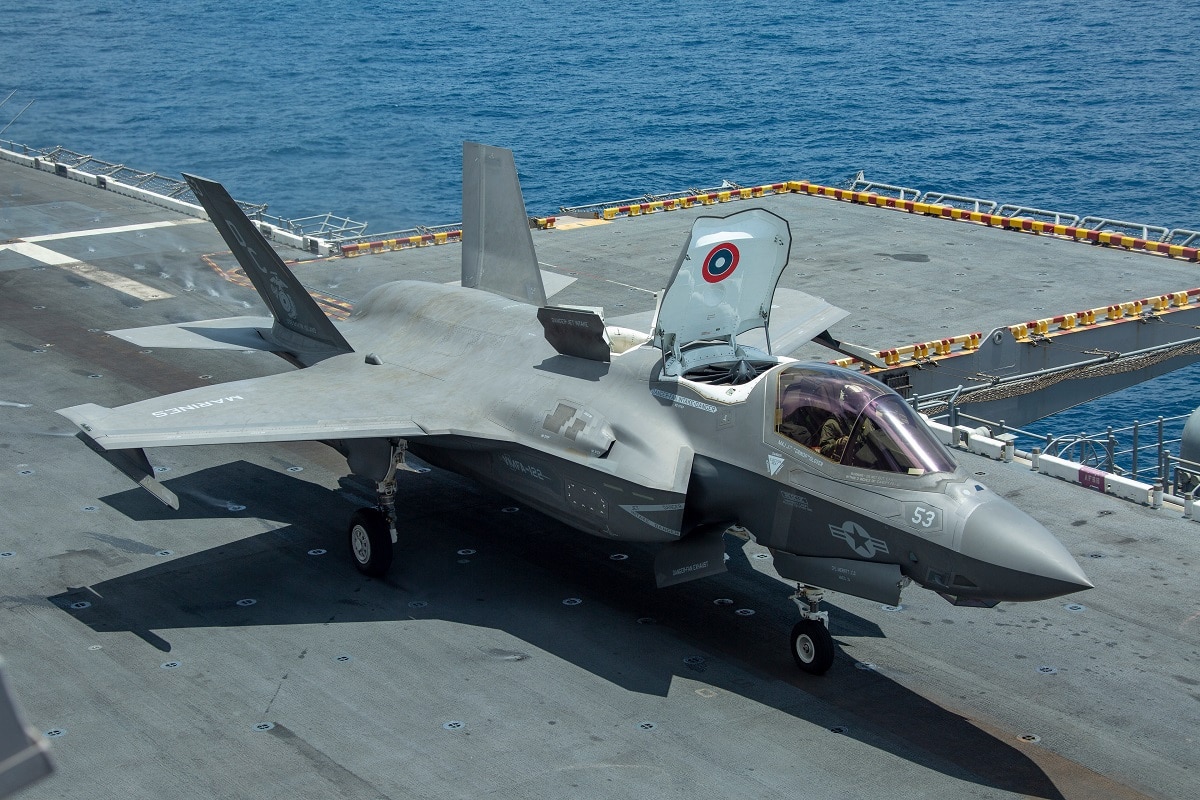
210408-M-UY835-1014 SOUTH CHINA SEA (April 8, 2021) A U.S. Marine Corps F-35B Lightning II assigned to Marine Medium Tiltrotor Squadron 164 (Reinforced), 15th Marine Expeditionary Unit, takes off from the flight deck of the amphibious assault ship USS Makin Island (LHD 8). The Makin Island Amphibious Ready Group and embarked 15th MEU are operating in the U.S. 7th Fleet area of operations to enhance interoperability with allies and partners and serve as a ready response force to defend peace and stability in the Indo-Pacific region. (U.S. Marine Corps photo by Cpl. Patrick Crosley)
The updated Izumo class reflects a total transformation of Japan’s naval force philosophy, going beyond individual platforms to reshape how its military expects to fight wars.
As upgrades continue, the Izumo class is expected not only to support full F-35B operations but also to expand aviation fuel capacity and improve deck handling systems.
The ships will also retain their core anti-submarine role, with SH-60K helicopters embarked and advanced C4ISR suites in place. Together, the enhancements will position the Izumo class as Japan’s most versatile maritime asset in decades.
About the Author:
Jack Buckby is a British author, counter-extremism researcher, and journalist based in New York who writes frequently for National Security Journal. Reporting on the U.K., Europe, and the U.S., he works to analyze and understand left-wing and right-wing radicalization, and reports on Western governments’ approaches to the pressing issues of today. His books and research papers explore these themes and propose pragmatic solutions to our increasingly polarized society. His latest book is The Truth Teller: RFK Jr. and the Case for a Post-Partisan Presidency.