
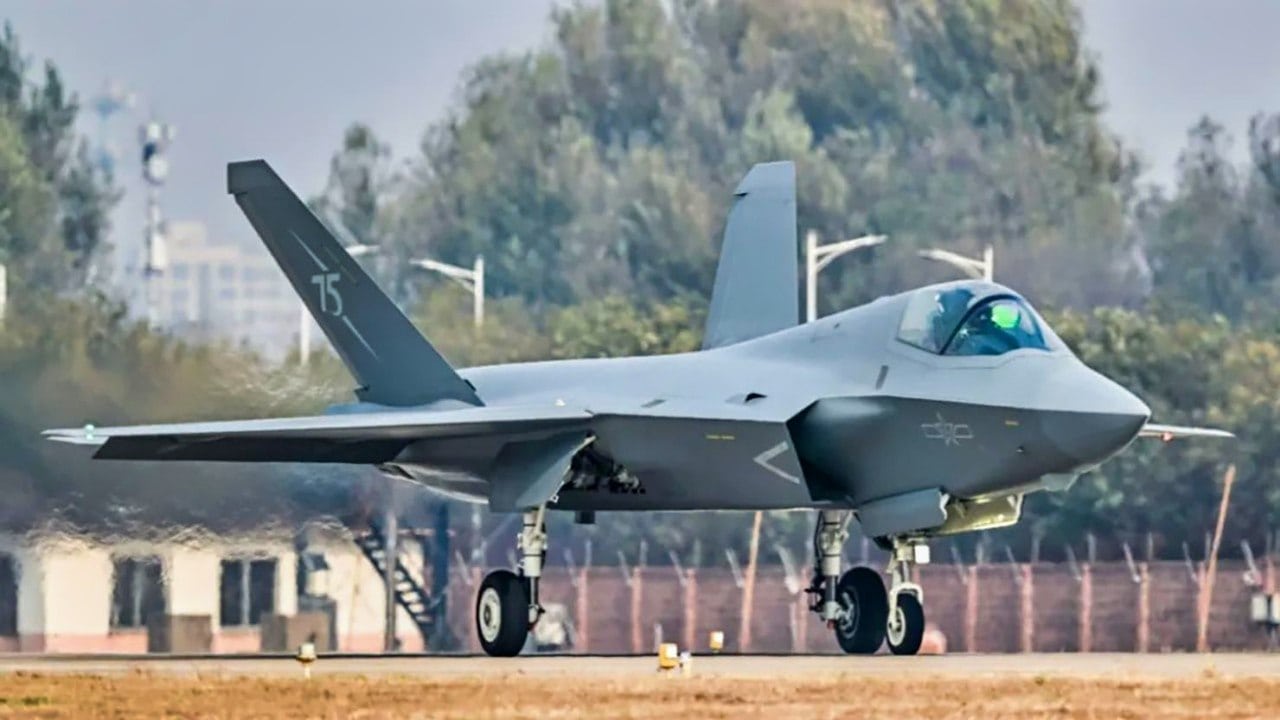
Key Points and Summary – China’s J-35 stealth fighter’s recent launch from the catapult carrier Fujian marks a real shift: Beijing is moving from showpiece carriers to a true, roaming air force at sea.
-Catapults, airborne early warning, and low-observable jets erode the comfort margin U.S. carrier groups once enjoyed near China’s coast.
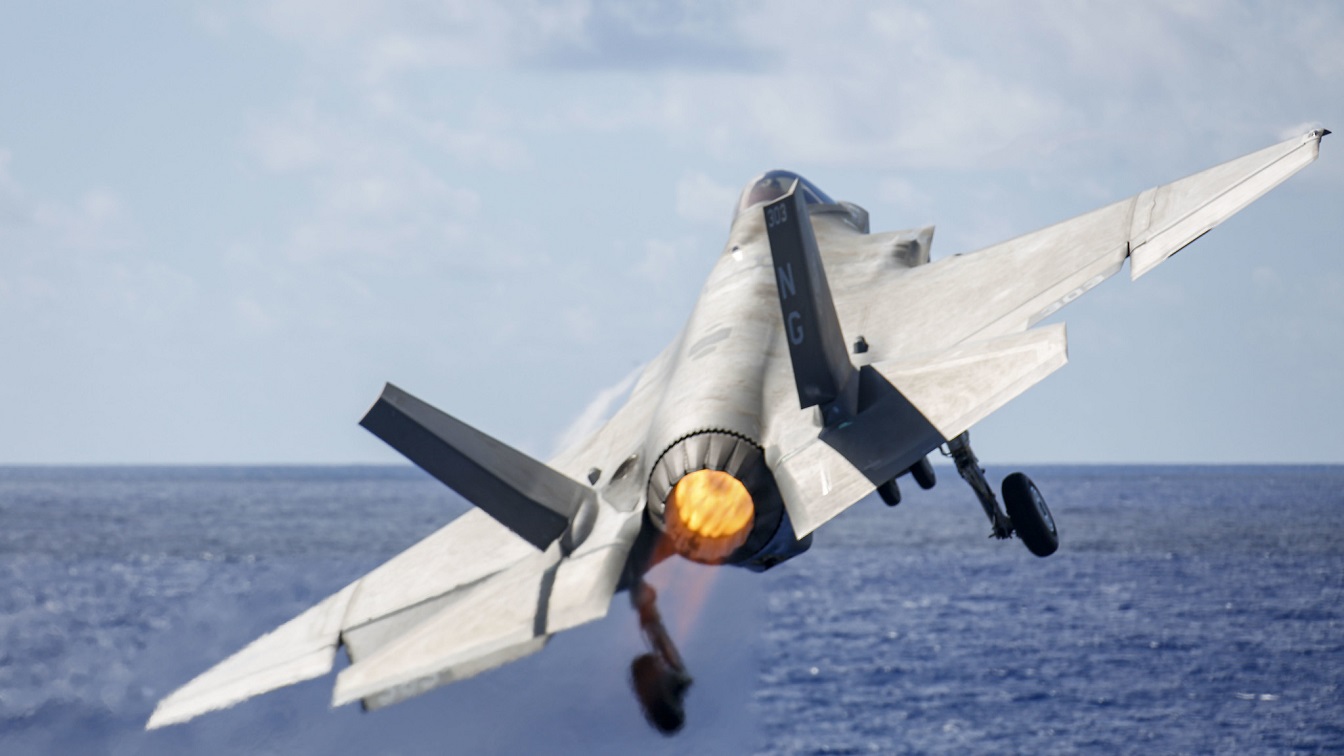
PHILIPPINE SEA (May. 13, 2022) An F-35C Lightning II assigned to the “Black Knights” of Marine Fighter Attack Squadron (VMFA) 314 launches from the Nimitz-class aircraft carrier USS Abraham Lincoln (CVN 72). The Abraham Lincoln Carrier Strike Group is on a scheduled deployment in the U.S. 7th Fleet area of operations to enhance interoperability through alliances and partnerships while serving as a ready-response force in support of a free and open Indo-Pacific region. (U.S. Navy photo by Mass Communication Specialist 3rd Class Michael Singley) 220513-N-MM912-1002
-The F-35C still leads in maturity, networking, and combat experience, but the contest is now ecosystem versus ecosystem—range, tankers, emissions discipline, and unmanned teammates.
-The smart U.S. response isn’t sailing closer; it’s using distance, deception, and hardened kill chains so American carriers decide when, and how, the silence breaks.
China’s J-35 Stealth Fighter Just Changed the Carrier Game
The first time a stealth fighter is flung from a Chinese catapult deck, the detail that matters isn’t the whoosh.
It’s the silence that follows. China’s early carriers were training wheels—ski-jump decks, heavy jets, short legs, and a lot of ceremony.
Fujian, the new catapult carrier, changes that. Catapults unlock heavier fuel loads, internal weapons, and the kind of delicate sensors stealth aircraft need to stay useful and survivable.
When a J-35 rolls, launches clean, and tucks itself into the sky beneath an airborne early warning aircraft’s gaze, China starts practicing the same playbook the U.S. Navy wrote over decades—only with a 21st-century twist.
This is why the J-35 matters. Not because it is certain to out-fight an American jet in a fair duel, but because it gives China the missing piece that turns a big ship into a working, roaming air force.
What Changes When the J-35 Shows Up
For years, U.S. carrier groups treated Chinese decks as noisy neighbors—busy, visible, and manageable at range.
The J-35 erodes that comfort.
A stealthy fighter launched by a precise electromagnetic catapult can reach farther with a smaller radar signature, hold more targets at risk, and choose when to be seen.
Add a proper carrier-borne early warning aircraft—the flying radar truck that spots threats and whispers cues to fighters—and the air over a Chinese carrier becomes less predictable. Not invincible, not impenetrable—just uncertain in the ways that make commanders slow down.
That uncertainty is the point. If the J-35 can make U.S. tankers shift their orbits, keep patrol aircraft nervous, and force escorts to commit more jets to guarding the “eyes and gas” of the air wing, then China’s carrier gains leverage before a missile ever flies. It’s strategy by posture: move the chessboard, not just the pieces.
The F-35C Comparison, Minus the Spec Sheet
The natural question is how the newcomer stacks up against the U.S. Navy’s F-35C.
The fairest answer is that they are trying to do the same job from very different histories. The F-35C has a decade of operational potholes behind it: software grown through combat deployments, a huge user base, and a sustainment network that stretches across alliances. Its secret sauce isn’t just a low-observable shape; it’s the way the jet fuses radar, infrared, and electronic sniffers into a single, calm picture—and then shares that picture with everyone who needs it.
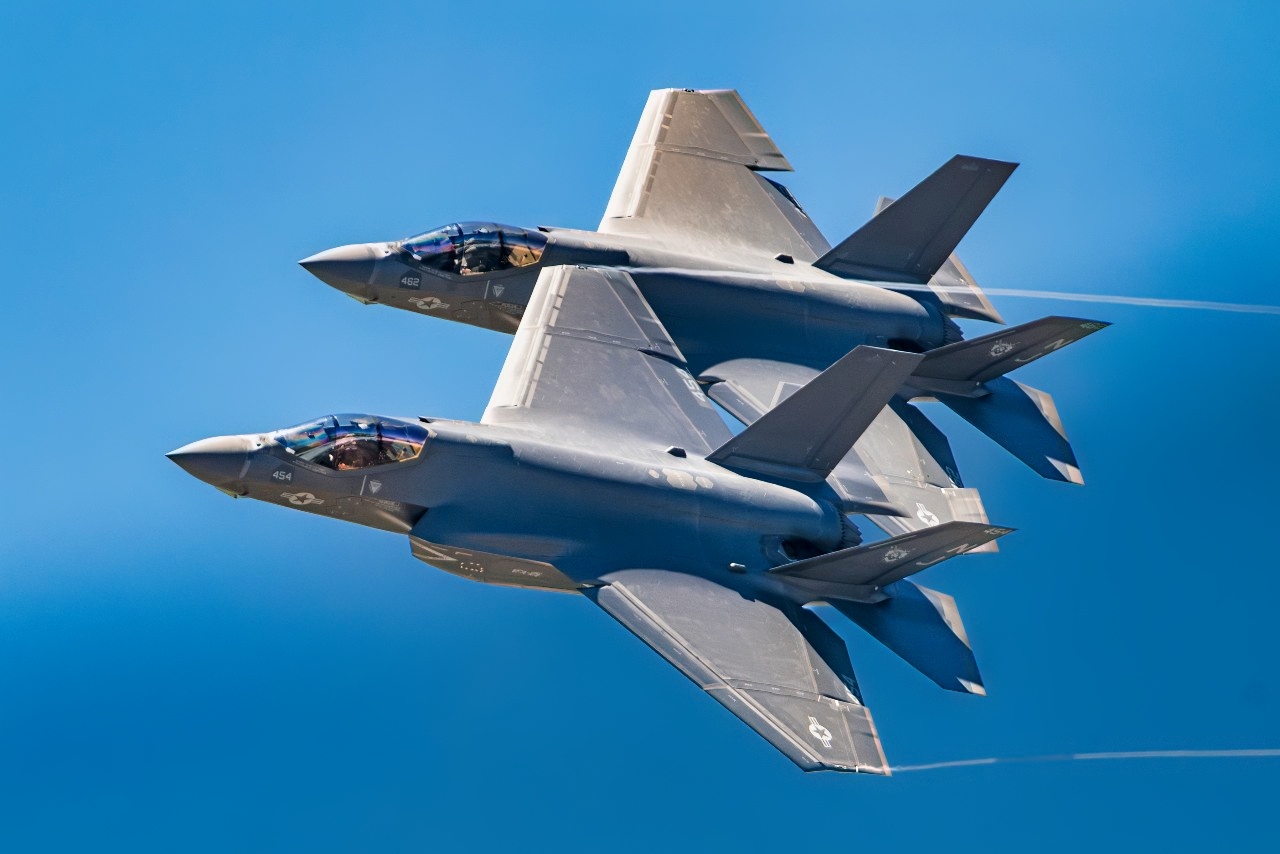
The U.S. Navy F-35C Lighting II Demo Team performs a flight demonstration at the Wings Over South Texas Air Show. This year’s air show marks Wings Over South Texas’s first return to Naval Air Station Corpus Christi since 2019.
The J-35 is catching up from the other direction: a fresh airframe tailored for catapult launches, internal carriage for stealth, and a home on a carrier built to power modern sensors. China will iterate fast—its industry now does—and the software will get better. In a year-one snapshot, the F-35C remains the more mature system. In a year-ten panorama, the question turns from “which jet” to “which ecosystem” can generate sorties, protect its tankers, and keep a resilient picture when the air fills with jamming and decoys.
What the U.S. Should Actually Do
If the J-35 is a shove, the worst American response is to stumble into the old habit of proving toughness by sailing closer.
The better move is patience with teeth.
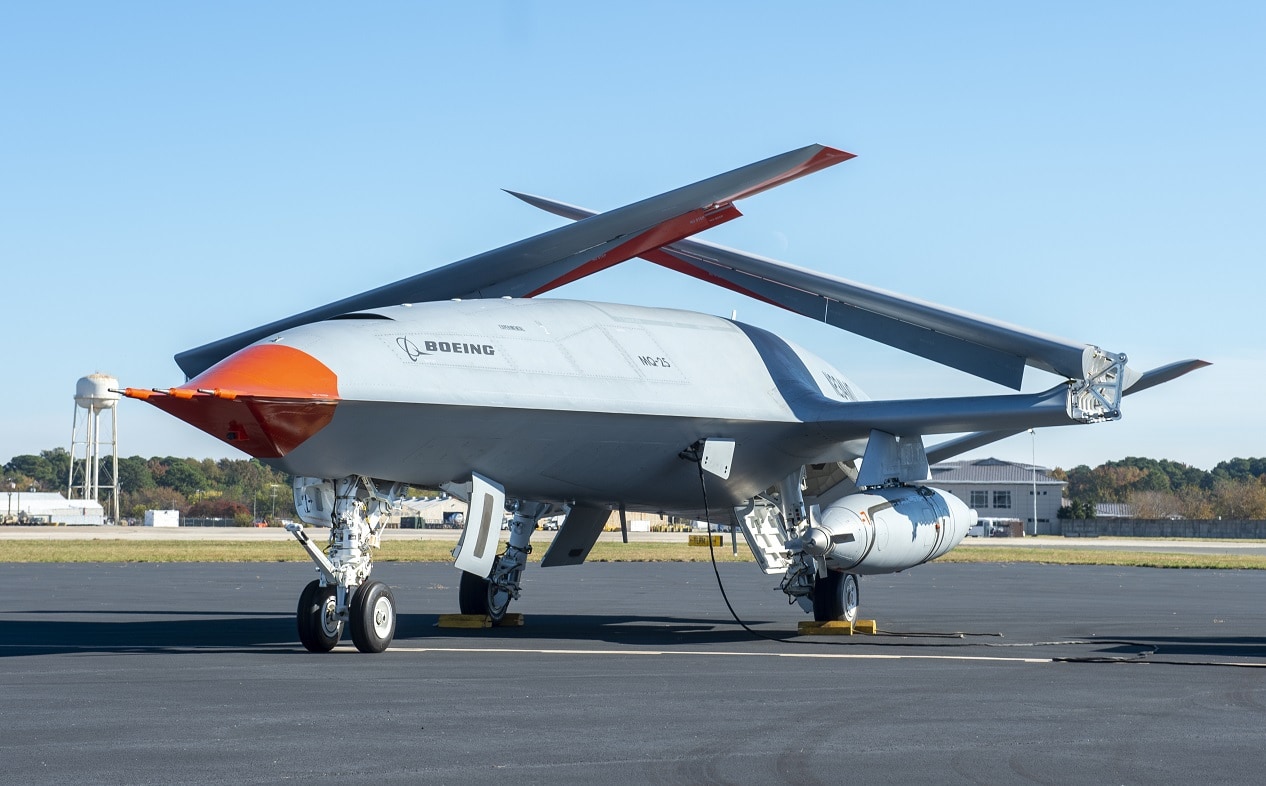
The U.S. Navy and Boeing conducted ground testing of the MQ-25 Stingray at Chambers Field onboard Naval Station Norfolk, Virginia. The MQ-25 Stingray is an unmanned aerial refueling aircraft. (U.S. Navy photo by Mass Communication Specialist 2nd Class Sam Jenkins)
Let range do the talking. The Navy already has a path: the MQ-25 tanker drone to push F-35Cs outward, longer-legged air-to-air and anti-ship weapons that let shooters stay quiet and far, and deck cycles designed around surprise rather than presence. Practice “no-comms” kill-chains until they’re boring—launch, find, decide, strike—with minimal radio chatter and a bias for passive sensing.
Just as important: treat high-value aircraft like royalty. Tankers and airborne early warning are the beating heart of a carrier day. Give them stealthy escorts when the J-35 is prowling. Use deception tools that seed doubt into any Chinese targeting picture. Make the first clean shot hard to earn and expensive to take.
None of this is glamorous. All of it keeps ships alive.
The J-35’s Likely Growing Pains
Every new carrier fighter has a phase where the brochure gives way to the pier. The J-35 will be no different.
Engines must prove they can deliver thrust and electric power day after day in salt air. Deck crews must learn the choreography that turns airplanes quickly without cutting corners on safety or stealth coatings. The datalinks that let a fighter fly “with its radar off” have to work amid jamming and clutter. These are not trivial hills to climb; they are the whole mountain. The difference now is that China can climb with an industrial base that no longer has to import everything important.
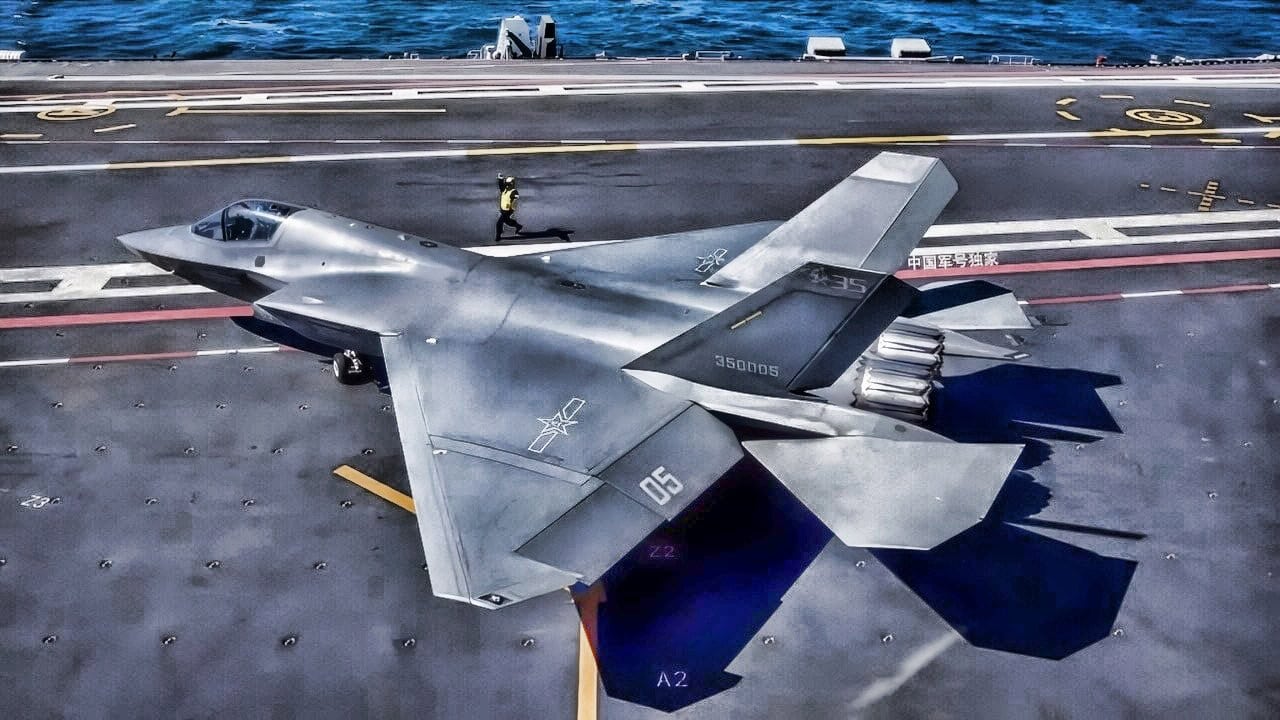
China J-35 Naval Stealth Fighter. Image Credit: PLAN.
That, too, should shape American thinking. Assume the problems, but also assume they get solved.
If You’re Looking for a Red Line, Watch the Quiet Stuff
The flashiest images from Fujian are the launches—the shot of a stealth jet leaving the deck, the frame of a big radar plane lumbering into the air. Useful pictures, sure, but the real red line to watch is invisible: does China start flying carrier packages that operate comfortably with minimal emissions?
Do we see exercises where J-35s push far under the wing of a carrier-borne radar aircraft, hand off tracks to shore-based shooters, and disappear again without bragging about it on the airwaves? When that becomes routine, the J-35 has graduated from new toy to daily tool.
Why This Isn’t the End of the American Aircraft Carrier
It’s fashionable to declare the carrier obsolete—missiles everywhere, drones in every direction, doom overhead. And yet, the platform endures because it can move the right airplanes to the right patch of ocean and keep them there, independent of anyone’s permission.
The J-35 doesn’t change that logic. It raises the price of bad habits. It punishes predictable orbits, sloppy emissions, and the belief that a big ship proves resolve by sailing closer.
The counter is a carrier air wing that treats distance as armor and data as ammunition. The F-35C was built for that kind of fight. So were the E-2D radar planes that feed it and the destroyers that screen the group. Add unmanned teammates—scouts, decoys, and eventual escorts—and a U.S. carrier looks less like a target and more like a conductor with a deeper bench.
In 2 Words On J-35: Don’t Panic
China’s navy just crossed a threshold it has eyed for years. A catapult carrier. A stealth fighter that belongs there. An airborne radar platform to bind it together. None of this makes Beijing’s fleet invincible; all of it makes it more serious.
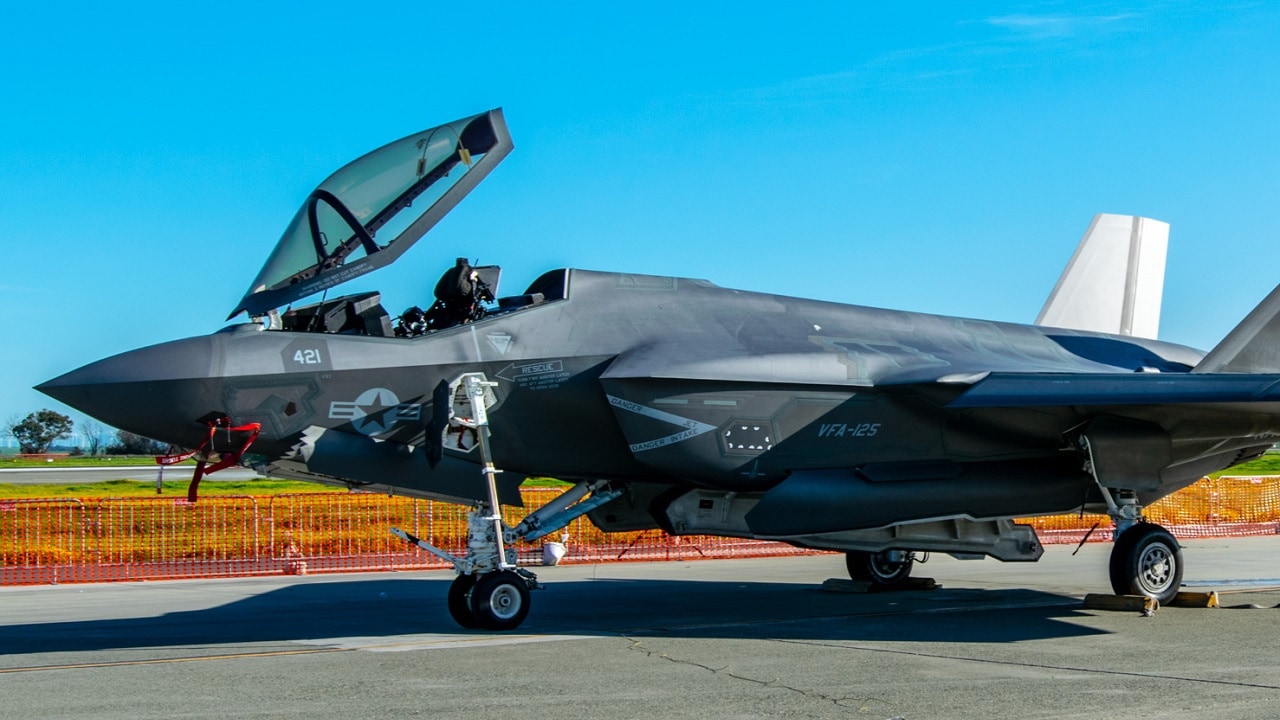
F-35C on Static Display. Image Credit: Creative Commons.
The right American reaction is not a flinch but a plan: extend reach, practice silence, and multiply the number of arrows the air wing can loose without edging into a trap.
If the J-35’s launch changes the sound of the Western Pacific, the answer isn’t to shout louder. It’s to make sure we’re the ones deciding when to break the silence.
About the Author: Harry J. Kazianis
Harry J. Kazianis (@Grecianformula) was the former Senior Director of National Security Affairs at the Center for the National Interest (CFTNI), a foreign policy think tank founded by Richard Nixon based in Washington, DC. Harry has over a decade of experience in think tanks and national security publishing. His ideas have been published in the NY Times, The Washington Post, The Wall Street Journal, CNN, and many other outlets worldwide. He has held positions at CSIS, the Heritage Foundation, the University of Nottingham, and several other institutions related to national security research and studies. He is the former Executive Editor of the National Interest and the Diplomat. He holds a Master’s degree focusing on international affairs from Harvard University. Email Harry: [email protected].

