
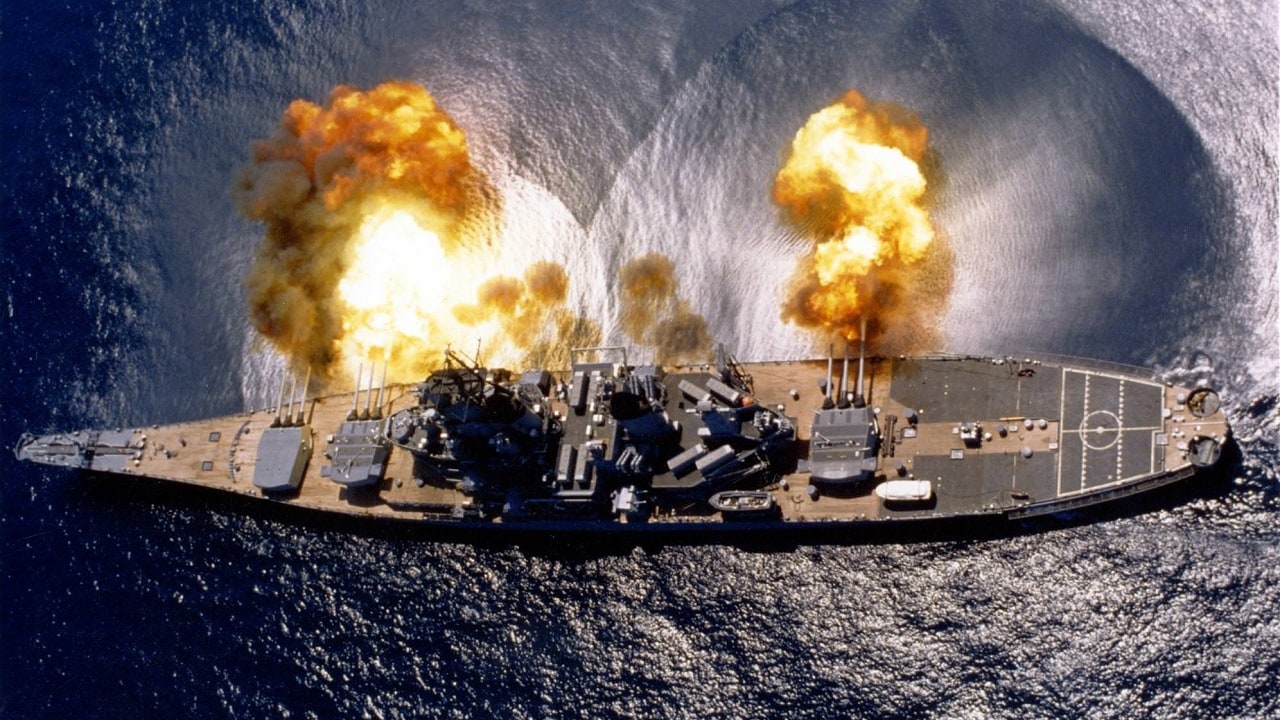
Key Points and Summary – The Iowa-class battleships were the greatest gun platforms ever to sail, but on paper their planned successors—the Montana-class—were even more formidable.
-Authorized in 1940, these “super battleships” would have been larger than the Iowas, carried twelve 16-inch guns, and matched Japan’s Yamato in armor and displacement.
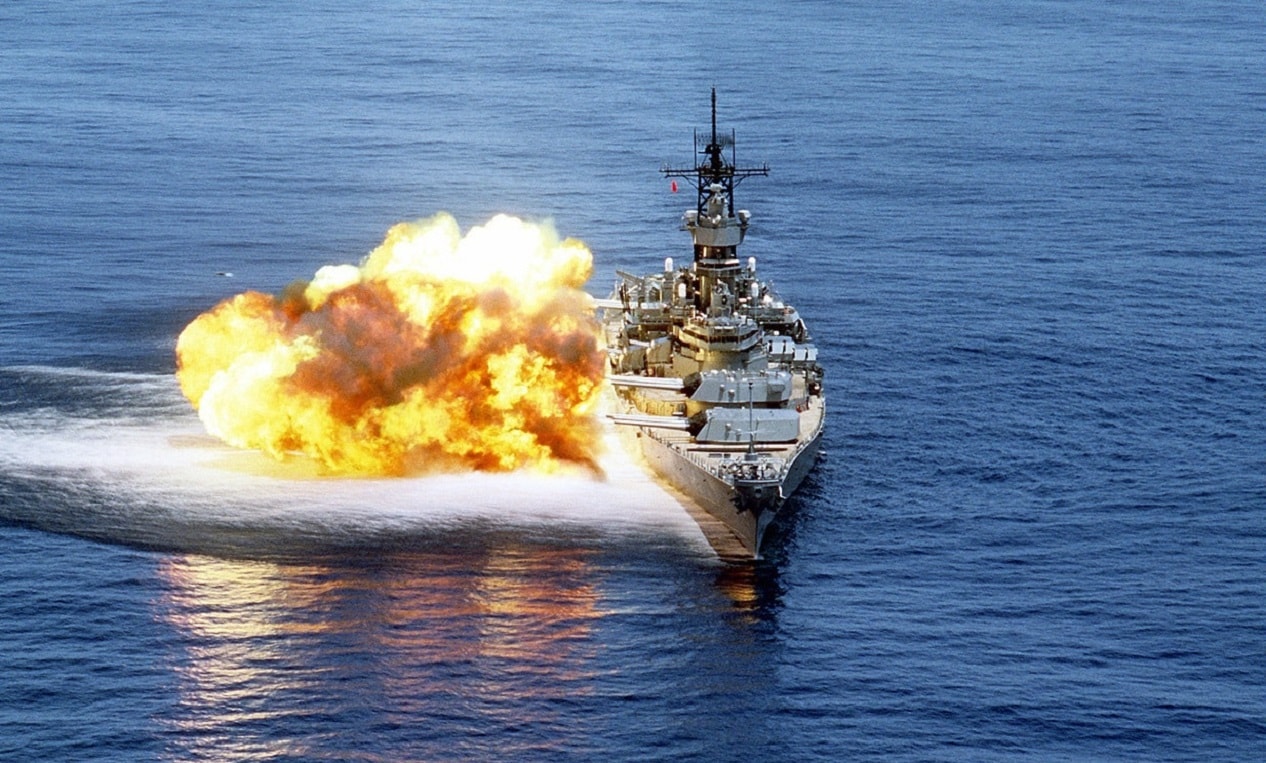
Iowa-class battleship. Image Credit: Creative Commons.
-Yet they were canceled before construction as World War II proved aircraft carriers, not battlewagons, were the true capital ships—and the slower Montanas couldn’t keep up with fast carrier groups.
-Had they been built and later refitted with Tomahawks and Harpoons like the Iowas, they might have served into Desert Storm and beyond.
The Montana-Class ‘What If’ That Could Have Changed Naval History
The Iowa-class battleships of the United States Navy have to be considered the most successful battleships of all-time, serving for 58 years and firing their mighty 16-inch/50 caliber guns in anger during World War II, the Korean War, the Vietnam War, the 1983 Lebanon campaign, and lastly but not least during the 1991 Persian Gulf War AKA Operation Desert Storm.
Indeed, one of the Iowas, the USS New Jersey (BB-62), is America’s most decorated battleship.
As impressive as the Iowas were, their planned successors, the Montana-class super battleships, could’ve been even more impressive.
Alas, the Montanas never came to fruition, and instead became one of the great “What if?” stories of naval history.
What Might’ve Been: Montana-Class Concept
The Montana-class battleships were the last battlewagons ever to be ordered by the U.S. Navy, authorized under the Two Ocean Navy Act (AKA the Vinson–Walsh Act) shipbuilding program of July 1940 and funded in Fiscal Year 1941.
Had they actually been built, the Montanas would’ve been nearly a third larger than their Iowa-class ancestors, with a hull length of 921 feet (280.41 meters), a beam width of 121 feet (36.88 meters), a draft of 36 ft (11 meters) and a full laden displacement of 72,104 tons.
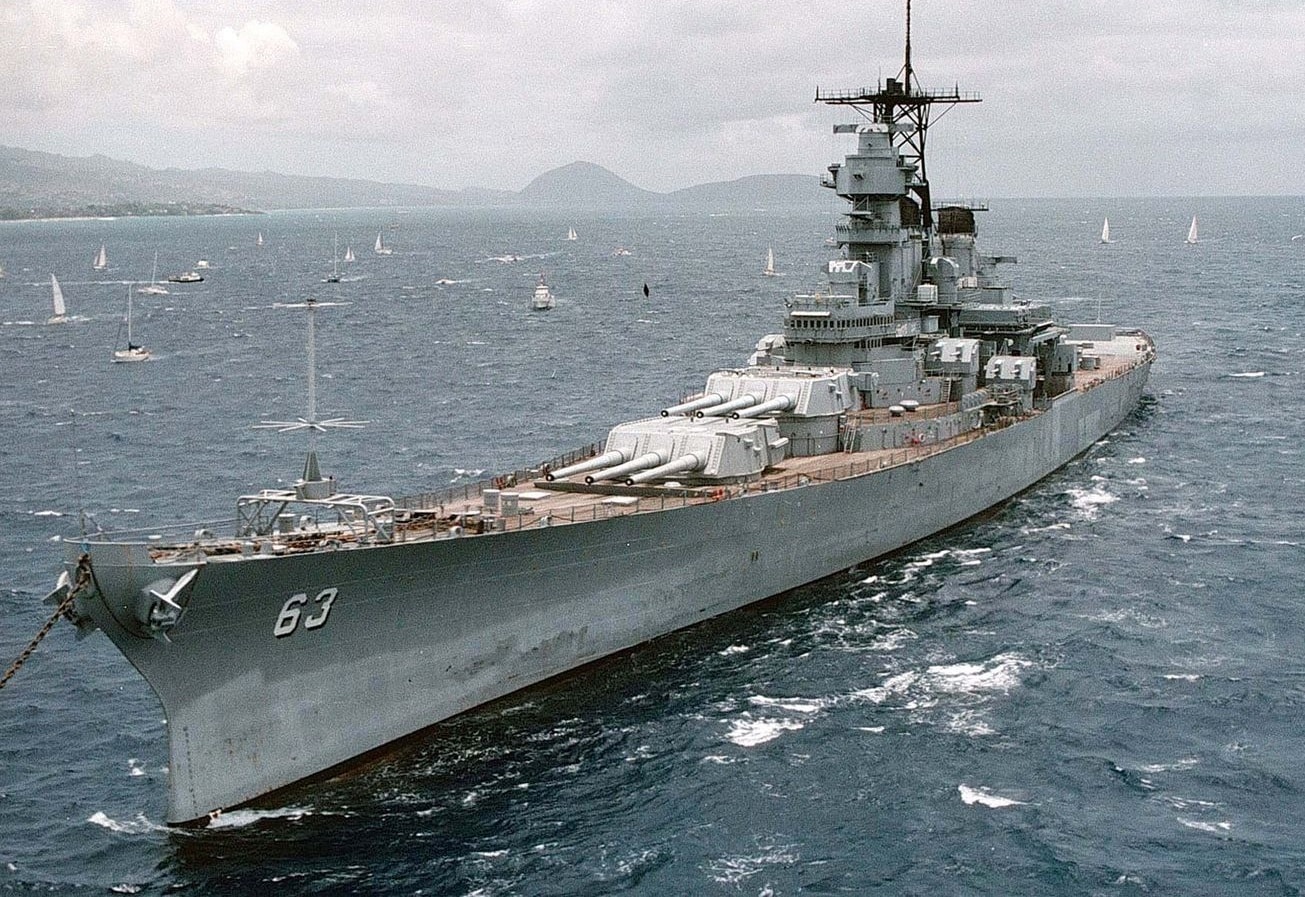
Iowa-class battleship. Image: Creative Commons.
For a basis of comparison, the Imperial Japanese Navy’s (IJN) Yamato and Musashi were still slightly heavier at 72,809 tons fully laden and wider abeam at 128 feet (38.9 meters) but shorter in hull length at 862 feet (233 meters).
The IJN’s behemoths still had the biggest guns, at 18.1 inches (46 centimeters), whilst the Montana super battleships would have retained the 16-inch/50 caliber (40.6-centimeters) Mark 7 main guns of the Iowas, but with an added, deadly twist: three extra such guns, for a dozen in total (two triple-turrets fore, two such turrets aft), and increased armor—21,000 tons with bulkheads at 18-inches of plating—for good measure.
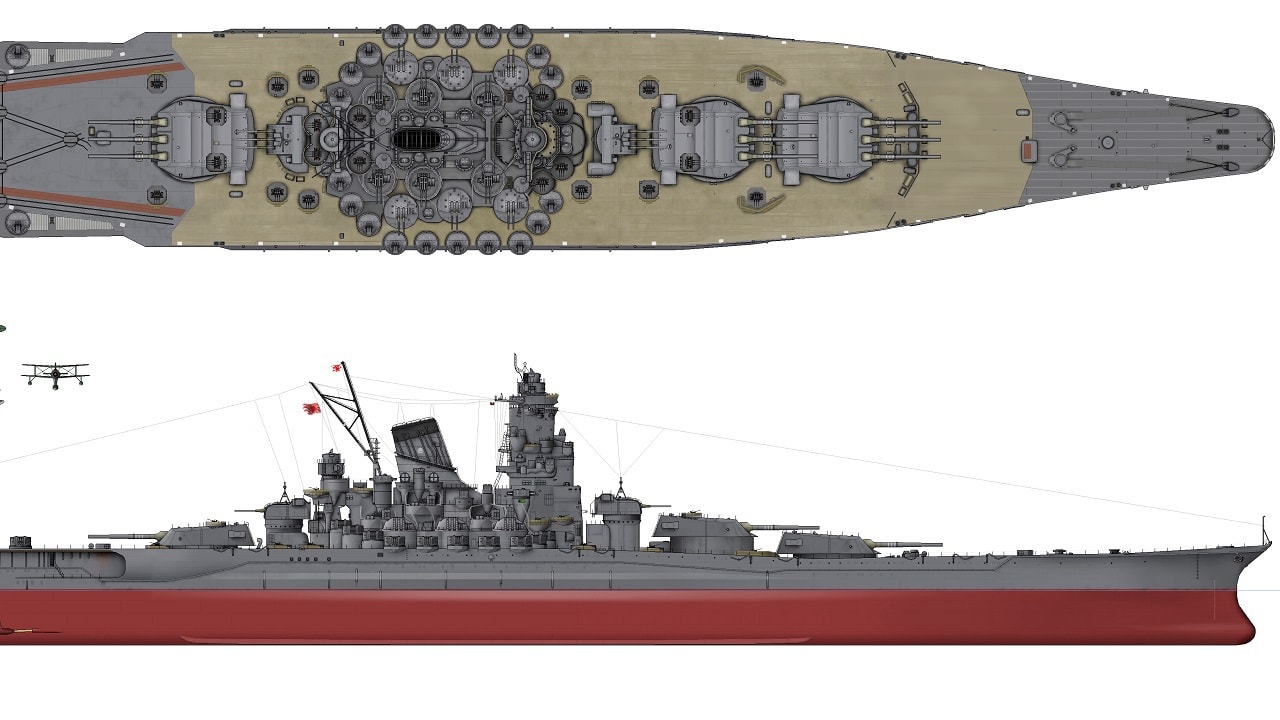
Battleship Yamato Blueprint. Image Credit: Creative Commons.
Total crew complement would’ve amounted to 2,355 enlisted seamen and commissioned officers.
The Navy ordered a quintet of these would-be warships.
The lead ship of the class, USS Montana (BB-67), would’ve been built at the Philadelphia Navy Yard along with the Ohio (BB-68), whilst Maine (BB-69) and New Hampshire (BB-70) were to be constructed at the New York Navy Yard in Brooklyn; and the Louisiana (BB-71) at the Norfolk Navy Yard in Portsmouth, Virginia.
What Went Wrong?
(Cue Sam Neill as Captain 2nd Rank Vasily Borodin in “The Hunt for Red October”: “I would like to have seen Montana…”)
So then, why were these ultra-promising battlewagons killed in the proverbial womb?
The biggest reason was a literal and figurative sea change in naval warfare, it was demonstrated during World War II (especially during the Battle of the Coral Sea and the Battle of Midway) that aircraft carriers had dethroned battleships as the predominant “capital ships” of naval power projection; even with their bristling antiaircraft (“ack-ack”) guns, battleships were quite vulnerable to the ravages of carrier-borne dive bombers and torpedo bombers.
They were quite vulnerable to submarine attack as well, as seen by the sinkings of the IJN battleship Kongo by the USS Sealion II (SS-315).
The death knell of the Montana program was further sealed by the ships’ speed, or lack thereof: a max speed of 28 knots compared with the 33-knot maximum speed capability of the Iowa class. This was simply not fast enough to escort the carriers.
Would They Have Lasted?
Had the Montanas actually been built, it seems reasonable to think that they would’ve had the same longevity as their Iowa-class predecessors, especially if they had demonstrated the same degree of adaptability to more armament.
One of the big reasons why the Iowas remained as viable as long as they did was their refitting with the following weapons systems:
32 × BGM-109 Tomahawk Land Attack Missile (TLAM)/cruise missile launchers
16 × RGM-84 Harpoon anti-ship missile launchers
4 × 20 mm MK 15 Phalanx CIWS (close-in weapon system)
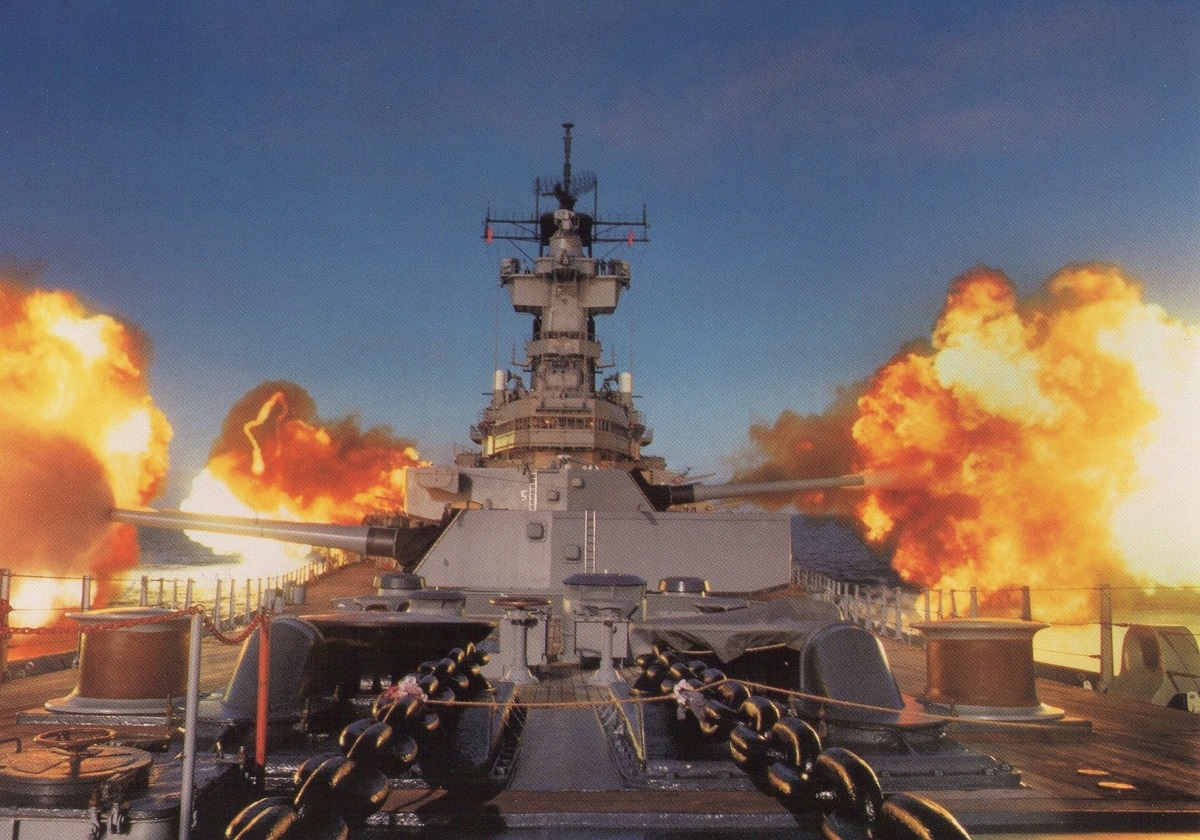
Image: Creative Commons.
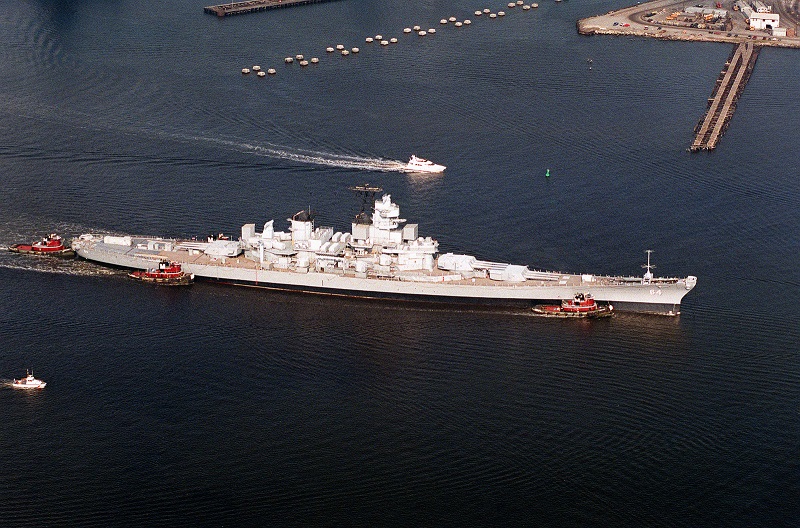
An aerial starboard side view of the Iowa class battleship WISCONSIN (BB-64) being towed past Norfolk Naval Base en route to the Norfolk Naval Shipyard at Portsmouth for ready reserve storage. The ship was moved from the Ship Intermediate Maintenance Facility when it was closed 30 September.
(To make room for these newer pieces of hardware, several of the battleships’ 5-inch/38 calibers guns, 40mm Bofors antiaircraft guns, and 20mm Oerlikon antiaircraft guns were removed.)
As proof of concept, during that Desert Storm swan song, USS Missouri (BB-63) fired 28 TLAMs in addition to 759 16-inch shells, whilst USS Wisconsin (BB-64) fired 24 of her own TLAMs in addition to 528 16″ rounds, 881 5″ rounds; for good measure, “Big Wisky” also expended 5,200 20mm CIWS rounds.
Given the fact that the Montanas would’ve been significantly larger than the Iowas, they too would’ve had plenty of extra space to accommodate TLAMs, Harpoons, and Phalanxes.
One can only imagine how much additional havoc they could/shoulda/woulda inflicted upon then-Iraqi dictator Saddam Hussein’s troops that had been occupying Kuwait in early 1991.
About the Author: Christian D. Orr, Defense Expert
Christian D. Orr is a Senior Defense Editor. He is a former Air Force Security Forces officer, Federal law enforcement officer, and private military contractor (with assignments worked in Iraq, the United Arab Emirates, Kosovo, Japan, Germany, and the Pentagon). Chris holds a B.A. in International Relations from the University of Southern California (USC) and an M.A. in Intelligence Studies (concentration in Terrorism Studies) from American Military University (AMU). He is also the author of the newly published book “Five Decades of a Fabulous Firearm: Celebrating the 50th Anniversary of the Beretta 92 Pistol Series.”