
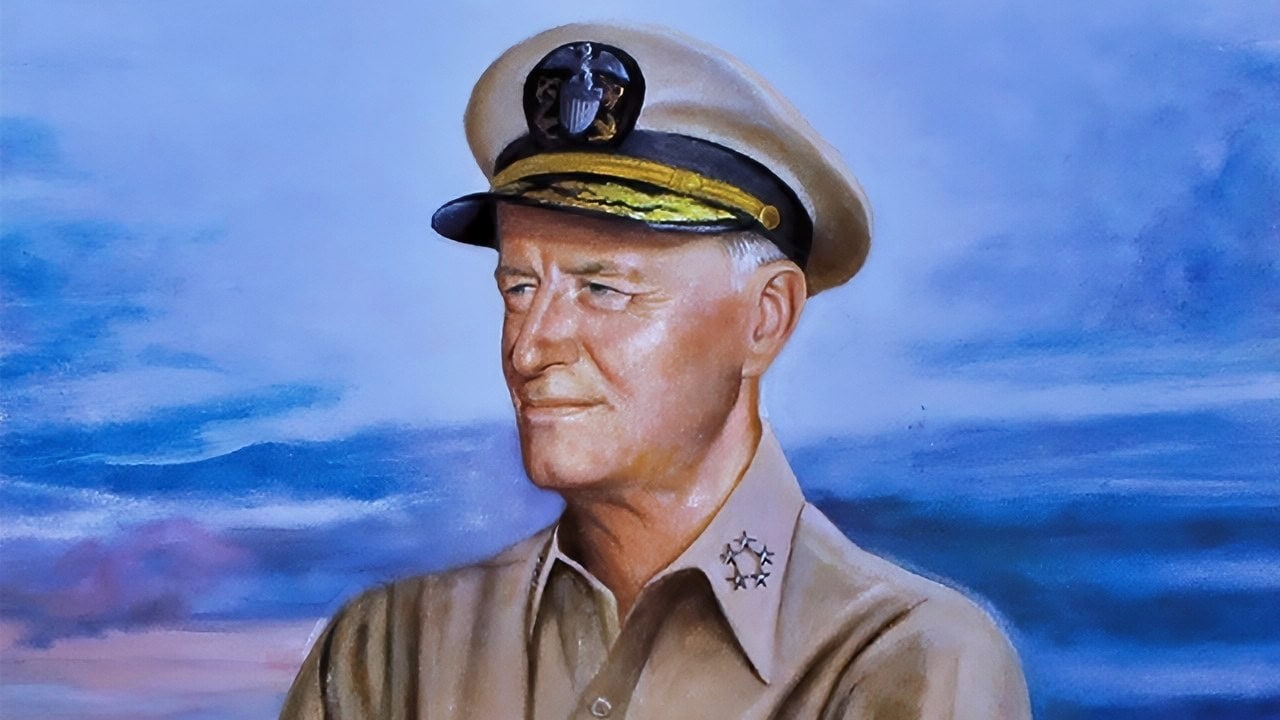
Synopsis: Fleet Admiral Chester W. Nimitz took command of the Pacific Fleet days after Pearl Harbor and became the steady hand behind America’s recovery at sea.
-His most famous strategic call came at Midway, where he accepted the intelligence picture and empowered commanders like Fletcher and Spruance to strike first—crippling Japan’s carrier force.
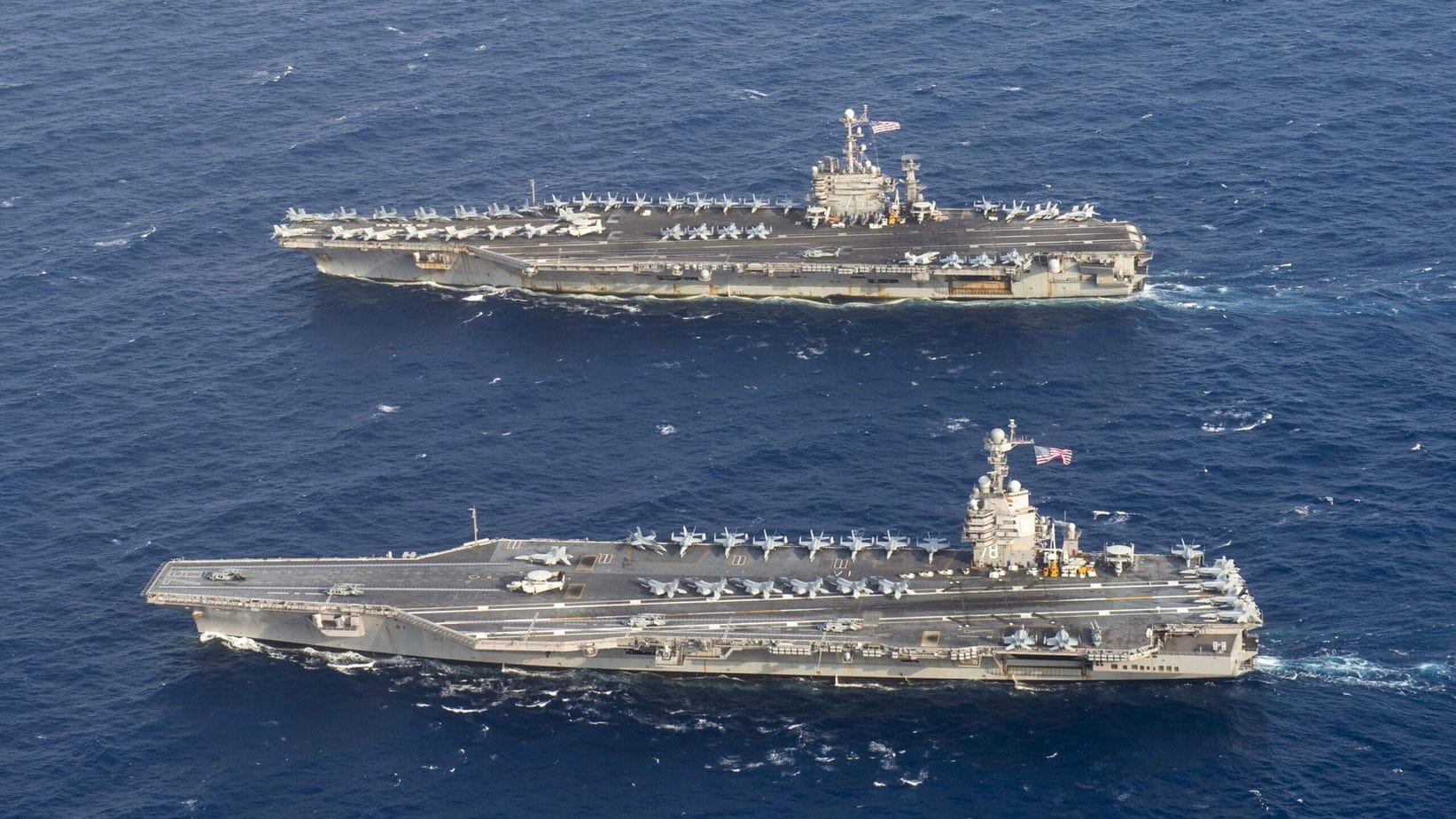
The U.S. Navy Gerald R. Ford-class aircraft carrier USS Gerald R. Ford (CVN-78) and the Nimitz-class aircraft carrier USS Harry S. Truman (CVN-75) underway in the Atlantic Ocean on 4 June 2020, marking the first time a Gerald R. Ford-class and a Nimitz-class aircraft carrier operated together underway. Gerald R. Ford is underway conducting integrated air wing operations, and the Harry S. Truman Carrier Strike Group remained at sea in the Atlantic as a certified carrier strike group force ready for tasking in order to protect the crew from the risks posed by COVID-19, following their successful deployment to the U.S. 5th and 6th Fleet areas of operation.
-Although Midway was a carrier-air battle, Nimitz’s deeper expertise was submarines, and he worked closely with leaders like Charles Lockwood to turn U.S. undersea warfare into a decisive campaign against Japan’s fleet and logistics.
-By 1944, the Philippine Sea and Leyte Gulf completed the destruction of Japanese naval power, and Nimitz earned five-star rank—leaving a legacy that still sails with the Nimitz-class carriers.
Chester Nimitz’s Finest Hours: Midway, Submarines, and the Pacific Turnaround
“God grant me the courage not to give up what I think is right even though I think it is hopeless.”—That quote belongs to Admiral Chester William Nimitz, who was such a revered senior leaders in the hallowed history of the United States Navy (USN) that an entire class of USN warships has been named in his honor.
Chester Nimitz lived for 80 years (24 February 1885 – 20 February 1966) and his naval career lasted for 51 years (1905–1966; the rank of [5-star] fleet admiral is a lifetime appointment, ergo he technically remained on active duty for the rest of his life with full pay and benefits), which meant the breadth of his accomplishments wasn’t limited to a single decade.
Nonetheless, his legendary status was cemented during World War II, starting on December 16, 1941 (a mere nine days after the Pearl Harbor raid), when Secretary of the Navy Frank Knox tabbed RADM Nimitz as Commander in Chief, US Pacific Fleet (CinCPac) and Commander in Chief, Pacific Ocean Areas, commanding Allied air, land, and sea forces in the region.
Battle of Midway (June 4-6, 1942)
Might as well start right off the bat with the achievement for which Nimitz is most famous. The Battle of Midway stands as the decisive turning point in the Pacific Theater of WWII and arguably the most stunning naval victory in modern history.

U.S. Navy Admiral Chester W. Nimitz Portrait. Image Credit: Creative Commons.
Therein, Douglas SBD Dauntless dive bombers taking off from the flight decks of the aircraft carrier Enterprise (CV-6), Hornet (CV-8), and Yorktown (CV-5) and, against all odds, sank the four Imperial Japanese Navy (IJN) flattops Akagi, Kaga, Soryu, and Hiryu (and for good measure, the heavy cruiser Mikuma).
At the operational level, the leaders responsible for the smashing victory at Midway were Admirals Frank Jack Fletcher and Raymond Ames Spruance.
However, at the strategic level, Nimitz was the mastermind, and in Spruance’s own words, “The credit must be given to Nimitz. Not only did he accept the intelligence picture but he acted upon it at once.”

The Japanese heavy cruiser Mikuma, photographed from a USS Enterprise (CV-6) Douglas SBD-3 Dauntless during the afternoon of 6 June 1942, after she had been bombed by planes from Enterprise and USS Hornet (CV-8). Note her shattered midships structure, torpedo dangling from the after port side tubes and wreckage atop her number four 203 mm gun turret. The photo flight was led by Lt(jg) E.J. Kroeger, A-V(N), USNR, of Bombing Squadron 6 (VB-6) with photographer Mr. A.D. Brick of Fox Movietone News in a SBD-3 of VB-3 (“3-B-10”). Kroeger was accompanied by Lt.(jg) C.J. Dobson of Scouting Squadron 6 (VS-6) and photographer CP(PA) J.S. Mihalovitch in SBD “6-S-18”.
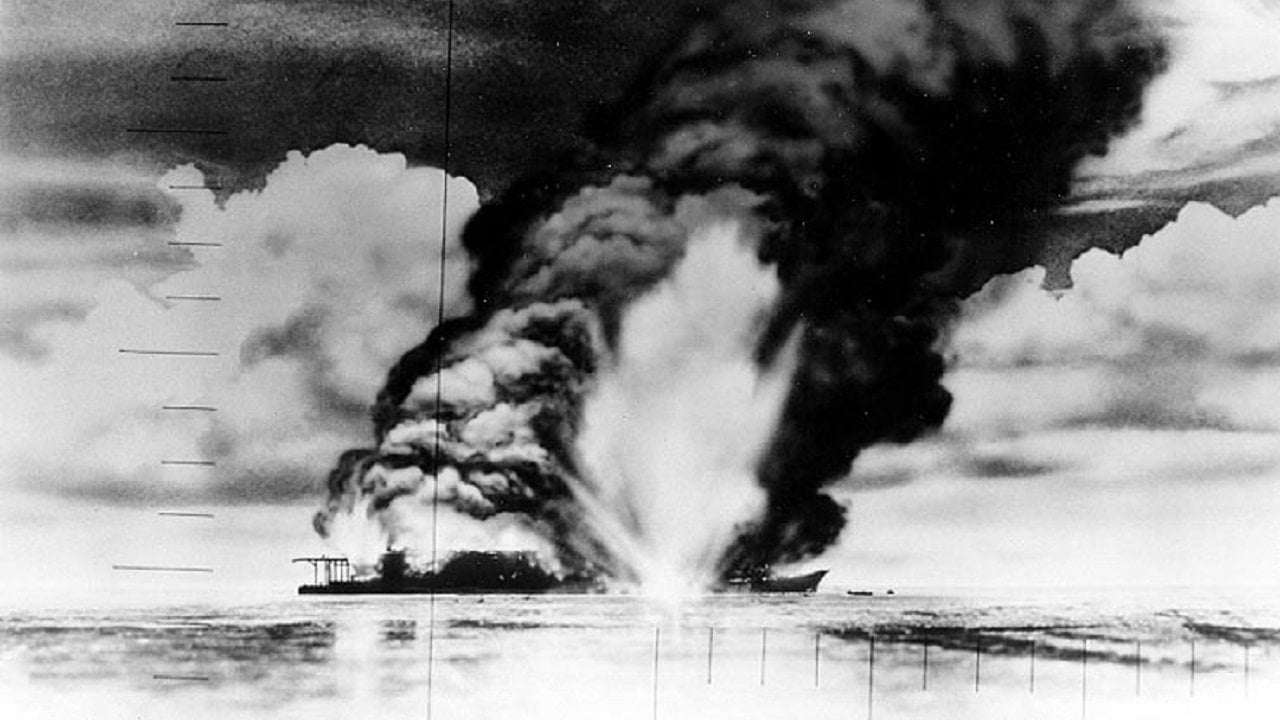
Diorama simulating periscope view from Nautilus, attacking a Japanese aircraft carrier at the Battle of Midway.
Nimitz the Submariner
As already indicated, the Battle of Midway was won primarily with carrier-based naval airpower; ergo, it’s entirely appropriate that the aforementioned warship class named in his honor is a class of nuclear-power supercarriers.
However, it was in the realm of submarines that Nimitz truly established himself as a subject matter expert, dating all the way back to 1907 when he was a young lieutenant; among other things, he had worked as Aide and Chief of Staff to COMSUBLANT during WWI.
In WWII, he worked hand-in-hand with his friend and fellow submariner, Vice Admiral (VADM) Charles A. Lockwood, to help USN submersibles finally attain their full deadly potential, wreaking havoc upon the IJN and Imperial Japan’s merchant fleet as well.
(And let’s not forget that though the submarine USS Nautilus [SS-168] didn’t sink any ships during the battle of Midway, she nonetheless made her own key contribution to that victory.)
As noted in the underrated 1981 book “War Under the Pacific“ by Keith Wheeler and the Editors of Time-Life Books, “Later, writing in praise of the submariners, Nimitz did not hesitate to compare them and their record to the best: ‘As British airmen are credited with saving Britain in those critical days after Dunkirk, so our gallant submarine personnel filled the breach after Pearl Harbor, and can claim credit, not only for holding the line, but also for carrying the war to the enemy.”
The Triple Crown of 1944
1944 was a banner year for ADM Nimitz’s career, especially for these three reasons:
-The Battle of the Philippine Sea (June 19-20, 1944), AKA “The Great Marianas Turkey Shoot” because IJN airpower was utterly cut to pieces by the marauding Grumman F6F Hellcat fighter pilots of the USN
-The Battle of Leyte Gulf (October 23-26, 1944), wherein Imperial Japan suffered even more grievous losses (to the tune of 26 ships sunk, including 3 battleships and 4 carriers) than they had at Midway
-On December 19, 1944, Nimitz was rewarded for his accomplishments via a promotion to the newly created rank of Fleet Admiral (5 stars)
Further Reading
Going back to the Battle of Midway, many excellent books have been written on that topic, from Walter Lord’s “Incredible Victory” (published in 1967) to Jonathan Parshall & Anthony Tully’s “Shattered Sword” (published in 2005).
However, my sentimental favorite is “Miracle at Midway,” penned by the late Gordon W. Prange, Donald M. Goldstein, and Katherine V. Dillon, and published in 1982.
I first read this book back in 1986, when I was a mere 6th grader (yes, I was a precocious kid), and re-read it in 2013 (this time with the perspective of an adult and a military veteran, to boot). One of the things about “Miracle at Midway.”
I find a sort of postscript in Chapter 42, wherein Prange separately interviewed Fletcher, Spruance, and Nimitz two decades after the epic battle.
Thusly, the reader gets not only firsthand insight into ADM Nimitz’s personality, but also his relationship with his beloved wife, Catherine Vance Nimitz née Freeman: “As with so many couple who have lived a long and companionable married life, the Nimitzes resembled one another. The admiral’s warmth, dignity, and charm were reflected in his wife’s appealing face, and their delightful quarters gave evidence that she, like her husband, was a person of action.”
Prange also included this direct quote from Catherine which explains why her hubby turned down multiple requests to write his memoirs: “’He didn’t want to hurt anyone. He had to dismiss a couple of officers during the war, and they were bitter. If he had written his memoirs, written them honestly, he would have had to hurt them. Chester never hurt anyone.’”
About the Author: Christian D. Orr, Defense Expert
Christian D. Orr is a Senior Defense Editor. He is a former Air Force Security Forces officer, Federal law enforcement officer, and private military contractor (with assignments worked in Iraq, the United Arab Emirates, Kosovo, Japan, Germany, and the Pentagon). Chris holds a B.A. in International Relations from the University of Southern California (USC) and an M.A. in Intelligence Studies (concentration in Terrorism Studies) from American Military University (AMU). He is also the author of the newly published book “Five Decades of a Fabulous Firearm: Celebrating the 50th Anniversary of the Beretta 92 Pistol Series.”