
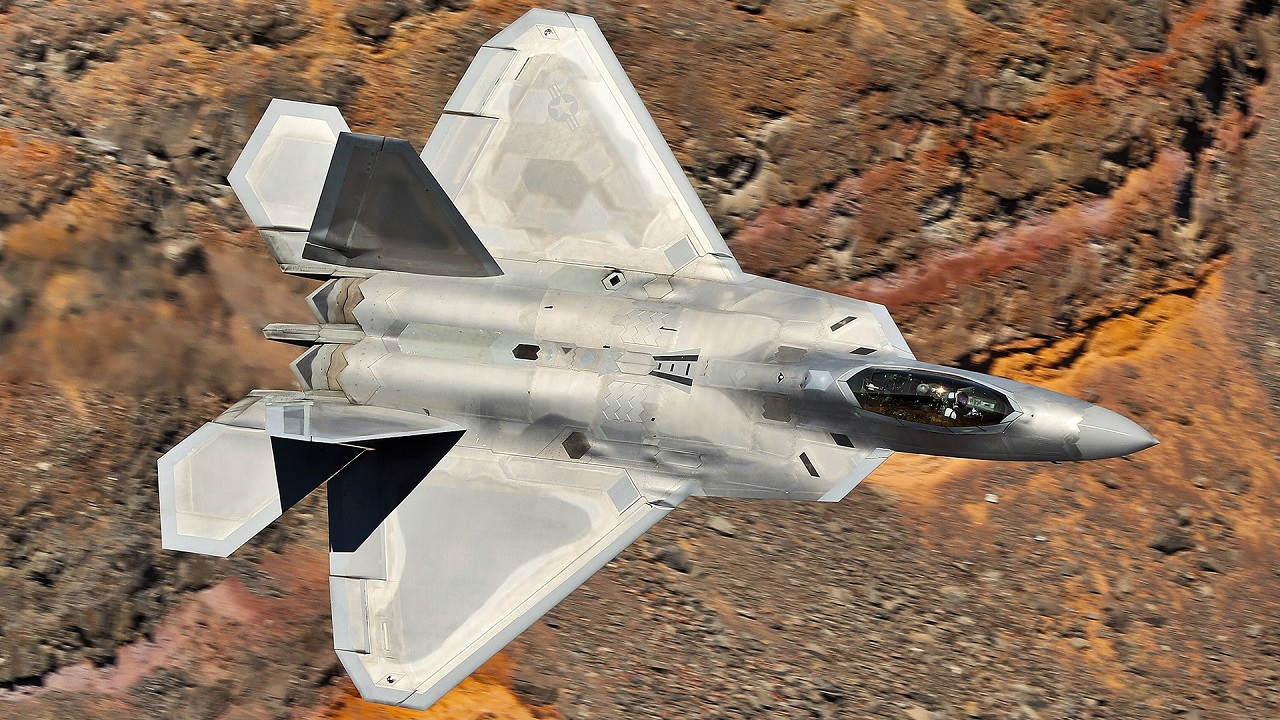
Key Points and Summary – The F-22 Raptor remains America’s premier air-superiority fighter, but its small fleet and shuttered production line make it brutally expensive to operate.
-With parts hard to source and sustainment tailored to a boutique force, the Raptor’s cost-per-flight-hour has surged while readiness has slipped.

F-22 Raptor. Image: Creative Commons.
-Critics trace today’s bill to the 2009 decision to end procurement early, leaving no true economy of scale.
-Now the Air Force is buying time with upgrades—an infrared defensive system and stealthier external tanks—to extend survivability and range.
-The tradeoff: billions more to keep a shrinking, indispensable fleet credible until successors arrive and deter peer rivals daily.
Bob Gates Ended the F-22 Early—Now America Pays the Price
In the history of the United States government’s Office of the Secretary of Defense (OSD)—or, as the Trump Administration has gone back to calling the position, Secretary of War (thus harkening back to the moniker used for the first 171 years of the office’s existence)—one of the worst decisions ever to emanate from that office was when then-SECDEF Bob Gates made the incredibly short-sighted decision back in 2009 to kill the F-22 Raptor program after only 187 airframes were built out of the original 381 planned. (Gee, thanks, Bob.)
Fortunately, the F-22 remains in service with the United States Air Force 20 years after its official operational debut.
It serves alongside its fellow Lockheed Martin Skunk Works 5th-generation stealth fighter, the F-35 Lightning II.
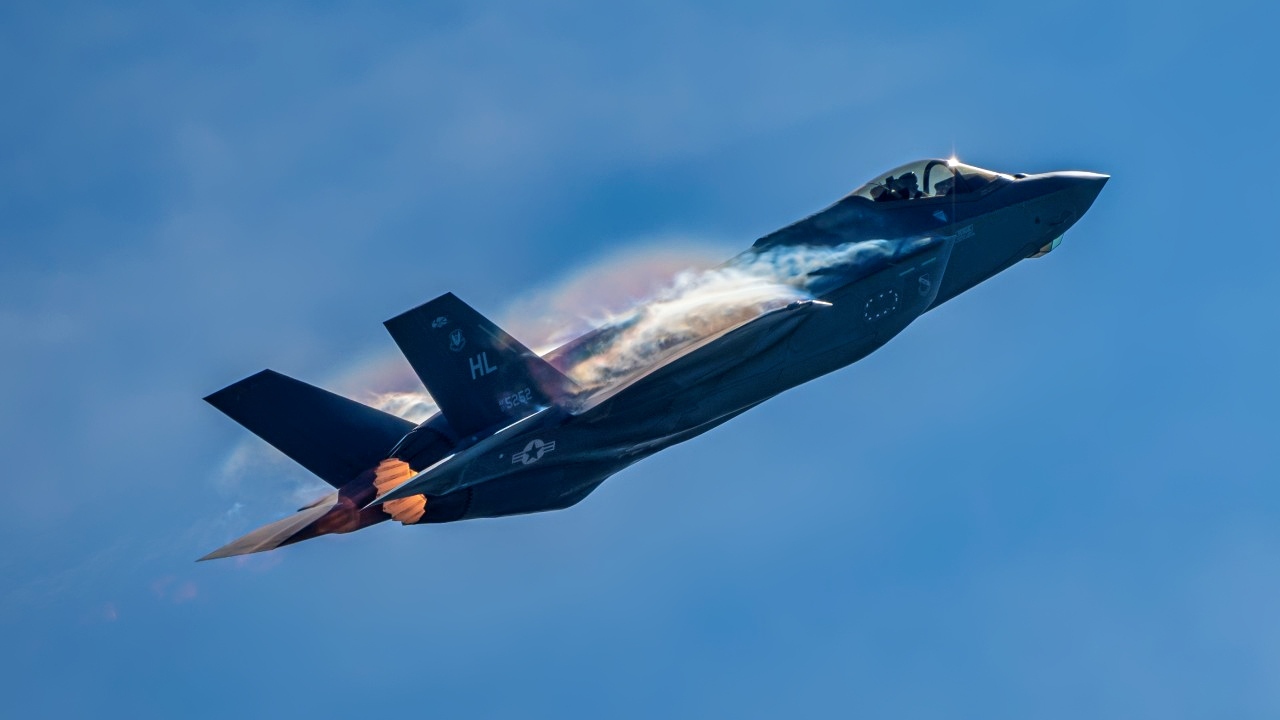
U.S. Air Force Maj. Kristin “BEO” Wolfe, F-35A Lightning II Demonstration Team commander and pilot, flies during a demonstration rehearsal at Hill Air Force Utah, April 28, 2021. The F-35A Lightning II Demonstration Team is part of the first operational F-35A wing for the Air Force, the 388th Fighter Wing, and flies over the Hill Air Force Base runway to practice and prepare for upcoming air shows around the world. (U.S. Air Force photo by Capt. Kip Sumner)
Unfortunately, though not as heavily publicized as the Lightning II’s oh-so-controversial price tag, the downside to the F-22’s continued survival is the fortune that it costs to keep the warbird flying. How did high-flying fighters’ costs spiral even higher than their 65,000-foot (20,000-meter) service ceiling?
A King’s Ransom for the Air Force F-22 Raptor Fighter
Believe it or not, it’s actually the F-22 and not the F-35 that’s *the* most expensive fighter jet in the world, at least by some accounts.
According to Rosita Mickeviciute in a February 21, 2025, AeroTime article titled “Top 10 most expensive fighter jets in 2025,” she said, “The flyaway cost for the F-22 is listed by the US Air Force as $143 million, but that’s barely half the cost of actually producing the jets.
The entire program cost the US over $67.3 billion for 195 aircraft, putting the per-Raptor cost at around $334 million … Despite its unmatched air superiority capabilities, the F-22 was deemed too expensive for mass production.”
In addition, the Government Accountability Office (GAO) estimates that it costs the USAF $85,325 to fly the F-22 for just one hour.
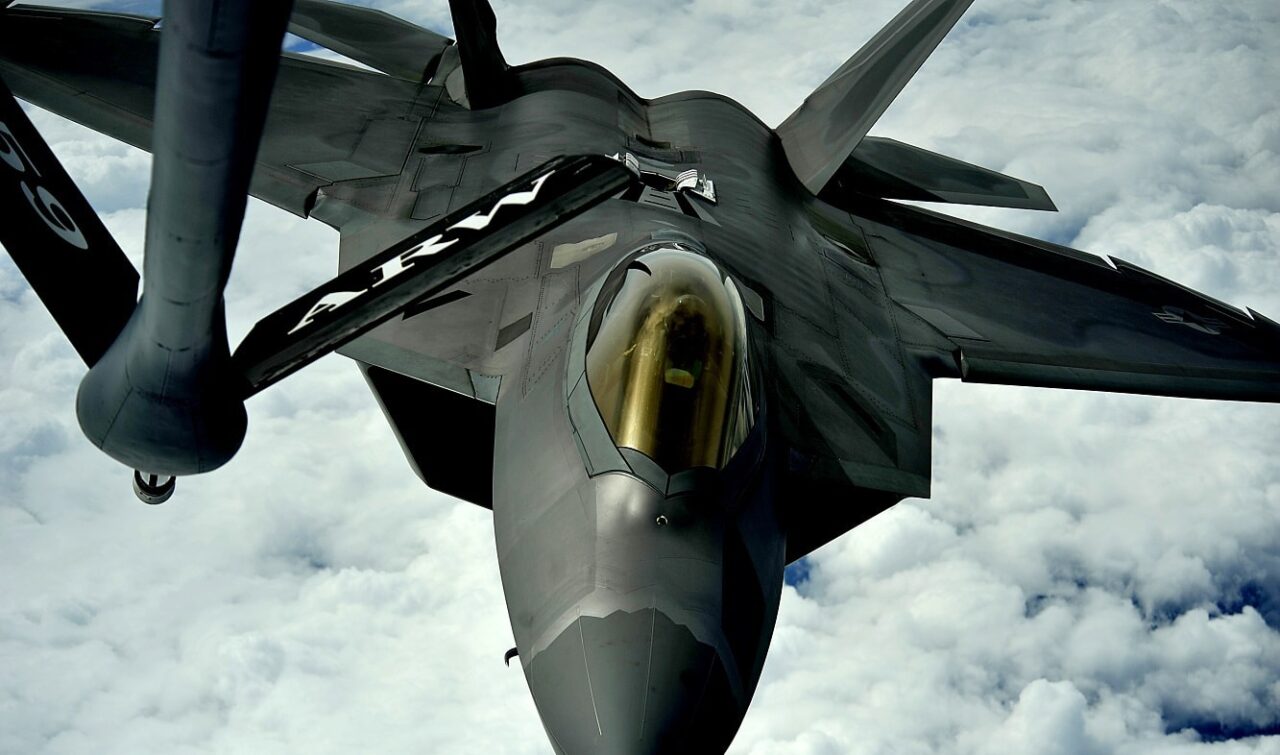
A 1st Fighter Wing’s F-22 Raptor from Joint Base Langley-Eustis, Va., pulls into position to accept fuel from a KC-135 Stratotanker with the 756th Air Refueling Squadron, Joint Base Andrews Naval Air Facility, Md., off the east coast on May 10, 2012. The first Raptor assigned to the Wing arrived Jan. 7, 2005. This aircraft was allocated as a trainer, and was docked in a hanger for maintenance personnel to familiarize themselves with its complex systems. The second Raptor, designated for flying operations, arrived Jan. 18, 2005. On Dec. 15, 2005, Air Combat Command commander, along with the 1 FW commander, announced the 27th Fighter Squadron as fully operational capable to fly, fight and win with the F-22.
And as if all that weren’t bad enough, James Kiefner of Simple Flying notes in an April 13, 2024, article titled “Explained: The Strengths & Weaknesses Of The F-22 Raptor Fighter Jet” that “There is no economy of scale to the aircraft. Production lines that shut down in the 2000s cannot be reinstated without massive investment, and spare parts cannot be sourced outside of those lines.”
Raptor Readiness (or Lack Thereof)
“But wait, there’s more” (as the old Ginsu knife TV adverts used to say).
There’s also the issue of receding readiness rates, which isn’t just plaguing the F-22 but the USAF as a whole. Regarding the Raptor specifically, its mission-capable rate in fiscal year 2024 was only 40.19 percent, a precipitous drop from 57.4 percent just two years prior, according to John A. Tirpak of Air & Space Forces Magazine.
An Automotive Analogy
As anyone who has ever owned a classic car can attest, an older machine costs a lot more to keep running, even if we’re talking about a make-and-model product line that’s still in production.
A perfect example is my sentimental favorite, the Ford Mustang. Between 2003 and 2006 (when Yours Truly was a young lieutenant in the U.S. Air Force, stationed at Scott AFB, Illinois), this writer had the honor and privilege of owning both a 1967 and a ’91 “Stang.”

The US Air Force (USAF) F/A-22 Raptor, flown by USAF Major (MAJ) David Thole, 422nd Test and Evaluation Squadron (TES), Nellis Air Force Base (AFB), Nevada (NV), heads out to the Nevada Test and Training Range (NTTR) for an operational test mission.
(The former was a gorgeous candy-apple red hardtop whilst the latter was white with a black ragtop; both were automatic transmission).
They were both a tremendous source of pride & joy, but they were also a major headache in terms of upkeep time and money.
Eventually, they became more trouble than they were worth, so I eventually sold them.
From there, I went to a 2003 Saturn L200 as my daily driver. That car served me wonderfully for 8 years … and then, as luck would have it, the Saturn Corporation went under in October 2010 in the wake of the recession-induced General Motors (GM) reorganization, and from that point on, obtaining spare parts became an even bigger nightmare than my dearly departed classic Mustangs. I ended up selling the L200 just before my second deployment to Iraq.
If a discontinued five-digit-dollar figure automobile can cause such monetary headaches, imagine how much worse it gets with a discontinued nine-figure fighter plane!
Light at the End of the Tunnel?
Fortunately, despite of all the financially challenges, the F-22 is being given a new lease on life, as in a massive upgrade program that will equip the remaining 142 operational Raptors with a new Infrared Defensive System (IRDS) for enhanced survivability and new stealthy, low-drag external fuel tanks that kill two stones with one bird by improving both the combat range and radar signature concerns of the current specimens.
However, as the saying goes, there is “no such thing as a free lunch.” These much-needed upgrades to the Raptor will run up the taxpayers’ bill even further; as Popular Mechanics puts it in a metaphorically melodramatic manner, this upgrade program amounts to “a stay of execution with an $8 billion lifeline.”
Once again: Gee, thanks, Bob (Gates).
About the Author: Christian D. Orr, Defense Expert
Christian D. Orr is a Senior Defense Editor. He is a former Air Force Security Forces officer, Federal law enforcement officer, and private military contractor (with assignments worked in Iraq, the United Arab Emirates, Kosovo, Japan, Germany, and the Pentagon). Chris holds a B.A. in International Relations from the University of Southern California (USC) and an M.A. in Intelligence Studies (concentration in Terrorism Studies) from American Military University (AMU). He is also the author of the newly published book “Five Decades of a Fabulous Firearm: Celebrating the 50th Anniversary of the Beretta 92 Pistol Series.”