
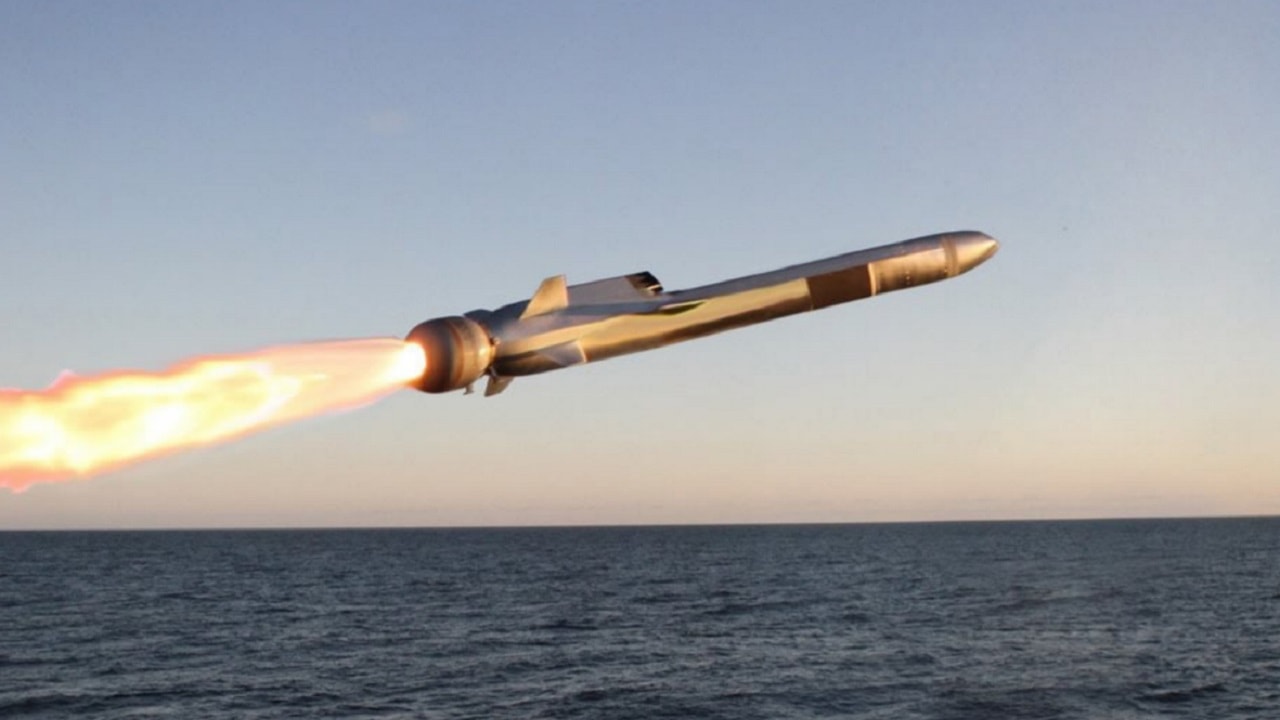
Key Points and Summary – The Naval Strike Missile (RGM-184A) is a next-generation, sea-skimming, subsonic cruise missile designed for both anti-ship and land-attack missions.
-Built by Norway’s Kongsberg, it offers 300+ km range, autonomous target recognition, and high maneuverability to evade modern air defenses.
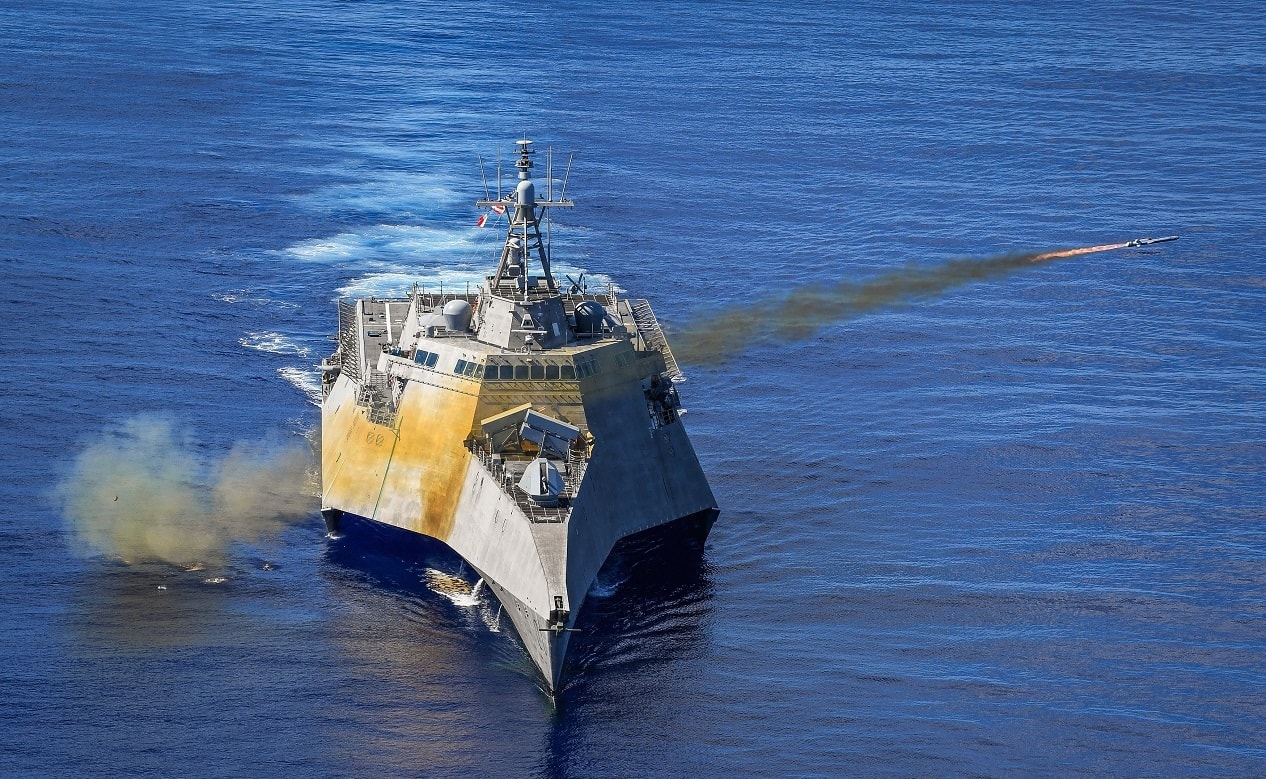
PHILIPPINE SEA (Oct. 1, 2019) Independence-variant littoral combat ship USS Gabrielle Giffords (LCS 10) launches a Naval Strike Missile (NSM) during exercise Pacific Griffin. The NSM is a long-range, precision strike weapon that is designed to find and destroy enemy ships. Pacific Griffin is a biennial exercise conducted in the waters near Guam aimed at enhancing combined proficiency at sea while strengthening relationships between the U.S. and Republic of Singapore navies. (U.S. Navy photo by Chief Mass Communication Specialist Shannon Renfroe/Released)
-Originally fielded by Norway and Poland, NSM is now spreading rapidly across NATO and allied fleets, from U.S. littoral combat ships and future frigates to Australian, British, Dutch, and other European warships.
-The U.S. Marine Corps is also adopting a mobile coastal-defense variant, NMESIS, mounting NSM launchers on JLTVs to threaten enemy ships from land.
Naval Strike Missile Has a Message for Enemy Fleets: Nowhere Is Safe
In the realm of naval surface warfare, guns have not yet been rendered completely obsolete, but they’re getting smaller and less frequently used in actual combat.
For example, the mighty 16-inch guns of the World War II-vintage Iowa-class battleships are a thing of the past.
The biggest guns we currently see on U.S. Navy warships are the 155 mm (6.1-inch)/62-caliber Mark 51 Advanced Gun System (AGS) on the Zumwalt-class (DDG-1000) destroyers and the 5-inch (12.7 cm)/62-caliber Mark 45 Mod 4 main guns on the Arleigh Burke-class destroyers.
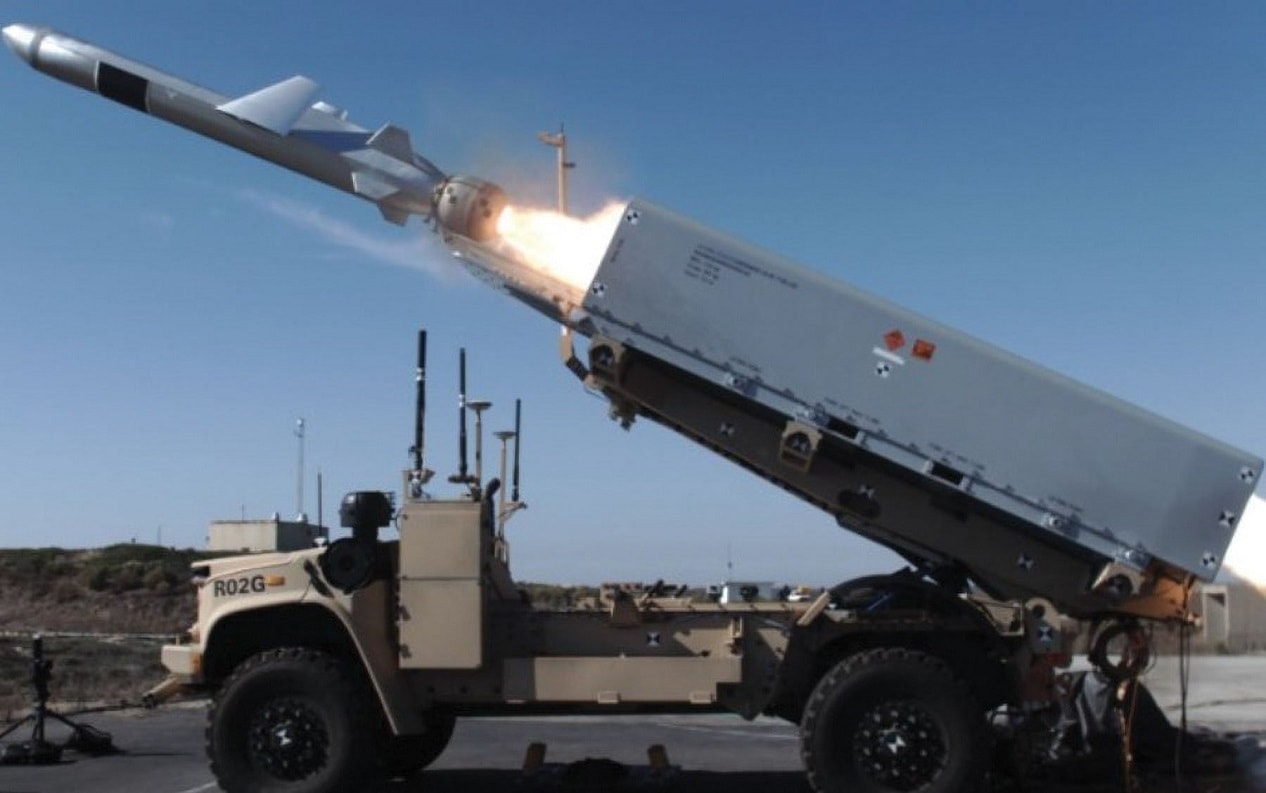
Naval Strike Missile. Image Credit: Creative Commons.
(NOTE: In the naval gunfire context, “caliber” refers to the barrel length in inches, not the bore diameter in tenths of an inch as it does in small arms, e.g., the .45 ACP caliber.)
Instead, missiles are becoming increasingly prominent in surface warfare due to their long-range, standoff attack capability.
Among the examples are the hoary Harpoon missile and our current subject, the comparatively newer Naval Strike Missile (NSM), designated the RGM-184A in official USN parlance.
Naval Strike Missile (RGM-184A) Initial History
The NSM is manufactured by Kongsberg Defence & Aerospace (KDA), named for the eponymous Norwegian city in which the firm is headquartered. Having the versatility to serve as both an anti-ship and land-attack missile, the NSM was originally dubbed the Nytt sjømålsmissil (“New sea target missile”) and tabbed as the direct successor to Kongsberg’s AGM-119 Penguin missile (which dates back to 1972, during the heady days of the Cold War).
The initial serial production contract for the Nytt sjømålsmissil was signed in June 2007, chosen by the Royal Norwegian Navy (Sjøforsvaret, which literally translates to “Sea defence”) for its Fridtjof Nansen-class frigates and Skjold-class corvettes.
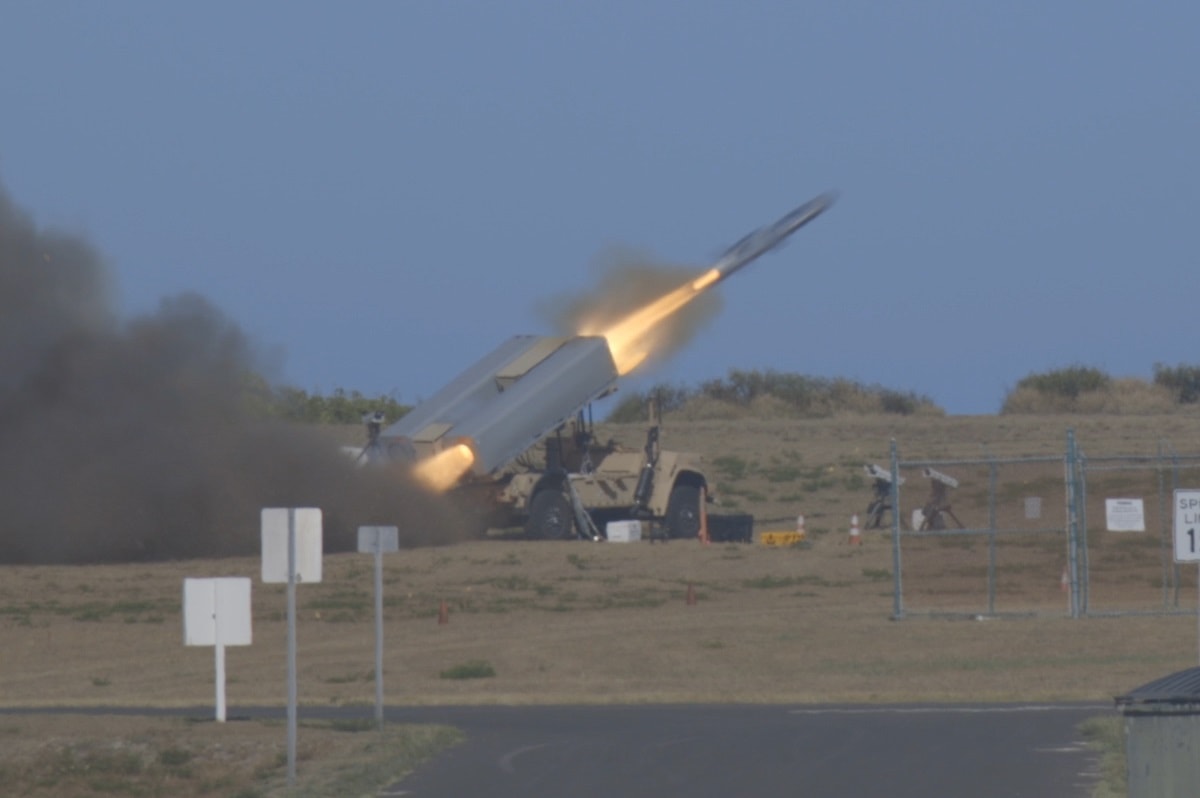
A Naval Strike Missile streaks out to sea before striking a naval target ship, Aug. 15, 2021, aboard Pacific Missile Range Facility Barking Sands, Hawaii. The missile flew more than 100 nautical miles before finding its mark. The live-fire sinking exercise demonstrated a Marine fires expeditionary advanced base’s ability to sense, target and strike a target at sea, providing sea control or contributing to sea denial in fleet operations. The Marine Corps’ Force Design 2030 centers on Marines providing long-range precision strike capabilities as a stand-in force during littoral operations in a contested environment. (U.S. Marine Corps photo by Lance Cpl. Dillon Buck, released)
The following year, the Polish Navy (Marynarka Wojenna AKA Marynarka) followed suit, ordering 50 of the weapons (they’re currently slated for the Wicher-class frigates and the Coastal Missile Squadron).
Fast-forward to October 10, 2012, the Royal Norwegian Navy fired an NSM for the first time, from the Skjold-class HNoMS Glimt (P-964).
As the manufacturer’s official info page states, “The NSM is a very flexible system, which can be launched from a variety of platforms against a variety of targets on sea and land … The airframe design and the high thrust to weight ratio give the NSM extremely good manoeuvrability. The missile is completely passive, has proven its excellent sea-skimming capabilities and with its advanced terminal manoeuvres, it will survive the enemy air defences. The Autonomous Target Recognition (ATR) of the seeker ensures that the correct target is detected, recognized and hit.”
NSM Tech Specs and Vital Stats
Range: >300 km (162 nm)
Max Airspeed: Mach 0.93 (316 m/s; 1,040 ft/s)
Overall Weight: 407 kg (897 lbs.)
Warhead Weight: 120 kg (260 lbs.)
Length: 3.96 m (156 inches)
Wingspan: 1.36 m (4 ft 6 in) with wings deployed
Unit Cost: $2,194,000 USD
Besides the USN, Sjøforsvaret, and Marynarka, the NSM has been adopted by the following naval forces:
-Royal Australian Navy; Anzac-class frigate, Hobart-class destroyer, and Hunter-class frigate
-Royal Netherlands Navy; De Zeven Provinciën-class frigate, Anti-Submarine Warfare Frigate (ASWF)
-UK Royal Navy; Type 23-class frigate, Type 45-class destroyer
US Navy vessels currently employing the RGM-184A include the Freedom-class littoral combat ship, the Independence-class littoral combat ship, the Constellation-class frigate, and the aforementioned Arleigh Burke-class. Meanwhile, the U.S. Marine Corps plans to field 261 specimens of the Navy-Marine Expeditionary Ship Interdiction System (NMESIS) by 2033, including the NSM mounted on a Joint Light Tactical Vehicle platform with semi-autonomous and autonomous capabilities to launch remotely.
Meanwhile, future operators slated for the NSM are:
-Belgian Navy; ASWF
-Royal Canadian Navy; River-class destroyer
–Royal Danish Navy (Søværnet); Ivar Huitfeld-class frigates
-German Navy (Deutsche Marine); Baden-Württemberg-class frigate
-Indonesian Navy; Klewang-class fast attack craft
-Royal Malaysian Navy; Maharaja Lela-class frigate; Lekiu-class frigate
-Spanish Navy; Álvaro de Bazán-class frigate, F110-class frigate
For good measure, the Latvian Naval Forces (Latvian Naval Forces (Latvijas Jūras spēki) and Romanian Naval Forces (Forțele Navale Române) are contemplating adopting a coastal defense version of the weapon.
Operational History and the Way Forward for the Naval Strike Missile
As far as this writer can ascertain, the NSM has yet to be “blooded” in actual combat. However, if World War III should break out against either Russia and/or China, there will certainly be a naval component to the war, in which case the NSM is virtually guaranteed to receive the harsh litmus test of battle many times over, due to the sheer number of U.S. allies that employ the NSM aboard their warships. Time will tell.
About the Author: Christian D. Orr, Defense Expert
Christian D. Orr is a Senior Defense Editor. He is a former Air Force Security Forces officer, Federal law enforcement officer, and private military contractor (with assignments worked in Iraq, the United Arab Emirates, Kosovo, Japan, Germany, and the Pentagon). Chris holds a B.A. in International Relations from the University of Southern California (USC) and an M.A. in Intelligence Studies (concentration in Terrorism Studies) from American Military University (AMU). He is also the author of the newly published book “Five Decades of a Fabulous Firearm: Celebrating the 50th Anniversary of the Beretta 92 Pistol Series.”